
Commercial Irrigation Installation Irvine CA
for Office, Retail, and Industrial Properties
A commercial landscape can look acceptable from the parking lot while its irrigation quietly works against it. Zones laid out for a planting plan two renovations ago, spray heads that now reach across a widened sidewalk, a controller no one on the property fully trusts: at some point another round of repairs stops making sense, and the site needs a system built for the landscape it actually has.
Our Commercial Irrigation Installation Irvine CA service is built for that point. We design and install new irrigation systems, expand coverage into new or redesigned landscape areas, and carry out major system replacements on office campuses, business parks, shopping centers, retail properties, and industrial sites with landscaped frontage or common areas. The work covers turf, planting beds, medians, and perimeter landscaping, and it is planned around a property that usually stays open while the work is underway.
This page is written for property owners, property managers, facility managers, and landscape project managers who are collecting estimates for commercial landscape irrigation installation in Irvine. It explains when new irrigation is warranted, what we evaluate before designing anything, how sprinkler and drip coverage are divided, how installation is coordinated with other site work and with tenants, and what a complete estimate should spell out. If your property needs troubleshooting, routine repairs, or help with a broader irrigation question rather than a new installation, our commercial irrigation services page covers that wider range of work.

Get a Free Estimate for Commercial Irrigation Installation in Irvine
Tell us about the landscape areas you plan to irrigate, expand, or replace. Share the Irvine property address, any site or landscape plans, and your target schedule, and we will arrange a site visit and a free written estimate. Call (888) 601-1117 or email info@landscaper-near-me.com.
When Does an Irvine Commercial Property Need a New Irrigation System?
A new system, an expansion, or a major replacement is usually warranted when the landscape has changed more than the irrigation has, or when the existing system can no longer be repaired into reliable coverage. Repairs restore components. Installation changes the layout itself: where water goes, how the zones are divided, and what controls them.
Projects in this category tend to follow a few recognizable patterns:
- New landscape buildouts. A new building, a parking expansion, or a pad site needs irrigation designed from the planting plan up.
- Office campus renovations. Turf is reduced, courtyards are replanted, or walkways are rerouted, and the old zones no longer line up with what is planted.
- Retail frontage redesigns. A center refreshes its entries and street frontage with a different planting layout, leaving existing heads and valves in the wrong places.
- Aging systems with chronic failures. Repeated mainline breaks, valves that will not close reliably, or wiring faults across many zones point to infrastructure near the end of its useful life.
Repair, Expansion, or Replacement?
These options are not interchangeable, and the right one depends on what the existing system can still do. Repair makes sense when the layout fits the landscape and the problems are isolated. Expansion makes sense when the existing mainline, controller, and water supply can support additional zones for new planting areas. A commercial irrigation system replacement makes sense when the layout, the infrastructure, or both no longer suit the site.
Replacement rarely means removing everything. A mainline in serviceable condition, a backflow assembly that tests correctly, or sleeves under paving that are still open can often be retained, which reduces both cost and disruption. Part of our assessment is identifying which components are worth keeping and which would hold the new design back.
How Irrigation Fits the Broader Landscape Project
Irrigation installation is frequently one piece of a larger change on the property. When the work is tied to a planting renovation or a new landscape, the irrigation design has to follow the planting plan, not the other way around. Property managers coordinating several landscape improvements at once can review our approach to commercial landscaping in Irvine for the wider scope we handle on these properties.
What We Evaluate Before Designing a Commercial Irrigation System
A sound design starts with the site rather than an equipment catalog. Before we lay out zones or recommend components, we document the conditions the system will have to work within. Designs that skip this step tend to produce dry corners, runoff, and zones that can never be scheduled correctly.
Existing Layout and Reusable Infrastructure
We locate the point of connection, mainline route, valves, controller, and field wiring wherever they can be found, and we note sleeves under walks and drive aisles. On older properties, original drawings are often missing or no longer match the site, so field verification matters. Knowing early what can be reused shapes the entire proposal, from trench routes to the equipment list.
Water Source, Flow, and Pressure
The water supply sets the limits of the design. We look at the meter and point of connection, the backflow prevention assembly, and whether the site irrigates with potable or recycled water. Many commercial landscapes in Irvine are irrigated with recycled water supplied by the Irvine Ranch Water District, and recycled-water systems carry their own requirements for components, identification, and use that the water provider governs.
Flow and pressure determine how many heads or emitters can operate on one valve and how many valves can run at the same time. We check static pressure and evaluate available flow so that each zone is sized to perform as designed rather than at the edge of what the supply can deliver.
Turf, Planting Beds, Slopes, and Exposure
We map where turf and planting beds are now, or where they will be after the renovation, along with slopes, sun and shade patterns, and the narrow strips and islands common on commercial sites. A bed shaded by a building for most of the day uses far less water than a sun-exposed slope beside a parking lot, and a slope that sheds water quickly needs a different application approach than level turf.
How Site Conditions Shape Irrigation Zones and Controller Selection
Zoning is where the site assessment becomes a design. Each valve should serve an area with similar watering needs, similar exposure, and one type of irrigation, so that a single run time suits everything on that zone.
Grouping Areas by Watering Need
Putting turf and shrubs on one valve, or pairing a shaded courtyard with a sun-baked frontage, forces a compromise in which one area is overwatered so the other is not underwatered. Separating them lets each zone be scheduled for what it actually needs. On slopes, zones are often split between the upper and lower sections so the bottom of the slope is not saturated by water moving down from above.
Choosing the Controller and Control Components
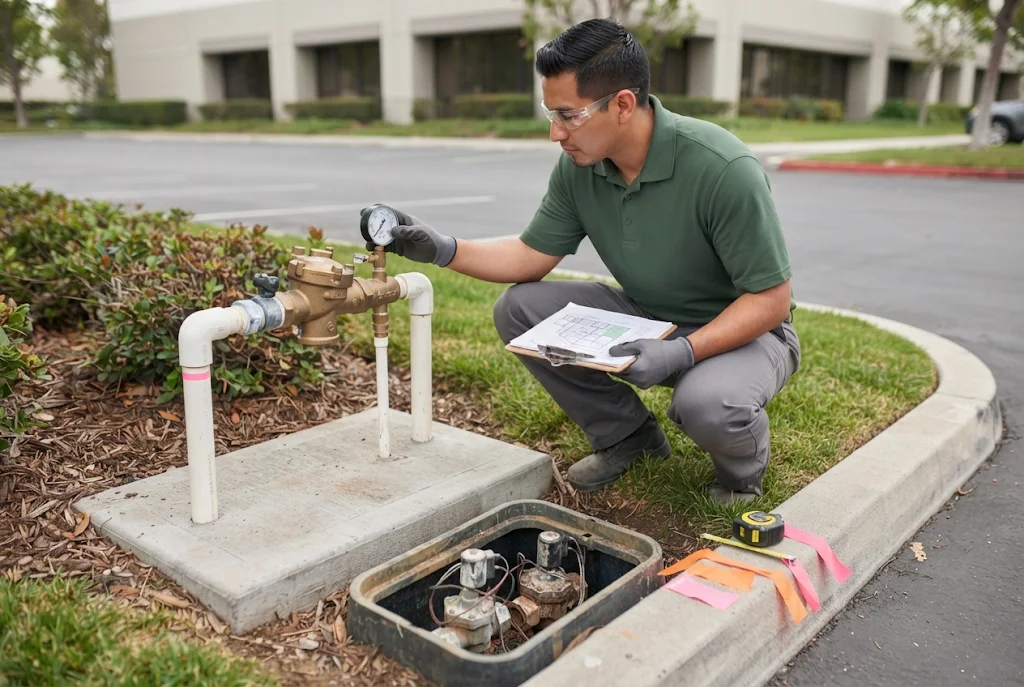
Controller selection follows the number of zones, how the property is managed, and how much monitoring the owner wants. Weather-based controllers adjust run times as conditions change. Controllers with flow-sensing capability, paired with a master valve and a flow sensor, can detect abnormal flow from a broken lateral or a stuck valve and shut down the affected zone or the system instead of letting water run unnoticed. Pressure regulation keeps sprinklers operating within their designed range, which improves uniformity and reduces misting.
For Irvine properties served by IRWD, these components are worth discussing before any equipment is purchased. The Irvine Ranch Water District’s Commercial Landscape Irrigation Improvement Program describes incentives for commercial large-landscape customers for devices such as master valves, flow sensors, and pressure regulators, with pre-approval required before components are bought. Program terms and availability can change, so we recommend confirming eligibility with the district early in planning. These are the kinds of commercial irrigation system upgrades that are easiest to include while a system is being designed or replaced.
Planning a Major Irrigation Replacement?
Start With What Is Already in the Ground
Before you commit to a full replacement, we can review the mainline, valves, controller, backflow assembly, and water supply on your property, identify what can be retained, and show how zones should be divided around turf, planting beds, slopes, and exposure. Call (888) 601-1117 to arrange a site review.
Sprinkler Coverage for Turf and Drip Irrigation for Planting Beds
Most commercial installations use both sprinklers and drip, and the line between them follows the landscape. Sprinklers suit turf areas large enough to be covered evenly. Drip suits planting beds, where water delivered at the root zone avoids wetting foliage, mulch surfaces, and the paving around the bed.
Sprinklers for Suitable Turf Areas
Turf coverage depends on head spacing, nozzle selection, and matched precipitation within each zone. Heads are generally spaced so each spray reaches the neighboring heads, which helps prevent the dry rings and browned edges typical of poorly laid out lawns. Rotary nozzles apply water more slowly than conventional spray nozzles, which can help on compacted or sloped turf where water would otherwise run off before it soaks in. For sprinkler-specific detail, including head types and layout options, see our page on sprinkler installation in Irvine.
Drip for Suitable Planting Beds
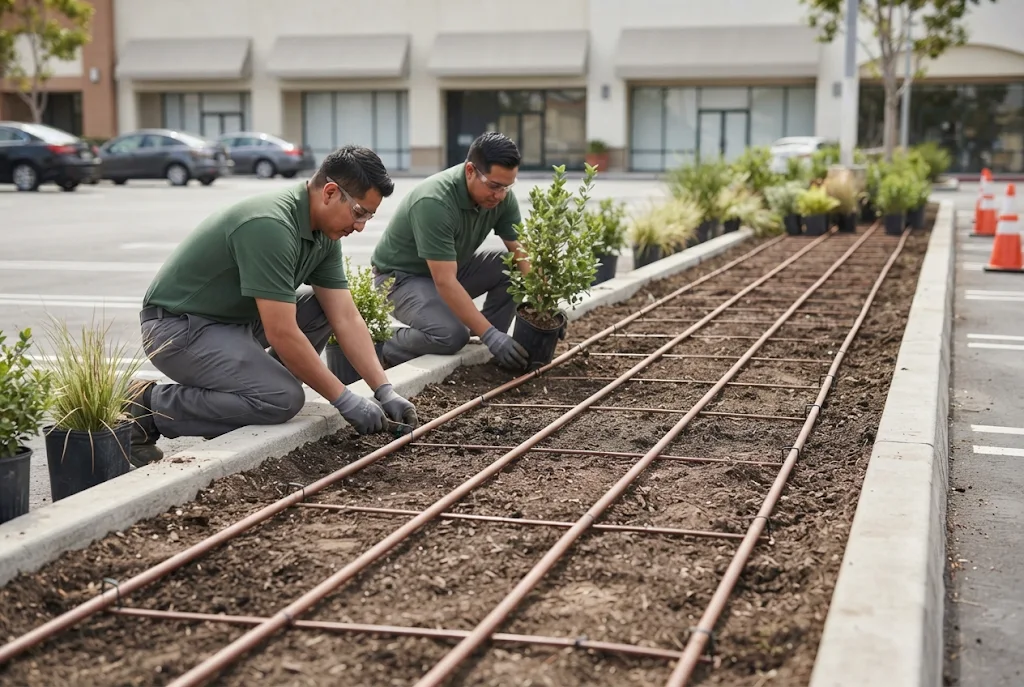
Beds planted with shrubs, groundcovers, and ornamental grasses are generally good candidates for drip, either as inline emitter tubing laid in a grid or as point-source emitters at individual plants. Drip zones need filtration and pressure regulation at the valve, and the layout should anticipate how the plants will fill in over time. Our page on drip irrigation installation for planting beds explains those components and layout choices in more depth.
Why Areas With Different Needs Get Separate Zones
Sprinklers and drip apply water at very different rates, so they should not share a valve. A spray zone may run for a few minutes, while a drip zone serving a similar area may need a much longer cycle. Keeping commercial sprinkler and drip system installation on separate zones is what allows each one to be scheduled correctly. The same reasoning applies to trees growing in turf, which often benefit from their own deeper, less frequent watering rather than relying on short lawn cycles.
How Irrigation Layout Limits Overspray Onto Walkways, Entries, and Parking
Overspray is mostly a design problem. Water on sidewalks, storefront entries, and parking stalls usually traces back to heads set too close to paving, nozzles with the wrong arc or radius, or spray irrigation in strips too narrow to cover without hitting hardscape. Getting these edges right during installation is far easier than correcting them head by head after the landscape is finished.
- Narrow strips and medians. Parking islands, medians, and the planting strips between curbs and walks are often better served by drip or other low-volume methods than by spray heads. California’s Model Water Efficient Landscape Ordinance, where it applies to a project, limits overhead spray in narrow areas and next to non-permeable surfaces for this reason.
- Head placement and arcs. Along walkways, heads are positioned to throw water away from the paving, with arcs set to the edge of the turf rather than past it.
- Entries and building faces. Areas near doors, signage, and glass storefronts get particular attention, since overspray there affects tenants, customers, and building surfaces.
- Slopes above paving. Where turf or planting slopes down toward a sidewalk or drive aisle, lower application rates and shorter repeat cycles help water soak in instead of sheeting across the pavement.
Overspray carries practical costs beyond wasted water. Wet walkways at a busy office entrance or a storefront create a slip concern, water pooling in parking areas draws tenant complaints, and repeated wetting stains walls and paving. A layout that keeps water inside the landscape protects the property as much as it protects the plants.
Irrigation Installation for Office Campuses, Retail Centers, and Industrial Frontage
The property type changes the priorities. The same families of sprinkler and drip components are installed on all three, but what the system has to accommodate differs considerably.
Office Campuses and Business Parks
Irrigation installation for office campuses often involves broad turf areas, courtyards, tree-lined walks, and outdoor seating used during the workday. Watering is typically scheduled for hours when buildings are lightly occupied, so zone run times and the total watering window have to fit together. Campuses with several buildings may also have multiple points of connection or controllers, which raises the question of whether to consolidate control as part of a replacement.
Shopping Centers and Retail Properties
Retail center landscape irrigation installation is shaped by frontage visibility, storefront entries, and parking-lot islands. Planting areas tend to be narrow and interrupted by drive aisles, which favors drip and other low-volume methods. Work has to be planned around business hours, customer parking, and tenant deliveries, and new planting at entries often needs to look settled quickly, which makes dependable establishment watering especially important.
Industrial Properties With Landscaped Frontage
Industrial sites usually concentrate landscaping along the street frontage, at office entries, and around employee parking, with long perimeter strips between the property line and loading or yard areas. Truck routes and loading docks constrain where and when trenching can happen. Perimeter landscaping on these sites is often fed by long runs from a single point of connection, so pressure loss over distance becomes part of the design calculation.
Plan an Irrigation Installation That Works Around Your Tenants
From phasing and entrance access to startup testing and zone maps at handoff, we plan commercial irrigation projects so the property keeps operating while the new system goes in. Call (888) 601-1117, email info@landscaper-near-me.com, or request a callback to talk through your project and schedule.
Coordinating Irrigation With Grading, Paving, Planting, and Sod
When irrigation is part of a larger landscape project, sequencing decides whether it can be installed cleanly. Mainline and sleeves belong in the ground before paving and curbs are finished. Laterals and valves generally go in after rough grading and before planting. Sprinkler heads are set to finished grade, and drip is installed with the plants or just after them.
That order means the irrigation crew, the grading and paving work, and the planting crew need a shared schedule. On projects that also include new hardscape, planting, and site improvements, we can coordinate the irrigation as part of our commercial landscape construction services, which keeps sleeve locations, valve placement, and planting layout aligned instead of leaving conflicts to be resolved in the field.
Testing Irrigation Before New Turf Goes Down
New turf depends on irrigation that works before the first roll is laid. Sprinkler zones serving future turf areas should be tested and adjusted at finished grade so coverage is confirmed first, because correcting a buried or misaligned head afterward means disturbing turf that was just installed. When a project includes new lawn areas, our commercial sod installation in Irvine can be scheduled so the irrigation is in place and tested ahead of time.
Protecting What Stays
Most renovations keep some existing trees, beds, or hardscape. Trench routes are planned to stay clear of the root zones of trees being preserved wherever the layout allows, and retained plantings need water throughout construction, which the phasing plan addresses.
Phased Installation on an Occupied Commercial Property
Most commercial irrigation work in Irvine takes place on properties that stay open. Tenants still need to reach their offices, customers still need parking, and deliveries still have to reach the loading area. Phasing divides the project into sections so that only part of the site is disturbed at any one time.
Dividing the Work Into Phases
Phases are usually defined by groups of valves or by areas of the property, such as one building frontage, one parking field, or one courtyard. Each phase is trenched, installed, backfilled, and tested before the next begins, which limits open trenches and lets restoration move across the site in step with the installation. This is the core of planning a phased irrigation system replacement on an occupied commercial property, and it affects both the schedule and the estimate.
Access, Entrances, and Parking
Work near main entrances, storefronts, and the busiest parking rows is generally scheduled for lower-traffic periods, with walkways kept open or clearly rerouted. Delivery routes and fire lanes stay clear. Before work begins, we review the phase plan with the property manager so tenants can be told which areas will be affected and when.
Keeping the Existing Landscape Watered
During a replacement, the old system is often taken out of service one section at a time. Plantings in areas that have not yet been converted still need water, so the phasing plan spells out how the existing landscape will be watered until each new zone is running, whether by keeping portions of the old system active or by providing temporary watering.
What a Commercial Irrigation Installation Estimate Should Include
A useful estimate shows exactly what will be built and what will stay in place, so proposals can be compared on the same basis. When comparing commercial irrigation installation bids, look for these items in writing:
- Areas and zones covered. Which turf areas, beds, medians, and perimeter strips are included, and approximately how many zones the design uses.
- Retained and replaced components. Which parts of the existing mainline, valves, wiring, backflow assembly, controller, and sleeves will remain, and which will be replaced.
- Controller and control equipment. The controller type and any flow sensing, master valve, or pressure regulation included in the scope.
- Surface restoration. How trenches through turf, beds, and any hardscape will be backfilled and restored, and who is responsible for each surface.
- Phasing and access. How the work will be sequenced around tenants, entrances, and parking.
- Startup testing. Line flushing, pressure checks, and zone-by-zone coverage testing and adjustment before handoff.
A proposal that leaves out restoration or testing may look lower on paper while shifting those costs back to the property later.
What You Should Receive at Handoff
At completion, the property should have a zone map identifying each valve, its controller station, and the area it serves; a controller programmed with documented settings; and an initial watering schedule for newly installed landscaping. New plantings and turf typically need more frequent watering while roots establish, and that schedule should be reduced as the landscape matures. Properties that want the system looked after once it is running can continue with our commercial landscape maintenance in Irvine.
Requesting an Estimate
The most accurate estimates start with accurate information. When you contact us about Commercial Irrigation Installation Irvine CA, please share the Irvine property address, site plans or landscape plans if they are available, the landscape areas affected, any access constraints such as tenant hours, delivery schedules, or restricted parking, and your desired project schedule. Call (888) 601-1117, email info@landscaper-near-me.com, or request a callback, and we will arrange a site visit and prepare a free estimate based on the property as it actually is.
FAQ's - Frequently Asked Questions
Often, yes, if they are in serviceable condition and suit the new layout. We check the mainline, valves, wiring, backflow assembly, and controller during the site assessment and list in the estimate which components stay and which are replaced. Reusing sound infrastructure can reduce trenching, cost, and disruption.
It depends on the scope. California’s Model Water Efficient Landscape Ordinance applies to new construction projects with 500 square feet or more of landscape area and to rehabilitated landscapes of 2,500 square feet or more when the project requires a building or landscape permit, plan check, or design review. Property owners or their project designers should confirm requirements with the City of Irvine, and we work from the approved plans when they apply.
Duration depends on the size of the landscape, the number of zones, how much existing infrastructure is retained, site access, and whether the work is phased around tenants. We provide a project schedule with the estimate after the site visit rather than quoting a timeline before we have seen the property.
Many Irvine commercial landscapes are irrigated with recycled water from the Irvine Ranch Water District. A new or replacement system can be designed for that supply, but recycled-water components, identification, and use must follow the water provider’s requirements, so we review the existing service and coordinate the design accordingly.
It should not. On replacement projects we plan how areas that have not yet been converted will be watered, either by keeping portions of the old system active or by temporary watering, until each new zone is installed and tested.
Yes, and in most cases it should be. Mainline and sleeves go in before paving is finished, valves and laterals after rough grading, and sprinkler zones are tested at finished grade before sod is laid. Drip is typically installed with the plants or immediately afterward.
Older commercial sites can have undocumented lines, failed sleeves, or utilities in unexpected places. If we find a condition that changes the scope, we stop and explain what we found, the options, and any cost or schedule effect before proceeding, so the property manager can make the decision.
Call (888) 601-1117, email info@landscaper-near-me.com, or request a callback. Including the property address, any site plans, the areas you want irrigated or replaced, access constraints, and your preferred schedule helps us prepare an accurate free estimate.