
Apartment Complex Landscaping Services
for Multifamily Communities
Apartment Complex Landscaping Services are the professional care of the outdoor grounds that residents share: the entry drive, the walk up to the leasing office, courtyards and lawns between buildings, planting beds along walkways, landscaped parking islands, and the strips of planting that wrap each building. On an occupied rental property those spaces are in use from early morning until late at night, and they are also the first thing a prospective resident sees on a tour. The landscape has to look cared for on the day a prospect arrives, and it has to stay that way the following week, after the mowers have moved on.
Landscaper-Near-Me.com provides apartment landscaping services for professionally managed apartment complexes, garden-style communities, and multifamily rental buildings. Recurring grounds maintenance is the center of that work. Installation, replanting, sod replacement, and irrigation improvements come into the picture when a part of the property has declined past what routine care can correct, and we scope those separately so they never blur the maintenance agreement. Apartment work is one part of our broader commercial landscape services, but it carries its own operating conditions, and this page is built around them.
We wrote it for the people who carry responsibility for those grounds: owners, onsite and regional property managers, multifamily management companies, asset managers, and the maintenance supervisors who field resident complaints about a broken sprinkler or an overgrown hedge. Below we explain what the service includes, which areas of a community deserve the most attention, how routine visits are organized, how crews work around residents, vehicles, and pets, how schedules and communication are set, how irrigation and trees are handled, when improvement projects make sense, and what goes into an estimate.

Free Estimates for Apartment Complex Landscaping Services
Tell us about your community, including the number of buildings, the lawns and beds involved, and what has been slipping. We will walk the grounds and prepare a free estimate for recurring maintenance. Call (888) 601-1117 or email info@landscaper-near-me.com.
What Do Apartment Complex Landscaping Services Include?
Apartment complex landscaping covers the care and improvement of grounds that belong to the property rather than to any one resident. That boundary matters. A resident’s patio planters, balcony containers, or a small garden plot assigned to a unit are usually the resident’s to tend, and general building maintenance such as painting, gutters, lighting repair, or parking-lot sweeping typically sits with the onsite maintenance team or another vendor. Our work starts at the soil, the turf, the plants, the trees, and the irrigation that keeps them alive.
Recurring Grounds Maintenance
The recurring portion is what most property managers are actually hiring. It is the scheduled work that keeps an established landscape steady through the year: lawn mowing and edging, shrub pruning, planting-bed upkeep, weed management, attention to mulch condition, removal of landscape debris, and routine observation of irrigation as crews move through the property. Apartment complex landscape maintenance succeeds when the grounds look much the same in the last month of an agreement as they did in the first.
Separately Scoped Improvement Projects
Improvements are a different category of work. Replacing a failed bed at the leasing office, installing new sod over a worn courtyard lawn, or reworking an irrigation zone that has never covered its area correctly each has its own scope, estimate, and approval. Keeping these out of the recurring agreement protects both sides: the maintenance price stays tied to maintenance, and improvement budgets are spent on decisions the owner has actually made.
Exactly what falls into each category depends on the property assessment and the scope we agree on in writing. One community might want mulch replenishment built into the recurring program; another might prefer to approve it as a seasonal add-on. Where an apartment property is part of a condominium or planned community governed by an association, the association’s rules and board process usually shape the arrangement, and our HOA landscape maintenance page covers that kind of governance in more detail.
Which Areas of an Apartment Community Need the Most Attention?
Every part of the grounds needs care, but not every part carries the same weight. On most apartment properties, a handful of areas do most of the work of shaping how residents and prospects feel about the community, and good apartment common area landscaping plans the scope so those areas are never the ones that slip.
- Entrances and the leasing-office approach. The monument sign, entry beds, and the walk from visitor parking to the leasing door form the opening scene of every tour. Plantings here should frame signage without hiding it and stay crisp between visits.
- Courtyards and central lawns. These are the spaces residents actually use for sitting, playing, and walking dogs. They take heavy wear, so turf condition, edges, and bed borders show neglect quickly.
- Planting beds beside resident walkways. Shrubs that creep into a path narrow it for strollers, carts, and anyone using a mobility aid. Beds along these routes need regular shaping and clean edges.
- Landscaped parking islands. Islands take vehicle damage, heat reflected from pavement, and litter. They also tend to be where irrigation breaks first.
- Building perimeters. Foundation plantings close to walls and windows need to stay clear of siding, vents, utility equipment, and ground-floor windows. Sound landscaping for apartment buildings keeps these beds low enough for appearance and practical access.
- Amenity surroundings. Landscaping around pools, clubhouses, playgrounds, barbecue areas, and mail kiosks sits where residents gather, so debris and overgrowth there draw complaints fast.
Walking the leasing tour route with the property manager is one of the most useful things we do during an assessment. It shows us exactly which beds, lawns, and walkways a prospect passes, and it lets us set the order in which crews work so those areas are freshest when tours are most frequent.
What Happens During Routine Apartment Landscape Maintenance?
A routine visit follows the scope that was agreed for the property, but the core tasks are fairly consistent. What changes from site to site is how much of each the grounds require and how often.
Turf Care
Where lawns exist, mowing and edging are the backbone of each visit. Mowing height and frequency follow the grass on site and the season, and edges along walks, curbs, and beds are kept defined so the lawn reads as maintained even from the parking lot. On larger communities, apartment lawn care also means watching for wear paths, thin areas, and patches stressed by irrigation problems. Properties that need a deeper turf program can draw on our commercial lawn care services.
Shrubs, Beds, and Mulch
Shrub pruning keeps plants in scale with walkways, windows, and signage instead of letting them be sheared hard once a year after they have already crowded everything around them. Bed upkeep includes pulling or treating weeds before they set seed, clearing leaf litter and trash that collects in plantings, and keeping an eye on mulch. When mulch has thinned to bare soil, weeds and moisture loss follow, so we note it and recommend replenishment where the scope allows.
Landscape Debris
Clippings, fallen leaves, palm fronds, and storm debris are removed from lawns, beds, and the hard surfaces next to them, and walks are cleared of what the work itself produced. Whether debris is hauled off site or placed in property containers is settled in the scope, since many communities have limited dumpster capacity.
Keeping Several Buildings Consistent
The most common complaint we hear from managers of larger communities is not that the landscape looks bad, but that it looks uneven: Building A is sharp while the back of Building F has been forgotten. We address that by dividing the property into defined service zones and tracking which zones were covered on each visit. That structure makes gaps visible to us before they become visible to residents, and it gives the manager a clear way to point at an area and ask about it.
Hold Every Building to the Same Grounds Standard
Uneven upkeep between buildings is a scope problem we can fix. We will map your property into service zones, walk the leasing tour route with you, and outline a maintenance plan that keeps the whole community consistent.
How Do We Work Around Residents, Vehicles, and Pets?
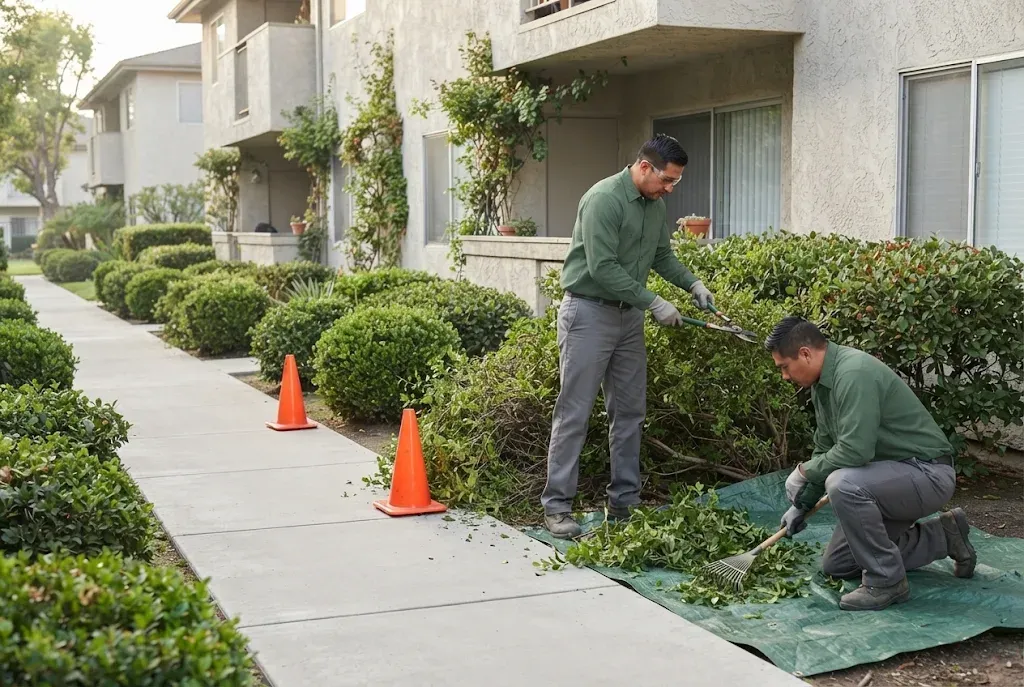
An apartment community is somebody’s home at every hour we are there. People are leaving for work, walking dogs, bringing in groceries, and working from the unit next to the hedge being trimmed. Good apartment community grounds maintenance takes that into account in how the work is set up, not just in how it is finished.
Resident Access and Work-Area Separation
Mowers, trimmers, and blowers throw debris, so crews keep a working distance from people and pause or redirect when someone approaches. When a task closes a walkway for longer than a few minutes, such as pruning a tall hedge or reworking a bed edge, we set out cones or other visible separation and keep an alternate route open where the layout allows. Blowers are directed away from open doors, patios, and parked cars.
Equipment Staging and Parked Vehicles
Trailers and equipment need somewhere to stop that does not block fire lanes, driveways, accessible parking, or a resident’s assigned space. We agree on staging locations with the property during setup. Parked cars are the other constant: clippings and gravel can mark paint, and work in parking islands is planned around which stalls are typically occupied at the time of the visit. When an island needs heavier work, the property can ask residents to move vehicles for that window.
Pet Areas
Dog runs, pet stations, and the lawns residents use for walking dogs see concentrated wear and waste. Crews need those areas clear of pet waste before mowing, and turf in them often declines faster than anywhere else on the property. Landscaping around apartment dog runs and pet areas usually works best with durable surfaces, tough plantings at the edges, and a realistic expectation of how much turf the space can support.
Coordinating Disruptive Work
Some tasks are simply loud or intrusive: heavy pruning beside units, tree work over parking, sod removal, or trenching for irrigation. We schedule these with the property manager in advance so residents can be notified through the community’s usual channels, and we avoid placing them during move-in days, resident events, or other times the manager flags.
How Often Should Apartment Grounds Be Maintained?
There is no single correct visit frequency for an apartment complex. The right schedule comes out of the property itself, and we would be wary of any proposal that offers one without looking at the grounds.
The factors that usually shape it include:
- Seasonal growth. Turf and shrubs grow fastest in the warm months and slow down in winter, so mowing and pruning needs rise and fall through the year.
- How residents use the grounds. Communities with busy courtyards, pools, and pet lawns need more frequent attention in those spaces than in low-traffic side yards.
- Leasing activity. During periods when tours are frequent, many managers want the entry and leasing path serviced shortly before peak tour days.
- Property size and layout. A large community may be serviced in rotation, with different zones covered on different days, rather than all at once.
- Management priorities. Budget, the owner’s standards, and plans for renovation or sale all affect how much is included and how often.
Those decisions become the property’s maintenance plan. Apartment landscaping maintenance plans that work well spell out which zones are covered, which tasks happen on each visit, which happen seasonally, and how the schedule changes through the year. They also say what falls outside the plan, so nobody is surprised when an irrigation repair or a replanting arrives as a separate proposal.
Communication With Onsite Staff
The schedule only holds if information moves both ways. During setup we confirm a preferred coordination contact, usually the community manager or maintenance supervisor, and the way they want to receive updates. Crews report landscape issues they observe, such as a broken sprinkler head, a dead shrub, vehicle damage to a bed, or a tree limb that looks compromised, and those observations are passed to that contact for review. In turn, the property can tell us about resident concerns, upcoming events, or areas that need extra attention before an inspection. Keeping a running list of observed issues and agreed priorities gives management something concrete to act on and to share with ownership.
How Are Irrigation Problems Handled on Apartment Properties?
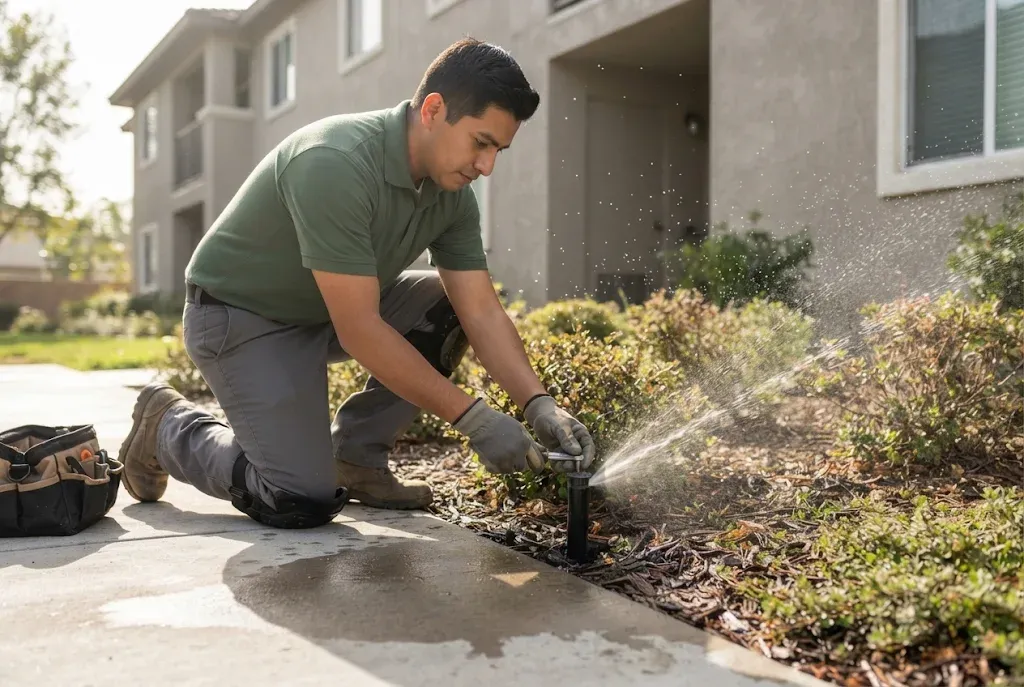
Irrigation is where many landscape problems on an apartment complex begin. A single broken head can flood a walkway outside a building entrance, while a clogged nozzle a few feet away leaves a section of lawn or bed going brown. Because crews are on the property regularly, routine maintenance visits are a practical time to notice those symptoms.
What We Look For During Maintenance Visits
- Leaks, broken heads, and pooling or soggy areas that stay wet long after a cycle
- Overspray onto walkways, parking areas, building walls, and windows
- Uneven coverage, where part of a lawn or bed stays green while the rest browns
- Stressed planting areas that point to a valve, controller, or coverage problem
- Heads knocked out of alignment by mowers, vehicles, or foot traffic
Overspray deserves particular attention on a residential property. Water on a walkway is a slip concern for residents, it stains walls and windows, and it is simply wasted. Water that routinely runs off a landscape onto paved surfaces is also the kind of waste that state and local conservation rules address, so correcting it is part of responsible grounds care.
Observation Versus Repair
Noticing an irrigation problem and fixing it are not always the same job. Depending on the scope, simple adjustments such as straightening or re-aiming a head may be handled during the visit. Replacing valves, repairing broken lateral lines, rebuilding zones, or changing how an area is watered are typically scoped and approved separately. Communities that need deeper system work can review our commercial irrigation services, and properties dealing mainly with broken heads, leaks, and coverage problems may be better matched to our sprinkler repair services. In either case, the observation comes to the property contact first, along with our recommendation, so the decision stays with management.
Grounds Care Planned Around the People Who Live There
From staging equipment away from resident parking to reporting irrigation issues to your onsite team, we plan apartment landscape maintenance around daily life on the property. Call (888) 601-1117 to talk it through, or request a callback.
How Should Trees Be Cared for Around Apartment Buildings?
Trees give an apartment community much of its character and shade, and they also sit over the places where residents walk, park, and gather. Tree care on these properties starts with assessment: looking at how each tree relates to buildings, roofs, parking stalls, light poles, walkways, and signage, and noting deadwood, crowding, or growth that has started to interfere with the space around it.
From there, trimming is planned around the property’s real conditions. Common goals include keeping limbs off roofs and away from walls and windows, maintaining clearance over walkways and drive aisles, opening sight lines to signage and lighting, and removing dead or broken branches. The amount of clearance appropriate for a given tree depends on its species, structure, and location, so we do not apply one universal clearance figure across a property. And while thoughtful pruning can reduce some risks, no trimming program can promise that a tree will never drop a branch; what it can do is catch visible problems and address them in a planned way.
Tree work over parking and walkways is also the most disruptive task on most apartment properties, so it is scheduled with management, areas beneath the work are closed while it is underway, and vehicles are moved where necessary. For larger trees or detailed pruning plans, our tree trimming services page explains that work more fully. When an assessment raises a concern that goes beyond routine trimming, we tell the property contact and recommend an appropriate next step rather than folding it quietly into a maintenance visit.
When Does an Apartment Community Need Landscape Improvements?
Recurring care holds a landscape steady, but it cannot rebuild one. When an area has declined far enough, more mowing and pruning will not bring it back, and an improvement project is the more honest recommendation. Signs that a property has reached that point include:
- Turf worn down to bare soil along shortcuts and in pet areas
- Planting beds with large gaps, dead plants, or exposed irrigation
- Shrubs so overgrown that pruning would leave bare, woody stems
- Areas where landscape debris and weeds have accumulated for a long time
- Visible differences in condition between buildings or service zones
Choosing Plants That Fit the Site
Replacement planting is where many apartment landscapes go wrong for a second time. A plant that suited the original design may be the wrong choice now that trees have grown and shaded the bed or that foot traffic has shifted. We select and replace plants based on sun exposure, the irrigation zone they will share, mature size relative to walkways and windows, the amount of foot traffic nearby, visibility from tour routes, and how much maintenance the property is prepared to provide. Plants that will outgrow their space within a couple of seasons create the same problem the project was meant to solve.
Phasing Improvements
Most communities do not renovate everything at once. Apartment landscape improvements are often phased by visibility and budget: the entry and leasing-office approach first, then a central courtyard, then secondary areas. That approach keeps recurring grounds care central while improvements are added in defined stages. Refreshed planting beds and replacement planting can be handled through our landscape bed design and installation work, and worn lawns that are worth keeping can be addressed through targeted commercial sod installation. Irrigation improvements are often paired with these projects, since new plantings and new turf rarely do well on a zone that was already failing.
Planning an apartment community landscape renovation is also the right time to ask whether every lawn is still earning its water. Turf that is only looked at, such as strips along parking or narrow areas between buildings, may be a candidate for a lower-water planting. Statewide restrictions on irrigating nonfunctional turf with drinking water already apply to many commercial and community properties, and whether or when they reach a particular rental property depends on how it is classified. The State Water Board’s frequently asked questions on the nonfunctional turf ban explains which properties are covered, and the local water supplier can confirm requirements for a specific site. Water-conscious landscape conversions for apartment communities can be planned in phases alongside other improvements, so courtyards and pet lawns residents actually use keep their turf.
What Affects the Cost of Apartment Complex Landscaping Services, and How Do You Get an Estimate?
The cost of apartment complex landscaping services depends on the property far more than on any standard rate, which is why we prepare estimates after looking at the grounds. The main factors are:
- Maintained area and how it is distributed across buildings and zones
- Turf and bed proportions, since mowing, bed care, and shrub work take different time and equipment
- Tree and shrub needs, including how much pruning and clearance work the site requires
- Access constraints such as gated areas, narrow paths, stairs, and limited staging space
- Existing condition, because a neglected property usually needs catch-up work before routine care can hold it
- Debris handling, including whether material is hauled away or placed in property containers
- Service frequency and how it changes through the year
- Requested improvements, which are priced separately from the recurring agreement
Information That Helps Us Prepare an Estimate
Apartment landscaping estimates come together faster and more accurately when we have a few details up front: the property location, its approximate size or a site plan if one is available, the current concerns that prompted the call, the maintenance scope you have in mind, any access limitations or gate procedures, and the name of the person who should coordinate with us. If you are budgeting for apartment landscape maintenance across a fiscal year or comparing it with other operating costs, telling us that early helps us lay out the recurring scope and any recommended improvements so they can be planned separately.
Comparing Proposals
Proposals for the same property can look very different, and the lowest number is not always the smallest scope. When comparing them, look at which zones and tasks each one includes, how often each task happens, how seasonal work is handled, how debris is managed, whether irrigation observation is part of routine visits, and how issues will be reported to your team. A proposal that spells these things out gives you something you can hold a contractor to.
Landscaping for apartment property managers should make the job easier, not add another thing to supervise. If your community needs dependable recurring care, a plan for areas that have slipped, or simply a clearer scope than the one in place now, we would like to walk the grounds with you. Landscaper-Near-Me.com provides multifamily landscaping services within our established service territory in Southeast Los Angeles County and Orange County, so if you have been looking for apartment landscaping services near me that understand occupied communities, call (888) 601-1117, email info@landscaper-near-me.com, or request a callback for a free estimate.
FAQ's - Frequently Asked Questions
Yes. We can work with a regional or portfolio manager while coordinating day-to-day details with each community’s onsite staff. Each property still gets its own assessment and scope, because grounds, plantings, and resident use differ from one community to the next, but reporting can be organized so the regional team sees issues across properties in a consistent way.
Usually not. Plants on private patios and balconies, and garden plots assigned to individual units, are generally the resident’s responsibility under the lease. Our scope covers the shared grounds owned and managed by the property. If management wants a specific exception, such as tidying vacant-unit patios before a move-in, it can be written into the scope.
In most cases, yes. We start with a walk of the property to document current conditions, since a transition often reveals deferred work. If catch-up pruning, cleanup, or irrigation repairs are needed before routine care can hold the grounds, we identify them separately from the recurring scope so you can decide how to handle them.
Crews note damage they find, such as a parking island crushed by a car or a bed dug up by a dog, and report it to your coordination contact. Minor cleanup may fit within routine work. Replacing plants, irrigation components, or turf is normally quoted separately so management can approve it and, where appropriate, address it with the responsible party.
Yes. Some properties use onsite staff for part of the grounds and bring us in for specific zones, often the entry, leasing approach, and amenity areas. The scope should clearly define the boundaries between our work and staff work so nothing falls between the two.
Yes. Exterior renovations, roofing, painting, and parking-lot work can make some areas inaccessible or put plantings at risk. We can pause or shift service in affected zones, protect plantings where practical, and plan replanting or cleanup once contractors finish. Letting us know the renovation schedule early makes that much easier.
Amenity areas are typically maintained as part of the regular scope, but they often need different timing. We try to schedule noisy work and blowing around pools, clubhouses, and play areas for times when they are lightly used, and we keep clippings and debris out of pool decks and seating areas. Plant choices near pools also need to account for splashing and leaf drop.
No. Estimates are free, and there is no obligation to move forward. We walk the property, discuss your priorities and concerns, and provide a written scope that separates recurring maintenance from any recommended improvements. You can reach us at (888) 601-1117 or info@landscaper-near-me.com to schedule a walk-through.