Professional Tree Removal Services
Tree removal is one of the more consequential decisions a property owner makes about a landscape, and it usually isn’t a decision made lightly. When a tree is dead, declining, storm damaged, or growing into direct conflict with a structure, driveway, or a planned improvement, professional tree removal is often the safest and most practical path forward. Landscaper-Near-Me.com provides tree removal services for homeowners, businesses, property managers, HOAs, and other property owners throughout our established Southeast Los Angeles County and Orange County service territory. This page explains how we evaluate a tree removal request, when full removal makes more sense than trimming or pruning, what happens during a typical tree removal project, and how to request a tree removal estimate for a residential or commercial property.
Get a Free Tree Removal Estimate
Tell us about the tree and we’ll schedule a visit to confirm whether removal is the right call.
When Does a Tree Actually Need to Be Removed?
Not every problem tree needs to come down, but some clearly do. The clearest candidates for tree removal are trees that are dead or in advanced decline, trees with structural defects serious enough to create an unacceptable risk, and trees that are physically obstructing a structure, walkway, driveway, or utility line. A tree that has lost most of its canopy, shows extensive trunk decay, has a sudden or pronounced lean, or has large cracks running through major limbs or the trunk is generally past the point where trimming or cabling can restore it to a safe, healthy condition.
Other common triggers for tree removal include storm-damaged trees that have suffered major limb failure or root-plate movement, trees crowding one another to the point that none of them can develop properly, and trees that conflict with a planned construction project, hardscape installation, or other property improvement. Property owners considering tree removal for property improvements should factor in root systems and canopy spread near the intended work area, not just the trunk location, since roots and limbs from a single tree can affect a wider footprint than most people expect.
Signs Homeowners and Property Managers Should Watch For
- Large sections of dead or leafless canopy, especially in spring or summer
- Fungal growth (conks or mushrooms) at the base of the trunk or along major roots
- Deep vertical cracks or seams in the trunk
- A lean that has developed suddenly or worsened noticeably
- Soil heaving or lifting near the root zone after wind events
- Large dead limbs positioned over a roof, parking area, or walkway
Because the consequences of misjudging a hazardous tree can be significant, the University of California’s Cooperative Extension program has published practical guidance on evaluating whether an older or declining tree should be kept or removed, including how canopy vigor, decay, and root loss factor into that decision. When a tree’s condition is uncertain, a documented site visit is the most reliable way to determine whether removal is genuinely necessary.
Tree Removal vs. Tree Trimming: How We Help You Decide
Complete tree removal is not always the right answer, and we don’t treat it as the default recommendation. Many trees that look concerning from a distance can be preserved through appropriate pruning once a closer inspection rules out the more serious structural problems described above. Understanding the difference between removal and trimming up front helps property owners avoid removing a tree that could have been saved, while also avoiding the cost and risk of repeatedly trimming a tree that has already passed the point of safe recovery.
Our tree trimming services are typically the better fit when a tree is structurally sound but has isolated deadwood, overextended limbs, or canopy density that needs to be reduced. Two techniques come up often in that conversation: crown reduction, which lowers the overall height and spread of a tree to reduce wind load and limb stress, and deadwooding, which removes dead or dying limbs before they become a falling hazard without removing the tree itself. Timing also matters for tree health, and property owners planning routine maintenance rather than removal may find it useful to review when the best time of year to trim trees actually is for the species involved.
When a tree removal estimate is requested, our first step is almost always to confirm whether removal is the appropriate recommendation or whether a trimming or pruning plan would resolve the concern with less disruption to the landscape.
Common Reasons Property Owners Choose Professional Tree Removal
Homeowners and commercial property owners request tree removal for a fairly consistent set of reasons, even though every property and every tree is different. Dead tree removal is the most straightforward case, since a dead tree provides no benefit and only increases in risk over time as wood dries out and limbs become brittle. Hazardous tree removal covers trees that are structurally alive but pose a real risk of limb or whole-tree failure near a home, business, parking area, or walkway. Damaged tree removal, including storm damaged tree removal, applies to trees that have suffered significant wind, lightning, or impact damage that leaves the remaining structure unstable even if part of the tree still appears healthy.
Obstruction is another frequent driver. A tree may be growing into a roofline, pushing against a fence, lifting a driveway or walkway, or crowding out other landscaping the property owner would rather keep. In some cases, a tree simply conflicts with a planned improvement, such as a new patio, addition, driveway expansion, or utility trench, making tree removal for construction and property improvements a practical first step rather than an afterthought.
Residential and Commercial Scenarios We Commonly See
- A single backyard tree that has died and now overhangs a home or garage
- Storm-damaged trees with split trunks or major limb failure after a wind event
- Trees along a shared property line growing into a neighboring structure or fence
- Commercial parking lot or perimeter trees that are lifting pavement or blocking sightlines
- Trees standing in the footprint of a planned addition, patio, or hardscape project
- HOA or common-area trees that a board has identified as a liability during a routine inspection
While emergency tree removal and formal tree risk assessment are related topics worth their own dedicated discussion, the underlying question on this page is the same one property owners ask most often: does this specific tree need to come down, and if so, what does that process actually involve.
Not Sure If It Needs to Come Down?
If trimming or pruning might solve the problem instead, we’ll walk you through the options before recommending removal.
What Happens During a Professional Tree Removal?
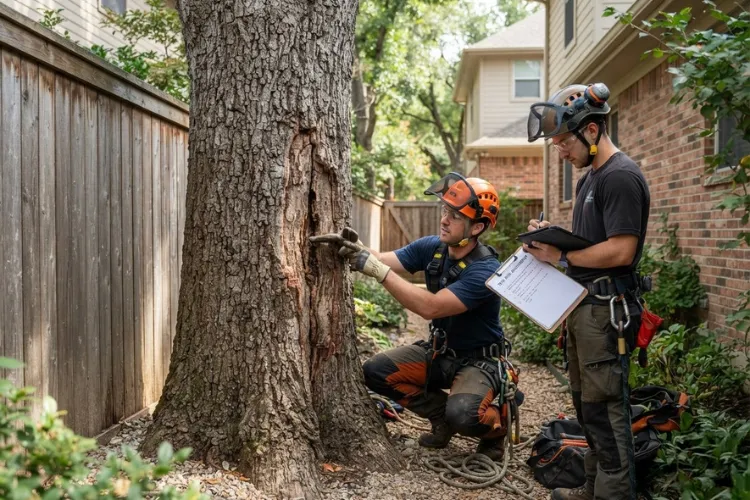
A professional tree removal project begins with a site assessment rather than a chainsaw. Before any cutting starts, the tree’s size, lean, condition, and surroundings are evaluated so the removal can be planned in a sequence that keeps the work area, structures, and anyone nearby as safe as possible. That planning stage also identifies the equipment the job will require, whether that means a bucket truck and chipper for an open backyard tree or a more deliberate piece-by-piece approach for a tree in a tighter side yard or near a shared fence line.
Once the plan is set, larger trees are typically removed in sections rather than felled as a single piece, especially when structures, landscaping, vehicles, or utility lines are nearby. Smaller, more open trees with a clear drop zone may be removed as a single fell when conditions allow it safely. Throughout the process, the crew continues to reassess the tree’s condition, since removal sometimes reveals internal decay or structural weakness that wasn’t fully visible from the ground.
Utility and Overhead Hazard Coordination
Trees growing near overhead power lines or other utility infrastructure require additional caution. When a tree removal near structures or utility equipment presents an electrical hazard, that work is coordinated appropriately with the property owner and, where required, the utility provider, rather than treated as routine ground-level tree work. We do not attempt utility-line work that falls outside the appropriate scope of a landscaping and tree removal provider.
Planning for Access, Safety, and Protecting the Rest of Your Property
Equipment access is one of the most underrated parts of planning a tree removal. A tree in an open front yard with a clear driveway approach is a very different project than a tree wedged between a fence line, a pool, and a neighboring structure. Before removal begins, we look at how equipment will reach the tree, where debris and cut sections will be staged, and what nearby landscaping, hardscape, irrigation lines, or structures need to be protected during the work.
Confined or difficult-access removals often call for a more methodical, piece-by-piece approach, sometimes using rigging to lower sections rather than dropping them, specifically to avoid damaging a fence, shed, patio cover, or neighboring plantings. Protecting the surrounding landscape matters just as much as removing the tree safely, since a tree removal project that damages a lawn, irrigation system, or nearby plant bed simply creates a second project that didn’t need to happen.
When Property-Wide Planning Helps
On properties with more than one tree under consideration, or where tree removal is only one piece of a broader landscape update, it often makes sense to look at removal alongside the property’s other landscape services needs at the same time, rather than scheduling each piece separately.
Residential vs. Commercial Tree Removal: What Changes
Residential tree removal is usually centered on a single tree or a small handful of trees on a homeowner’s property, with scheduling flexibility built around the homeowner’s availability. Commercial tree removal introduces different considerations. Office parks, retail centers, industrial sites, and multifamily properties often have multiple trees to evaluate at once, tenant or customer traffic to work around, and parking areas or walkways that need to remain usable during the project.
HOAs and community associations bring their own layer of coordination, since a tree flagged for removal in a common area typically needs board awareness, resident communication, and sometimes a broader look at other trees in the same common area that may be approaching the same condition. Facility and property managers evaluating tree removal across a portfolio of properties benefit from consistent documentation of why a given tree was removed, which supports both budget planning and any questions that come up later from tenants, ownership, or a board.
Regardless of property type, the underlying evaluation stays the same: is the tree dead, hazardous, damaged, or genuinely in conflict with the property’s use, and does removal solve that problem more effectively than trimming, cabling, or another form of tree care.
Let's Talk About Your Tree Removal Project
Call Landscaper-Near-Me.com or request a callback and we’ll help you plan the next step for your property.
What About the Stump, Wood, and Debris After Removal?
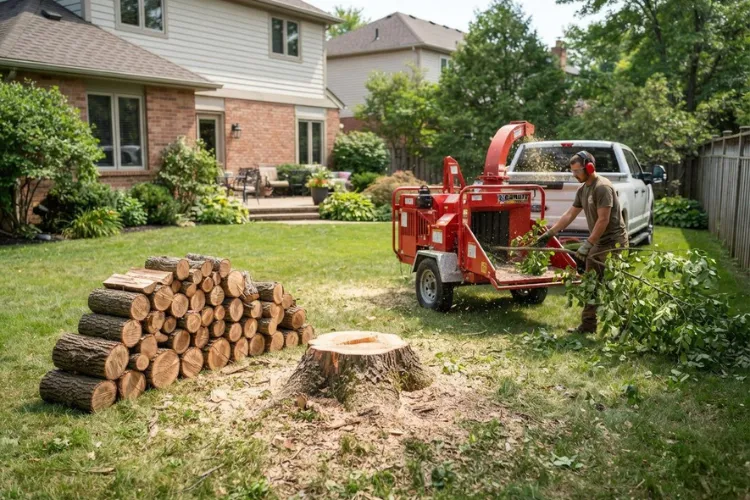
Once a tree is down, three practical questions usually follow: what happens to the stump, what happens to the wood, and what happens to the smaller debris. The stump and remaining root system are typically left in place unless stump grinding services are separately requested and scoped, since grinding a stump is a distinct piece of work with its own equipment and access considerations. Property owners planning a hardscape project or new planting in the same area should raise the stump early in the conversation, since it can affect the timeline for what comes next.
Wood and debris handling depends on the agreed scope of the project. Some property owners want the site cleared completely, while others prefer to keep cut firewood-length rounds or have specific disposal preferences for larger commercial sites. Confirming debris and cleanup expectations before the work begins, rather than after, keeps the project’s final scope clear for everyone involved.
Preparing for Removal Day and What Happens Afterward
A little preparation on the property owner’s end makes tree removal day go more smoothly. Clearing vehicles, patio furniture, and other items from the immediate work area, confirming gate or side-yard access, and flagging any known irrigation lines, low-voltage wiring, or buried features near the tree all help the crew plan the removal more efficiently and avoid unnecessary damage to the rest of the property.
After removal, the site is typically left graded and cleared according to the agreed scope of work. This is also a natural point to think about what comes next for that part of the property. Some property owners choose to leave the area open, while others want to restore or upgrade the space with new planting, sod, or a broader landscape refresh. Tree replacement and planting is a common next step when a removed tree played a meaningful role in the property’s shade, privacy, or overall landscape design, and it’s worth discussing as part of the same conversation as the removal itself, alongside our broader landscape services.
Requesting a Tree Removal Estimate
Deciding whether a tree genuinely needs to come down, or whether trimming and continued care make more sense, is easier with a direct look at the tree rather than a guess from a photo or a description over the phone. If you’re weighing dead tree removal, hazardous tree removal, storm damaged tree removal, or simply a tree that’s grown into conflict with your property, our team can evaluate the tree, explain the reasoning behind the recommendation, and provide a clear tree removal estimate before any work begins.
Landscaper-Near-Me.com works with homeowners, businesses, property managers, and HOAs throughout our Southeast Los Angeles County and Orange County service territory on both routine and more involved tree removal projects. If you’re searching for a tree removal company or a broader tree service near me, request a free estimate, call our team, or ask for a callback, and we’ll help you figure out the right next step for your tree.
FAQ's - Frequently Asked Questions
Dormant trees, especially deciduous species in winter, can look bare without being dead. Signs that a tree has actually died include brittle branches that snap cleanly with no green tissue underneath the bark, no new bud growth at the start of the growing season, and bark that is loose or peeling away from large sections of the trunk. If you’re unsure, a site visit is the most reliable way to confirm the tree’s condition before deciding on removal.
Permit requirements vary by city and sometimes by tree species, size, or location on the property, so it’s worth checking with your local city or county planning department before removal, especially for larger trees or protected species. We’re happy to discuss what we know about a specific situation, but the property owner should always verify current local requirements with the appropriate local authority.
Timing depends heavily on the tree’s size, condition, and how accessible it is. A smaller tree in an open area may be removed in a few hours, while a large tree in a tight side yard or near structures and utility lines can take considerably longer due to the more careful, piece-by-piece approach that safety requires.
Sometimes, yes. Trees that are structurally sound but have isolated deadwood, overgrown limbs, or excessive canopy weight are often good candidates for trimming or pruning rather than removal. We evaluate each tree individually and will recommend trimming over removal whenever it’s a safe, practical option.
Stump removal is typically a separate, additional step from tree removal itself, since grinding a stump involves different equipment and access considerations. Let us know if you’d like the stump addressed as part of your project so it can be included in the scope and estimate.
Debris handling is based on the scope agreed to before work begins. Some property owners want the site fully cleared, while others prefer to keep cut wood. We’ll confirm your preference as part of the estimate so there are no surprises after the work is complete.
Cost depends on the tree’s size, condition, location on the property, and how much access the crew has to work safely. Because these factors vary so much from property to property, we provide a specific tree removal estimate after evaluating the tree rather than a flat, one-size-fits-all price.
Trees growing near overhead power lines or utility infrastructure require extra caution and, in some cases, coordination with the utility provider. We evaluate this during the site visit and will let you know if a situation falls outside the appropriate scope of our tree removal services.