
Landscape Design and Installation Irvine CA
for Front Yards, Backyards, and Full-Yard Renovations
An Irvine yard rarely needs just one thing. The front lawn has thinned, the walk to the door is a plain strip of concrete, the beds along the house hold shrubs that were planted long ago and sheared into boxes, and the backyard is a rectangle of grass that children and a dog have worn into paths. Fix any one of those on its own and the result tends to look patched. Plan them together and the yard starts to work as a whole.
That is the reason most homeowners ask us about Landscape Design and Installation Irvine CA projects: they want one coordinated plan for the front yard, the backyard, or the entire property, followed by an installation that carries the plan out in the right order. We start with how you use the space, where sun and shade fall, which plants and features are worth keeping, how water moves across the lot, and what shape the irrigation is in. From there we lay out planting beds, lawn, and walking routes, prepare the soil, and coordinate irrigation, sod, paths, or patios where the project calls for them.
Some owners come to us with bare soil around a recently purchased home. Others are renovating a landscape that has simply outgrown itself. The questions are much the same either way, and we have answered them here in roughly the order they come up on a real project: what a coordinated project includes, what we look for on site, how front and back yards differ, how we choose plants and plan for a dry climate, how installation is sequenced, and what helps us prepare your free estimate.

Plan Your Irvine Landscape Project With a Free Estimate
Tell us which areas you want to change and how your household uses them. We will walk the property with you, talk through what to keep, and prepare a free estimate for the design and installation scope. Call (888) 601-1117 or request a call back.
What Is Included in Landscape Design and Installation for an Irvine Home?
Landscape design and installation is a single project that takes a yard from a plan to finished, planted ground. The design side decides where things go and why: bed shapes, plant choices, lawn size, walking routes, and how water will reach each area. The installation side builds it, from clearing and grading through soil preparation, irrigation, planting, mulch, and any sod. Handled as one Irvine landscape design and build project, the decisions stay connected. Whoever places a bed is also thinking about how its irrigation will be routed and how its soil will be prepared, so nothing falls into the gap between a drawing and the crew that installs it.
New yards starting from bare soil
A yard with nothing in it gives us the most freedom and the fewest constraints from existing plants. It can also hide problems. Construction traffic may have compacted the soil, the existing grade may not suit the layout you want, and irrigation stub-outs may have been left without any real plan behind them. Part of the design work on a new yard is finding out what the soil and grade actually look like before committing to a layout.
Partial renovations
Many projects cover one area: the front yard before a sale, the backyard once the children are older, or a side yard that was never finished. A partial renovation still has to tie into what stays. New beds need to meet existing paving cleanly, new irrigation zones have to connect to the existing valves and controller, and the new planting should look intentional beside the parts of the yard that are not changing.
Full-yard redesigns
A full-yard landscape renovation in Irvine treats the front, side, and back yards as one property. That makes it easier to carry a consistent plant palette and set of materials around the house, to reorganize irrigation into zones that suit the new layout, and to do the messiest work, such as removal and grading, once rather than several times over the years.
When a component deserves its own page
Patios, pavers, sprinklers, and sod often appear inside a landscape project, and on this page we treat them as parts of the larger plan. If the work you have in mind is mainly a patio, a wall, or a walkway, our page on hardscape installation in Irvine covers that kind of project in more depth. For our broader overview of how we approach these projects across our whole service area, see our landscape design and installation services.
What Do We Look At Before Drawing a Landscape Plan?
The site assessment settles most of the design before a single line is drawn. We walk the property with you and look at the conditions that will either support the layout you have in mind or work against it. Each of the following changes what we recommend.
How you intend to use the space
We start with use, not plants. A backyard that hosts dinners for eight needs a level area big enough for a table and chairs that can be pushed back. A yard where children kick a ball needs open lawn with no shrubs in the way. A dog that patrols the fence line will wear a path there no matter what is planted. We ask who uses each part of the yard, when, and for what, and we let those answers set the size and position of lawn, seating, and planting before anything else is decided.
Sun, shade, and exposure
Sunlight on a residential lot is rarely even. One side of the house may take hard afternoon sun while another stays shaded most of the day, and a neighbor’s mature tree or a two-story wall can shade a bed that looked sunny when you first saw it. We note where the sun falls and for roughly how long, because exposure drives plant choice and, later, how each area is watered.
Existing plants and trees
Not everything has to go. A healthy, well-placed tree is worth designing around, and some established shrubs can be kept, thinned, or worked into the new layout. Other plants are past saving: shrubs sheared until only bare stems remain inside, groundcover overrun by weeds, or plants that outgrew a space they were never suited to. We tell you what we think is worth keeping and why, and we are just as direct about what is likely to struggle if it stays.
Slopes, low spots, and runoff
Water has to go somewhere. We look at where the yard drains during irrigation and rain, whether water sits against the foundation or a wall, and whether a slope is carrying soil and mulch onto a walk. Those observations shape bed heights, the placement of paths, and whether grading or drainage work belongs in the project.
Access for materials and equipment
Many backyards can only be reached through a side yard and a gate. Access affects how soil, plants, and debris move in and out, whether small equipment can be used at all, and sometimes the order in which the front and back are built. A narrow gate is much easier to plan around than to discover on installation day.
The condition of the irrigation system
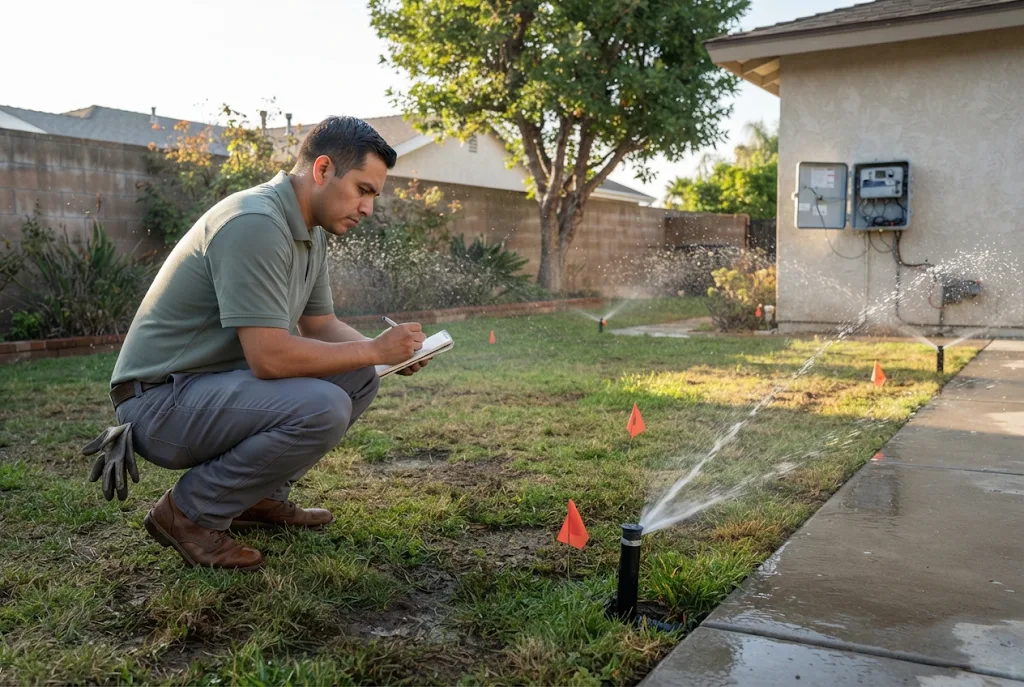
We check what the existing system is actually doing: which valves serve which areas, whether heads are broken, tilted, or spraying onto paving, whether lawn and shrubs share a zone, and how the controller is programmed. Sometimes most of the system can be kept and adapted. Sometimes the layout changes enough that new zones make more sense than patching old ones. Knowing which situation you are in early keeps the estimate realistic.
How Do Front Yard and Backyard Projects Play Out Differently?
The same assessment can lead to very different designs depending on which part of the property is involved. The two scenarios below are hypothetical illustrations, not descriptions of specific completed projects, but they reflect choices Irvine homeowners commonly weigh. Each shows how the purpose of the space changes planting, circulation, irrigation, and the role of lawn.
Scenario one: refreshing a front entry with a defined walkway and layered planting
Picture a front yard with a rectangular lawn running up to the house, a thin row of shrubs against the foundation, and a straight concrete walk from the driveway to the door. The owners want an entry that feels welcoming and finished, and they would like to stop mowing a lawn nobody uses.
Circulation. Front yard landscape design in Irvine often starts with the walk. Widening it, giving it a gentle curve, or adding a small landing at the door changes how a visitor approaches the house. Pavers, poured concrete, and decomposed granite held by a firm edge are all possibilities. If pavers are chosen, the walkway becomes a project component that connects to our paver installation in Irvine work.
Planting. In place of a single row of shrubs against the wall, the design builds depth: low groundcover or small perennials along the walk, mid-height shrubs and grasses behind them, and a few taller plants or a small tree to frame the entry and soften the corners of the house. The foundation bed is widened so plants can reach their mature size without being sheared back every season.
Lawn. Much of the front lawn may give way to planting here. Any turf that remains becomes a deliberate shape that is easy to water evenly and quick to mow, not a leftover strip.
Irrigation. Converting lawn to beds usually means rethinking the zones. Planting beds are often better served by drip, while the remaining lawn keeps its own spray or rotor zone. Heads that used to water the lawn edge may need to be capped or moved so they do not spray the new walk.
Scenario two: renovating a backyard for seating, play, or pets
Now picture a backyard with a small patio slab outside the slider, a large lawn worn bare along the fence, and a few struggling shrubs in narrow beds. The household wants somewhere to sit outdoors in the evening, room for children to play, and a yard that holds up to a dog.
Circulation. Backyard landscape design and installation begins with how people and pets really move. The route from the slider to the seating area, the path to the side gate, and the dog’s favorite loop along the fence all need surfaces that can take the traffic. A strip of durable mulch or decomposed granite where the dog already runs usually works better than trying to keep grass alive there.
Lawn. In this yard, lawn may earn its place. A play lawn sized to how the children actually use it, on its own irrigation zone, can be more practical than any alternative. The aim is a lawn with a job to do rather than a lawn by default.
Planting. Beds move to where they will not be trampled: along the back wall, around the seating area, and into the corners. Plants near the seating area can provide screening or shade, and beds near the play lawn use sturdy plants that shrug off the occasional stray ball. With pets in the household, we talk through plant choices with that in mind and suggest confirming any specific plant concerns with your veterinarian.
Irrigation. The lawn, the beds, and any trees usually belong on separate zones because their water needs differ. If the seating area expands into existing lawn, sprinkler lines in that area may need to be rerouted before any new paving goes down.
Find Out What Your Yard Can Keep Before You Start Over
Healthy trees, established shrubs, and working irrigation zones can often stay. During your estimate visit, we will point out what is worth retaining and how it fits a new layout for your front entry, your backyard, or both.
How Do We Choose Plants for an Irvine Landscape Installation?
We choose plants for the conditions they will live in and the space they will eventually fill, and only then for appearance. A plant that looks right in a nursery container can be the wrong choice if it will outgrow its spot within a few years or needs far more water than the rest of its bed. Four factors drive our recommendations.
Mature size
The most common planting mistake is spacing for the day of installation rather than for maturity. We look at each plant’s expected height and spread and place it so it can reach that size without crowding a walk, a window, or its neighbors. As a result, new beds can look a little sparse for the first season. That is intentional, and mulch covers the open soil while the plants fill in.
Exposure
Full sun, part shade, and deep shade each call for different plants. Reflected heat matters as well: a bed against a sunny wall or beside a driveway can run noticeably hotter than open ground a few feet away. We match plants to the exposure of each individual bed instead of using one palette for the whole yard.
Water needs
Plants vary widely in how much supplemental water they need through a dry summer. Putting plants with similar needs in the same bed, and on the same irrigation zone, is one of the most effective ways to keep a landscape healthy without overwatering any part of it. We return to this in the water-wise section below.
Upkeep
Every plant comes with a maintenance profile: how often it needs pruning, whether it drops heavy litter, whether it has to be cut back each year, and how it behaves if it gets less attention than planned. We ask how much time you or your maintenance provider will realistically spend in the yard, then choose plants that suit that level of care. A plant that needs constant shearing to stay in bounds is usually a sign it was the wrong plant for the space.
How Do Planting Beds, Mulch, Edging, and Turf Fit Together in the Layout?
These four elements give the yard its shape. Beds hold the plants, mulch protects the soil between them, edging keeps each material where it belongs, and turf covers the areas meant for open use. Getting the relationships between them right is what makes a new landscape look settled instead of assembled.
Planting beds
We size beds generously enough for layered planting wherever the space allows, so there is room for low, middle, and taller plants rather than a single row. Bed lines are drawn to be easy to maintain: smooth curves or clean straight runs, not tight wiggles that a mower or edger cannot follow. If your project centers on beds rather than the whole yard, our page on landscape bed design and installation goes further into bed shapes, layering, and plant spacing.
Mulch
A layer of mulch over planting beds helps the soil hold moisture, evens out soil temperature, and cuts down on weed germination. Organic mulches such as shredded bark break down over time and need topping up, and we keep mulch pulled back from plant crowns and tree trunks. Where a bed meets a walk or patio, we also think about how the mulch will stay in place when the irrigation runs and when it rains.
Edging
Edging is the boundary between materials: bed and lawn, lawn and path, mulch and paving. Concrete mow curbs, metal or plastic edging, and a cleanly cut soil edge each carry different trade-offs in cost, appearance, and upkeep. A firm edge between turf and beds is especially useful because it keeps grass from creeping into the planting and gives the mower a clear line to follow.
Turf
When lawn is part of the plan, we shape it on purpose: a defined panel with simple geometry that can be irrigated evenly and mowed easily, placed where it will actually be used. Narrow strips and awkward corners of lawn are hard to water without overspray, and they are often the first areas we suggest converting to planting. Where new turf is included, it goes down after irrigation and soil preparation are complete. Our page on sod installation in Irvine covers lawn replacement as a standalone project.
What Does Water-Wise Landscape Design in Irvine Look Like in Practice?
Water-wise landscape design in Irvine means planning for long, dry summers and rainfall that arrives mostly in the cooler months, so the landscape stays healthy on no more supplemental water than it needs. In practice it is less a particular style than a set of three decisions: how plants are grouped, how water is delivered, and where lawn is kept.
Group plants by water need
When a thirsty plant and a drought-tolerant plant share a bed and a valve, one of them is always watered wrong. Grouping plants with similar needs into the same areas, a practice usually called hydrozoning, lets each irrigation zone be scheduled for the plants it actually serves. The University of California’s WUCOLS database rates landscape plants as high, moderate, low, or very low water use for different regions of the state, and this UC Master Gardener guide to hydrozoning with the WUCOLS plant database explains how to look plants up for your area. We apply the same principle when we assign plants to beds and beds to zones.
Irvine Ranch Water District, which serves Irvine, also publishes landscape guidance and has offered rebate programs for converting lawn to water-efficient planting. Program terms change from time to time, so it is worth checking the district’s current offerings before planning a project around a rebate.
Use drip where it fits
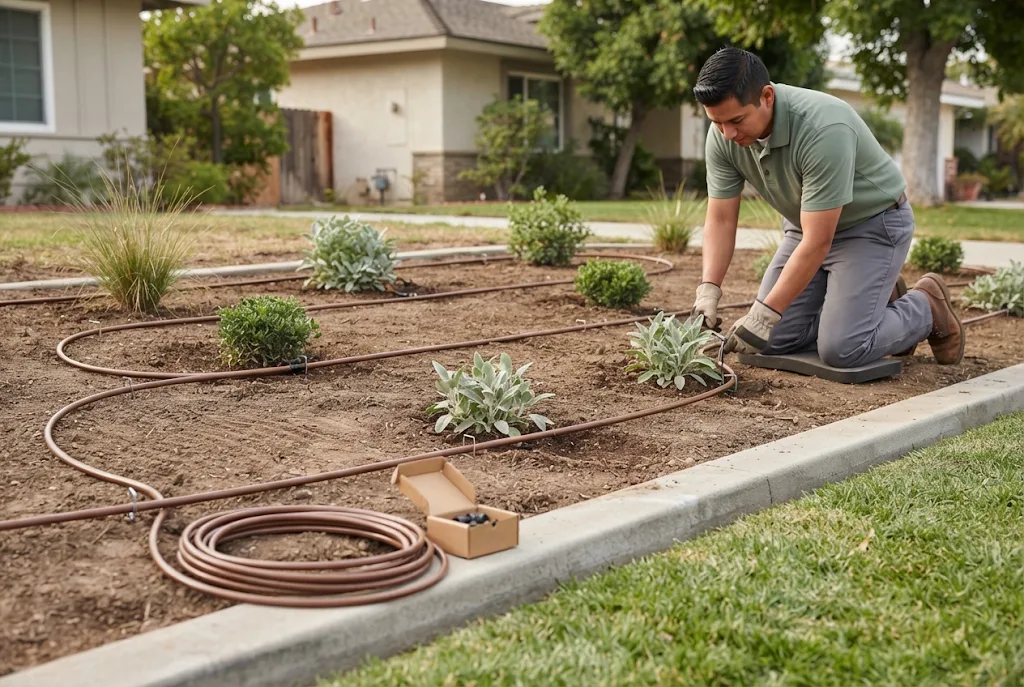
Drip irrigation delivers water slowly to the root zone of each plant, with far less overspray and runoff than spray heads in most planting beds. It is usually a strong fit for shrub, perennial, and groundcover beds, while lawns are generally watered with sprays or rotors. Our page on drip irrigation for planting beds explains the components and how drip zones are laid out.
Keep lawn where it does a job
A water-wise yard does not have to be free of lawn. Turf earns its water where it gets used: a play area, space for a dog, or a small panel that opens up a backyard. What tends to go are decorative strips and front lawns that are rarely walked on. Homeowners weighing that change often begin by replacing an Irvine lawn with water-wise landscaping in the front yard, where turf sees the least use, while keeping a practical lawn out back.
Ready for a Water-Wise Yard That Still Works for Your Household?
Call (888) 601-1117 or request a call back to discuss plant choices, lawn areas, and drip-irrigated beds for your Irvine property. We will answer your questions and help you define the scope for a free estimate.
How Do Grades, Drainage, and Irrigation Routes Shape the Installation Sequence?
Residential landscape installation in Irvine follows an order set mostly by two things: what goes underground, and what fixes a finished height. Anything buried has to go in before something is built or planted on top of it, and anything that sets an elevation, such as a walk or patio, determines how the surrounding soil is graded. A typical sequence looks like this, although every project adjusts it:
- Protect and remove. Trees and plants being kept are protected, buried utility lines are marked through California’s 811 system before digging, and unwanted plants, old turf, and debris are removed.
- Rough grading and drainage. Soil is shaped so water moves away from the house and toward suitable outlets, and any drainage lines are installed.
- Irrigation mainlines and sleeves. Pipe that must cross under future paths or patios goes in now, often inside sleeves so lines can be reached later without breaking paving.
- Hardscape edges and surfaces. Walks, patios, and edging are built, which sets the finished heights the planting areas have to meet.
- Soil preparation and fine grading. Planting areas are loosened, amended where needed, and graded to their final height.
- Zone piping, heads, and drip. Lateral lines, sprinkler heads, and drip tubing are installed and tested.
- Planting, mulch, and sod. Plants go in, beds are mulched, and any sod is laid last so other work does not damage it.
Why grades come first
A bed that ends up higher than the walk beside it will wash mulch and soil across the paving every time the irrigation runs. A lawn graded slightly toward the house can send water toward the foundation. Setting grades before anything is built lets each surface drain in the intended direction and lets beds finish slightly below paving edges, which keeps mulch where it belongs.
Routing irrigation around paving
Where new or rebuilt irrigation has to pass beneath a planned path or patio, the crossing is far easier to handle before the paving goes in than after. Spray and rotor systems for lawns are often installed or reworked as part of a larger landscape project, and our page on sprinkler installation in Irvine covers that work on its own.
Soil preparation before planting and sod
Soil that has been compacted by construction, foot traffic, or years under a lawn often needs to be loosened before anything is planted. Depending on what we find, preparation may include removing rock and debris, ripping or tilling compacted areas, and working in organic amendment where it will help. We avoid working soil while it is saturated, because that can damage its structure. A soil test can be useful when plants have struggled for no obvious reason, and we will tell you when we think one is worthwhile.
Coordinating planting and sod with paved areas
Where planting meets a walk or patio, the finished soil and mulch should sit a little below the paving surface, and sod should be set so its surface finishes level with the adjacent edge. Sprinkler heads near paving are adjusted so they water the turf and beds rather than the concrete. Small details like these are where a coordinated installation shows: clean transitions, no overspray on the paving, and no trip edges.
What Helps Us Prepare an Accurate Landscape Design and Installation Estimate?
The clearer the picture of your property and goals, the more useful the estimate. Our Free Estimates for Landscape Design and Installation Irvine CA projects are built around a defined project scope, and you can help define that scope before we visit or speak with you:
- Photos or approximate dimensions. A few photos of each area and rough measurements of the yard help us understand the scale before the site visit.
- What to keep and what to remove. Note the trees, plants, paving, or features you want to retain, and anything you already know should go.
- How you want to use the space. Seating, play, pets, entertaining, growing food, or simply a front yard that takes less upkeep.
- Access constraints. Gate widths, side-yard clearance, slopes, and anything else that limits how materials can reach the work area.
- Desired features. A new walk or patio, a lawn area of a particular size, or a planting style you have in mind.
- Whether to phase the work. Some owners prefer to finish the whole yard at once; others split it by area or by budget.
Phasing a larger project
Planning a landscape renovation in phases can make a full-yard project easier to manage, but the order matters. Underground work that serves the whole property, such as an irrigation mainline or drainage, is often best completed in the first phase so later phases do not require digging through finished areas. We can lay out the complete design first and then divide the installation into stages that suit your schedule.
HOA and city review
Many Irvine homes are in homeowners associations that review exterior landscape changes, particularly in front yards. Some kinds of work, such as certain walls, structures, or electrical work, may also fall under City of Irvine requirements. What applies depends on your property and the scope of the project, so we recommend confirming the requirements with your HOA and the city before installation is scheduled. We can share the layout and plant list from your design for any submittal you need to prepare.
What Happens After Installation, and How Do You Get Started?
A new landscape needs closer attention in its first months than it will later. At handoff, we walk the yard with you and go over the topics that matter most while the plants and any new sod become established.
Initial watering
New plants have small root balls that dry out faster than the soil around them, so they usually need more frequent watering at first. New sod needs especially consistent moisture until it roots into the soil below. We review how the controller is programmed for each zone and how to adjust it as plants establish and the seasons change.
Establishment care
Through the first season, plan to check soil moisture, watch for stressed plants, keep mulch at a sensible depth, and pull weeds before they set seed. We explain what normal establishment looks like, which signs point to a problem, and when to begin cutting back on watering as roots grow out. If you would like ongoing help, residential landscape maintenance is among our services, and we are happy to talk about it at the estimate.
Your next step
If you are ready to talk about Landscape Design and Installation Irvine CA projects for your front yard, your backyard, or the whole property, send us a few photos and a short description of what you have in mind, or call (888) 601-1117. You can also email info@landscaper-near-me.com or use the Request Call Back button on this page. We will discuss your goals, confirm what the project should include, and arrange your free estimate.
FAQ's - Frequently Asked Questions
Often, yes. Many Irvine neighborhoods have homeowners associations that review exterior landscape changes, especially in front yards, and some walls, structures, or electrical work may also involve city requirements. Check your HOA guidelines and confirm with the city what applies to your property and scope. We can share the layout and plant list from your design for your submittal.
Yes, when they are healthy and suit the new layout. We protect retained trees during the work, avoid heavy grading or trenching in their root zones where we can, and plan the irrigation so established plants are not overwatered by new zones. If we think a plant is unlikely to do well in the new design, we will tell you before work begins.
It depends on the size of the area, how much removal and grading is needed, whether hardscape or new irrigation is included, and how easily materials can reach the yard. A front entry refresh is usually a much shorter project than a full-yard renovation. Design decisions, any HOA review, and material availability also affect the start date. We give you a realistic schedule with your estimate.
Yes, and many homeowners do. We recommend designing the whole property first so the phases fit together, then handling shared underground work, such as an irrigation mainline or drainage that serves both areas, early on so the second phase does not disturb the first.
No. A water-wise landscape keeps lawn where it serves a purpose, such as a play area or space for a pet, and gives it its own irrigation zone. Lawn that is rarely used, especially narrow strips and little-used front lawns, is usually the better candidate for low-water planting on drip.
Parts of it often can, such as the valves, controller, or mainline, if they are in good condition. A new layout may still call for rezoning, capping heads that watered former lawn, converting beds to drip, or adding zones. We check the system during the site assessment and explain what can stay and what should change.
Irvine’s mild climate allows planting through much of the year, but fall is often a favorable time for shrubs, perennials, and California native plants because cooler weather and seasonal rain help roots establish before summer. Summer planting is possible with careful watering. Warm-season sod generally establishes best when temperatures are warm.
Often, yes. On a slope, we look first at erosion, runoff, and access. Deep-rooted groundcovers and shrubs, mulch, and low-precipitation or drip irrigation all help hold soil and reduce runoff. Where a slope needs to be terraced to create flat, usable space, retaining walls may be needed, and depending on height and conditions, engineering review or permits may apply.