
Residential Landscaping vs Commercial Landscaping: What's the Difference?
A backyard in Downey and the entrance to a retail center in Cerritos may share the same turf, the same drip emitters and even the same species of shrub. Yet the way each landscape is planned, scheduled, maintained and budgeted can look very different. That gap is what the Residential Landscaping vs Commercial Landscaping comparison is really about. It isn’t a question of which category is “better.” It’s about which set of priorities fits the property in front of you.
On a home, landscaping usually serves the people who live there: their privacy, their weekend routines, the look of the street-facing yard. On a business or managed property, the landscape also has to support customers, tenants, employees and visitors, and the people who make decisions about it are often property managers or HOA boards rather than the end users. Below, we walk through how residential vs commercial landscaping differs in design, maintenance, irrigation, cost factors, contracts and safety, so homeowners and property managers alike can make a well-informed decision before requesting an estimate.
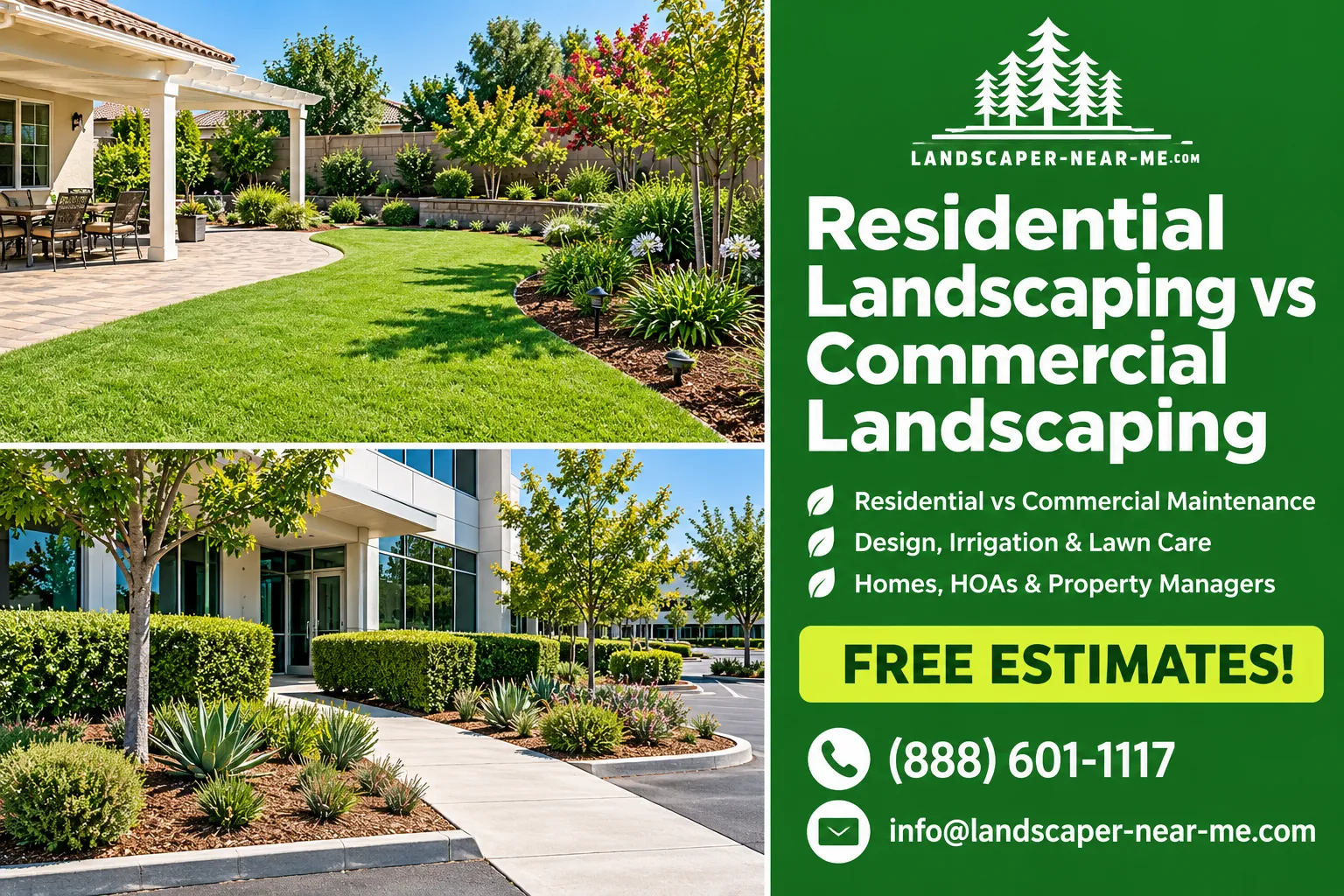
Planning a Home or Business Landscape? Get a Free Estimate
Whether you’re improving a backyard or managing landscaping for a commercial property, we’ll look at your site, talk through your goals and give you a free estimate based on your property’s actual needs. Call (888) 601-1117 or email info@landscaper-near-me.com.
What Is the Difference Between Residential and Commercial Landscaping?
The core difference between residential and commercial landscaping is who the landscape serves and how decisions about it get made. Residential landscaping covers the planning, installation, improvement and upkeep of outdoor spaces at private homes. Those choices are mostly shaped by the homeowner’s preferences, comfort, budget and how the family actually uses the yard. Commercial landscaping applies similar horticultural practices to offices, retail centers, business parks, multifamily communities and other managed properties. On those sites, consistent appearance, safe circulation and dependable upkeep often carry as much weight as aesthetics.
Residential property landscaping: built around personal use
Residential property landscaping tends to be personal. A homeowner might want a vegetable bed beside the patio, a lawn the kids can play on, a hedge that blocks the neighbor’s second-story window, or a front yard that improves curb appeal before a sale. The person paying for the work usually lives with the result every day and can make decisions quickly. Our Landscape Services page outlines the range of residential landscaping services homeowners typically consider, from planting and lawn care to renovations.
Commercial property landscaping: built around shared use and operations
Commercial property landscaping serves a broader audience. A shopping center’s planters need to look orderly for thousands of shoppers. An office park’s lawn and walkways need to stay usable during business hours. An apartment community’s common areas need to work for dozens of households at once. Decisions often pass through a property manager, facility manager, owner group or HOA board, and work may have to follow budgets, approval steps and documentation. If you want a deeper overview of the commercial side specifically, see What Is Commercial Landscaping?
Where the two categories overlap
Commercial vs residential landscaping is not a contest between different crafts. Mowing, pruning, mulching, irrigation repair, soil preparation and plant selection follow the same horticultural principles regardless of who owns the property. Multifamily buildings and HOA-managed neighborhoods also blur the line: they’re residential in purpose but are often managed like commercial accounts. When people compare landscaping for homes vs businesses, the useful distinction is less about labels and more about scale, decision-making, scheduling and service expectations.
Residential Landscaping vs Commercial Landscaping: A Side-by-Side Comparison
The table below summarizes the most common differences between residential and commercial landscaping. Treat it as a set of typical tendencies rather than fixed rules. A large estate may have more complex needs than a small professional office, and a single-tenant commercial building may be simpler to maintain than a sprawling hillside home.
| Comparison Factor | Residential Landscaping | Commercial Landscaping |
|---|---|---|
| Property types | Single-family homes, private yards and gardens | Offices, retail and shopping centers, business parks, mixed-use developments, multifamily properties, HOA common areas |
| Primary objectives | Personal enjoyment, privacy, comfort, curb appeal, outdoor living | Consistent appearance, welcoming entrances, functional circulation, tenant and customer experience |
| Design priorities | Reflects owner taste; patios, gardens, play and entertaining areas | Durable, uniform plantings; clear sightlines; low-disruption maintenance planning |
| Project size and complexity | Usually one site with a few landscaped zones | Often multiple landscaped areas, parking islands, entries and perimeter strips, though not always larger |
| Lawn and planting maintenance | Scheduled around the household’s preferences and budget | Scheduled to keep a consistent standard across the whole property |
| Irrigation management | Fewer zones; homeowner may adjust the controller | Often more zones and plant types; changes typically coordinated with management |
| Scheduling | Flexible; often weekday visits while owners are at work | Timed to reduce disruption to customers, employees and tenants |
| Safety and accessibility | Safe walkways, yard usability, family and pet use | Clear pedestrian routes, visibility at entries and driveways, parking-area upkeep |
| Service agreements | One-time projects or simple recurring service | Written scope of work, reporting and review periods are common |
| Budgeting and cost factors | Set by the homeowner; one-time improvements are common | Often tied to annual operating budgets and approved scopes |
| Owner or manager involvement | Homeowner decides directly | Property manager, facility manager, owner group or HOA board approves work |
The pattern that comes out of this residential landscaping compared to commercial landscaping view is straightforward: the horticulture is similar, while the management layer around it changes. The rest of this article looks at each factor in more detail.
How Property Use Shapes Residential and Commercial Landscape Design
Residential landscape design vs commercial landscape design comes down to a single question: who is the space for, and what do they need it to do? A family yard is designed around a household’s daily life. A commercial landscape is designed around how many different people arrive, move through and use the property, and how reliably it can be maintained.
Lawns, planting beds, trees and shrubs
At home, lawn size and planting-bed layout often follow lifestyle. Some homeowners want open turf for kids and pets. Others prefer to replace thirsty grass with planting beds, groundcovers or gravel. Trees are usually chosen for shade, privacy or ornamental value. On commercial property, beds and lawns are typically laid out for uniformity and easy access by maintenance crews. Shrubs near entrances, parking areas and signs are often selected and placed so they can be kept at a height that doesn’t block views.
Mulch, groundcover and low-maintenance planning
Mulch and groundcovers help both categories suppress weeds, hold soil moisture and give beds a finished appearance. Homeowners may choose mulch types based on color or texture. Commercial sites often favor durable materials that hold up to foot traffic and wind and that can be replenished consistently across many beds. Low-maintenance landscape planning matters in both cases. For a homeowner, it may mean less weekend work. For a property manager, it can mean fewer service hours and more predictable upkeep over the life of a contract.
Walkways, entrances and gathering areas
Hardscape plays a different role depending on the property. Residential projects often focus on patios, garden paths and outdoor living spaces where the family gathers. Commercial projects tend to emphasize walkways that guide visitors from parking to the front door, plazas or seating areas for employees and tenants, and entry features that make a property easy to find. Our Hardscape Services page covers the paving, walls and other hardscape features that often anchor these designs.
In both settings, design choices made at the start shape maintenance requirements for years afterward. That’s why we encourage owners and managers to think about long-term upkeep while a design is still on paper.
Match Your Maintenance Plan and Irrigation to Your Property
Design choices made today shape mowing, bed care and irrigation needs for years. Whether you have a single-family yard or a multi-zone commercial site, let’s review how your property is used and build a maintenance plan that fits it.
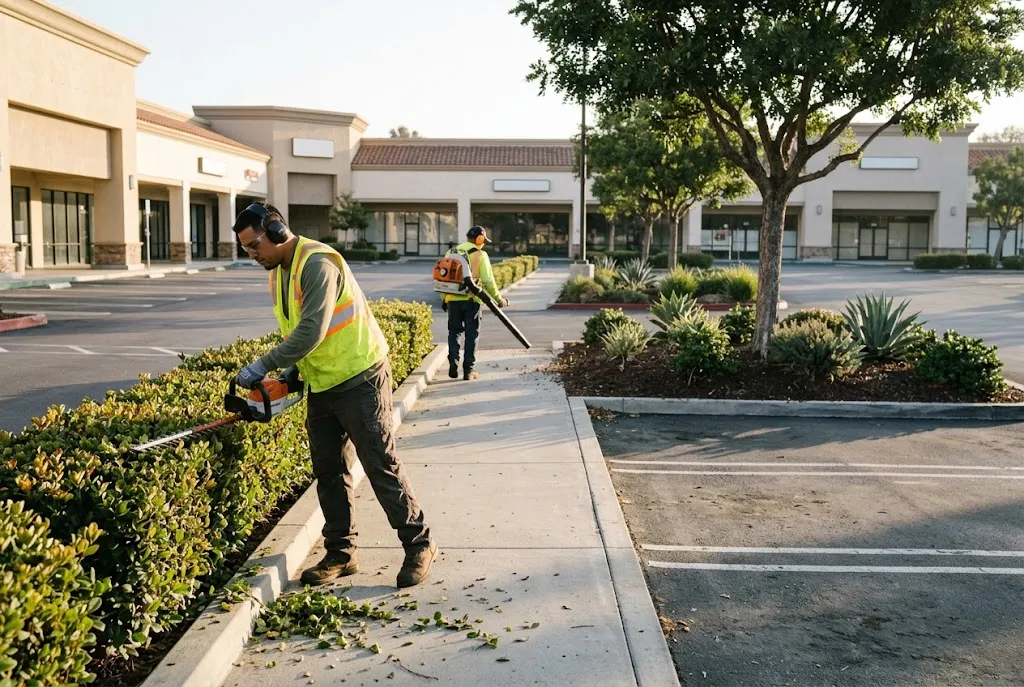
Residential vs Commercial Landscape Maintenance: Schedules, Tasks and Coordination
Most routine landscape maintenance tasks are the same on a home and a business property. What differs is how often they happen, when they happen and how the work is coordinated with the people who use the site. In residential vs commercial landscape maintenance, the biggest variable is usually the level of consistency the property owner expects, not the type of work.
Routine tasks both property types share
Regular maintenance on either type of property typically includes:
- Lawn mowing and edging to keep turf at an appropriate height and borders clean
- Shrub trimming and pruning for shape, plant health and clearance
- Weed control in lawns, beds and hardscape joints
- Planting bed maintenance, including replacing failed plants and cultivating soil
- Mulch replenishment as material breaks down or washes away
- Irrigation inspections to catch broken heads, clogged emitters and leaks
- Seasonal cleanup of leaves, debris and spent annuals
- Tree care coordination, often handled through specialized services such as Tree Trimming Services
- Landscape condition monitoring so small problems are noticed before they spread
How often each task is needed depends on plant types, turf variety, soil, irrigation, usage, the season, our Southern California climate and the service scope you agree on. There’s no universal mowing or pruning interval that fits every property.
Residential landscaping maintenance requirements
Residential landscaping maintenance requirements are usually set by the homeowner. One family may want weekly lawn service. Another may want a monthly visit for bed care and pruning and handle the mowing themselves. Newly installed turf calls for its own short-term routine, which we cover in detail on our Sod Care page. Residential vs commercial lawn care differs mainly in flexibility: a homeowner can shift a visit or skip a week, and the only people affected are the household.
Commercial landscaping maintenance requirements
Commercial landscaping maintenance requirements tend to be more structured. A property manager may need every bed, parking island and lawn panel kept to the same standard so the site looks consistent from any entrance. Crews often have to work around business hours, deliveries, tenant move-ins and customer traffic, and noisy equipment may need to run at times that cause the least disruption. Our Commercial Lawn Care Services page explains how turf care fits into that kind of schedule.
Retail properties are a good example. Planters, entrances and parking-lot islands are seen by shoppers every day, and maintenance crews have to share space with vehicles and pedestrians. Our page on Shopping Center Landscape Maintenance covers those specific challenges in more depth.
Does Project Size Make Commercial Landscaping More Complex?
Sometimes, but not always. Project complexity depends on the property’s layout, features, access and site conditions much more than on whether it’s classified as residential or commercial. A small professional building with a single lawn panel and a few shrub beds may be simpler than a hillside home with retaining walls, terraced planting and a multi-zone irrigation system.
A typical residential yard improvement
Picture a homeowner replacing a tired front lawn with a water-wise planting design, a new walkway and drip irrigation. The work happens on one parcel, usually with one decision-maker. Access is through a side gate or driveway, and equipment size may be limited by narrow side yards. The scope is clearly bounded, and once installation is finished, maintenance is generally simple.
A typical commercial site project
Now picture landscape improvements across a shopping center, office property or multifamily development. There may be dozens of separate landscaped areas: entry monuments, parking islands, perimeter strips, courtyards and slopes. Each may have different sun exposure, soil and plant needs. Work might need to be phased around open storefronts or occupied units, and crews may have to coordinate with property management, security and other vendors.
Factors that drive complexity on either property
Whether a site is a home or a business, these factors usually have the biggest effect on landscaping complexity:
- The number and size of landscaped areas
- Access limitations such as gates, slopes, parking lots or restricted hours
- Equipment that fits the site and the scope of work
- Site coordination with residents, tenants or other contractors
- The number of irrigation zones and controllers
- Planting requirements, including soil preparation and plant spacing
- Who handles ongoing maintenance responsibilities after installation
When it comes to residential and commercial landscape installation, those factors shape scheduling and staffing far more than the property label does.
Are Commercial Irrigation Systems Different from Residential Irrigation Systems?
Residential and commercial irrigation systems use the same basic components: sprinkler heads, drip emitters, valves, controllers and backflow devices. The difference is usually scale and coordination. A commercial property may have more zones, more controllers, more plant types and more people who need to know when watering happens. A home system is often smaller and managed directly by the owner.
Sprinkler and drip irrigation
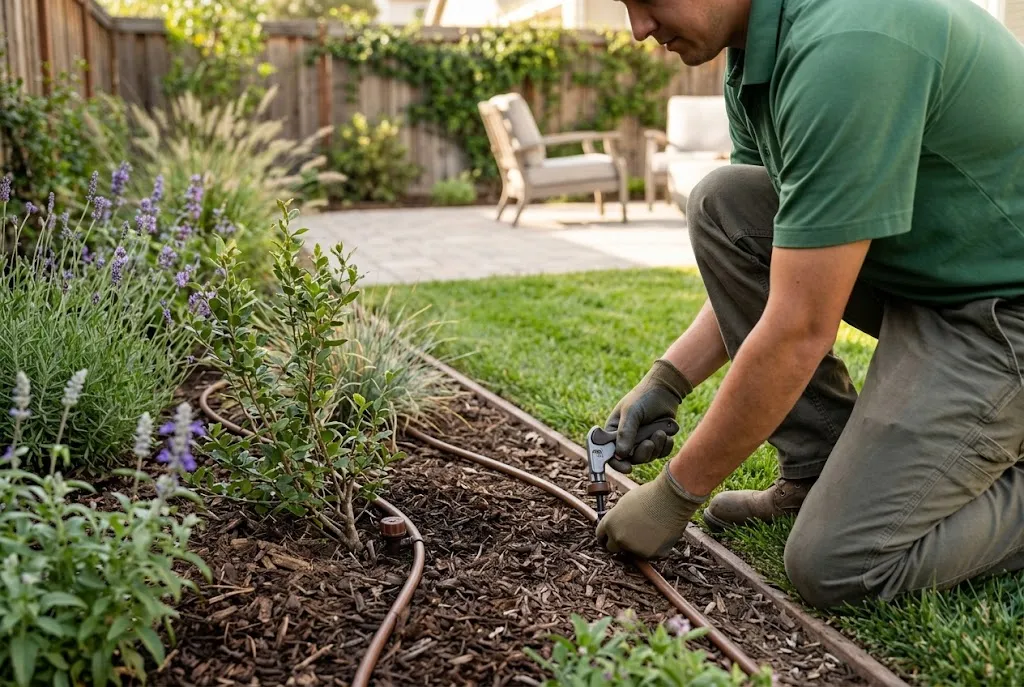
Both property types commonly combine spray or rotor sprinklers for turf with drip irrigation for shrubs, trees and planting beds. Drip delivers water near the root zone, which can reduce overspray onto walkways, buildings and parking areas. That’s an especially practical benefit on commercial sites, where overspray can affect pedestrians and pavement.
Zoning, controller programming and plant-specific watering
Good irrigation design groups plants with similar water needs into the same zone, so lawns, shrubs and trees each get appropriate watering. On a home, that may mean a handful of zones on one controller. On larger or more varied commercial properties, it can mean many zones spread across multiple controllers. Each needs to be programmed for sun exposure, slope, soil and plant type. Coordinating those zones is a meaningful part of commercial landscaping maintenance.
Inspections, adjustments and leak repair
Regular inspections catch broken heads, misaligned spray patterns, clogged filters and leaks before they waste water or damage plants. Controllers also need seasonal adjustment as temperatures change. The EPA WaterSense watering tips offer helpful guidance on watering efficiently, regularly checking irrigation systems and considering weather-based controllers. Our Irrigation Services page explains the repair and installation work we provide, and property managers can find details on larger systems on our Commercial Irrigation Services page.
Water management in Southern California
Southern California’s summers are generally warm and dry, so water-efficient landscape planning matters for both homes and businesses. That can include choosing plants suited to the local climate, reducing turf in areas where it isn’t used, converting suitable beds to drip, mulching to hold soil moisture and considering drought-tolerant alternatives. Watering rules can vary by city and water supplier and may change over time, so we recommend that owners and managers check current local guidance before setting or changing irrigation schedules.
Talk With Our Team About the Right Landscaping Fit
Homeowners, property managers and HOA representatives can call (888) 601-1117, email info@landscaper-near-me.com or request a callback. We’ll answer your questions and help you choose the services that make sense for your property.
Is Commercial Landscaping More Expensive Than Residential Landscaping?
Not necessarily. Commercial landscaping doesn’t automatically cost more per square foot, and residential work isn’t automatically less expensive. Residential vs commercial landscaping costs depend on what the property needs and what the service scope includes, so two estimates for “landscape maintenance” can describe very different amounts of work.
Factors that influence landscaping estimates
Whether you’re pricing a home project or a commercial account, these factors usually affect the estimate:
- Property size and the amount of turf, planting beds and hardscape
- Landscape condition, since overgrown or neglected sites need more initial work
- Maintenance frequency, such as weekly, biweekly or monthly visits
- Labor requirements for the tasks included in the scope
- Equipment needs, including access for mowers, trucks or lifts
- Irrigation complexity, such as the number of zones, controllers and repairs
- Planting and material selections, from plant sizes to mulch and stone
- Site accessibility, including gates, slopes and parking-lot logistics
- One-time improvements versus recurring maintenance
- Contract scope and service expectations, including reporting or after-hours work
Why per-property estimates beat general pricing
A homeowner with a small, well-kept yard may pay relatively little for a monthly visit. The same homeowner planning a full backyard renovation could spend more on that one project than a small office pays for a year of routine maintenance. On the commercial side, a large site with efficient layouts and good access may be less expensive to maintain per area than a smaller site with tight access and many detailed beds. Because of these variables, a property-specific estimate based on an on-site evaluation gives you a much more useful comparison than generalized price ranges.
How Landscaping Contracts, Scheduling and Site Safety Differ
Landscaping service contracts vary a lot between homes and managed properties. Residential agreements tend to be simple and flexible. Commercial landscaping contracts vs residential contracts often involve more detail about scope, scheduling, communication and documentation, although no single contract structure applies to every commercial property.
One-time requests versus recurring maintenance
Homeowners often start with a one-time service, such as a cleanup, a planting project or an irrigation repair, and then decide whether they want ongoing care. Commercial properties more often begin with a recurring maintenance agreement that defines what will be done, how often and to what standard. Both arrangements can work well when the scope is clear.
Scope of work, communication and documentation
A clear scope-of-work description helps everyone. It might list mowing, edging, pruning, weed control, mulching, irrigation checks and seasonal cleanup, along with how often each is included. On commercial accounts, agreements may also cover who the crew reports to, how extra work is approved, how property access is handled, what service documentation is provided and when the contract will be reviewed or renewed. Seasonal adjustments, such as changing visit frequency during slower growing months, are worth discussing up front on any property. For more on how we structure work for managed properties, visit our Commercial Landscape Services page.
Landscape maintenance scheduling
Landscape maintenance scheduling is often where the two categories feel most different. At a home, visits can usually happen any weekday. At an office building, a retail center or an apartment community, crews may need to avoid peak traffic, quiet hours or events and work in sections so the property stays open and usable.
Safety, accessibility and property use
Property use also shapes safety priorities. On a residential property, we pay attention to:
- Walkways free of trip hazards and overgrowth
- Yard areas that stay usable for the household
- Tree and shrub clearance around the house, roof and paths
- Privacy screening that stays healthy and controlled
- Plant and material choices that suit family and pet use
On commercial sites, commercial landscaping safety and accessibility considerations typically include:
- Clear pedestrian routes from parking to entrances
- Visibility near entrances, driveways and signs
- Landscape maintenance around parking areas and drive aisles
- Unobstructed customer and tenant access
- Tree and shrub clearance over walkways and vehicle areas
- Work planning that reduces disruption and keeps crews and equipment away from foot traffic
Specific accessibility or safety obligations depend on the property and applicable rules, so owners and managers should confirm requirements with the appropriate professionals. Our role is to keep the landscape from working against safe, comfortable access.
Choosing the Right Landscaping Services for Your Home or Business Property
Choosing residential or commercial landscaping services starts with the property, not the label. The best fit depends on what you need done, how the site is used and how much coordination the work will require.
Can the same landscaping company handle both?
Some landscaping companies serve both homes and commercial properties, while others focus on one category. Neither approach is automatically better. What matters is whether a provider’s experience and capacity match your site. When you compare providers, consider:
- Relevant project experience with properties like yours
- Equipment and staffing suited to the size and layout of the site
- Property size capabilities, especially for multi-area commercial sites
- Maintenance scheduling that works around your residents, tenants or customers
- Service documentation, such as visit records or reports, if you need them
- Landscape installation experience if improvements are planned
- Commercial property coordination with managers, boards and other vendors
Landscaper-Near-Me.com provides landscaping services for homeowners and property managers alike. We still encourage every homeowner and property manager to confirm that a provider’s services and qualifications fit their specific property.
Practical steps for homeowners and property managers
Before requesting estimates, it helps to:
- Identify your property-specific landscaping goals.
- Decide whether you need installation, ongoing maintenance or both.
- Note the current condition of lawns, beds, trees and irrigation.
- Consider how often you want maintenance visits.
- Review irrigation needs and any known problems.
- Identify access limits and scheduling constraints.
- Ask for a clearly defined service scope in writing.
- Compare estimates based on included work, not just the total.
- Verify relevant qualifications where appropriate for the work.
Southern California considerations for every property
In our service territory across Southeast Los Angeles County and Orange County, warm and dry summers make thoughtful plant selection, irrigation management and turf care important for homes and businesses alike. Drought-tolerant plantings, efficient irrigation and seasonal upkeep can help any landscape stay healthy while using water carefully. Individual site conditions and current local watering restrictions should be reviewed before choosing methods or plant palettes.
Taking the next step
In the end, the residential landscaping vs commercial landscaping question is really about fit: the right scope, schedule and level of coordination for the property you own or manage. Whether you’re a homeowner planning a backyard refresh, a property manager overseeing a retail center or an HOA representative responsible for shared landscaping, we’re glad to talk through your goals. Call us at (888) 601-1117, email info@landscaper-near-me.com or request a free estimate, and we’ll help you find the landscaping approach that suits your property.
FAQ's - Frequently Asked Questions
HOA common areas serve residential communities, but they’re usually managed more like commercial accounts. A board or management company approves the work, maintenance follows a defined scope and schedules have to account for many residents. We treat them as residential in purpose and commercial in management.
Apartment and condominium properties are home to residents, yet their landscaping is typically handled as a commercial service. A property manager oversees it, crews maintain shared spaces and work is scheduled around occupied units, parking and resident foot traffic.
Commercial landscaping commonly includes lawn care, shrub and hedge pruning, weed control, bed maintenance, mulch replenishment, irrigation inspection and repair, seasonal cleanup and coordination of tree care. Some properties also add plant installation, renovations or water-saving upgrades. The exact list depends on the agreed scope of work.
A commercial landscape is often the first thing customers, tenants and visitors see. Consistent maintenance keeps entrances inviting, walkways and sightlines clear and plants healthy, and it helps catch irrigation problems early. That supports both the property’s appearance and its everyday function.
Often, yes. Many providers that work on commercial properties also serve homeowners, but not all do. Ask whether the company takes residential projects of your size and whether its scheduling, equipment and service options suit a private yard.
It can be. Climate-appropriate plants, reduced turf in low-use areas, drip irrigation and mulch can lower water use on a backyard or an office campus. The best approach depends on sun exposure, soil, how the space is used and current local watering guidance.
It helps to share the property type and approximate size, the services you want, how often you’d like maintenance, any irrigation issues you’ve noticed and any access or scheduling limits. Photos are useful too. We’ll confirm details during a site evaluation before giving you a free estimate.
Usually it should. Plant growth, turf needs and irrigation demand shift through the year, so visit frequency, pruning timing and controller settings are often adjusted between warmer and cooler months. The right changes depend on the plants, the property and the agreed service scope.