
Commercial Landscaping Newport Beach
for Coastal Commercial Properties
A commercial property in Newport Beach is looked at constantly. Tenants walk the entry every morning, visitors form an opinion before they reach the lobby, and board members drive past the same planters every weekend. That level of visibility is why commercial landscaping Newport Beach property managers depend on has to be steady, scheduled, and handled without reminders.
Landscaper-Near-Me.com provides commercial landscape maintenance throughout Orange County and Southeast Los Angeles County, and Newport Beach sits well inside that established service area. We work with property managers, facility managers, HOA and community association boards, multifamily owners, and the people responsible for office, retail, and hospitality properties who need grounds care that arrives on schedule and leaves the site looking finished.
The sections below cover what a commercial landscaping program actually includes here, how coastal conditions shape the maintenance calendar, and what the day-to-day service relationship looks like once a property is on a regular rotation. Estimates are free, and a walkthrough is usually the fastest way to get a straight answer about your site.

Get a Free Estimate for Your Newport Beach Commercial Property
Walk the site with us and get a written estimate at no cost. We will look at the turf, plant material, trees, and irrigation, then put a realistic scope in front of you. Call (888) 601-1117 or email info@landscaper-near-me.com to set up a time.
What a Commercial Landscaping Newport Beach Service Program Covers
A commercial program is an ongoing maintenance agreement rather than a one-time project. The commercial landscaping services Newport Beach properties actually need fall into two groups: routine grounds care that happens on every visit, and specialty work that only comes up a few times a year. Handled on one schedule, the site stays consistent instead of swinging between overgrown and freshly cleaned up.
The recurring portion of the schedule generally includes:
- Mowing, edging, and line trimming of all turf areas
- Blowing and cleanup of walkways, entries, drive aisles, and parking areas
- Shrub and hedge shaping, along with removal of spent or damaged growth
- Weed management in turf, planting beds, and hardscape joints
- Irrigation checks, sprinkler adjustment, and repair of broken components
- Fertilization and soil care on a seasonal cycle
- Debris removal and haul-away after every visit
Around that core we schedule the work that happens less often: tree trimming, mulch replenishment, plant and shrub replacement, sod repair, seasonal color changes, and larger renovations when a property is ready to update its appearance. Our Commercial Landscape Services page describes the full range of work we handle across the territory; this page narrows that down to the way those services apply to commercial property landscaping Newport Beach owners and managers are responsible for every month.
What holds it together is the schedule itself. Commercial grounds maintenance works when the same crew arrives on the same day, knows where the irrigation shutoff is, and notices the rotor that stopped turning before anyone in the office does.
How Coastal Conditions Change the Maintenance Calendar Here
Newport Beach landscapes are maintained in a mild, dry-summer climate where most rainfall arrives between late fall and early spring. Plants rarely stop growing outright, so the mowing and pruning calendar runs closer to year-round than it does in colder regions. The upside is a landscape that can look good in January. The downside is that a neglected property declines quickly and visibly.
Being close to the water adds a few specific pressures worth planning around:
- Salt-laden air and steady wind. Exposed sites near the Balboa Peninsula and along the coastline tend to show more leaf burn and faster wear on plantings than properties a few miles inland. Salt-tolerant material generally holds up better in entries, parking islands, and other windward positions.
- Marine layer mornings. Overcast, humid mornings through late spring and early summer keep foliage wet longer, which can encourage fungal issues in dense hedges and shaded turf. Thinning growth for airflow usually does more good than reaching for a spray.
- Soil that varies by the mile. Sites closer to the sand drain fast and lose nutrients quickly, while bluff and inland properties often sit on heavier soil that holds water far longer. Two properties a short drive apart can need noticeably different irrigation run times.
- Constant visibility. Commercial corridors around Fashion Island, Newport Center, Corona del Mar, and Newport Coast carry high traffic and high expectations. A ragged bed edge or one dead plant in an entry planter gets noticed here in a way it might not elsewhere.
None of this calls for exotic maintenance. It calls for a plan built around the specific site instead of a generic route stop, which is the main reason Newport Beach commercial landscaping is worth walking before anyone quotes a price.
Matching the Program to the Property Type
Commercial is a broad word. A 12-building apartment community and a single-tenant office building both need dependable grounds care, but almost nothing about their schedules looks the same. We build the scope around how the property is used and who is judging it.
HOAs and Community Associations
Association work carries an extra layer: the people paying for the service also live with it. HOA landscaping in Newport Beach usually means common-area turf, entry monuments, slopes, greenbelts, and streetscape trees, all of it visible to residents daily. Boards typically care about consistency, clear communication before disruptive work, and having someone who can speak plainly at a meeting about why a slope is thinning or what a replanting would involve.
Multifamily and Apartment Communities
Multifamily properties are graded during leasing tours. Entry drives, leasing office frontage, pool surrounds, and courtyard plantings carry most of the weight, and turnover means the site is being seen by new prospects every week. Trash-area screening and clear sightlines along walkways matter more than they do on other property types.
Office and Professional Properties
Office landscapes are usually judged on order rather than lushness. Clean lines, healthy turf panels, tidy planter beds, and unobstructed walkways read as a well-run building. Scheduling around tenant hours matters here, and early-morning service is often the least disruptive option.
Retail Centers and Shopping Properties
Retail properties are dominated by parking fields, islands, and pad sites. The recurring issues are trees outgrowing their islands, sightline conflicts with tenant signage, irrigation damage from vehicles, and litter accumulating in bed areas. Retail also runs on seasonal timing, and grounds work usually needs to stay out of the way during peak shopping periods.
Hospitality and Guest-Facing Properties
Hotels, restaurants, and event properties have the least tolerance for visible maintenance activity and the highest expectation of polish. Work windows tend to be narrow, detail standards are higher, and entries, pool areas, and outdoor dining surrounds get attention on nearly every visit.
Across all five, property management landscaping in Newport Beach comes down to the same thing: one point of contact who knows the site, a schedule that holds, and issues reported before they become complaints.
Have Your Irrigation System Checked Before the Next Water Bill
Broken heads, failed valves, and outdated controller programming waste water quietly for months. Ask us to run every station on your property and report what we find. Reach us at (888) 601-1117 or info@landscaper-near-me.com.
Turf and Groundcover: The First Thing Anyone Notices
Turf is the most demanding element on most commercial sites and the one people evaluate first. Commercial lawn care in Newport Beach generally works with two categories of grass, and the difference drives the whole schedule.
Cool-season turf, most often tall fescue, stays green through winter and gives properties a consistent year-round look, but it uses more water through the dry months and thins out under heat and heavy foot traffic. Warm-season turf such as bermuda or St. Augustine handles heat and traffic better and uses less water in summer, but it slows down and loses color in the cool season. Neither one is the right answer everywhere. A shaded courtyard and a full-sun parking median are different problems.
Once the grass type is settled, the routine work matters more than any product:
- Mowing height and frequency. Cutting too short is the most common cause of thin, stressed commercial turf. Fescue is commonly maintained on the taller side to shade its own root zone, while bermuda is kept lower and cut more often during active growth.
- Sharp equipment. Dull blades tear rather than cut, and torn leaf tips brown out within a day or two. It is one of the clearer differences between a maintained lawn and a mowed one.
- Edging and definition. Crisp edges along walks, curbs, and beds do more for perceived quality than almost anything else on the property.
- Fertilization on a cycle. Feeding is timed to the growth pattern of the grass rather than the calendar quarter, and rates are kept moderate to avoid pushing soft growth that invites disease.
- Aeration and thatch management. Compacted turf in high-traffic areas stops taking water no matter how long the irrigation runs.
When an area has declined past the point where maintenance will bring it back, replacement is usually cheaper than another year of patching. Our Commercial Lawn Care Services page covers the ongoing side of turf care, and our Sod Care resource explains what new sod needs during establishment, which is the stretch where most commercial installations succeed or fail.
Irrigation Management and Responsible Water Use
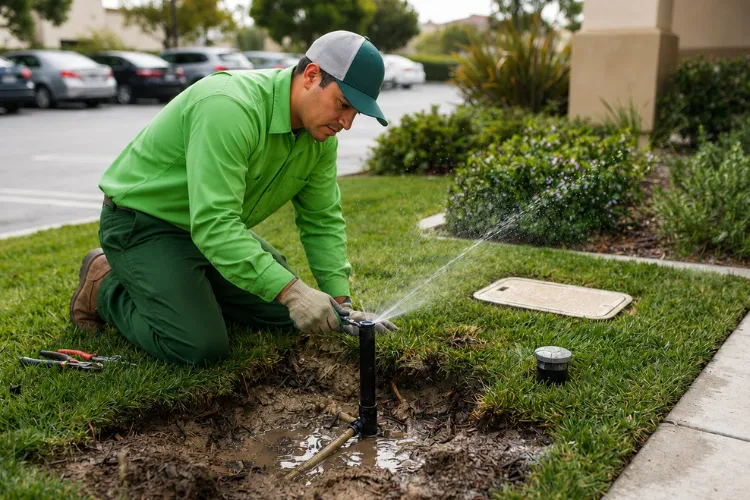
Irrigation is where commercial landscapes quietly lose the most money and the most plant material. A broken head on a residential lawn is obvious. A broken head on a 40-station commercial system running at 4:00 a.m. can go unnoticed for weeks while it floods a walkway and starves the zone beside it.
Commercial irrigation services in Newport Beach start with knowing what is actually installed. On a first visit we typically walk the controller, run each station, and note what we find:
- Heads that are broken, sunken, tilted, blocked by growth, or spraying pavement
- Mismatched heads within a single zone, which guarantees some areas are overwatered while others stay dry
- Pressure problems, including misting at the nozzle from high pressure and weak throw from low pressure
- Leaks at valves, laterals, and fittings, along with valves that fail to close fully
- Controller programming that no longer matches the season, the plant material, or the current use of the property
From there the work is ordinary and unglamorous: commercial sprinkler repair and adjustment, nozzle changes to even out coverage, converting shrub beds to drip where spray never made sense, and seasonal controller adjustments so run times track actual demand instead of staying on a summer program in February. Weather-based controllers can help on larger sites, though they still need someone to check them.
Water efficiency is a practical concern in Southern California, and it is also a regulated one for certain projects. California’s Model Water Efficient Landscape Ordinance published by the Department of Water Resources sets statewide standards that local agencies apply to qualifying new and rehabilitated landscape projects. We do not promise a specific reduction in your water bill, and requirements for any particular project should be confirmed with the city and your water provider. What we can do is keep the system delivering water where it is supposed to go, which is where most of the waste is. Our Irrigation Services page goes further into repair, installation, and system design.
Trees, Palms, and Shrubs: Managing the Vertical Layer
Turf gets the attention, but trees create the liability and the long-term value. Commercial tree trimming in Newport Beach is mostly about clearance, structure, and timing.
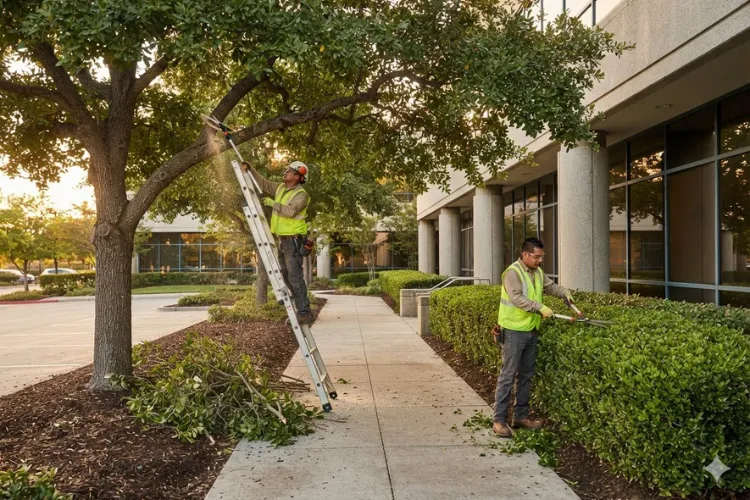
Clearance work keeps limbs off buildings and roof lines, maintains headroom over walkways and drive aisles, keeps growth out of light fixtures and security cameras, and stops canopies from swallowing tenant signage. On retail and office sites this is the pruning that gets requested most, usually right after someone in a delivery truck finds the low branch.
Structural pruning is the less visible half of the job. Removing dead, crossing, and weakly attached limbs while a tree is still young shapes how it grows for decades and reduces the chance of failure later. Two practices worth avoiding on any commercial property: topping, which forces weak regrowth and permanently damages tree structure, and over-thinning interior growth, which leaves long bare limbs with heavy ends that are more likely to break in wind.
Palms are their own category and are common throughout Newport Beach. Routine palm maintenance means removing dead fronds and seed stalks, not stripping the canopy back to a narrow tuft. Over-pruned palms are slower to recover and more vulnerable to wind and pest pressure.
Shrubs and hedges fill the space between. Shearing everything into blocks on a fixed rotation eventually hollows out the interior of most plants, so we mix shearing with selective hand pruning to keep hedges dense and to let flowering shrubs actually flower. Overgrown foundation plantings also get reduced rather than simply squared off, since covered windows and blocked walkway lighting create their own problems. Larger removals, elevated work, and detailed canopy care are covered on our Tree Service Near Me page.
Ready to Hand Off Your Grounds Maintenance Schedule?
One crew, one point of contact, and a schedule that holds through the busy growing months. Tell us about your property and we will build the scope around how it is actually used. Call (888) 601-1117 or email info@landscaper-near-me.com for a free estimate.
Hardscape, Bed Edges, and the Details That Read as Maintained
Two properties can have identical plant material and look completely different. The difference is almost always in the hard edges and the finish work, which is the part of commercial hardscape services in Newport Beach that has the most impact per dollar.
Beds are the clearest example. A defined bed line, cut cleanly and held all season, frames everything inside it. A fresh layer of mulch at a reasonable depth, kept back from trunks and stems rather than piled against them, holds soil moisture, moderates soil temperature, and suppresses a large share of weed germination before it starts. Bare, crusted soil in a planter bed reads as neglect even when the plants in it are healthy.
The hardscape itself needs periodic attention too:
- Settled or lifted pavers and cracked concrete at walkway transitions, which become trip hazards as well as eyesores
- Roots pushing up walks and curbs, where the fix may involve root pruning, a root barrier, or replacing a section of flatwork
- Weeds and moss in joints, seams, and expansion gaps
- Decomposed granite paths that have thinned, rutted, or migrated after storms
- Damaged header board, edging, and planter walls that let bed material spill onto paving
Weed management runs through all of it. A pre-emergent program applied at the right points in the season, combined with targeted spot treatment and hand pulling in bed areas, is far less work than chasing established weeds through spring. When a property needs new paving, seat walls, planters, or drainage improvements rather than upkeep, our Hardscape Services page covers that side of the work.
What Ongoing Service Actually Looks Like
Most managers have been burned by a landscape contractor at some point, so it is worth being specific about how the relationship runs rather than describing it in adjectives.
Service frequency is set by the property. Sites with substantial turf, heavy traffic, or guest-facing frontage are commonly serviced weekly. Properties that are mostly shrub beds, groundcover, and low-water plantings often do fine on a less frequent rotation. During peak growth in spring and early summer, the same site produces noticeably more work than it does in midwinter, and a realistic schedule accounts for that instead of pretending every visit is identical.
A regular visit follows a predictable sequence: turf first, then detail work in beds and along edges, then irrigation checks on a rotating portion of the system, then cleanup and debris removal. Specialty tasks such as tree trimming, mulch, fertilization, pre-emergent, and seasonal color are scheduled separately at the right time of year rather than squeezed into a routine visit.
The part that matters most to property managers is what happens between visits. Broken irrigation, storm damage, vandalism, and vehicle damage do not wait for the next scheduled service, and neither do tenant complaints. We would rather hear about a problem directly and get it handled than have it surface in a board packet six weeks later. When we find something during a visit that falls outside the maintenance scope, such as a failing tree or a section of mainline that needs replacement, we report it with a recommendation instead of quietly working around it.
Commercial grounds maintenance in Newport Beach also has to be coordinated. Crews work around tenant hours, delivery windows, HOA quiet hours, farmers markets, valet operations, and events. That coordination is a scheduling problem, not a landscaping problem, and it is usually the difference between a contractor who fits the property and one who does not.
Getting Started With Commercial Landscaping in Newport Beach
The first step is a walkthrough. We look at the turf, the plant material, the trees, and the condition of the irrigation system, and we ask how the property is used and what has been frustrating about the current arrangement. That visit is how we build a scope that reflects the site instead of a generic per-visit price, and it is also how you find out whether anything on the property needs attention before it becomes expensive.
Estimates are free, and there is no obligation attached to one. If you are comparing commercial landscapers in Newport Beach, ask each of them what they found during the walkthrough. The specifics of that answer usually tell you more than the number at the bottom of the proposal.
We also maintain commercial properties throughout the surrounding territory, including our work with Commercial Landscapers Anaheim, CA and Commercial Landscapers Santa Fe Springs CA, which is useful when a portfolio spans more than one city and you would rather deal with one contractor than four.
If your property is due for a change, or you simply want a second opinion on how the grounds are being handled, call us at (888) 601-1117 or email info@landscaper-near-me.com. We will schedule a walkthrough, put a written estimate in front of you, and let the property make the case.
FAQ's - Frequently Asked Questions
It depends on what is growing. Properties with significant turf, heavy foot traffic, or guest-facing frontage are commonly serviced weekly. Sites that are mostly shrub beds, groundcover, and low-water plantings often do well on a less frequent rotation. Growth also swings seasonally here, so a good schedule accounts for heavier spring and early-summer growth rather than treating every month the same. We recommend a frequency after seeing the property, not before.
Yes. Common-area turf, entry monuments, greenbelts, slopes, and streetscape trees are a regular part of our commercial work. Association properties usually need clear notice before disruptive work, consistent results residents can see, and someone who can explain a recommendation in plain language when a board asks. We are comfortable working through a management company or directly with a board.
We do this regularly. The transition normally starts with a walkthrough so we can document the current condition of the turf, plant material, trees, and irrigation before we take responsibility for it. That record protects both sides. If we find deferred issues such as failed valves or declining plant material, we will tell you what is maintenance and what is a separate repair rather than absorbing it silently and raising the price later.
Contact us and we will get out there. Breaks, storm damage, vehicle damage, and vandalism do not wait for the next service day, and a running lateral can do real damage to hardscape and plantings overnight. During routine visits we also test a rotating portion of the system so problems are found before they are reported by a tenant.
Yes, and it usually works better that way. One contractor across a portfolio means consistent standards, a single point of contact, and one set of invoices to reconcile. Our service territory covers Orange County and Southeast Los Angeles County, so portfolios spread across several cities in that area can generally be handled together.
Yes. We walk the property, look at turf condition, plant material, trees, hardscape, and the irrigation system, and ask how the site is used and when service can happen without disrupting tenants or guests. You receive a written scope and price with no obligation. There is no charge for the visit and no requirement to sign anything at the end of it.
We do both. Alongside routine maintenance we handle plant and shrub replacement, sod installation and repair, mulch and bed renovation, irrigation upgrades, seasonal color changes, and larger landscape renovations when a property is ready to update its appearance. Improvement work is quoted separately from the maintenance schedule so you can see exactly what each one costs.
Not much. It helps if you know roughly how the property is used, when crews can work without conflicting with tenants or events, and what has been frustrating about the current service. Irrigation controller locations and any recent repair history are useful if you have them, but we can find all of it during the walkthrough if you do not.