
Medical Office Landscaping Services
for Clinics, Dental Offices, and Medical Office Buildings
Medical Office Landscaping Services keep the outside of an occupied medical property orderly while patients, visitors, and staff are arriving and leaving all day. The work is mostly recurring maintenance: mowing and edging where turf exists, pruning shrubs, containing groundcover, managing weeds in planting beds, clearing landscape debris, and checking the irrigation that keeps it all alive. Around that routine sits a smaller category of targeted improvements, such as replacing worn-out plants at an entrance or renovating a tired bed in phases.
What makes a medical office different is the way people use the site. A patient using a walker needs the path from the drop-off curb to the door to be clear. A first-time visitor needs to read the directional sign at the parking-lot entrance. A practice manager needs to know that a crew will not run a blower beside the waiting-room window during a morning full of appointments. Landscaper-Near-Me.com provides commercial landscape maintenance throughout our established service territory in Southeast Los Angeles County and Orange County, and this page explains how we approach medical office properties specifically: standalone medical and dental offices, multi-tenant medical office buildings, outpatient clinics, and medical office complexes.
The sections below cover what the service includes, how we scope a property, how we work around patient access, how irrigation and plant choices are handled, and what information helps us prepare an accurate estimate.
What Do Medical Office Landscaping Services Include?
At their core, medical office landscaping services are exterior grounds care for a property that stays open and occupied while the work happens. Recurring medical office landscape maintenance is the main service; most properties need a crew on a regular schedule far more than they need a redesign. Our broader commercial landscape services page describes the full range of commercial work we handle. On a medical property, that work is organized around the areas patients actually move through.
Landscape Areas We Review on a Medical Office Property
When we walk a site to assess it, we look at each landscape area separately because each one has a different job:
- Building entrances. Beds and planters beside the main doors, which most patients see up close.
- Patient drop-off areas. Curbside planting near a canopy or loading zone, where people step out of cars, rideshares, and medical transport vans.
- Pedestrian routes. Walkways from parking to the entrance, including ramps and their adjoining planting strips.
- Parking-lot islands. Shrubs, trees, and groundcover that can creep into stalls or block a driver’s view.
- Perimeter planting. Street frontage and property edges, often the first part of the site a visitor notices.
- Lawn areas. Turf panels where they exist, which need mowing, edging, and irrigation attention.
- Signage beds. Plantings around monument signs and directional signs.
- Existing courtyards. Interior or side courtyards some medical office complexes include for staff and visitors.
Not every property has all of these. A single-story dental office may have an entrance bed, a few parking islands, and a frontage strip. A medical office complex may have every category, repeated across several buildings. Medical office complex landscaping usually also involves shared areas that belong to no single tenant, which affects who approves the work. Outpatient clinic landscaping services fall somewhere in between, often with one main entrance but a busier drop-off area. Whatever the size, our Medical Office Landscaping Services start with the same site walk.
How Is Landscaping for Medical Office Buildings Different From Other Offices?
The horticulture is largely the same. A boxwood hedge at a medical building is pruned the way one is pruned anywhere else. The difference is in timing, access, and who is affected when something goes wrong. Our office building landscaping services page covers general office properties, where most visitors are employees who know the building and arrive in a predictable morning wave. Landscaping for medical office buildings has to account for a different pattern, and good medical building landscaping starts from that pattern rather than from a generic office checklist.
Arrivals are spread across the day and tied to appointment times. Many visitors have never been to the building before and are relying on signs to find the right entrance. Some are using wheelchairs, walkers, or canes, and some are being dropped off by family or transport services. Staff may be coming and going between shifts. Deliveries of supplies arrive at side or rear doors. A planting bed that has grown a foot into a walkway is a minor annoyance at a typical office; on a medical property, it narrows the route that someone with a mobility aid has to use.
That is why we treat entrance visibility, drop-off areas, and walkway edges as standing priorities on every visit rather than items to catch up on when the schedule allows. It is also why scheduling conversations come early in our process instead of after the contract is signed.
What Determines the Scope for Each Medical Office Property?
There is no standard package that fits every medical office, so we build the scope from five observations made on site:
- Property layout. How many entrances there are, where the drop-off area sits, how parking connects to the doors, and how much of the landscape lines a walkway.
- Current landscape condition. Whether the beds are established and stable or overgrown, thinning, or full of weeds. A property that has gone without consistent care often needs a cleanup before routine maintenance can hold it steady.
- Patient traffic. Which routes carry the most people and at what times. High-use routes get the closest attention to edges and encroachment.
- Operating hours. When the practices open and close, which days are busiest, and whether any tenants keep extended or weekend hours.
- Maintenance access. Where a crew can park, where equipment can be staged without blocking anyone, and which areas can only be reached through occupied spaces.
These factors also determine how long a visit takes and how it should be sequenced. A complex with three buildings and a shared drop-off loop is not maintained in the same order as a dental office with one door, and the proposal we write should reflect the property in front of us rather than a template.

Request a Free Estimate for Medical Office Landscaping Services
We will walk your entrances, drop-off area, walkways, parking islands, and irrigation, then propose a maintenance scope that fits how your property operates. Call (888) 601-1117 or email info@landscaper-near-me.com to schedule a visit.
How Do We Keep Entrances, Walkways, and Signs Clear of Vegetation?
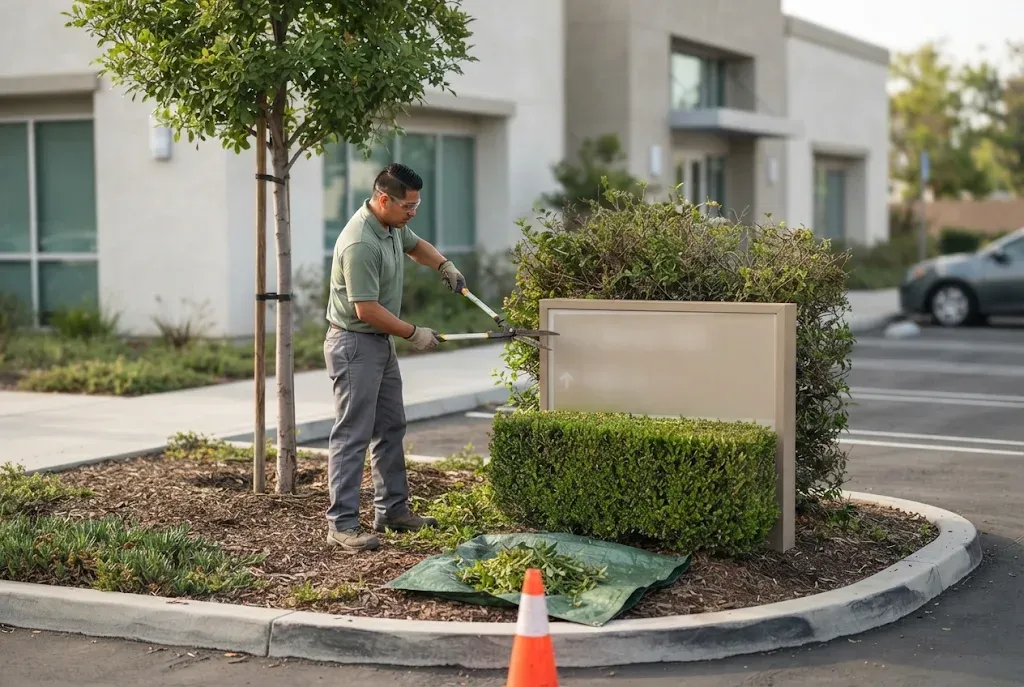
Encroachment is gradual. A shrub gains a few inches each growth cycle, groundcover sends runners over a curb, and a tree limb settles lower each year until it reaches a sign face. Nobody notices any single change, and then a walkway is noticeably narrower or a directional sign is half hidden. Routine medical office grounds maintenance should stop that drift before it becomes a problem.
On each visit, our crews check the landscape edges along:
- Walkways and ramps, including the planting strips on both sides
- Entrance doors and the approach to them
- Patient drop-off curbs and canopy areas
- Monument and directional signs
- Parking-lot islands where plants can block a driver’s line of sight
We prune and contain vegetation so it stays behind the bed edge and below sign faces. Where we notice something outside the landscape scope, such as a lifted paver beside a planter, a broken bed curb, or a damaged edge where a vehicle has driven over a planter, we note it and report it to the property manager for follow-up. We do not represent that as an accessibility inspection, but it gives the people responsible for the site an earlier look at issues they may want to address.
Tree and Shrub Upkeep Around Entrances, Signs, and Parking
Shrubs near doors and signs generally respond well to regular, moderate pruning that keeps them at a stable size instead of being cut back hard once a year. Trees are a different matter. Raising a canopy over a walkway, thinning limbs that are blocking a sign, or clearing branches away from a building wall can be routine work, but larger trees, trees showing decay or structural defects, and work close to buildings or overhead lines may call for a specialist assessment before anything is cut. Our tree trimming services page explains how we handle that work. On a medical property, we also plan tree work for times when the area beneath it can be closed off without blocking the main route to the door.
How Do We Work Around Patients, Visitors, and Staff During Service?
We assume the building will be open while we work, and we plan the visit around that. Before service starts, we ask the property manager to confirm a few things: which entrance must stay open at all times, where the drop-off area is busiest, which doors receive deliveries, and whether any tenant has a particular concern, such as a pediatric practice with families waiting outside or a clinic whose patients often arrive using mobility aids.
From there, we agree on the practical details with the property manager:
- Equipment use. Where mowers, trimmers, and blowers will be used and in what order, so crews are not working on both sides of a walkway at once.
- Temporary work areas. How a section being pruned or replanted will be marked off, and how pedestrians will be routed around it if a walkway edge is affected.
- Debris removal. Where clippings are collected and when they leave the site, so piles are not left beside an entrance between tasks.
- Parking and staging. Where the crew vehicle and trailer go so they do not take accessible stalls or block the drop-off lane.
Timing Noisy Work Around Appointment Schedules
Blowers, string trimmers, and mowers are loud, and the sound carries into waiting rooms and exam rooms near the exterior walls. Where it is feasible, we sequence the visit so the noisiest work near entrances and occupied windows happens during quieter periods, such as before the first appointments or during a midday lull the property manager identifies. We cannot promise silent equipment, and we cannot guarantee unrestricted after-hours availability, but we can build a visit order that reduces disruption where it matters most. If a tenant’s schedule changes, a quick call lets us adjust the next visit.
What Does Medical Office Lawn Care and Bed Maintenance Involve?
The routine tasks on a medical property are familiar ones. What matters is doing them consistently and leaving the site clean afterward. A typical maintenance visit may include:
- Mowing and edging where turf exists, with clean edges along walkways and curbs so grass does not spill onto pavement.
- Shrub pruning to maintain shape and keep plants inside their beds and away from doors, windows, and signs.
- Groundcover containment so spreading plants stay within bed edges and off walkways.
- Planting-bed weed management by hand removal and other appropriate methods agreed with the property manager.
- Leaf and litter removal from landscape areas, including the wrappers and debris that collect in entrance beds and parking islands.
- Cleanup after service, clearing clippings from walkways, curbs, and drop-off areas before the crew leaves.
Medical office lawn care follows the same principles as any commercial turf program, adjusted for the fact that many medical properties have small, high-visibility lawn panels near the entrance rather than large open fields. Our commercial lawn care services page covers turf care in more detail, including how we approach declining or thinning lawns.
How Often Should a Medical Office Property Be Serviced?
There is no single correct schedule. Visit frequency should follow how fast the plants on your property grow, the time of year, how heavily the site is used, and what the agreed scope includes. Turf and fast-growing shrubs usually need more frequent attention during the warmer growing months and less during cooler periods. A busy medical office complex with heavy foot traffic may need debris cleared more often than a small dental office with modest traffic. We recommend a frequency after seeing the property and discussing your expectations, and we revisit it if the site’s needs change.
Plan Grounds Maintenance Around Your Patient Appointment Hours
Tell us when your practices open, when arrivals peak, and which entrance must stay clear. We will build a medical office grounds maintenance plan that sequences noisy work and walkway tasks around your schedule wherever it is feasible.
How Should Irrigation Be Maintained at a Medical Office Property?
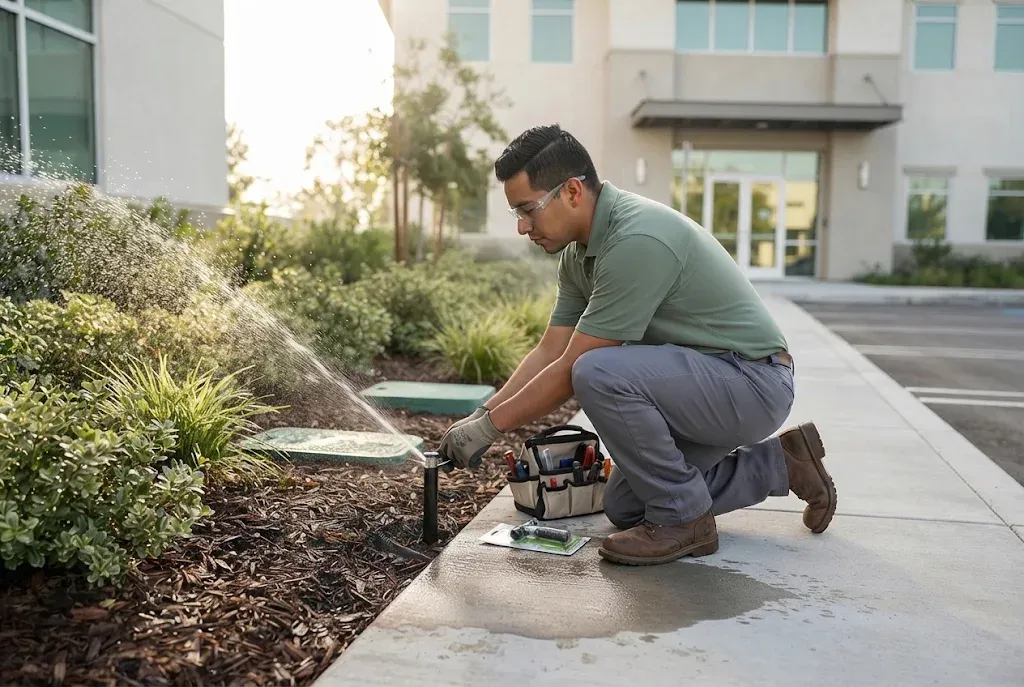
Medical office irrigation maintenance has two goals: keeping the landscape adequately watered and keeping water off the surfaces people walk on. A sprinkler head knocked sideways by a mower or a car bumper can soak the same stretch of sidewalk every morning, leaving a wet walkway and a stain on the concrete while the bed it was meant to water dries out. On a property where patients may be walking with canes or walkers, water reaching pedestrian surfaces is worth correcting promptly.
During irrigation checks, we look for:
- Leaks at heads, fittings, valves, and drip lines
- Broken, tilted, sunken, or clogged sprinkler heads
- Overspray onto walkways, ramps, drop-off curbs, parking areas, and building walls
- Uneven coverage that leaves dry spots in turf or beds
- Runoff and pooling at the low points of a bed
Some issues can be corrected during a routine visit, such as straightening a head or adjusting a spray pattern. Others need a repair recommendation that we send to the property manager for approval. Any adjustment or repair we recommend is based on the conditions we find on site and on whatever watering requirements apply to the property; we do not apply a fixed schedule to every location. For broken heads and zone-level problems, our sprinkler repair services page explains the repair work in more detail, and our commercial irrigation services page covers system-level evaluation and upgrades.
For property owners and facility managers who want background on efficient irrigation at commercial sites, the U.S. Environmental Protection Agency publishes WaterSense at Work best management practices for commercial and institutional facilities, which include separate guidance on landscaping and irrigation.
When Should a Medical Office Property Consider Landscape Improvements?
Routine maintenance keeps a landscape stable. It cannot fix a bed planted with the wrong shrubs for the space, replace plants that have declined past recovery, or rebuild a planter that has been damaged by vehicles. Those situations call for medical office landscape improvements, which we treat as a separate, optional scope so a property manager can approve them independently of the recurring maintenance agreement.
Common Reasons Property Managers Request Service
Requests usually begin with something visible:
- Entrance beds that have become overgrown or crowded
- Vegetation covering monument or directional signs
- Accumulated leaves, litter, and debris in landscape areas
- Turf that is thinning, patchy, or declining
- Recurring irrigation problems in the same zones
- Upkeep that has been inconsistent under a previous arrangement
Some of these are solved through better maintenance alone. Others point to a plant or irrigation problem that maintenance will keep fighting without resolving.
Choosing Site-Appropriate Replacement Plants
When selective replacement makes sense, we choose plants based on the specific location rather than appearance alone. The main considerations are sun exposure, the space available, the plant’s mature size, whether it fits the irrigation already serving that bed, how much maintenance it will need, and how close it sits to a walkway or entrance. A shrub that matures at six feet wide does not belong in a two-foot strip beside a ramp, no matter how good it looks in a nursery container. Choosing plants that fit their space is often the most effective long-term step toward low-maintenance planting for medical office properties, because it reduces the pruning needed to keep routes clear.
Phasing Work on an Occupied Property
Improvements do not need to happen all at once. On a building that stays open throughout the week, renovating one entrance bed or one group of parking islands at a time keeps most of the site undisturbed and spreads the cost across budget periods. Phased landscape renovation for occupied medical buildings also lets the property manager see how a finished section performs before approving the next one.
Bring Consistent, Well-Coordinated Upkeep to Your Medical Office Property
Whether you manage one dental office or a multi-building medical complex, we are glad to talk through the property with you. Call (888) 601-1117, email info@landscaper-near-me.com, or request a callback and we will arrange a free estimate.
What Information Helps Us Prepare Medical Office Landscaping Estimates?
Medical office landscaping estimates are most accurate when we understand both the landscape and how the property operates. Before or during the site visit, it helps to have the following information available:
- Property size and maintained areas. Which beds, lawns, islands, and courtyards are included, and which belong to a neighboring parcel or another party.
- Current problems. Overgrown areas, recurring weeds, declining turf, or locations where vegetation is already reaching walkways or signs.
- Irrigation condition. Known leaks, zones that never seem to work correctly, and whether a controller schedule has been reviewed recently.
- Desired visit frequency. What you are used to and what you expect, so we can explain whether it suits the property.
- Operating-hour constraints. Practice hours, peak arrival times, and any windows when exterior work should be avoided.
- Access requirements. Gate codes, parking instructions, delivery schedules, and areas that require advance notice.
- Approval responsibility. Who approves routine work, who approves improvements and repairs, and whether an owner, asset manager, or association must sign off.
Shared Grounds at Multi-Tenant Medical Buildings
Many medical office buildings house several practices, and the landscaping is usually a common-area responsibility managed by the owner or property manager rather than by individual tenants. Lease terms vary, though. Some tenants of a standalone building handle their own exterior care, and some complexes divide landscaping between an owners’ association and individual parcels. Clarifying who is responsible for which areas and who can approve work is one of the first things we sort out, because it determines how the scope is written and who receives our reports and recommendations.
When property managers compare medical office landscape contractors, these details are often what separate one proposal from another. A clear scope, a schedule built around operating hours, and a defined approval path tend to matter more over a multi-year agreement than small differences in the visit price.
The result we aim for with Medical Office Landscaping Services is straightforward: a medical office exterior that looks orderly and cared for every day, with clear routes from parking to the door, readable signs, healthy plantings, and irrigation that waters the landscape instead of the sidewalk. That consistency reflects well on the practices inside and makes the property manager’s job easier. We do not make clinical, therapeutic, or safety guarantees, but we do provide dependable landscape care planned around the people who use the site.
If you are evaluating recurring maintenance or a targeted improvement for a medical office, dental office, outpatient clinic, or medical office complex, call Landscaper-Near-Me.com at (888) 601-1117 or email info@landscaper-near-me.com. We will schedule a time to walk the property with you and prepare a free estimate based on what we find.
FAQ's - Frequently Asked Questions
Yes, most visits take place while the building is open. We work out the visit order with the property manager so the noisiest tasks near entrances and occupied windows happen during quieter periods where feasible, and we keep at least one main entrance route clear at all times.
We confirm which entrances and drop-off areas must stay open before service starts, work on one side of a walkway at a time, mark off temporary work areas, and keep equipment and crew vehicles out of accessible stalls and the drop-off lane. Clippings are cleared from walkways before the crew moves on.
Routine irrigation checks and minor adjustments can be part of the recurring scope. Repairs such as replacing broken heads, fixing leaks, or correcting a zone are usually handled as approved additional work, so the property manager can review each repair before it is completed. We can describe how that would work for your property during the estimate.
Shared grounds are usually managed by the owner or property manager, but leases and association documents vary. We confirm who approves routine maintenance, repairs, and improvements at the start, and we direct reports and recommendations to that person so nothing is left waiting for the wrong approval.
Yes. Dental office landscape maintenance follows the same approach as larger medical properties, scaled to the site. A single-practice building may only need entrance beds, a few parking islands, and a frontage strip maintained, and we write the scope to match.
Often that is the best way to begin. If beds are overgrown or full of debris, an initial cleanup brings the landscape back to a condition that regular visits can hold. We will tell you during the estimate whether we think a cleanup is needed and what it would cover.
When our crews notice issues next to the landscape, such as a lifted paver, a damaged planter curb, or a broken bed edge, we report them to the property manager. These observations are informal and are not a substitute for an inspection by the appropriate trade or consultant.
No. It is commercial landscape maintenance planned around how medical office properties operate, including patient arrivals, appointment schedules, and shared grounds. We do not provide clinical, infection-control, or regulatory compliance services, and we do not represent healthcare-specific credentials.