
HOA Landscape Maintenance for Community Association Common Grounds
HOA landscape maintenance is the recurring care of the grounds an association owns or controls: the entry monuments residents pass every morning, the shared lawns between buildings, the planting beds along walkways, and the landscaped edges of pools, tot lots, and recreation areas. For board members and community managers, the work is rarely about a single visit. It is about a dependable, clearly written scope that keeps those spaces consistent from week to week and holds up when the board changes, the manager changes, or the contract goes back out to bid.
We provide HOA landscaping services to planned residential communities, condominium developments, and townhome associations throughout our service territory in Southeast Los Angeles County and Orange County. This page is written for the people who define and approve that work. It explains how we map association-managed areas before quoting, which routine tasks typically belong in a recurring contract, how irrigation checks fit into the scope, which projects are better priced separately, and what to have ready when you request a walkthrough.
If your association also manages retail frontage, office parcels, or other non-residential grounds, our Commercial landscape services page covers how we approach those properties. Everything below focuses on the shared spaces residents live with every day.

Request a Free HOA Landscape Maintenance Estimate
Share your property location, the common areas you need maintained, and your desired start date. We will schedule a walkthrough and prepare a free estimate built around your association’s actual scope. Call (888) 601-1117 or email info@landscaper-near-me.com.
What Does HOA Landscape Maintenance Cover in a Community Association?
At its core, an HOA landscape maintenance program covers the planted and turf areas the association is responsible for, cared for on a predictable schedule. In most communities that includes four kinds of space, and each one asks something different of the crew.
Entrances and Monument Areas
The entry is the first impression for residents, guests, and prospective buyers. These beds usually receive the closest attention: tight edges, well-shaped shrubs, seasonal color where the board has chosen to fund it, and prompt removal of litter that collects around signage and curbs.
Shared Lawns and Open Turf
Greenbelts, courtyard lawns, and turf between buildings see dog walking, children’s play, and foot traffic that cuts corners. Mowing height, edging along walks, and watching for compaction or thin spots all matter more here than on a lawn few people use.
Planting Beds and Pathways
Beds along sidewalks and building foundations need shrub care, weed control, and clearance so plants do not crowd walkways, cover lighting, or press against siding and windows.
Landscaped Recreation Areas
Planting around pools, clubhouses, and play areas has its own practical concerns, such as keeping clippings out of pool decks and keeping sightlines open around play equipment. Common-area landscape maintenance works best when each of these zones is named in the scope rather than lumped together as “grounds.”
Who Maintains What? Mapping Association Areas Before We Quote
Before we price anything, we want to know exactly which areas the association maintains. That sounds obvious, yet unclear boundaries are one of the most common sources of friction between boards, residents, and landscape crews.
Under California Civil Code Section 4775, an association is generally responsible for repairing, replacing, and maintaining the common area, while owners maintain their separate interests, and owners generally maintain exclusive use common areas while the association handles their repair and replacement. The same section also allows the declaration to provide otherwise, which is why your community’s governing documents, not general assumptions, should define the boundaries. Your association’s manager or legal counsel is the right source for interpreting those documents; our job is to make sure the landscape scope reflects whatever the association has decided.
In practice, we ask the board or manager to help us identify:
- Association-managed areas such as entries, greenbelts, parkways, slopes, and recreation grounds.
- Limited-use or exclusive-use areas, including patios, small front yards, or side yards assigned to individual units, and who cares for the plants inside them.
- Owner-maintained areas the crew should not enter or service.
- Exclusions, such as areas maintained by a city, a utility, or a neighboring association.
A marked-up site map is the simplest way to settle these questions. Once the map is agreed upon, crews know where to work, residents know what to expect, and the board has a clear reference when a homeowner asks why a particular bed was or was not serviced.
Which Routine Tasks Belong in a Recurring HOA Grounds Maintenance Schedule?
The recurring tasks in an HOA grounds maintenance contract are the ones that keep the property looking cared for between board meetings: mowing, edging, shrub care, planting-bed upkeep, and debris removal. How each task is defined matters as much as whether it appears on the list.
Mowing and Edging
Turf areas are mowed at a height suited to the grass type and season, with string trimming around obstacles and edging along sidewalks, curbs, and bed lines. Shared lawns that carry heavy foot traffic often benefit from attention to wear patterns and irrigation coverage as well. For turf-specific programs such as fertilization or aeration, our commercial lawn care for shared turf areas explains the options associations typically consider.
Shrub Care and Hedge Shaping
Shrubs and hedges are pruned to keep walkways, signage, lighting, and building faces clear while maintaining the plant’s natural form where possible. The scope should state whether shaping happens every visit or on a rotating basis through the year.
Planting-Bed Upkeep
Bed care usually includes weed control, light cultivation or mulch touch-ups where mulch is part of the design, and removal of spent annuals or dead plant material. Replacement plants and new installations are typically quoted separately.
Debris Removal
Clippings, leaves, and litter are cleared from walkways, gutters along common drives, and hard surfaces after work is complete. Listing which hard surfaces are blown or swept prevents later disagreement about parking areas, pool decks, or carports.
Get Your Common-Area Scope Mapped Before the Next Bid
Unclear boundaries and loosely defined tasks lead to missed areas and surprise invoices. We can walk your community with the manager or landscape committee, mark association-managed areas and exclusions, and outline which work belongs in the recurring contract.
How Often Should Crews Visit? Setting Frequency by Growth, Season, and Resident Use
There is no single correct visit frequency for HOA landscape maintenance. The right schedule depends on how fast the landscape grows, how intensively residents use it, and what standard of appearance the board wants to hold.
Several site conditions shape our recommendation:
- Turf type and growth rate. Warm-season grasses common in Southern California typically grow fastest in late spring and summer and slow down in the cooler months, so mowing needs often shift with the seasons.
- Resident use. A greenbelt used daily for dog walking and play shows wear and debris faster than a decorative slope few people walk on.
- Visibility. Entrances, leasing or clubhouse areas, and main drive aisles are often serviced more often than back slopes or perimeter beds.
- Plant palette. Fast-growing hedges and flowering shrubs need more frequent shaping than many drought-tolerant plantings.
- Seasonal events. Leaf drop, post-storm cleanup, and spring growth surges may call for added attention at specific times of year.
Many associations settle on a base schedule with tasks that rotate through the year, so higher-visibility zones receive steady attention while lower-use areas are serviced on a longer cycle. Whatever the board chooses, the HOA landscape maintenance contract should spell out the frequency for each type of area. “Weekly service” means very little if it does not say which tasks happen every week and which happen monthly or quarterly.
When we walk a property, we will tell you where we think the current frequency is more than the site needs and where it may be falling short. That conversation is often where an association finds room to adjust the budget without lowering the standard residents notice.
How Irrigation Checks Fit Into Common-Area Landscape Maintenance
Irrigation is where many maintenance agreements become vague, and vague irrigation language tends to produce surprise invoices. We prefer to separate what the maintenance crew observes and adjusts from what requires a repair quote and board approval.
What Routine Observation Can Cover
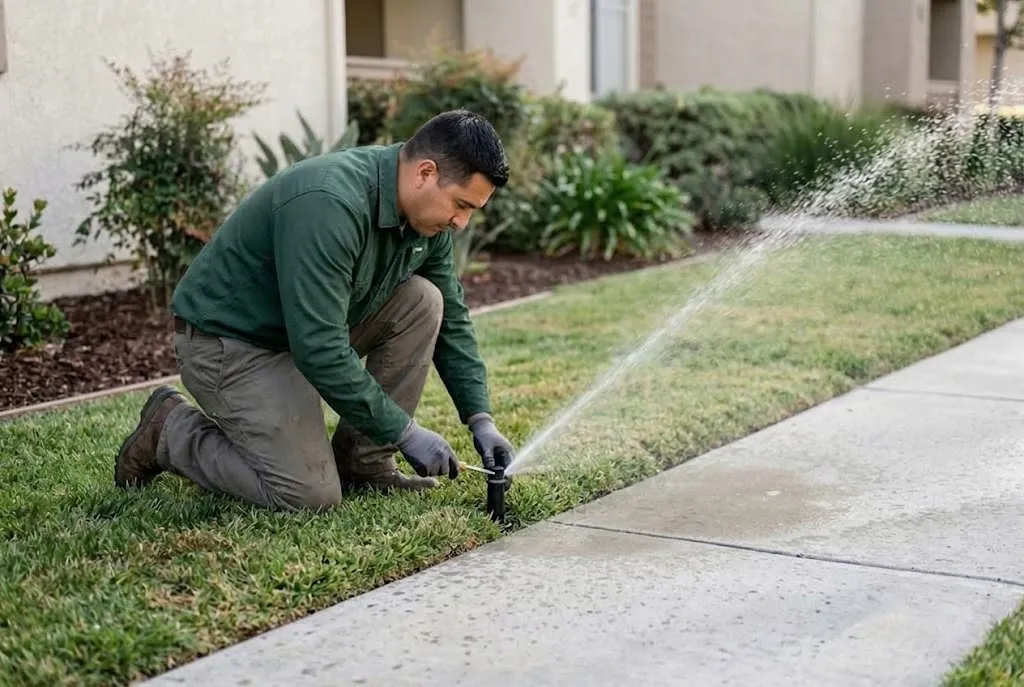
During regular service, crews can watch for the visible signs that something is wrong with the system: water pooling or running across walkways, overspray hitting buildings, fences, or parked cars, dry patches in turf or beds, broken or tilted heads, and damage from mowers or vehicles. A scope may also include agreed seasonal adjustments to controller run times and minor head alignment, if the board wants those included.
What Usually Requires a Separate Quote
Valve replacements, mainline or lateral line breaks, controller replacements, conversions to drip irrigation, and system redesigns are repair or upgrade work. Those items should be documented, reported to the manager, and priced for approval before work begins. Our commercial irrigation services cover that repair and upgrade work in more detail.
Why Reporting Matters
Clear reporting gives the board a record of what was found, when, and what was recommended. It also helps associations plan for water-efficiency changes. California’s AB 1572, for example, restricts using potable water to irrigate nonfunctional turf in common interest developments, with water suppliers indicating a compliance date of January 1, 2029 for HOA common areas. Boards should confirm the details that apply to their community with their water supplier, but documented irrigation observations make that planning considerably easier.
What Work Is Usually Scoped Separately From the Maintenance Contract?
A recurring maintenance price works best when it covers predictable, repeatable tasks. Work that varies widely in size, requires specialized equipment, or happens only occasionally is usually priced as a separate proposal so the board can approve it on its own merits.
Common examples include:
- Tree work. Pruning mature trees, raising canopies over drive aisles, clearing limbs from roofs, and removals typically require different crews and equipment than routine shrub care. Our tree trimming services for common areas page explains how we approach that work.
- Turf replacement. When a shared lawn has thinned beyond what regular care can recover, replacement may be the better option. See our page on sod installation for worn common-area lawns for what that project involves.
- Irrigation repairs and upgrades, as described in the previous section.
- Plant replacement and bed renovations, including drought-tolerant redesigns of tired or high-water areas.
- Storm or event cleanup that goes beyond normal debris removal.
Separating this work does not mean it should be an afterthought. The maintenance crew is often the first to notice a tree that needs attention or a lawn that is declining, so the contract should describe how those observations reach the manager and how proposals are submitted. That way, the routine price stays stable while the board keeps control of larger spending decisions.
Talk With Our Team About Your Community's Grounds Care
Whether you are reviewing your current provider, planning a vendor transition, or preparing a board discussion, we are glad to answer questions about scope, visit frequency, and resident logistics. Call (888) 601-1117 or request a callback.
How Should Resident-Facing Logistics Be Handled?
Community association landscaping happens where people live, park, walk dogs, and work from home. Good logistics planning keeps service days predictable for residents and keeps the board out of the middle of avoidable complaints.
Gate Access and Entry
Gated communities need a reliable way for crews to enter on service days, whether that is a vendor code, a fob, or a call box arrangement. The access method, and who to contact if it stops working, should be documented before the first visit.
Service Windows
Many associations set preferred hours for equipment use, and local noise rules may also apply. Agreeing on start times, the order in which areas are serviced, and any days to avoid, such as street sweeping or trash collection days, reduces conflicts with residents and vehicles.
Walkway Access and Safety
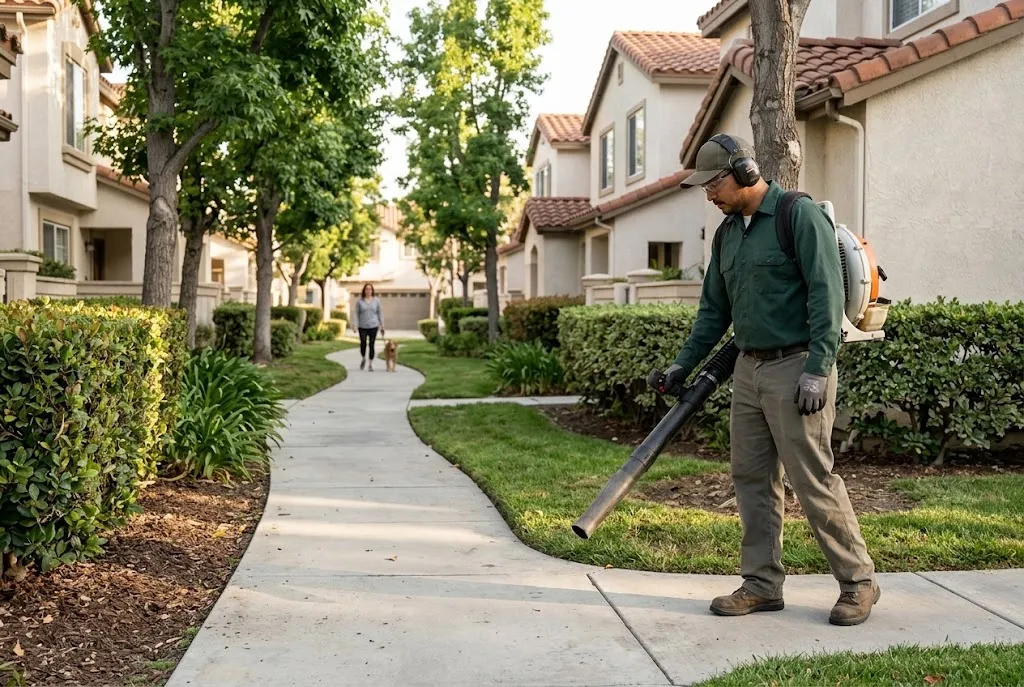
Crews should keep sidewalks and paths passable during work, pause blowers and trimmers when residents pass, and avoid blowing debris toward open doors, parked cars, or pool areas.
How Concerns Reach the Board or Manager
Residents will notice things: a missed bed, a broken sprinkler, a hedge they would like trimmed. We recommend that these requests go through the community manager or a designated board contact rather than directly to the crew. That keeps requests consistent with the approved scope, prevents one resident’s preference from overriding the board’s direction, and creates a record of what was asked and how it was resolved.
What Does a Smooth Vendor Transition Look Like?
Changing landscape providers is often the moment when the board discovers how much information lived only with the previous crew. A short, organized handoff protects the property during the first weeks of new service.
When an association moves its HOA landscape maintenance to our team, these items are the most useful to gather:
- The current scope of work, including any amendments, add-ons, or tasks that were performed informally without being written down.
- Site maps showing maintained areas, exclusions, and owner-maintained spaces.
- Irrigation information, such as controller locations, valve maps if they exist, known problem zones, and the current watering schedule.
- Access instructions for gates, controller enclosures, storage areas, and restricted spaces.
- Unresolved issues, including pending repair requests, resident complaints, and any areas the board considers below standard.
The board should also review the outgoing contract’s termination and notice terms so the start date aligns with the end of current service and the property is not left without coverage. Early in a transition, we walk the property with the manager or a landscape committee member, confirm the map, and note existing conditions. That baseline helps everyone separate inherited problems from new ones and gives the board a fair way to measure progress.
Preparing for a Walkthrough and Comparing HOA Landscape Maintenance Proposals
A productive walkthrough starts with a few documents and decisions. When you request an HOA landscaping maintenance estimate, having the following ready lets us price the work accurately and lets your board compare proposals on equal terms:
- Property location and the approximate size or number of units in the community.
- A property map marking the areas the association maintains.
- Your existing scope, if you have one, even if it needs revision.
- Priority areas such as the entry, clubhouse, or high-use greenbelts.
- Service exclusions and any owner-maintained areas.
- Your desired start date and any timing tied to the current contract.
Comparing Proposals Briefly
When proposals arrive, resist comparing only the monthly total. Line them up by the areas covered, the tasks included, the visit frequency for each type of area, and the work each company prices separately. Two bids at a similar price can describe very different levels of service, and a lower bid may simply leave out tasks the current provider performs. A consistent scope document given to every bidder is the most effective way to make proposals comparable.
Working With Our Team
Whether your community is a condominium association that needs focused condominium landscape maintenance around tight building corridors, or a planned development with greenbelts and slopes, our goal is the same: a clearly defined scope, a schedule that fits how residents use the property, and responsive communication with the board and manager. Call us at (888) 601-1117 or email info@landscaper-near-me.com to schedule a walkthrough and request a free estimate for your association’s common grounds. You can also request a callback, and we will follow up to discuss your property location, the areas you need maintained, and your preferred start date.
FAQ's - Frequently Asked Questions
That depends on the termination and notice terms in your current agreement. We recommend reviewing those terms with your manager first, then choosing a start date that begins when the current service ends so the property is never left without coverage.
We suggest routing resident requests through the community manager or a designated board contact. That keeps requests consistent with the approved scope and gives the association a record of what was reported and how it was handled.
Weed control in planting beds is commonly part of a recurring scope. The contract should state how weeds are managed, how often beds are serviced, and whether hardscape cracks or parking areas are included.
Debris removal after each visit is a standard part of the scope we discuss with associations. The contract should identify which walkways, drives, and hard surfaces are cleared so expectations are clear for residents.
Work outside the recurring scope, such as tree pruning, irrigation repairs, plant replacement, or sod, is documented and submitted as a separate proposal. Nothing beyond the agreed scope should proceed until the board or manager approves it.
Yes. We can identify high-water areas, adjust controller schedules where the scope allows, and propose drought-tolerant or drip conversions. California’s AB 1572 also restricts potable irrigation of nonfunctional turf in HOA common areas, so it is worth confirming your requirements with your water supplier.
Yes. We work with condominium developments, townhome associations, and planned residential communities. The scope simply changes with the property, from tight courtyards and building corridors to larger greenbelts and slopes.
We serve community associations throughout Southeast Los Angeles County and Orange County, including cities such as Whittier, Downey, Cerritos, Long Beach, Anaheim, Fullerton, Orange, Santa Ana, Irvine, Costa Mesa, and Newport Beach. Call (888) 601-1117 to confirm service for your property.