
How to Take Care of Sod After You Lay It?
The sod is down, the seams are tight, and the yard finally looks like a lawn again. What happens over the next several weeks decides whether those pieces knit into one healthy turf or slowly fade at the edges. If you are wondering how to take care of sod after you lay it, the short answer is that new sod care comes down to three things you can actually observe: how moist the soil is under the sod, whether the roots have started to grip the ground, and whether the lawn is firm enough to be mowed and walked on.
We wrote this guide for homeowners, DIY lawn-renovation customers, and property managers who are looking after freshly installed turf. It focuses on sod care after installation rather than on how to install a lawn or which grass to buy, and it treats every timeline as a range, because weather, soil, shade, and the grass itself all move the schedule. If you would like a broader look at ongoing turf maintenance, our sod care page covers that side of the story.
How to Take Care of Sod After You Lay It: The First Day
The most important action after installation is water, and it should come quickly. Sod arrives as living turf that has been cut from a field, so its roots are shortened and its blades are already working hard. Once pieces are down, they should be watered promptly rather than left to sit while the rest of the yard is finished. On larger jobs it helps to water sections as they are completed, so the first strips laid are not baking while the last strips are still being placed.
The goal on day one is a lawn that is thoroughly moist through the sod and into the soil beneath it, not one that merely looks wet on top. Lift the corner of a piece at the edge of the lawn, or press a screwdriver or a long, thin probe into the ground, and check that the soil under the turf is damp. If the surface is dark but the soil an inch or two down is dry, the water has not gone far enough.
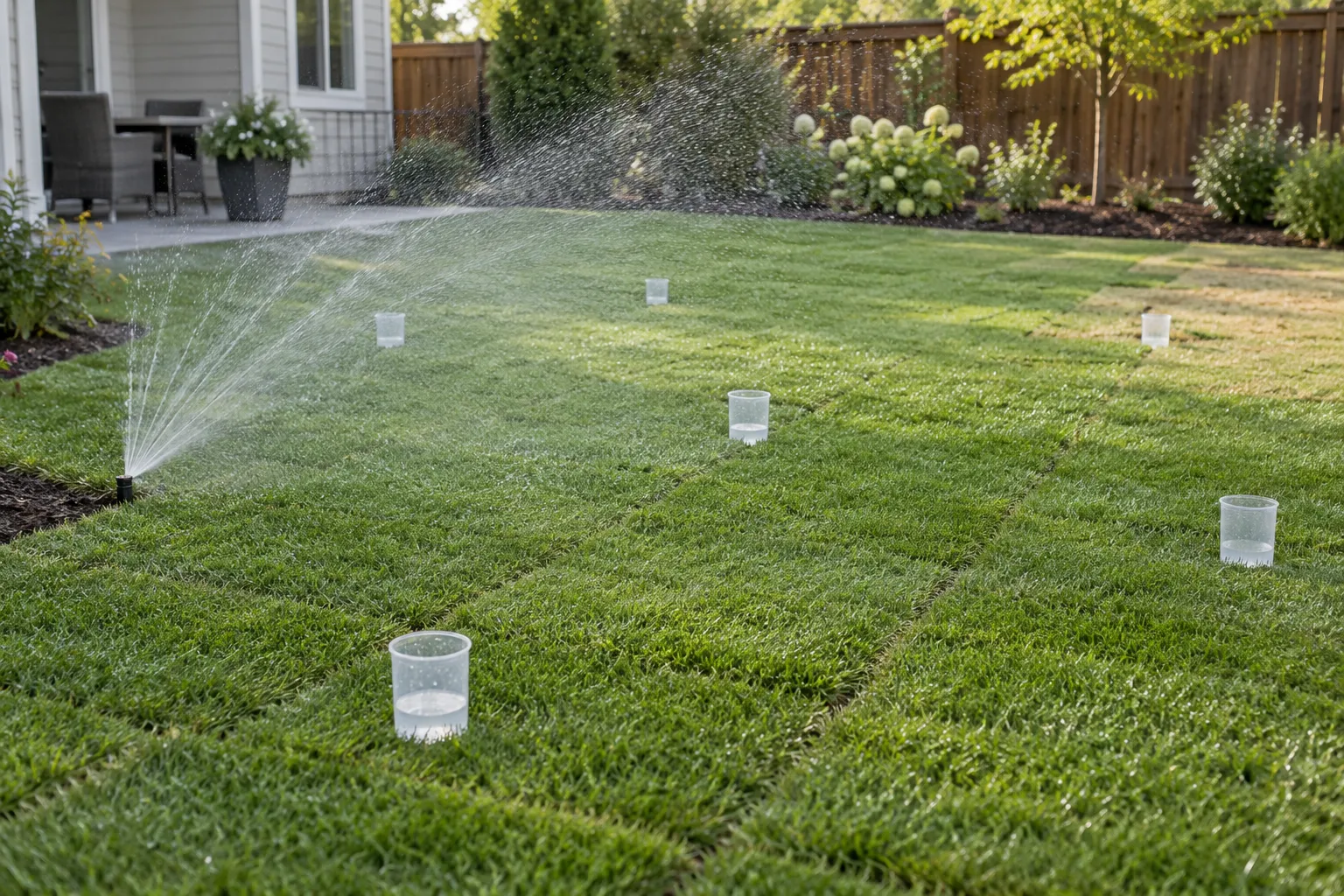
Take a few minutes at the same time to watch your sprinklers run. Look for brown or dry strips where spray does not reach, heads that are blocked or tilted, and places where water pools or runs off along a walkway. New turf shows irrigation weaknesses very quickly, and it is far easier to correct a dry corner in the first days than after it has already declined. If you would like a hand with coverage problems, our irrigation services team can look at how the system is delivering water to the new lawn.
Finally, keep foot traffic to a minimum from the start. Walk only where you must, and step on boards or existing paths if you need to reach a spot in the middle of the lawn.
How Do You Water New Sod Without Overdoing It?
Watering newly laid sod is a balance. The turf needs steady moisture while its roots are short, yet soil that stays saturated can keep roots from reaching downward. The University of California’s turf guidance notes that new sod typically needs frequent watering for its first weeks, sometimes more than once a day in hot weather, and warns that too much water can discourage roots from growing deep into the soil. You can read that guidance in the UC Integrated Pest Management program’s advice on irrigating new sod.
How often to water new sod
There is no single runtime that fits every yard, so we do not give one. A shady, clay-heavy backyard holds moisture very differently from a sunny, sandy front strip, and a hot, windy afternoon can dry a lawn in hours. Instead of counting minutes, let the soil tell you. Check the ground under the sod each day, and increase or decrease watering based on what you find. In hot, dry, or windy weather you may need to water more often, and after rain you may be able to skip a cycle entirely.
How much water new sod needs
Think in terms of depth rather than duration. Early on, you want the top layer of soil beneath the sod to stay consistently moist. A few times during the first weeks, a longer, deeper watering can help make sure moisture is reaching the root zone rather than only wetting the leaf blades. Since sprinkler output varies from one zone to the next, it is worth measuring sprinkler coverage and watering rates with a few catch cans so you know what each zone really delivers.
Adequate moisture versus too much
Adequate moisture feels cool and damp when you press a finger or probe into the soil, and the sod stays flat and green. Too much water shows up as puddles, squishy footing, water running off the edges, or a lawn that never seems to firm up. If you see those signs, cut back and look at drainage and sprinkler overlap before adding more time.
How Can You Tell When Sod Is Taking Root?
People often ask how long sod takes to root. Many references describe roughly two to three weeks before new sod begins anchoring, but that is a general expectation, not a promise. Cooler weather, heavy shade, compacted soil, or an uneven watering pattern can stretch the timeline, while warm, sunny conditions with good soil contact can shorten it. It is better to look for the signs of rooting than to rely on a date on the calendar.
The clearest signs sod is taking root are physical. Gently lift a corner of a piece at the edge of the lawn. At first it will peel up with no resistance at all. Over time you will feel a little tug as roots begin to hold, and eventually you may see short, pale, new roots reaching into the soil below. Do this sparingly and set the corner back down right away, pressing it into contact with the soil and watering it in. Repeated tugging can undo the very progress you are trying to confirm.
The seams offer another clue. Pieces that stay put when you gently press along their edges, and turf that no longer feels loose or spongy underfoot, are usually further along than pieces that shift or curl.
Transitioning new sod to regular watering
Once roots are gripping, the watering pattern should slowly change. Rather than switching abruptly, stretch the time between waterings a little at a time while making each session deeper. This encourages roots to follow moisture downward. The UC guidance mentioned above notes that once turf is well established, far less frequent irrigation is usually enough. If the lawn shows stress as you stretch the interval, ease back and stretch more slowly. Rooting depth, weather, and grass type will all influence how fast you can move, and this is a good moment to review the choosing grass for Southern California lawns guide if you are unsure which turf you have.

Planning New Sod Care? Start With a Free Estimate
Whether your sod was just installed or you are still preparing the yard, we can talk through watering, coverage, and early lawn care for your property. Ask us for a free estimate.
When Can You Walk on New Sod, and What About Pets?
Everyone wants to know when to walk on new sod, and the honest answer is: as little as possible at first, and normal use only once the lawn is firm. New sod sits on a bed of soil that is kept wet, and wet soil is soft. Footsteps can press dents into that surface, push pieces out of alignment, and open gaps at the seams where the turf can dry out.
Use the ground itself as your guide. If your shoes leave impressions, or if a piece slides when you step near it, the lawn is not ready for play. When the turf has begun to root and the surface feels solid, light walking, such as moving a hose or checking sprinklers, becomes reasonable. Heavier activities like children’s games, parties, or moving furniture across the lawn should wait until the sod is well anchored.
Dogs deserve the same consideration. Running and digging can tear at loose turf, and concentrated urine can cause burned spots on any lawn, new or old. Many owners find it easiest to give pets a separate area for the first stretch, then bring them back gradually once the sod is holding firm. Keep heavy equipment, wheelbarrows, and ladders off the new turf whenever possible, and if a job requires crossing the lawn, spread the load with plywood.
When Should You Mow New Sod?
Deciding when to mow new sod depends on rooting, dryness, and growth, not on a fixed day. Before the first cut, the turf should be firmly rooted so the mower does not tug it loose. The ground should also be dry enough that wheels do not sink in or rut the surface. A lawn that has just been watered heavily is a poor candidate for mowing, so plan the first mowing when the surface has had time to firm up.
Blade condition matters more on new turf than on an established lawn. A dull blade tears grass and leaves ragged tips that turn brown, while a sharp blade makes a clean cut. Set the mower height according to your grass type; different species are kept at different heights, so a Bermuda lawn and a tall fescue lawn will not share the same setting. If you are not sure which you have, our guide to choosing grass for Southern California lawns explains the common types and how they differ.
The rule that applies to nearly every lawn applies with extra force here: never remove more than about one-third of the blade height in a single cut. Cutting too much at once stresses shallow roots and can leave the turf looking scalped. If the grass has grown taller than usual, it is better to take it down in two or three passes over a week or so than to cut it all at once. The UC turf guidance also recommends letting new turf grow a bit above its usual height before the first mowing so that you stay within the one-third limit.
When Should You Fertilize New Sod?
Fertilizer is one of the areas where a universal date does more harm than good. Many sod installations begin with a starter fertilizer or soil amendments worked into the soil before the turf goes down, so your lawn may already have what it needs. Adding more right away can burn tender roots or push leafy growth at the expense of rooting.
A better approach is to ask three questions. First, what did the soil test say? A test from a reputable lab tells you what nutrients the soil actually lacks, and it is more reliable than guessing. Second, what grass do you have, and is it in its active growing season? Warm-season and cool-season lawns feed on different schedules. Third, what was already applied at installation? If your installer or the sod supplier applied a starter product, you may be able to wait until the lawn is established and mowing regularly before feeding again.
Whatever you choose, follow the label directions, avoid overapplying, and water fertilizer in according to the product instructions. More fertilizer does not speed up rooting, and excess nutrients are a common cause of burn and wasted product. If you are unsure, we would rather you ask before applying than after the lawn has yellowed.
Uneven Watering Can Undermine New Sod
Dry corners, soggy patches, and missed sprinkler coverage are among the most common reasons new turf struggles. We can review how your irrigation is serving the new lawn.
How Do You Spot Problems in New Sod Early?
New sod usually tells you something is wrong well before the damage is severe. Learn the early warning signs and check the basics first, because most problems trace back to water.
- Drying edges or curling seams. Edges dry out first. Check that the soil beneath is moist and that sprinklers are reaching the perimeter.
- Uneven moisture. Patches that are wet next to patches that are dry point to overlapping or missing sprinkler coverage, or to slope and drainage differences.
- Bluish-gray color. A dull bluish-gray tint is a classic sign that grass needs water, as the UC guidance notes.
- Persistent wet areas. Spots that stay soggy may have drainage problems, a leaking valve, or too much runtime for that zone.
- Weak rooting. Pieces that still lift with no resistance long after installation suggest poor soil contact, dryness underneath, or waterlogging.
Before assuming disease or pests, or reaching for a product, check soil moisture in several places and run your sprinklers to see where the water actually lands. Guessing at a cause can lead to treatments the lawn does not need.
What not to do after laying sod?
Some of the most damaging mistakes are simple ones. Do not let the sod dry out, even briefly on a hot or breezy day. Do not keep the soil saturated, since constant sogginess can keep roots from going deep. Do not disturb developing roots by dragging equipment, staging heavy loads, or repeatedly lifting pieces to look underneath. Do not mow before the turf is rooted and the ground is dry enough to support the mower, and do not cut too much grass at once. Avoiding these common new sod care mistakes protects the investment you have already made.
Do the Timing and Installation Details Change How Sod Establishes?
They do. Sod that went down in ideal conditions with careful soil preparation generally roots more predictably than sod installed in a heat wave over rough ground. If you are planning another section, our future guides on preparing soil before laying sod and choosing the best season to lay sod in Southern California go deeper on those topics. Here is the short version, since it affects how you care for what is already down.
What is the best month to lay sod?
It depends on the turf species and local conditions rather than one universal month. Cool-season grasses, such as tall fescue, generally establish best in early fall or early spring, when air temperatures are moderate. Warm-season grasses, such as Bermuda, generally do best when laid in mid-to-late spring, when warming soil supports rapid growth. Whatever the season, extreme heat, hard cold, and unreliable irrigation make establishment harder. In Southern California, that means paying attention to heat waves and dry, windy stretches that can pull moisture out of new turf.
What is the best month to put sod down?
The answer is the same, because it is the same question worded differently: match the season to the grass. Choose early fall or early spring for cool-season turf and mid-to-late spring for warm-season turf, and make sure you can water consistently in the weeks that follow. A perfect month with no dependable irrigation is worse than a slightly less ideal month with a system that works.
What are some common mistakes people make when laying sod?
Most installation errors show up later as establishment problems. Inadequate soil preparation can leave uneven or compacted ground that roots cannot penetrate. Delayed installation, where sod sits rolled up or stacked, can weaken it before it goes down. Poor soil contact leaves air pockets that dry roots out, and gaps between pieces let seams brown and weeds move in. Stretching sod to cover a gap causes shrinkage and thin spots, and delayed watering after installation can set the lawn back in its first hours. If your new lawn is struggling, it is worth checking whether one of these is the underlying cause.
Questions About Your New Lawn? Talk It Through With Us
Call Landscaper-Near-Me.com at (888) 601-1117, or request a callback and tell us how your new sod is doing. We will help you decide what it needs next.
When Should You Call a Professional for Help With New Sod?
Most new lawns can be looked after by a careful homeowner or property manager with a probe, a little patience, and a watering routine that responds to the weather. Still, there are moments when a second opinion saves time and turf. Persistent rooting problems, where pieces refuse to anchor despite good watering, deserve a closer look at soil contact, compaction, and moisture beneath the sod. Uneven watering that you cannot fix by adjusting a controller often points to sprinkler coverage, pressure, or head placement. Standing water and soggy areas may signal a drainage concern that will not resolve on its own.
In those cases we can help. We support turf through establishment and beyond, and our team can evaluate how water is reaching the lawn. For shared or residential common-area turf, a professional assessment can also give property managers a clear picture before a small problem turns into a large replacement.
New sod rewards steady, attentive care. Keep it moist but not saturated, watch for real signs of rooting, hold off on traffic and mowing until the lawn is firm, and treat fertilizer as a decision rather than a routine. When you would like an experienced set of eyes on your lawn, call Landscaper-Near-Me.com at (888) 601-1117 or request a free estimate, and we will talk through what your new sod needs.
FAQ's - Frequently Asked Questions
Rain can supply part or all of the moisture new sod needs, but it is not always even or deep. Check the soil beneath the turf after rain. If it is damp, you can usually skip a cycle. If it is dry a couple of inches down, the lawn still needs water.
Push a screwdriver or thin probe through the sod into the soil, or gently lift a corner and feel the ground beneath. Soil that is cool and damp is in good shape. Dry, crumbly soil means the sod needs more water, and standing water means it needs less.
Some visible seams are normal, but gaps that widen or turn brown mean the edges are drying out. Keep seams moist, avoid stretching or pulling pieces, and ask us about the problem if the gaps keep growing.
Early morning is usually a good choice because less water evaporates and the turf can dry a little during the day. New sod may need extra cycles in hot, dry, or windy weather, so adjust to what the soil beneath the turf is telling you.
Read the product label carefully first. Many products caution against use on new turf until it is established, and the wrong product can injure it. If you are unsure, ask a professional before applying anything.
A dull bluish-gray tint often means the grass needs water, while yellowing can be linked to overwatering, poor drainage, or nutrient issues. Check soil moisture and sprinkler coverage before adding fertilizer or treatments.
Keep the pet off the area, press any loosened pieces back into contact with the soil, and water them in. Small burned or torn spots can often be repaired. If damage is spreading, contact us so we can take a look.
Yes. Sod installation and lawn care are among the services Landscaper-Near-Me.com offers, along with irrigation design and repair. Call (888) 601-1117 or request a free estimate to discuss your property.