
Commercial Lawn Care Services
Commercial Lawn Care Services keep the most visible part of a commercial property looking maintained every week of the year, not just after an occasional cleanup crew comes through. On an office park, a retail center, an industrial campus, or an HOA common area, turf is usually the first thing a tenant, customer, or prospective buyer notices, and it is also the element that shows neglect fastest. A shrub that misses a pruning cycle looks fine for a month. A lawn that misses two mowings looks abandoned.
We build recurring commercial lawn maintenance programs for properties throughout Orange County and Southeast Los Angeles County, and we build them around how each site is actually used rather than around a generic mowing route. The sections below explain what a commercial lawn service covers, why commercial turf wears differently than a residential lawn, how we set a maintenance schedule that fits your operating hours, and how we handle irrigation, turf repair, and seasonal work once the program is running.
What Commercial Lawn Care Services Include on a Managed Property
Mowing is the visible part of the work, but on most commercial properties it accounts for a small share of the hours. A complete commercial lawn care program covers everything that determines whether the turf holds up between visits: cutting, edge definition, weed pressure, irrigation performance, debris removal, and repair of the areas that fail first.
On a typical recurring program we handle:
- Commercial lawn mowing on a set rotation, with cutting heights matched to the grass species on site
- Edging along walks, curbs, planter beds, and equipment pads, plus string trimming around light poles, bollards, signage, and utility boxes
- Commercial turf and grass maintenance, including monitoring for thinning, scalping, wear paths, and irrigation-related stress
- Weed management in turf and along turf edges before weeds set seed and spread across the property
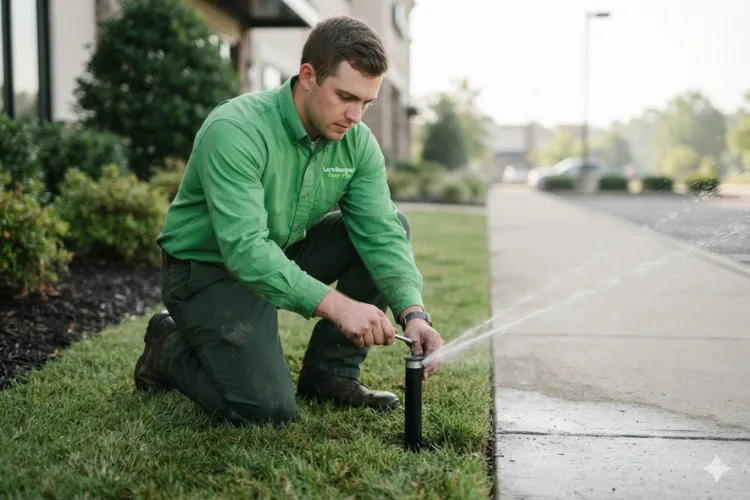
- Commercial irrigation inspection during service visits, with sprinkler adjustment and coverage correction as problems appear
- Seasonal lawn care and cleanup, including leaf and storm debris removal from turf areas
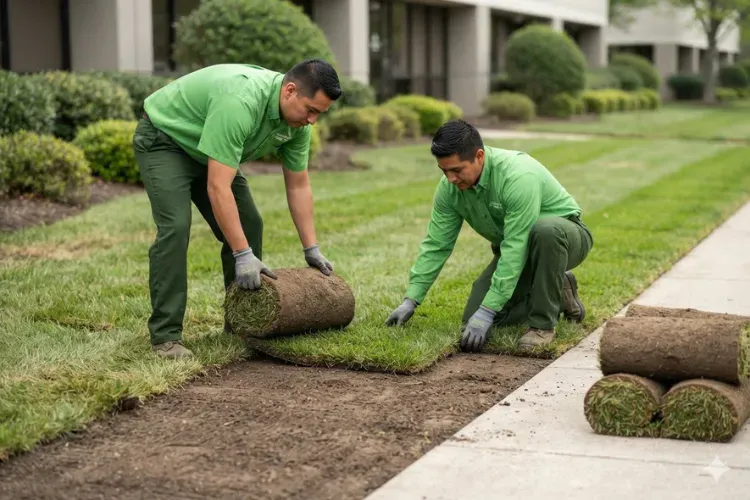
- Commercial sod installation and replacement where turf has deteriorated past the point of recovery
- Routine property inspections so small problems get reported before they become visible to tenants
It is worth separating this from the broader scope of Commercial Landscape Services, which extends into shrub care, tree work, bed renovation, and larger grounds projects. Commercial lawn care concentrates on turf: keeping it cut, edged, watered correctly, and repaired. Many of our clients run both, but they are scoped and scheduled differently, and confusing the two is a common reason a property ends up with a beautifully pruned entry and a failing lawn behind it.
Why Commercial Turf Wears Differently Than a Residential Lawn
A residential lawn is walked on by a handful of people. A commercial lawn is walked on by everyone who decides the sidewalk is too long a route. That single difference drives most of what we plan around on business lawn care accounts.
Traffic and soil compaction
Foot traffic compacts soil, and compacted soil holds less air and takes in water more slowly. Turf growing in it produces shallower roots and recovers from stress more slowly. On commercial properties this shows up as predictable wear lines: the diagonal shortcut from the parking lot to the entry door, the strip beside a bike rack, the patch of grass next to a smoking area or a dog relief station at an apartment community. These areas are not failing because of the mowing schedule. They are failing because they are being used as a path, and they need to be treated as a traffic problem rather than a turf problem.
Heat, reflection, and shade
Turf bordered by large asphalt lots absorbs reflected heat and dries out faster than turf in an open field, which is why the perimeter strips around parking areas are often the first sections to brown in August. At the opposite extreme, lawn on the north side of a multi-story building or under a dense mature canopy may receive only a few hours of usable light per day. Thinning turf under trees is frequently a light problem rather than a water problem, and selective canopy work through our Tree Trimming Services often does more for the grass below than any adjustment to the irrigation controller.
Equipment access and obstacles
Commercial turf areas are broken up by hardscape, drive aisles, transformers, planters, and bollards. Narrow strips and tight corners cannot be maintained the same way as an open panel of grass, and crews working them under time pressure are where scalped corners and string-trimmer damage around tree trunks originate. We plan equipment by area rather than by property, which is slower on paper and produces a noticeably more consistent result.
Setting a Recurring Schedule Around How Your Property Operates
The most common complaint we hear from property managers about a previous commercial lawn service is not quality. It is unpredictability, or crews arriving at the wrong time. A maintenance schedule has to work around the building, not just the grass.
Before we propose a rotation, we ask about the things that actually constrain service:
- Operating hours and noise windows. A medical office needs blowers finished before patients arrive. A restaurant pad wants crews gone before the lunch rush. An HOA usually has a start-time restriction in its rules.
- Parking and access. Lots that fill by 8:00 a.m. need turf work near drive aisles done early, or on a day when the lot is lighter.
- Growth rate by season. Warm-season turf in full sun may need weekly mowing through summer and far less through winter dormancy. A fixed year-round frequency either overspends in January or lets the property get shaggy in June.
- Visibility priorities. Entry monuments, leasing office frontage, and street-facing turf carry more weight than the lawn behind a loading dock, and the schedule should reflect that.
- Who reports problems. Establishing one point of contact on each side prevents the situation where three tenants report the same broken sprinkler and nobody reports the one that matters.
Once those constraints are on paper, the rotation itself becomes straightforward, and it should be written into the scope so that everyone can tell whether it was met. Properties that need mowing bundled with broader grounds work can fold lawn care into a wider maintenance agreement through our Landscape Services, which keeps one crew accountable for the whole site rather than splitting responsibility across vendors.

Get a Free Estimate for Your Property's Lawn Care Program
Send us the property address and we will walk the turf, review the irrigation zones, and put a written commercial lawn maintenance scope in front of you at no cost. Call (888) 601-1117 or request a callback and we will schedule the walkthrough around your building’s hours.
Mowing, Edging, and Trimming Standards That Make a Property Look Managed
A property reads as well-maintained or poorly maintained from about fifty feet away, and at that distance almost all of the signal comes from three things: cut uniformity, edge definition, and the absence of debris. Getting those right is a matter of standards rather than effort.
Cutting height and the one-third guideline
The long-standing turf management guideline is to remove no more than about one-third of the leaf blade in a single mowing. Cutting more than that at once removes too much of the plant’s photosynthetic tissue, which stresses the roots and opens space for weeds. In practice this means the mowing interval has to follow the growth rate, and that on a property that has been allowed to get long, the right correction is two closer-spaced cuts rather than one severe one. Mowing height itself is set by species: fine-bladed hybrid bermudagrass tolerates a much lower cut than tall fescue, and cutting fescue to bermudagrass height is a reliable way to scalp a lawn into failure.
Blades, patterns, and clippings
Dull blades tear grass rather than cut it, and the torn tips brown within a day or two, which gives a lawn a hazy, off-color cast even though it was just mowed. Alternating the mowing direction between visits keeps turf from leaning permanently and reduces rutting on soft ground. On most commercial turf, returning clippings to the lawn is appropriate and recycles nutrients back into the soil; on formal entry lawns or when growth has outpaced the schedule, clippings are collected so the property does not look striped with windrows.
Edges and detail work
Edge definition is where commercial mowing services separate. A clean vertical edge along concrete makes a lawn look deliberate; a rounded, overgrown edge makes an otherwise healthy lawn look untended. We maintain hard edges along walkways, curbs, driveways, and planter walls, and we keep string trimmers off tree trunks and irrigation heads, since trimmer damage at the base of a young tree is often fatal and rarely traced back to its cause. On properties where turf meets extensive paving, seat walls, or paver areas, coordinating lawn edges with the Hardscape Services already installed on site keeps those transitions crisp instead of ragged. Blowing down walks, curb lines, and parking areas afterward is part of the mowing visit, not a separate service.
Irrigation Efficiency and Where Commercial Lawns Lose the Most Water
More commercial turf problems trace back to irrigation than to anything else we see, and the losses are rarely dramatic. They are a misaligned head watering the sidewalk, a valve that runs eight minutes longer than it needs to, and a slope that sheds half of what it receives. Multiplied across a large property and repeated three times a week, that adds up quickly on the water bill and shows up in the turf.
The recurring problems we find on commercial properties:
- Coverage gaps and overspray. Heads sink, get knocked out of alignment by mowers or vehicles, or clog partially. The result is a dry arc in the turf and a wet stain on the adjacent concrete, sometimes twenty feet apart.
- Mixed heads on one valve. When rotors and spray heads share a zone, they apply water at very different rates. Running the zone long enough to satisfy the rotors floods everything the spray heads cover.
- Runoff on slopes and compacted soil. Water applied faster than the soil can absorb it runs to the curb. Splitting a long run time into shorter cycles with soak periods between them lets the same volume actually reach the root zone.
- Controllers left on one schedule. A program set in July and never revisited waters a dormant winter lawn at summer rates. Seasonal adjustment is the single cheapest efficiency improvement available on most sites.
- Shallow, frequent watering. Brief daily cycles keep the surface wet and roots shallow. Deeper, less frequent irrigation encourages roots to follow moisture downward, which makes turf far more resilient through a heat wave.
During each maintenance visit we walk zones and flag what we find, and we handle repairs, head replacement, nozzle changes, and coverage correction through our Irrigation Services. For properties pursuing water-wise and drought-conscious lawn care, the work usually starts here rather than with turf removal: a system delivering water evenly and on a seasonally correct schedule often supports the same lawn on substantially less water.
Diagnosing and Repairing Thin, Bare, or Failing Commercial Turf
Replacing turf that failed for an unresolved reason produces a lawn that fails again, usually within a year and usually in the same spot. So the first step on any deteriorated area is diagnosis, and it is faster than most people expect.
Working through the likely causes
We check irrigation coverage in the failing area first, since uneven application explains a large share of patchy commercial lawns. Then soil condition and compaction, particularly on wear paths and anywhere vehicles or equipment have crossed the turf. Then light, since a lawn receiving two hours of filtered sun will never hold density regardless of care. Then mowing damage, which shows up as scalped high points and thinning at slope crowns. Pests and disease come last in the sequence, not because they are unimportant but because they are diagnosed far more accurately once the cultural problems are ruled out. The University of California maintains detailed integrated pest management guidelines for turfgrass that we use as a reference point when a property has a recurring pest or disease issue, and we would rather identify a specific cause than apply a broad treatment to a lawn that is actually short on water.
Repair, renovation, or replacement
Small thin areas in otherwise healthy turf often fill in on their own once irrigation and mowing are corrected. Larger areas may need aeration to relieve compaction, followed by topdressing and seeding for cool-season lawns. When turf is genuinely gone, commercial sod replacement gives a property an immediate, uniform result, which matters when a leasing tour or a board walkthrough is on the calendar. We install and maintain new turf through our Sod Care service, and new sod needs a different irrigation schedule than established lawn for the first several weeks while roots knit into the soil below.
There is also an honest answer we give regularly: some areas should not be lawn. A three-foot strip between a drive aisle and a building wall, or a shaded slope nobody uses, will consume water and labor indefinitely and never look good. Converting those to planting or groundcover usually costs less over a few years than repeatedly resodding them.
Turf Thinning or Sprinklers Running Long? Let's Look at It
Bare patches, brown perimeter strips, and water running to the curb usually share a fixable cause. Tell us what you are seeing on the property and we will diagnose the turf and irrigation together before anything gets replaced. Reach us at info@landscaper-near-me.com or request a callback.
Seasonal Priorities for Commercial Lawn Care in Southern California
Lawns here do not shut down the way they do in colder regions, so commercial lawn maintenance is a year-round program with shifting priorities rather than a season that starts and stops. What changes is where the attention goes.
Spring
Growth accelerates and mowing frequency has to increase with it, often before a fixed schedule would call for it. Warm-season grasses such as bermudagrass come out of winter dormancy and green up as soil temperatures rise, and this is the point where winter weed problems become obvious against new green growth. Spring is also when we run a full irrigation check on most properties, because a system that sat mostly idle through winter reveals its broken heads the first week it runs hard.
Summer
Heat and water management dominate. Irrigation run times need adjusting upward, but so does distribution uniformity, since heat exposes every weak spot in coverage. Cutting height matters more in summer than at any other time: taller turf shades its own soil, holds moisture longer, and tolerates heat stress better than turf mowed short. Wear on high-traffic lawn and turf areas peaks alongside outdoor use at retail and apartment properties.
Fall
This is the productive window for renovation. Compaction relief, overseeding of cool-season lawns, and sod replacement all establish more reliably in fall than in mid-summer heat, and a property renovated in autumn enters the following spring in far better condition. Leaf drop from deciduous trees begins, and leaves left on turf through a wet week will smother the grass beneath them.
Winter
Mowing frequency drops, and irrigation should drop with it; controllers left at summer settings through a rainy stretch waste a great deal of water and encourage disease in saturated soil. Bermudagrass turf goes tan and dormant, which is normal rather than a failure. Winter is when we handle storm debris on turf areas, keep drains and turf swales clear, and catch up on the detail work that is hard to fit into peak-growth months.
Lawn Care Programs by Property Type
Commercial Lawn Care Services are not one program applied at different acreages. What a property needs from its turf changes with what the property is for.
Office properties and business parks
Turf here is primarily a first impression and a break space. Priorities are entry and street frontage, clean edges along walkways between buildings and parking, and scheduling that keeps equipment noise away from the workday. Courtyard and patio lawns get more foot traffic than their size suggests and need wear planning.
Retail centers and multi-tenant properties
Visibility from the street and from the parking field drives everything, and the perimeter strips and pad-site islands that face traffic are the hardest turf on the property to keep alive. These areas take reflected heat, occasional vehicle intrusion, and irrigation overspray complaints from tenants. Service timing has to work around delivery windows and peak shopping hours.
Industrial and light-industrial properties
Turf is usually limited to frontage and office entries, with the rest of the site paved. The lawn that exists carries a disproportionate share of the property’s appearance, and it often sits directly against truck aprons and drive aisles where compaction and edge damage are constant. Reliability and low-drama maintenance matter more than ornamental detail.
HOAs and managed communities
Common-area turf is used, not just viewed: children, pets, and residents crossing between buildings. HOA lawn care carries an additional layer of expectation, since residents notice and report every missed edge, and boards need a maintenance record they can point to. Consistency of crew and schedule is worth more here than almost anywhere else. Our commercial teams work across communities and business properties throughout the region, including our Commercial Landscapers Anaheim, CA service area, and the program is built around each community’s rules rather than a standard route sheet.
Put Your Commercial Lawn Maintenance on a Schedule You Can Count On
Consistent crews, a rotation that follows the growing season, and one point of contact when something needs attention. That is what a recurring commercial lawn service should deliver. Request a callback and we will build a maintenance program around your property.
What Working With Our Commercial Lawn Care Team Looks Like
Most property managers come to us about Commercial Lawn Care Services for one of two reasons: an existing lawn maintenance arrangement has become unreliable, or a property has reached the point where the turf visibly needs help. Either way, the process starts the same way.
The walkthrough
We walk the property with you, or on our own if that is easier, and look at the things that determine scope: total turf area and how it is broken up, grass species and current condition, irrigation zones and obvious coverage problems, wear paths and problem areas, access constraints, and the areas that carry the most visual weight. If we see something that will keep failing without a fix, we say so during the walkthrough rather than after the first invoice.
The estimate
You receive a free estimate that spells out what is included, how often we will be on site, and what falls outside the recurring scope, such as sod replacement or irrigation repairs beyond routine adjustment. We would rather write a scope you can hold us to than a vague one that creates arguments in month three.
Ongoing service
Once the program starts, our aim is that you stop thinking about the lawn. Crews follow the agreed rotation, note irrigation and turf issues as they come up, and report anything that needs a decision on your end. As conditions change through the year, we adjust mowing frequency and irrigation timing rather than running the same program in January that we ran in July.
We provide commercial lawn care and grounds maintenance across our established service territory in Orange County and Southeast Los Angeles County, including Whittier, Irvine, Newport Beach, Costa Mesa, Santa Ana, Anaheim, Garden Grove, Orange, Fullerton, Long Beach, Cerritos, Commerce, City of Industry, and Downey. Managers of properties on the Los Angeles County side of our territory can also review our Commercial Landscapers Cerritos CA page for a closer look at how we work in that area.
If your property’s turf is not holding up, or you are simply tired of chasing a vendor for a schedule, the fastest way forward is a walkthrough and a written scope. Call us at (888) 601-1117, email info@landscaper-near-me.com, or request a free estimate through our site, and we will look at the property and tell you plainly what it needs. If you have been searching for a dependable landscaper near me to take over recurring commercial lawn maintenance, we would welcome the opportunity to earn the account.
FAQ's - Frequently Asked Questions
It depends on the grass species, the season, and how much irrigation and fertility the turf receives, so a single frequency rarely fits a property year-round. Most commercial lawns in our area need weekly mowing through the peak growing months and less often through winter. The practical rule we work to is that a mowing should never remove much more than about a third of the blade height at once, so we set the interval by how fast the turf is actually growing rather than by the calendar alone.
Our estimates spell out the recurring scope: mowing frequency, edging and trimming, blow-down of walks and parking areas, turf and weed monitoring, irrigation checks during visits, and seasonal cleanup of turf areas. They also identify what sits outside the recurring scope, such as sod replacement, larger irrigation repairs, or renovation work, so there are no surprises later. Estimates are free.
Recurring failure in the same location almost always means the underlying cause has not been addressed. The usual culprits are an irrigation coverage gap, soil compaction from foot or vehicle traffic, too little light, or repeated mower scalping on a high point. Replacing the turf without correcting the cause produces the same result within a season, so we diagnose the area before recommending any repair.