
Sod Installation Laguna Beach CA
for Hillside, Compact, and Worn-Out Lawns
A Laguna Beach lawn rarely sits on a flat, open lot with a truck parked right beside it. Front yards drop toward the street, backyards are reached through a side gate or a flight of steps, and a single lawn can sit in full afternoon sun on one side and in the shadow of the house on the other. Those details shape a sod project long before the first roll goes down, which is why we treat sod installation Laguna Beach CA homeowners ask us about as a planning job first and an installation job second.
We install natural-grass sod for Laguna Beach homeowners and residential property owners in two common situations: a new lawn on bare or previously unplanted soil, and the replacement of turf that has thinned out, browned in patches, or never filled in properly. In both cases, the work includes looking at the slope, the soil, the sprinkler coverage, and how materials will physically reach the yard, because each of those can change the scope of the job and the estimate that goes with it.
If you are comparing sod installers in Laguna Beach, the sections below explain what we look at during a visit, how hillside lots and tight access affect the work, how we match grass to sun, shade, and foot traffic, and what goes into a free estimate. You can also send us your yard details right away and we will take it from there.

Planning a New Lawn in Laguna Beach? Start With a Free Sod Estimate
Share your lawn’s approximate size, a few photos, and how the yard is reached. We will visit to measure, check the soil, slope, and sprinklers, and give you a free estimate for your sod installation.
What Does Sod Installation in Laguna Beach Include?
A complete sod installation covers everything between the lawn you have now and a new lawn that is rooted and ready to mow. Delivering grass and laying it over the existing surface is only a small part of that. Most of the effort goes into the ground underneath and the water that will reach it.
New Lawns on Bare Soil
Natural grass lawn installation on bare ground is common after a remodel, after an older landscape has been cleared, or where a yard was never finished. Bare soil often looks ready, but it may be compacted by construction traffic, mixed with leftover gravel or debris, or graded so water runs toward the house. We check those conditions first, then bring the surface to a finished grade that drains away from structures and sits just below adjoining walkways and borders.
Replacing Turf That Has Worn Out
Lawn replacement in Laguna Beach usually starts with an existing lawn that has become patchy, weedy, or uneven. Replacement means removing the old turf, including its roots and thatch, and preparing the soil beneath it rather than laying new sod on top. Aggressive grasses such as kikuyugrass and bermudagrass deserve particular attention here, since pieces left in the soil can grow back up through a new lawn.
Whether the project is a full backyard or a modest front yard sod replacement, our residential sod installation work follows the same sequence: assess the site, correct what caused problems before, prepare the soil, install the sod, and start the watering that establishes it. For an overview of the full service beyond Laguna Beach, see our sod installation services.
Why Should a Failing Lawn Be Diagnosed Before New Sod Goes Down?
New sod will not fix the conditions that ruined the old lawn. If the same spots dried out, stayed soggy, or thinned every summer, those patterns usually point to a cause that will still be there after the new grass is installed. Finding that cause first is far less expensive than replacing the same section of lawn twice.
These are the warning signs we pay closest attention to:
- Recurring dry patches in the same places. Brown areas that return year after year often trace back to sprinkler heads that are blocked, misaligned, spaced too far apart, or fitted with mismatched nozzles. On a sloped lawn, the upper edge may also dry first because water moves downhill before it soaks in.
- Pooling or soft ground. Water that stands for hours after irrigation can come from compacted soil, a low spot in the grade, a leaking line, or run times that are longer than the soil can absorb. Grass sitting in saturated soil tends to yellow and thin.
- Uneven sprinkler coverage. When some areas get soaked and others barely get wet, the lawn ends up overwatered and underwatered at the same time. New sod exposes those gaps quickly, because every piece needs consistent moisture along its edges.
- Thinning in shade. A lawn that has slowly disappeared under a tree canopy or along a north-facing wall may have been the wrong grass for that light, not a watering problem at all.
When the sprinkler system is part of the problem, the right move is usually to repair or adjust it before installation. Raising a sunken head or swapping a cracked nozzle can often be handled as part of site preparation. A leaking lateral, a valve that will not open, or a zone that simply cannot cover its area is a separate repair that is much easier to complete before the lawn is down. When a system needs more than a quick adjustment, our sprinkler repair services can address it before the new lawn is scheduled.
How Does a Sloped Yard Change a Sod Installation Project?
Slope affects nearly every step of a sod job, from how the soil is graded to how the sod is laid and how it is watered afterward. Many Laguna Beach homes are built on hillsides, so even a front lawn that looks gently tilted can shed water faster than a flat yard and dry unevenly from top to bottom.
Runoff Is the First Concern
On a slope, water that is not absorbed quickly runs downhill. That carries moisture away from the top of the lawn, can wash loose soil from beneath new sod, and sends irrigation water onto walkways, driveways, and neighboring property. Local water-use rules also restrict irrigation runoff, so a sloped lawn has to be watered in a way the soil can actually absorb. In practice, that often means shorter, repeated watering cycles with time in between for the water to soak in, rather than one long run.
How We Lay Sod on a Slope
- Rows run across the slope, following the contour instead of running up and down. Seams that run downhill can act as channels for water.
- End seams are staggered in a brick-like pattern, so no straight joint runs the full length of the hill.
- Installation usually starts at the bottom and works upward, with each row butted tightly against the one below.
- Steeper sections are pinned with sod staples or stakes so pieces cannot slide before roots grip the soil.
- Sprinkler coverage is checked at the top and bottom of the slope, where dry and wet extremes are most likely to show up.
Not every slope should be sod. A bank that is too steep to mow safely, or one that cannot be watered without constant runoff, may be better suited to groundcover or another planting. We will tell you if we think that is the case. For readers who want the full sequence of grading and preparation steps, a planned guide on how to prepare a sloped yard for sod installation will cover that topic in more depth.
Sloped Lawn or Gate-Only Access?
We Plan the Job Around It
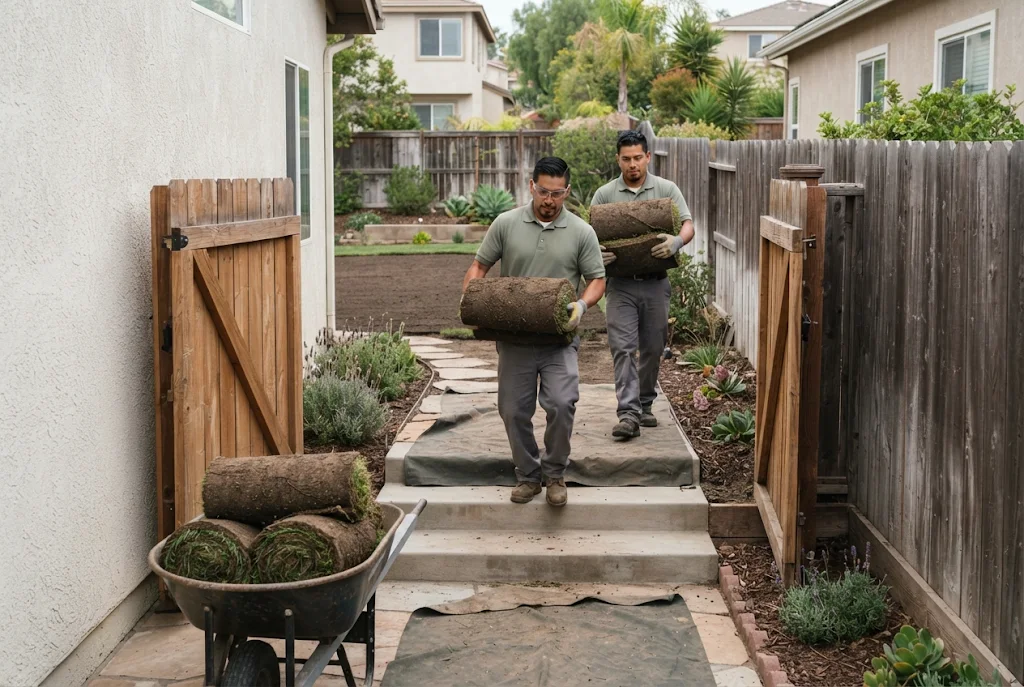
Hillside grading, staked rows, runoff-conscious watering, and sod carried in by hand through a side gate all change how a lawn is installed. We work out those details at the site visit so installation day runs smoothly.
What If Your Yard Is Only Reachable Through a Side Gate or Steps?
Restricted access is one of the most common reasons a Laguna Beach sod job takes more planning than the lawn size alone would suggest. Every square foot of sod, every load of soil amendment, and every scrap of removed turf has to travel between the street and the lawn. When that path is a narrow side yard, a set of garden steps, or a gate too small for equipment, the work shifts from machines to hand labor.
Moving Material In and Out
Freshly cut sod is heavy and perishable, so it should be installed as soon as possible after delivery, ideally the same day it arrives. On a restricted-access property, we plan where the pallets will be staged, how pieces will be carried or wheeled to the lawn, and how many people that will take. Old turf and soil coming out of the yard follow the same route in the other direction, which affects disposal time as well.
Parking and Staging on Tight Streets
Some neighborhoods have narrow streets, limited curb space, or driveways that cannot hold a pallet without blocking the garage. We ask about parking and delivery space during the estimate so the installation day does not depend on guesswork.
Protecting the Rest of the Property
Carrying material through a finished landscape means protecting what is already there. We look at the walkway surfaces, planting beds, and hardscape along the route and plan to keep them clean and intact. Equipment that cannot fit through the gate stays out of the yard, and work that would normally be done by a machine, such as stripping old turf, may be done with smaller tools instead.
None of this is unusual, and it does not mean a compact or hard-to-reach yard is a poor candidate for sod. It does mean the access route belongs in the estimate from the start, which is why we ask for photos of the path to the lawn, not just the lawn itself.
What Do We Check During a Laguna Beach Lawn Assessment?
Our site visit is designed to answer two questions: what needs to happen before sod can succeed in this yard, and how much work that involves. The visit covers the following points.
- Lawn size and shape. We measure the area and note curves, narrow strips, and edges that require extra cutting and fitting.
- Access. Gates, steps, slopes along the route, distance from the street, and where delivery and disposal can be staged.
- Existing turf and weeds. What is growing now, how thoroughly it has to be removed, and whether aggressive grasses need extra attention.
- Soil condition. Compaction, texture, rocks or construction debris, and whether amendment is likely to help.
- Slope and grade. How steep the lawn is, which way water moves across it, and whether the surface drains away from the house.
- Drainage. Low areas, soft ground, and signs that water collects after irrigation or rain.
- Sprinkler coverage. Head type and spacing, zone layout, damaged or sunken heads, overspray onto paving, and the controller.
- Sun, shade, and use. How many hours of direct light each part of the lawn receives and how the space will be used day to day.
Some of what we find can be handled as part of normal preparation. Other items, such as a major irrigation repair or a significant regrading need, may be separate work. We would rather point those out at the assessment than discover them halfway through the installation.
Which Grass Fits Your Yard’s Sun, Shade, and Foot Traffic?
The best grass for a Laguna Beach lawn depends on the specific yard rather than the city as a whole. Sun exposure, foot traffic, and the irrigation available all influence which sod will hold up, and a single property can have more than one set of conditions.
Sun and Shade Across the Day
A lawn that faces open sky most of the day behaves differently from one shaded by the house in the afternoon or by mature trees through midday. Bermudagrass, for example, generally performs best in full sun and struggles in shade, while St. Augustinegrass and tall fescue usually tolerate partial shade better. Where a section of the yard receives very little direct light, no lawn grass may perform well, and we would recommend a different treatment for that area instead of sod that will thin out.
Foot Traffic and Use
A backyard where children and pets play daily needs a grass that recovers from wear. A front lawn that mostly frames the house can lean toward appearance and lower water demand instead.
Irrigation and Seasonal Color
Warm-season grasses often slow down and lose some color in cooler months, while cool-season tall fescue tends to stay greener through winter but typically needs more water during summer heat. How well your sprinkler system covers the lawn, and how much you are willing to water, belongs in the decision. Our guide to grass types suited to Southern California compares the common options in detail, and we are happy to talk through which one fits each part of your yard during the visit.
Ready for a Natural Grass Lawn That Fits Your Laguna Beach Yard?
Call (888) 601-1117 or email info@landscaper-near-me.com to discuss your lawn, or request a callback and we will reach out to review the access, sprinklers, and grass options with you.
What Happens on the Day of Your Laguna Beach Sod Installation?
Once the assessment is done and any irrigation or drainage corrections are made, the installation itself follows a predictable order. On many residential lawns, the sod can be laid in a single day, although removal and soil preparation may take place over one or more earlier visits depending on the yard.
1. Remove the Existing Turf
Where there is an existing lawn, we strip it along with its root mat and remove the debris. On restricted-access properties, this step is often done with smaller equipment or by hand.
2. Prepare the Soil Surface
The soil is loosened where it is compacted, amended when the site calls for it, and raked to a smooth grade. The finished surface is set slightly below adjoining walkways, patios, and edging, roughly the thickness of the sod, so the new lawn sits flush instead of forming a raised lip. Sprinkler heads are adjusted to the future lawn height at this stage.
3. Lay and Fit the Sod
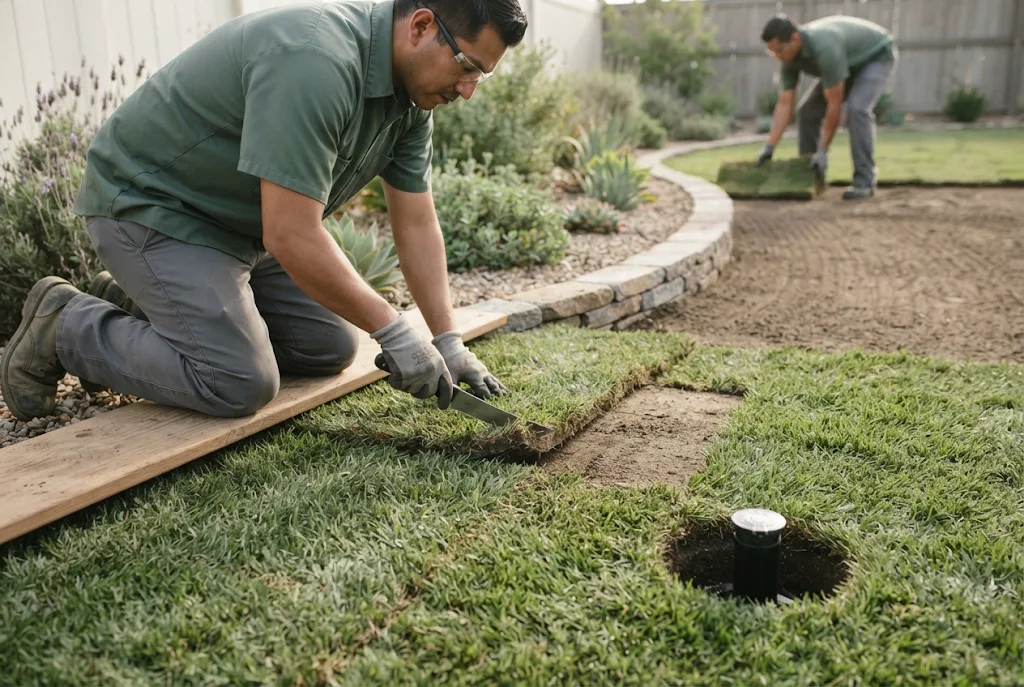
We start along a straight edge, such as a walkway or driveway, and lay each piece tight against its neighbor without overlapping or stretching it. Seams are staggered, and pieces are cut cleanly to fit around planting beds, curves, stepping stones, and sprinkler heads. Small gaps along borders are where new sod dries out first, so careful fitting matters most at the edges.
4. Settle and Water
The installed sod is pressed into firm contact with the soil, often with a lawn roller, and then watered thoroughly so moisture reaches the soil beneath it. That first deep watering is what starts the roots growing downward.
How Should New Sod Be Watered and Cared for in the First Weeks?
New sod needs steady moisture while its roots grow into the soil below. Early on, that usually means watering often enough to keep both the sod and the soil directly beneath it moist. As roots develop, watering shifts toward less frequent, deeper cycles that encourage the lawn to root deeper.
Adjust Watering to the Site and Local Rules
A sloped lawn, a sunny strip beside a wall, and a shaded corner will not dry out at the same rate, so a single schedule rarely suits every zone. Watering also has to follow the rules set by your water provider. Much of Laguna Beach is served by the Laguna Beach County Water District, while South Laguna is served by the South Coast Water District, and each sets its own restrictions. For example, the Laguna Beach County Water District’s year-round water use rules prohibit sprinkler irrigation between 8 a.m. and 8 p.m., prohibit runoff, and call for systems to stay off during and after measurable rain. Hand watering with a hose fitted with an automatic shut-off nozzle is exempt from those hours, which can help when a section of new sod dries during a warm afternoon. Rules can tighten during declared water shortages, so we recommend confirming the current requirements with your provider before installation.
Limit Foot Traffic and Check Before the First Mow
Keep people and pets off the new lawn as much as possible while it roots, since footsteps on wet sod leave depressions and can shift seams. Before the first mowing, gently lift a corner of a piece. If it resists, the roots are taking hold, and the lawn is usually close to ready. If it lifts freely, give it more time. For a day-by-day walkthrough of watering, mowing, and early fertilizing, see our article on how to care for newly laid sod.
What Affects Sod Installation Estimates in Laguna Beach, and How Do You Request One?
Sod installation estimates in Laguna Beach are shaped more by the site than by the grass. Two lawns with the same square footage can involve very different amounts of work, which is why we base estimates on what we see in the yard instead of a flat rate. The factors that most often affect the scope include:
- Lawn area, along with how many curves, narrow strips, and borders the sod has to be fitted around.
- Turf removal and disposal, including how much old lawn and soil leave the property and how far it has to be carried.
- Access, such as side gates, steps, a long distance from the street, or limited parking for delivery.
- Soil preparation, from loosening compacted ground to amending and grading a hillside lawn.
- Slope, which can add staking, extra care at the seams, and closer attention to drainage.
- Sprinkler issues that need to be repaired or adjusted before the sod goes down.
- Grass selection, since sod varieties differ in cost and availability.
What to Send With Your Estimate Request
A few details help us understand your yard before the visit and make the conversation more useful:
- Approximate lawn dimensions, even rough measurements or a simple sketch
- Photos of the lawn, plus the path from the street to the lawn
- Access details such as gate width, steps, and where a delivery could park
- Any known drainage problems, soggy areas, or spots that stay dry
- Known sprinkler issues, such as broken heads or zones that do not seem to work
Whether you are starting a new lawn on bare soil or replacing tired turf in a hillside yard, a good result depends on solving the site’s problems before the sod arrives. To request a free estimate for sod installation in Laguna Beach, CA, call Landscaper-Near-Me.com at (888) 601-1117, email info@landscaper-near-me.com, or request a callback, and we will arrange a time to look at your yard and talk through the options.
FAQ's - Frequently Asked Questions
Yes. A slope can be too steep to mow safely or too steep to water without constant runoff. Moderate slopes can usually be sodded with rows laid across the hill and pinned in place. Where a bank is very steep, we may suggest a groundcover or other planting instead, and we will explain why during the visit.
Not always. We do need clear access to the yard, gates unlocked, and the sprinkler controller available so we can water the new sod. Many homeowners prefer to be there at the start of the day to confirm details and again at the end to go over the watering plan.
Light use is usually fine once the sod has rooted firmly, which you can check by gently lifting a corner. Until then, keep traffic to a minimum. Heavy play and digging pets are hardest on new sod, so a little extra patience helps the lawn settle evenly.
That is the goal. We grade the soil slightly below adjoining paving and edging, roughly the thickness of the sod, so the finished lawn sits flush. Existing hardscape that is uneven or settled may limit how perfectly the lawn can meet it, and we will point that out ahead of time.
Often, yes. A failed section can be replaced when the rest of the lawn is healthy and the cause of the damage has been corrected. Keep in mind that new sod may differ in color or texture from older grass at first, especially if the original variety is hard to match.
When turf removal is part of the project, hauling away the old lawn, roots, and excess soil is included in the scope we outline. On properties with steps or a narrow side yard, that material is carried out by hand, which we factor into the estimate.
Some grasses tolerate partial shade better than others, so a lightly shaded area may still support a lawn. Deep, all-day shade is a different matter. In those spots, we may recommend a shade-tolerant groundcover or mulch instead of sod that will thin out.
Yes, for the first few weeks, because the roots are short and the soil beneath them dries quickly. Watering is then reduced as the lawn establishes. All watering still has to follow your water provider’s rules, including restrictions on watering hours and runoff, so we plan the schedule with those in mind.