
Tree Removal Whittier CA – Free Estimates
Searching for Tree Removal Whittier CA usually means a decision is already taking shape. A tree has died, dropped a heavy limb, started leaning toward the garage, or simply stands where a patio or new planting is supposed to go. Before anyone starts cutting, the useful questions are practical ones: does this tree really need to come down, who has authority over it, what will the work involve on this particular lot, and what will the estimate cover?
At Landscaper-Near-Me.com, we help Whittier homeowners, rental and multifamily managers, HOA representatives, and commercial property managers work through those questions by connecting them with relevant tree removal providers for an on-site look and a free estimate. This page explains how local tree removal in Whittier is typically evaluated, which site conditions carry the most weight, and what to have ready before you call. Our overview of tree removal services covers how removals are generally carried out; here we concentrate on the access, boundary, and jurisdiction details that come up on Whittier properties.
The short version:
- Symptoms alone do not settle whether a tree should be removed. An on-site assessment does, and it sometimes points to pruning instead.
- Ownership and jurisdiction should be confirmed before work is scheduled, especially for parkway trees and trees on a shared boundary.
- Access, nearby structures, and overhead lines shape the work as much as the size of the tree.
- Hauling, cleanup, and stump work belong in the estimate only when they are written into the scope.

Request a Free Tree Removal Estimate in Whittier
Tell us about the tree, where it stands, and what concerns you. We will help connect you with a tree removal provider who can assess it on site and prepare a free estimate. Call (888) 601-1117 or request a call back.
Tree Removal Whittier CA: When Should You Request an Assessment?
Request an assessment when a tree’s condition or position has changed in a way you cannot judge from the ground. You do not need to have decided that the tree must go. The purpose of the visit is to find out.
Requests for an assessment generally fall into four groups:
- Dead or declining trees. A canopy that failed to leaf out, large sections of bare wood, or bark separating from the trunk. This is the usual starting point for dead tree removal in Whittier.
- Storm and wind damage. Split limbs, branches hanging in the canopy, or a root plate that has shifted after strong winds. Damaged tree removal in Whittier is not always a full removal, which is one reason the tree should be looked at before a scope is set.
- Structural concerns. A lean that was not there before, cracks where major stems meet, or soil lifting on one side of the base.
- Conflicts with buildings or planned improvements. A trunk pressing against a wall, limbs resting on a roof, or a tree standing in the footprint of an addition, driveway, or redesigned yard.
None of these signs proves that removal is necessary. Some trees that look alarming are stable, and some that look ordinary have serious defects, so we do not diagnose a tree from a description or a few photographs. What we can do is help you get a qualified provider on site.
One caution applies before any appointment. If a tree or large limb has already come down on a structure, is blocking a street, or is in contact with power lines, keep people away from it and contact the utility or emergency services as the situation requires.
Tree Removal Versus Pruning: Does the Whole Tree Have to Come Down?
Not always. A careful look at tree removal versus pruning sometimes shows that the problem is limited to specific limbs while the trunk and root system remain sound. In those cases, a provider may recommend keeping the tree and correcting the part that is causing concern.
Dead branches are the clearest example. When the dead wood is scattered through an otherwise living canopy, deadwood removal through selective pruning can reduce the chance of falling limbs without sacrificing the shade and screening the tree provides. Limbs that crowd a roofline or hang over a neighbor’s yard can often be handled the same way.
Retention has limits, and an honest assessment will say so. Removal is more likely to be the recommendation when most of the canopy has died, when the trunk or root system is compromised, or when the tree’s location cannot be reconciled with a structure or an approved construction plan.
If pruning turns out to be the better fit for your tree, our page on tree trimming in Whittier explains that service in detail. During the visit, it is reasonable to ask:
- What specifically makes removal the recommendation for this tree?
- Would pruning address the concern, and for roughly how long?
- If the tree stays, what should we watch for afterward?
Who Has Authority Over the Tree? Ownership and Jurisdiction Checks in Whittier
Before work is scheduled, confirm two things: who owns the tree, and which agency’s rules apply to the property. Both are easier to sort out at the start than after a crew has been booked.
Is the Tree Private, Shared, or in the Parkway?
A tree whose trunk stands entirely inside your lot is normally yours to manage, subject to any local rules. A trunk that straddles the property line is a different matter. Ownership may be shared, and the sensible first step is a conversation with the neighbor and a clear agreement before anyone requests removal.
Parkway trees, the ones growing in the strip between the sidewalk and the curb, should not be treated as private trees. Inside city limits, the Parks, Recreation and Community Services Department oversees them, and the City of Whittier parkway tree information states that a permit is needed to plant, trim, or remove one. The City has also had its parkway tree rules under review, so ask the Parks Division what currently applies instead of relying on what a neighbor did a few years ago.
Is the Property in the City of Whittier or Unincorporated Los Angeles County?
A Whittier mailing address does not answer this question. Communities such as West Whittier-Los Nietos and South Whittier are unincorporated, which makes Los Angeles County the responsible authority there. County requirements can differ from the City’s and may include protections for certain trees, such as oaks.
Managed properties have another layer. An HOA’s governing documents, a lease, or an ownership group’s approval process may control whether a tree in a common area can be removed and who signs off. We cannot tell you whether authorization is required for a particular tree. The responsible agency or association can, and it is worth getting that answer in writing.
Is Your Tree Close to a Fence, Roofline, or Narrow Side Yard?
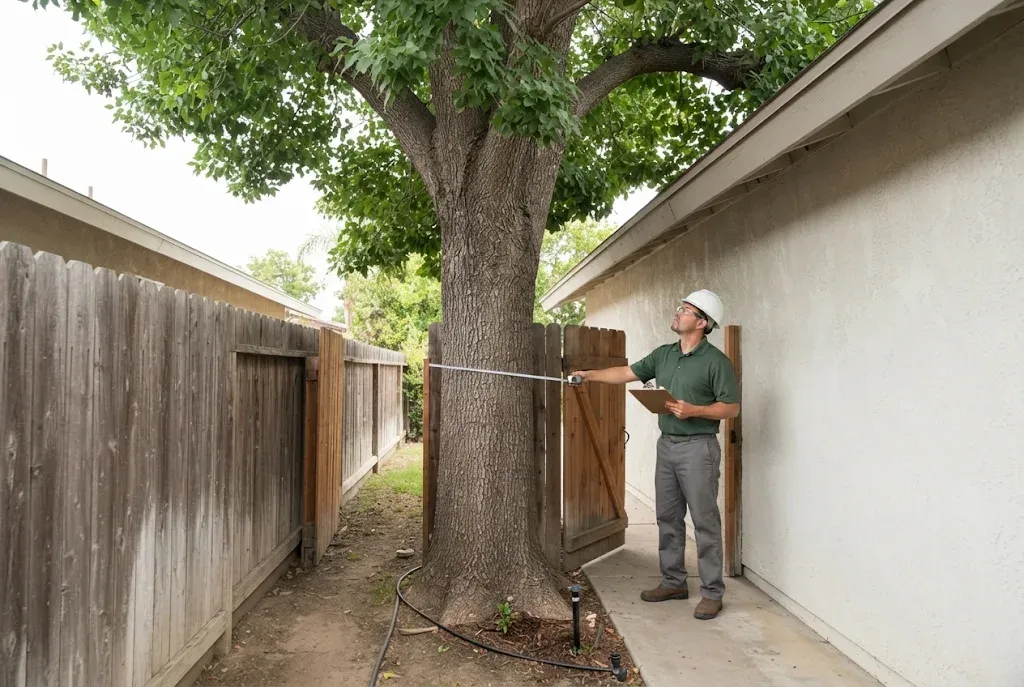
Tight access and nearby structures deserve an on-site look before anyone quotes the work. Share your gate width, a few photographs, and what sits beneath the canopy, and we will help line up a provider who can plan around them.
What Does a Provider Evaluate on Site Before Quoting a Removal?
A site visit looks at the tree and at everything within reach of it. Two trees of the same species and height can call for very different plans depending on what stands underneath and beside them.
The Tree Itself
Height, trunk diameter, canopy spread, and the number of main stems establish how much material has to be handled. Condition matters just as much. Sound wood behaves predictably when it is cut and lowered. Dead or decayed wood may not, and that affects how a provider plans the work.
Structures, Fences, and Working Space
Tree removal near fences and buildings depends on where cut sections can safely be brought to the ground. A provider will note rooflines, block walls, wood fences, patio covers, pools, sheds, and anything on the neighboring lot that sits under the canopy. They will also look for open ground where material can be staged.
Planting, Irrigation, and Paved Surfaces
Sprinkler heads, drip lines, valve boxes, lawn, pavers, and established shrubs are easy to overlook and easy to damage. Point them out during the visit so protecting them becomes part of the plan and not an afterthought.
Overhead Utilities
Lines running through or beside a canopy change the job. Work close to energized power lines is restricted to people qualified for it, and the electric utility may need to be involved before removal can proceed. Southern California Edison serves much of the Whittier area. If you believe a tree is growing into power lines, raise it with the utility directly and mention it when you request an estimate.
How Do Tight Lots and Backyard Access Change the Job?
Access decides how the wood leaves the property, and that shapes the crew, the equipment, and the time involved. A front-yard tree beside an open driveway is one kind of project. Backyard tree removal in Whittier, where the only route out may be a side gate, is another.
Our page on tree cutting services describes how a tree is generally taken apart in sections. On a constrained lot the sequence is similar, but each step is governed by the space available. Several situations come up repeatedly on Whittier properties:
- Established yards. A tree planted decades ago may now be surrounded by a room addition, a patio cover, mature hedges, and a neighbor’s garage. The yard grew up around it, and little open ground remains.
- Restricted access between buildings. Tree removal with limited yard access often means cutting smaller pieces and carrying them out by hand through a narrow side yard, a gate, or a courtyard passage.
- Shared boundaries. When part of the canopy extends over the adjoining property, the provider may need the neighbor’s permission to enter or to lower material on that side.
- Driveways, parking areas, and pedestrian routes. On multifamily, HOA, and commercial sites, stalls and walkways under the tree may need to be closed for a time, with notice to tenants and visitors.
- Sloped ground. On hillside lots, footing and the path for moving wood become part of the planning.
None of this makes a removal impractical. It does mean the provider should see the route as well as the tree, so measure the gate opening and mention steps, slopes, and low eaves when you first get in touch.
What Goes Into Tree Removal Estimates in Whittier?
An estimate reflects the specific tree and the specific site, which is why we do not publish price lists. A figure offered without seeing the property is a guess. The main tree removal cost factors are consistent, though, and knowing them makes an estimate easier to read:
- Tree dimensions. Height, trunk diameter, and canopy volume.
- Condition. Whether the wood is sound, dead, or storm-damaged.
- Accessibility. The distance and obstacles between the tree and the street.
- Surrounding obstacles. Structures, fences, utilities, and landscaping within reach of the canopy.
- Removal complexity. How much of the tree must be lowered under control instead of dropped into open space.
- Debris handling. Whether branches and wood are hauled away, chipped, or left on site.
- Agreed scope. Everything beyond taking the tree down, covered in the next section.
These factors explain why a modest tree wedged between a house and a block wall can be quoted higher than a larger one standing in an open lawn. They also explain why estimates from different providers are comparable only when they describe the same scope.
Knowing what to ask before approving a tree removal estimate matters as much as the number at the bottom. Estimates arranged through Landscaper-Near-Me.com are free, and reviewing one does not commit you to the work.
Know What Your Whittier Tree Removal Will Involve Before You Approve It
Have questions about scope, stump options, or authorization? Talk them through with us first. Call (888) 601-1117 or email info@landscaper-near-me.com, and we will help you get a clear, written scope and a free estimate to review.
What Does the Estimate Include? Confirming Scope in Writing
An estimate includes only what it states. Most disagreements after a removal trace back to an item one side assumed and the other never priced. Before approving anything, check whether each of these is addressed:
- Branch and trunk removal. Is the whole tree coming down, and at what height will the trunk be cut?
- Hauling. Will all branches, logs, and chips leave the property, or will some remain?
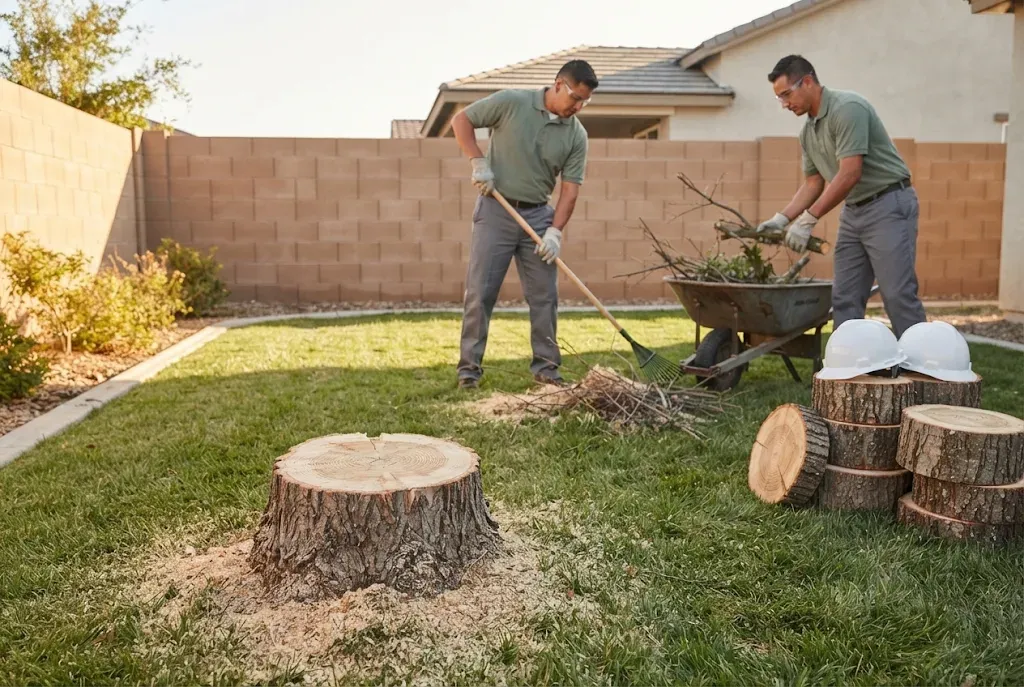
- Cleanup. Does it cover raking and blowing the work area, including the neighbor’s side where material fell?
- Stump treatment. Is the stump staying, and if not, what is being done with it?
- Surface restoration. Is any repair of lawn, soil, or paving included?
Do not assume these items are included or that every provider offers them. Ask for each one to be listed as included or excluded.
Stump and Root Work Are Separate Questions
Removing a tree above ground leaves a stump and a root system below it. What happens next can take several forms, and they are not interchangeable:
- Stump grinding uses a machine to reduce the stump to chips, typically to a point below the surrounding grade. The larger roots stay in the ground.
- Stump excavation digs out the stump and the root mass attached to it. It disturbs more soil and needs more room to work.
- Root work addresses individual roots away from the stump, such as those running beneath a planned patio or planting bed.
Each requires its own scope confirmation, and we treat stump work as a question to raise during the estimate, not as a service to presume. Understanding stump grinding versus stump removal before the site visit helps you ask for the result you want.
How Should You Prepare the Property Before the Crew Arrives?
Good preparation starts with information and ends with a clear path to the tree. The more a provider knows beforehand, the more useful the first visit will be.
Information and Photographs to Provide
- The property address and whether it lies in the City of Whittier or an unincorporated area.
- Photographs of the whole tree, the base of the trunk, and the specific concern.
- Photographs of the route from the street to the tree, including the gate, with its width.
- Anything under or beside the canopy: structures, fences, lines, pools, and planting.
- What you want to end up with, and whether the tree is yours, shared, or possibly in the parkway.
Access and Movable Items
On the day of the work, move vehicles out of the driveway and away from the curb near the tree. Clear patio furniture, potted plants, play equipment, and anything fragile from the work area and the access route. Unlock gates, secure pets indoors, and flag sprinkler heads you want protected.
Coordinating With Occupants and Managers
For rentals, multifamily buildings, and commercial sites, tell tenants in advance which parking stalls, walkways, or entrances will be affected and for how long. Let adjoining neighbors know as well, particularly if access to their side is needed. Property managers should have any owner or HOA approval settled and name an on-site contact who can make decisions if a question comes up.
What Will the Site Look Like Afterward, and What Comes Next?
Expect the site to look unfinished unless the scope says otherwise. Where only above-ground removal was agreed, a stump will remain, usually with sawdust and disturbed soil around it. Even after grinding, roots stay in the ground and the area can settle as the remaining wood breaks down.
The space will behave differently, too. Beds that sat in shade will receive full sun, a fence or a neighbor’s window may suddenly be in view, and irrigation that was set for a shaded area may need adjusting.
For those reasons, planning landscape restoration after tree removal deserves a separate conversation. Replacement planting, regrading, or new lawn should be assessed on their own once you can see the cleared site. If you are still unsure whether removal, pruning, or another service fits your situation, our guide to tree service options compares them.
Whether you are arranging residential tree removal in Whittier for a single backyard tree or coordinating work across a managed property, the next step is the same: describe the tree, the access, and what you want the site to look like afterward. To discuss Tree Removal Whittier CA with us, call (888) 601-1117, email info@landscaper-near-me.com, or use the Request Call Back button on this page. We will help connect you with tree removal services in Whittier suited to your property and arrange a free estimate.
FAQ's - Frequently Asked Questions
It depends on the size of the tree, how easily the crew can reach it, and how much has to be lowered in sections. Some removals are finished within a day, while larger or harder-to-reach trees can take longer. The provider preparing your estimate should give you an expected timeframe for your tree, along with anything that could extend it.
Not on your own decision. When a trunk stands on the boundary, ownership may be shared, so talk with your neighbor and reach a clear agreement before requesting removal. If the two of you disagree about ownership or responsibility, get appropriate legal guidance before any work is scheduled.
That is between you and the provider. Many property owners choose to be present at the start to confirm the scope and walk the access route. If you cannot be there, make sure gates are unlocked, pets are secured, vehicles are moved, and the crew has a phone number where you can be reached.
Removal can generally be scheduled in any season here. Weather, provider availability, and site conditions are the usual variables. Nesting birds or other wildlife in the canopy can also affect timing, so mention any activity you have noticed. If you have a concern about the tree’s stability, do not wait for a particular season to have it assessed.
Some disturbance is possible wherever heavy wood and equipment move across a yard. You can reduce the risk by pointing out sprinkler heads, drip lines, valve boxes, and delicate surfaces during the site visit and asking how they will be protected. Also confirm in writing whether any repair of lawn or paving is part of the scope.
Often, yes, but ask before the estimate is written. Leaving logs or chips on site changes the hauling portion of the scope, and the provider will want to know where the material should go and what lengths you would like the wood cut to.
Stay clear of it and do not attempt any cutting yourself. Contact the electric utility that serves the property, which is Southern California Edison for much of the Whittier area, and report the situation. If a line is down or the tree is in contact with one and there is immediate danger, call 911. Let us know about the lines when you request an estimate as well.
Yes. We help HOA representatives and managers of rental, multifamily, and commercial properties connect with tree removal providers and arrange free estimates. It helps to have a site map or photographs, the location of affected parking and walkways, and confirmation of who can authorize the work.