
Commercial Landscapers Irvine CA
for Office, Retail, and Industrial Properties
Most people who search for Commercial Landscapers Irvine CA are not looking for a brochure. They manage an occupied property, something about the grounds needs attention, and they want to know what a maintenance scope should include before they ask anyone for a number. This page is written for that situation.
Through Landscaper-Near-Me.com, we help commercial property owners, property managers, and facilities managers describe the work their site needs and connect with providers suited to it. Our focus here is recurring grounds maintenance in Irvine for office parks and business campuses, retail centers, mixed-use commercial properties, and light industrial sites, along with the targeted improvements that sometimes sit beside a maintenance agreement. The property examples below are illustrative scenarios, not descriptions of specific addresses, and they are meant to help you recognize your own site in them.
If you already know what you need, requesting a free estimate is the quickest next step. If you are still sorting it out, start with the scope.

Request a Free Estimate for Commercial Landscape Maintenance in Irvine
Tell us the property type, the areas you need maintained, and the visit frequency you have in mind. We will follow up to discuss a recurring maintenance scope for your Irvine office park, retail center, mixed-use, or light industrial site. Call (888) 601-1117 or request a call back below.
Commercial Landscapers Irvine CA: What Does a Recurring Maintenance Scope Cover?
A recurring scope is the list of tasks a crew performs on every scheduled visit, written clearly enough that you could walk the property afterward and check the work. For most occupied sites, commercial landscape maintenance in Irvine is built from four routine tasks:
- Turf mowing and edging, where turf exists. Lawn areas are cut to a consistent height and edged along walks, curbs, and bed lines so the boundaries stay crisp. Plenty of commercial properties have little or no lawn, and the scope should say so instead of carrying a line item nobody needs.
- Planting-bed upkeep. Weeds are pulled or treated, groundcover is kept off the pavement, and spent growth is cleared so the beds look intentional.
- Shrub pruning. Shrubs and hedges are trimmed to hold their shape, stay clear of signs, windows, lights, and walkways, and keep sight lines open at driveways.
- Landscape debris cleanup. Clippings, fallen leaves, and litter caught in planted areas are collected and hauled away, and hard surfaces are cleared before the crew leaves.
Everything beyond those four is a decision. Irrigation checks, seasonal color, mulch, and plant replacement can be folded into the recurring visit, billed separately, or left out, and a sound scope states which. Our commercial landscape services page describes the broader range of work available for commercial sites. Where lawn makes up a large share of the grounds, our commercial lawn care services page goes further into mowing, edging, and turf health.
Why the written scope matters before the price
Two proposals for the same property can sit far apart in price simply because they describe different work. One may assume weekly visits with bed weeding included. Another may assume fewer visits and treat weeding as an extra. Settling the areas, the tasks, and the frequency first is what makes the numbers comparable.
How Do Maintenance Priorities Shift Across the Irvine Business Complex?
They shift with how each property is used. The City of Irvine describes the Irvine Business Complex, on the northwest side of the city, as a mix of office, industrial, residential, and mixed-use properties. That variety makes it a useful reference point, because a manager with buildings in the district may be responsible for three quite different landscapes within a short drive of one another.
Offices: tenant-facing entrances and courtyards
Landscape maintenance for office parks and business campuses usually concentrates effort where tenants and their visitors actually walk. Picture a multi-tenant office building with a planted entry plaza and a shaded courtyard where employees eat lunch. The entry beds, the route from the parking structure, and the courtyard seating area deserve attention on every visit. The slope behind the trash enclosure does not need the same finish. Office park landscaping in Irvine rewards that kind of prioritizing: hedges held below the window sills, walkways cleared before the workday starts, and no sprinklers running across the paths people take to the lobby.
Light industrial: perimeter beds and loading-area approaches
Grounds maintenance for industrial parks and distribution facilities is driven less by appearance and more by access. Consider a light industrial building with a street-facing landscape strip, perimeter beds along the fence line, and a truck court at the rear. The frontage still shapes a visitor’s first impression, so it receives regular bed care or mowing. Along the perimeter and near the loading-area approaches, the job is different. Shrubs must not narrow the drive aisles, branches must stay clear of trailers, and drivers need an open view where trucks exit to the street. Crews also need to know when the docks are busiest so their equipment is never parked in a truck’s path.
Mixed-use: several audiences on one site
A mixed-use commercial property combines these demands. Ground-floor businesses want clean, open frontage. Occupants upstairs notice noise and timing. Shared walkways carry foot traffic all day. Scopes for these sites often divide the property into zones, each with its own standard and its own work window.
What Do Retail Centers Need From a Landscape Crew?
Retail centers need landscaping that never comes between a customer and a storefront. That sounds obvious, yet it explains most of what a retail scope contains. Shrubs and trees near monument signs and tenant signage are pruned so the names stay readable from the street and the parking lot. Parking-lot islands are kept tidy and low enough that drivers can see pedestrians and cross traffic. Planters beside the entries are maintained closely because shoppers pass within a few feet of them.
Timing matters as much as technique. Mowers, blowers, and running sprinklers are a nuisance, and sometimes a hazard, when the lot is full, so retail work is commonly scheduled before stores open. Wet walkways deserve particular care at a shopping center, where overspray lands on the same pavement customers cross with carts and children. For a closer look at this property type, see our page on shopping center landscape maintenance.
Commercial property landscaping in Irvine spans all of these settings, and one manager may oversee more than one of them. Writing a short scope for each property type, instead of a single generic document, usually produces clearer proposals and fewer surprises once service begins.
Dry Patches or Wet Walkways? Have the Irrigation Looked At
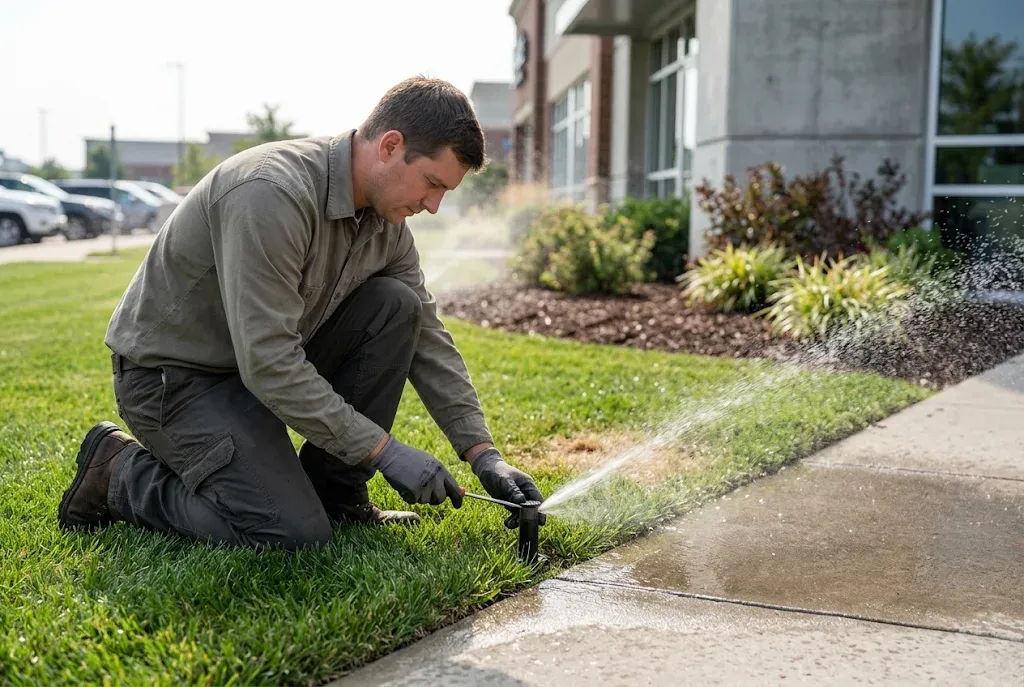
Stressed turf, overspray on pavement, and uneven coverage rarely fix themselves. Describe what you are seeing and where, and we will help you decide whether an irrigation assessment or a targeted repair belongs in your maintenance scope.
Which Turf and Planting-Bed Symptoms Point to an Irrigation Problem?
Three symptoms account for most irrigation complaints on commercial sites: dry patches, overspray onto walkways, and uneven coverage. Each leaves evidence in the landscape long before anyone opens a valve box.
- Dry patches. A brown or thinning area in otherwise healthy turf often traces to a single head that is clogged, tilted, sunken, or blocked by growth, or to a zone that runs for less time than its neighbors.
- Overspray onto walkways. Wet pavement after a cycle, water stains on walls and fences, and runoff along the curb suggest heads that are misaligned, set to the wrong arc, or operating at a pressure that turns spray into mist.
- Uneven coverage. Alternating lush and stressed bands of lawn, or shrubs at one end of a bed outperforming those at the other, can indicate mismatched nozzles, poor head spacing, or plants with different water needs sharing one valve.
These clues are not proof. Compacted soil, heat reflected from a sun-facing wall, foot traffic, and root competition from mature trees can each produce a dry patch with a fully functional sprinkler standing beside it. The pattern is what helps. Damage that follows the shape of a spray arc points toward irrigation, while damage that follows a shortcut path or a shade line points somewhere else.
The cost of ignoring a real fault is easy to underestimate. The Irvine Ranch Water District, which serves Irvine, notes in its landscape and irrigation tips that a single broken or missing sprinkler part can waste as much as 1,000 gallons of water in a week. On a property with many zones, a few unnoticed failures show up both on the water bill and in the condition of the plants.
When Should an Irrigation Assessment or Targeted Repair Be Part of the Scope?
Add an assessment when symptoms repeat, spread, or appear in several zones. Ask for a targeted repair when the cause is visible and isolated. A broken head beside a driveway, clipped by a delivery vehicle, is a repair. Dry turf across half the frontage with no obvious damage is a question, and an assessment is how it gets answered.
An irrigation assessment generally means running the system one zone at a time and recording what is found: heads that fail to rise, leaks, blocked or misdirected spray, areas with no coverage, and controller schedules that do not match the plantings. The result is a list of findings a property manager can rank and budget for, which is far more useful than a general remark that the system needs work.
How this fits into a maintenance agreement varies. Some scopes include a visual check during regular visits and bill repairs as they arise. Others schedule periodic inspections as a defined task. When you send a request, tell us which irrigation concerns you already know about and whether you would like the system evaluated before or alongside recurring service. Our commercial irrigation services page covers assessments, repairs, and system work in more depth.
What Belongs in the Recurring Contract and What Is Scoped Separately?
Recurring work keeps the existing landscape in its current condition. Improvements change that condition. Keeping the two apart on paper prevents the most common disagreement in commercial maintenance, which is an owner expecting a result the recurring price was never built to deliver.
Three improvements come up often on occupied properties:
- Replacing declining plants. Shrubs that have thinned, died back, or outgrown their space leave gaps routine pruning cannot fix. Replacement is quoted by quantity, size, and species, ideally after someone has asked why the originals struggled.
- Refreshing mulch. Mulch breaks down and thins with time. Topping it up restores a finished look, helps the soil hold moisture, and discourages weeds, but it is a material-and-labor project and not part of a normal visit.
- Restoring worn turf. Lawn damaged by foot traffic, shade, or a past irrigation failure may need renovation or new sod. If the underlying cause is still present, restoration should wait until it has been corrected.
Separately scoped does not have to mean separately managed. Many property managers prefer one provider for both, with improvements proposed as individual line items they can approve or defer as budgets allow. What matters is that each item carries its own description and its own price.

Put a Clear Maintenance Scope in Place for Your Irvine Property
You know which areas matter, when crews can work, and what has been bothering you about the grounds. Share those details with Landscaper-Near-Me.com by phone at (888) 601-1117, by email at info@landscaper-near-me.com, or through a call back request, and we will take it from there.
How Often Should a Commercial Property in Irvine Be Serviced?
There is no single correct interval. Visit frequency should follow site conditions, what is planted, and how the property is used, and any proposal that names a frequency ought to be able to explain it.
Site conditions come first. A property with broad lawn panels needs more frequent attention during active growth than one planted mainly with shrubs and groundcover. Trees that shed heavily, exposed corners that collect windblown litter, and slopes that are slow to work all affect how long a visit takes and how soon the next one is due.
Planting needs come next. Formal hedges lose their lines quickly and call for regular shearing, while naturalistic or drought-tolerant plantings may need less frequent but more selective pruning. Seasonal color, where it is used, runs on a replacement calendar of its own.
Property use often settles the question. A retail center or a prominent office lobby is judged daily by customers and tenants, so managers there tend to choose tighter intervals. A light industrial site with limited public exposure may be well served by fewer visits concentrated on the frontage and on keeping access clear.
Seasonal priorities
The mix of tasks changes across the year even when the schedule does not. Warm, dry months put irrigation performance under the most scrutiny, and controller schedules generally need adjusting as temperatures and day length change. Cooler months suit corrective pruning, bed cleanup, and many planting projects. Leaf drop and windy spells create short bursts of cleanup. A scope that lets the crew rebalance its time between tasks handles these swings better than one that fixes the same minutes per task all year.
What Should You Have Ready When You Request an Estimate?
The more precisely you describe the property, the more accurate and comparable the responses will be. Requests for commercial landscape maintenance estimates in Irvine move fastest when they include the following:
- Property address and type. Office, retail, mixed-use, or light industrial, plus the approximate size of the site if you know it.
- Areas to maintain. List the turf, planting beds, parking-lot islands, slopes, courtyards, planters, and perimeter strips. Note anything excluded, such as areas a tenant or an association maintains.
- Known irrigation concerns. Dry patches, overspray, leaks, a controller nobody on site can program, or simply uncertainty about the system’s condition.
- Access restrictions. Gate codes, security check-in, locked utility areas, loading-dock activity, and where crews may park.
- Preferred work windows. Before tenants arrive, before stores open, weekdays only, or limits on noisy equipment near certain buildings.
- Desired visit frequency. State what you have now and whether it has been working. If you are unsure, say so and ask for a recommendation with the reasoning behind it.
A site map, a few photos of problem areas, and a copy of the current scope are helpful additions. They also help with the step that follows. How to compare commercial landscape maintenance proposals is a subject of its own, but it begins with confirming that each one covers the same areas, tasks, and frequency before you look at the totals.
How Does Landscaper-Near-Me.com Help Irvine Property Managers Get From Scope to Service?
We give you one place to describe the property and what it needs, and we connect that request with providers relevant to the work. For a manager weighing commercial landscaping services in Irvine, that means less time repeating the same site details and a clearer basis for judging what comes back.
Irvine is part of our service territory across Orange County and Southeast Los Angeles County. Reasons to reach out vary: a maintenance agreement for a property that has just changed hands, a second look at a landscape that has slipped, an irrigation question worth answering before the dry months, or a set of improvements to price alongside routine care. Managers responsible for several sites, or looking for ongoing oversight and not visits alone, may also want to read about commercial landscape management.
If you came here looking for Commercial Landscapers Irvine CA, the next step is short. Gather the six details listed above, decide whether irrigation or improvements should be evaluated together with routine maintenance, and send the request. Estimates are free. Call us at (888) 601-1117, email info@landscaper-near-me.com, or use a Request Call Back button on this page, and we will follow up about your property.
FAQ's - Frequently Asked Questions
Yes. Commercial maintenance is commonly scheduled early in the morning or at other low-traffic times so that mowing, blowing, and irrigation do not interfere with tenants, shoppers, or deliveries. Include your preferred work windows and any noise limits in your request so the schedule can be planned around them.
You can. Some managers need service only for the common areas, the street frontage, or one building in a larger campus. List the areas you want covered and the areas someone else maintains, and the scope can be written to match.
It depends on the agreement. Many scopes include a visual check of the system during regular visits and treat repairs as separately approved work, while others define periodic inspections as their own task. Ask for the irrigation terms to be spelled out so you know what is covered before service starts.
Usually, yes, though the visits look different. Sites planted with shrubs, groundcover, and trees still need pruning, weed control in the beds, debris removal, and irrigation oversight. Frequency may be lower than on a turf-heavy property, and the scope should reflect the plantings you actually have.
For most commercial properties a site visit produces a more reliable estimate, because areas, access, slopes, and plant condition are hard to judge from an address alone. Photos and a site map can speed things up. Let us know how to arrange access if the property is gated or has a security desk.
Yes. If you manage more than one site, list each address with its property type and any differences in scope or scheduling. Describing them together makes it easier to see where a consistent standard applies and where a property needs its own approach.
They are normally proposed as separate line items. Replacing declining plants, refreshing mulch, and restoring worn turf involve materials and labor beyond a routine visit, so each is described and priced on its own for you to approve, schedule, or defer.
No. A free estimate request is a way to describe your property and learn what a maintenance scope could look like. You decide whether to move forward after you have reviewed the information. To start, call (888) 601-1117 or email info@landscaper-near-me.com.