
Tree Trimming Anaheim CA
for Shopping Centers and Commercial Properties
Tree trimming in Anaheim, CA is rarely about one tree. At a shopping center or retail plaza, it usually starts with a list: a canopy dropping into a row of parking stalls, a pepper tree hiding the monument sign from the street, a ficus pushing toward the walkway in front of a busy tenant, and a few dead limbs nobody wants hanging over a drive aisle. Our approach to Tree Trimming Anaheim CA properties is built around that reality. We look at where trees meet cars, customers, signs, and storefronts, and we plan pruning that solves those specific conflicts without stripping the shade and character your property depends on.
This page is written mainly for property owners, retail center managers, and commercial facility managers who need a clear picture of what selective pruning involves before they request an estimate. We explain what to look for during a site walk, how we set clearance and pruning scope, how deadwood removal differs from clearance work, what information speeds up a quote, and how we coordinate work windows around deliveries, tenants, and customer traffic. Homeowners dealing with similar branch clearance or deadwood concerns over driveways and entrances will find a short section for them near the end.
If you are comparing options across the region, our main Tree Trimming Services page covers our wider approach to tree care for residential and commercial properties. The sections below focus on what matters most for commercial tree trimming in Anaheim: clearance, visibility, and scheduling that respects how your property actually operates.
Free Estimates for Tree Trimming in Anaheim, CA
Tell us which trees are crowding parking stalls, signs, or entrances at your Anaheim property. We will walk the site, define the pruning scope, and provide a free estimate. Call (888) 601-1117 or email info@landscaper-near-me.com.
What Do Anaheim Property Managers Flag During a Tree Walk?
Most requests for tree pruning in Anaheim come from something a manager, tenant, or customer noticed. The trigger is often practical rather than cosmetic: a branch scraped a delivery truck, a tenant complained that customers cannot find the storefront, or a low limb is brushing shoppers on the way to the door. When we walk a commercial property, we start with the problems people are already experiencing and then look for the ones that are developing.
Here are the kinds of conditions that typically end up on a manager’s list during a site walk:
- Branches hanging low over parking stalls, where they drip sap, drop debris onto vehicles, or force drivers to avoid certain spaces.
- Limbs extending into drive aisles or fire lanes, where box trucks, waste haulers, and delivery vans need room to pass.
- Canopies covering tenant wall signs, pylon signs, monument signs, or directional signs that guide traffic through the lot.
- Growth crowding sidewalks, ADA paths of travel, and the walkways that lead customers to building entrances.
- Branches touching or overhanging roofs, awnings, gutters, or exterior lighting.
- Dead or broken limbs visible in the canopy, especially over seating areas, cart corrals, and high-traffic stalls.
- Trees blocking light from parking lot fixtures, leaving dark patches in the evening.
Not every item on that list carries the same weight. A dead limb over an entrance deserves faster attention than a canopy that is simply getting full. Part of our job is helping you sort the list so the pruning plan addresses risk and access first, then visibility, then appearance.
How Does Tree Pruning for Sign Visibility Work Without Ruining the Canopy?
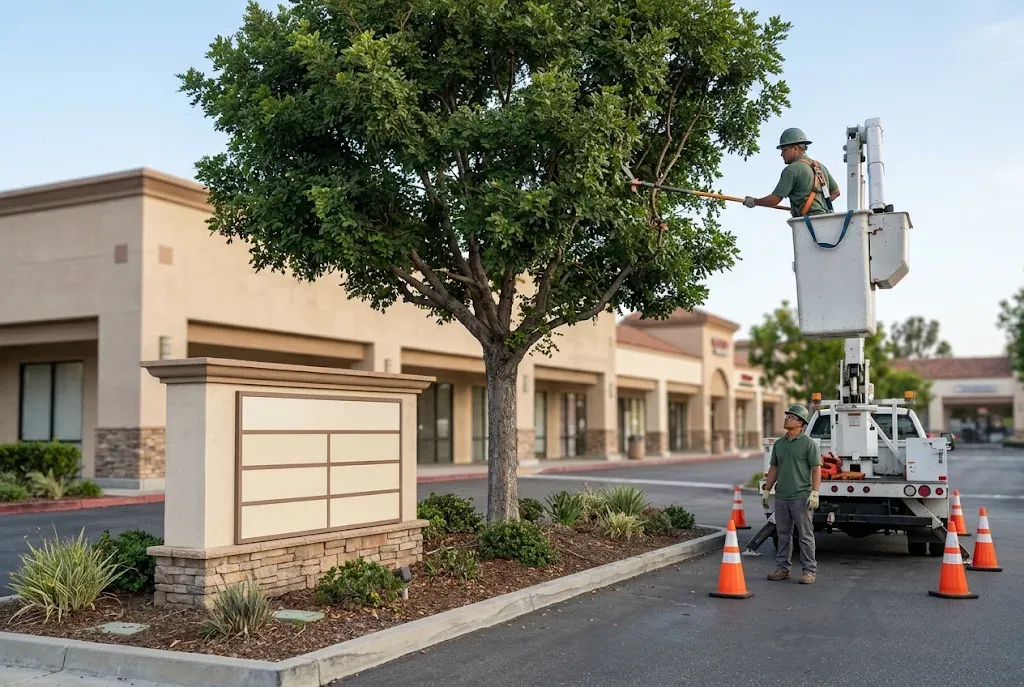
Tree pruning for sign visibility works best when it opens a sightline rather than removing a tree’s crown. The goal is to let a driver on the street or in the drive aisle see a tenant’s name at the distance where it matters, while the tree keeps enough foliage to stay healthy and keep providing shade. In most cases, that means selective thinning and targeted reduction of the specific limbs that sit between the sign and the viewer.
The wrong approach is the one many retail centers have seen: heavy heading cuts or topping that leave stubs and a flat, chopped crown. Topping tends to trigger dense, weakly attached regrowth that can block the same sign again, and those new shoots can be more prone to breaking. The UC Statewide IPM Program’s guidance on pruning landscape trees explains the difference between thinning cuts and heading cuts and why topping mature trees is discouraged.
Starting From the Viewer’s Position
We look at the sign from where customers actually see it: the travel lanes on the adjacent street, the main entry driveway, and the drive aisle facing the storefront. A sign that is clear from the sidewalk may still be hidden from a moving car. Identifying the real sightline helps us remove less wood while still improving visibility.
Balancing Tenant Expectations and Tree Health
Tenants often want their sign completely uncovered, while owners want to keep mature trees that make the center comfortable. A selective plan can usually improve visibility without over-pruning. When a tree is planted so close to a sign that only severe cutting would clear it, we will tell you so, and that conversation may shift toward longer-term options rather than repeated heavy pruning.
How Much Clearance Do Parking Stalls, Drive Aisles, and Building Entrances Need?
The right clearance depends on what moves underneath the tree. A parking stall used by passenger cars needs different clearance than a drive aisle used by delivery trucks, and a pedestrian walkway has its own requirements. Rather than applying one height across the whole property, we set clearance targets by zone, based on how each area is used and on any requirements your property, lease agreements, or local codes impose.
Parking Lot Tree Trimming Over Stalls and Drive Aisles
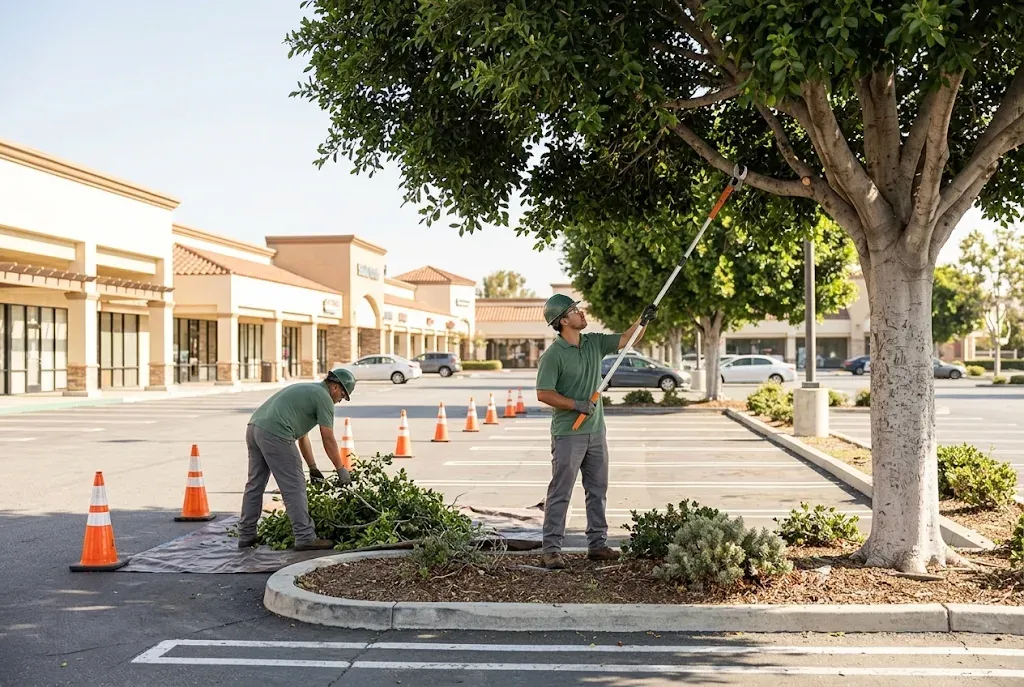
Parking lot tree trimming typically focuses on raising the lower canopy so vehicles can park and pass without contact, and on removing limbs that hang over stalls in a way that encourages debris and sap drop. Drive aisles and loading routes often need more vertical room than parking stalls because of truck heights. We confirm with you which routes are used by vendors, waste haulers, and delivery vehicles so the clearance matches real traffic.
Tree Branch Clearance at Building Entrances
Tree branch clearance at building entrances matters for both safety and first impressions. Customers should be able to walk from their car to the door without ducking under limbs or brushing through foliage. We also look at branches near awnings, door canopies, security cameras, and lighting at the entrance, since those conflicts are easy to overlook until something is damaged or a camera view is blocked.
Sidewalks and Paths of Travel
Walkways along the storefronts and through the lot need consistent clearance so pedestrians, strollers, and people using mobility devices can pass comfortably. If your property has accessibility obligations along those routes, clearance should be planned with those requirements in mind. We note low limbs along paths of travel during the assessment and include them in the scope so they are not handled piecemeal.
Open Up the Sightlines to Your Tenant Signs
Selective pruning can clear signs, drive aisles, and walkways while keeping the shade your customers park under. Send us a few ground-level photos of the trees in question, and we will recommend a clearance scope that fits your center.
How Does a Site Assessment Set the Right Pruning Scope?
A site assessment turns a general complaint into a defined scope of work. Before we price commercial tree trimming in Anaheim, we walk the property to identify which trees are involved, what each one needs, and why. That gives you an estimate tied to specific trees and specific outcomes rather than a vague promise to “trim the trees.”
During the walk, we typically record:
- The trees involved. Location, approximate size, and species where it can be identified, so everyone is talking about the same trees.
- The clearance needed. Stalls, aisles, signs, entrances, and walkways each have their own target.
- The reason for pruning. Clearance, sign visibility, deadwood removal, or structural concerns.
- Tree condition. Signs of decay, cracks, dieback, pest activity, or previous poor cuts that affect what pruning is appropriate.
- Access and setup. Where equipment can be staged, which stalls may need to be blocked, and what overhead obstacles exist.
Trees in the Public Parkway
Some trees along the street frontage of an Anaheim property may be city street trees rather than private trees. Under Anaheim Municipal Code Section 13.12.080, trimming or pruning a street tree requires written permission from the city’s Director of Community Services or a designee, and permitted work must follow specific standards. During the assessment, we flag trees that may sit in the public right-of-way so they can be confirmed with the city before anyone touches them. If a city tree is part of your sign visibility problem, the right first step is contacting the city, not pruning it.
Trees Near Utility Lines
Branches growing into overhead power lines are a separate category. That work typically falls to the utility or to qualified line-clearance crews, and we note those conflicts in the assessment rather than including them in standard pruning.
What Is the Difference Between Selective Clearance Pruning and Dead Branch Pruning?
Selective clearance pruning and dead branch pruning solve different problems, even though they often happen during the same visit. Clearance pruning removes or shortens living branches that conflict with something on the property. Dead branch pruning removes wood that is already dead, dying, or broken, regardless of whether it is in anyone’s way.
Selective Clearance Pruning
Clearance work is about relationships: the branch and the truck, the canopy and the sign, the limb and the walkway. Because it involves cutting living tissue, it calls for restraint. We choose cuts that redirect growth and preserve the tree’s structure, and we avoid removing more live canopy than the clearance goal requires. Heavy removal of live wood in a single visit can stress a tree, so a large clearance correction may be better handled over more than one pruning cycle.
Dead Branch Pruning
Dead branch pruning targets limbs that no longer contribute to the tree and may eventually fall. In a shopping center, the location of that deadwood matters a great deal. A dead limb over landscaping in a corner of the lot is a different priority than one hanging above a cart corral or entry walk. We explain this process in more detail in our article on removing dead branches through deadwooding, including why deadwood should be removed with proper cuts rather than simply broken off.
Why the Distinction Affects Your Estimate
Separating the two helps you make decisions. If budget or timing is limited, deadwood over high-traffic areas may come first, with broader clearance and sign visibility work scheduled next. Seeing them as separate line items makes that kind of phasing easier to plan.
When Should Commercial Trees in Anaheim Be Trimmed?
The best timing depends on the tree’s species, its current condition, and the reason it needs pruning. Urgent problems, such as a cracked limb over a walkway, should not wait for an ideal season. Routine clearance and shaping work, on the other hand, can often be planned for a time that suits both the tree and your property’s operations. Our guide on when to schedule tree trimming covers the general seasonal considerations in more depth.
Species and Growth Habits
Commercial properties in Anaheim often include a mix of trees, from fast-growing evergreens that fill in quickly around signs to deciduous trees whose structure is easier to see when they are bare. Some species respond to pruning with vigorous regrowth, which affects how often clearance needs to be maintained. Others flower on a seasonal schedule that owners may want to protect. We consider these differences when recommending timing rather than treating every tree on the lot the same way.
Tree Condition
A tree that is stressed by drought, root damage from paving, pests, or previous over-pruning may need a lighter approach or a different timing plan. Removing deadwood from a stressed tree can still make sense, while heavy live-wood reduction may be better postponed.
Nesting Birds
Mature trees in parking lots and along storefronts can host nesting birds, particularly during spring and summer. California law protects active bird nests, so pruning plans during nesting periods should account for that possibility. If active nests are found, the scope or schedule may need to be adjusted for the affected trees.
Plan Tree Work Around Your Busiest Hours
Before a crew arrives, we confirm the scope, the work window, and any stalls or entrances that need temporary closure. Call (888) 601-1117 or request a callback, and we will walk through the schedule with you.
What Should You Send for a Tree Trimming Estimate in Anaheim?
The more we know before the site visit, the faster and more accurate the estimate. You do not need a formal arborist report to get started. A few practical details help us understand the scope and arrive prepared to discuss it.
- Property address and the name of the center or building.
- Approximate tree count involved in the work, even if it is a rough number.
- Tree locations described by area, or better, a marked site plan or aerial screenshot showing which trees you are concerned about.
- Photos taken from the ground showing the problem: the branch over the stall, the hidden sign, the limb near the entrance.
- Affected stalls, aisles, or entrances so we understand which parts of the property will be impacted during work.
- Access restrictions such as gated areas, loading dock hours, tenant restrictions, or areas that cannot be closed.
- Preferred work windows including days or times when the lot is quieter.
If you manage several properties, sending the same details for each one lets us compare scope across sites. Owners preparing for a first project may also want to think through how to prepare a commercial property for scheduled tree work, including tenant notices and vehicle relocation, before the crew arrives.
How Do We Schedule Shopping Center Tree Pruning Around Customers and Tenants?
Scheduling shopping center tree pruning is a coordination process, not just a date on a calendar. Tree work in an active retail environment affects parking, deliveries, and customer access, so we plan it with the property manager before work begins. A clear plan reduces surprises for tenants and keeps the work moving once the crew is on site.
Confirming Scope and the Work Window
We start by confirming the final scope and the available work window. If your center has quieter hours, such as early mornings before most tenants open, we discuss whether those windows can work. Availability for early, late, or off-peak scheduling depends on the scope and on our crew calendar, so we confirm it during the estimate rather than promising it in advance.
Identifying Temporary Closures
Some areas will need to be temporarily closed while work is overhead. That may mean blocking a row of stalls, closing a section of drive aisle, or routing pedestrians around an entrance. We identify those areas ahead of time so you can notify tenants and, if needed, post notices for customers.
Working Around Deliveries and Peak Traffic
Loading zones, drive-through lanes, and pickup areas often have predictable busy periods. We plan the order of work so the most disruptive tasks avoid peak customer traffic and scheduled deliveries where possible, and we keep tenant access in mind throughout the day.
Phased Work
For larger centers, or for properties where closing large parking areas is not practical, phased work can be an option when site conditions and crew availability allow. One phase might address deadwood and entrance clearance, followed by parking lot and sign work in later visits. If your center already receives regular grounds care, tree work can be coordinated with that schedule; our Shopping Center Landscape Maintenance page explains how ongoing maintenance is structured for retail properties.
Residential Tree Trimming, Broader Property Care, and Your Anaheim Estimate
Homeowners in Anaheim face many of the same issues on a smaller scale. Branches can hang over driveways, scrape cars, crowd front walkways, or block the path to the front door. Dead limbs above a driveway or patio deserve the same priority they would at a commercial property. For residential properties, we keep the scope focused on clearance over driveways, walkways, and entrances, along with deadwood removal and structural pruning where it is needed.
For commercial owners, tree trimming is often one part of a larger conversation about how the property looks and functions. If you are also evaluating irrigation, planting, seasonal cleanups, or regular grounds maintenance, our page on Commercial Landscapers Anaheim, CA covers our broader commercial landscaping services in the city.
When you are ready to move forward with Tree Trimming Anaheim CA work, the next step is simple. Send us the property address, a few ground-level photos, and a short description of the trees causing problems. We will review the site, define the pruning scope, talk through timing and work windows, and provide a free estimate. Call us at (888) 601-1117, email info@landscaper-near-me.com, or request a callback, and we will help you plan tree work that clears stalls, signs, and entrances while keeping your property operating smoothly.
FAQ's - Frequently Asked Questions
Trees in the public parkway may be city street trees. Anaheim Municipal Code Section 13.12.080 requires written permission from the city before anyone trims or prunes a street tree. We flag these trees during the assessment so you can confirm ownership and permission with the city first.
Early or off-peak work windows may be possible depending on the scope and our crew schedule. Let us know your preferred windows when you request an estimate, and we will confirm what is available before scheduling.
It should not. We use selective thinning and targeted reduction to open a sightline rather than topping or stripping the crown. If a tree sits so close to a sign that only severe cutting would clear it, we will explain that before any work is done.
Usually not. We typically close only the stalls, aisle sections, or walkways directly beneath active work, and we identify those areas in advance so you can notify tenants.
It depends on the species, how fast it grows, and how much clearance the area needs. Fast-growing trees near signs and drive aisles may need attention more often than slower trees in landscape islands. We can suggest a reasonable cycle after seeing your trees.
Work near energized lines is typically handled by the utility or qualified line-clearance crews. We note those conflicts during the assessment and recommend contacting the utility, while we handle the rest of the pruning scope.
Yes, we offer free estimates. The estimate identifies the trees involved, the type of pruning recommended, the clearance goals, and how the work and cleanup will be handled so you know the scope before work begins.
It helps to have a contact available at the start of the day to confirm closures and answer access questions. After that, we keep the property manager informed and walk the completed areas with you if you would like.