What Is Better for a Driveway: Concrete or Asphalt?
Ask ten homeowners what is better for a driveway: concrete or asphalt, and you will usually get ten confident answers, most of them shaped by whichever surface happened to hold up at the last house they owned. The more useful answer is less tidy. Neither material wins on every property. A concrete driveway and an asphalt driveway behave differently under vehicle loads, under sustained sun, under moving water, and under a fixed budget, and the surface that serves one home well can be the wrong call two streets away.
We build and maintain hardscape surfaces throughout Southeast Los Angeles County and Orange County, and the driveways that last are rarely the ones that began with a material preference. They begin with an accurate reading of the site and an owner who understands which tradeoffs they are willing to live with. What follows is the same comparison we would walk through with you standing at the top of your own driveway: what each material actually is, what each one does well, what each one asks of you afterward, and how to line those answers up against your own priorities before anyone breaks ground.
See What Concrete or Asphalt Would Cost on Your Driveway
A material comparison gets you halfway. A real number for your own property gets you the rest of the way. We will measure the area, look at the existing surface and base, and lay out what a concrete driveway and an asphalt driveway would each involve here — at no cost and with no obligation.
Concrete and Asphalt Are Not Two Colors of the Same Product
Most driveway material comparison articles jump straight to cost, which skips the one difference that explains everything else. Concrete and asphalt are not variations on a theme. They are two structurally different kinds of pavement, and they fail, age, and repair in two different ways because of it.
Concrete is a mixture of portland cement, sand, coarse aggregate, and water. Once placed, it hardens through a chemical reaction rather than by drying, and the result is a rigid slab. That slab carries load by spanning across its base, distributing the weight of a vehicle outward over a wide area. Engineers call this rigid pavement, and the term is literal: the surface is designed not to bend. Control joints are cut or tooled into the slab specifically because concrete will shrink slightly as it cures and will crack somewhere, so the joints decide where.
Asphalt is a blend of aggregate coated and bound with bitumen, a petroleum-based binder that never fully hardens. It arrives hot, is spread in lifts, and is compacted into place. The binder keeps the finished surface slightly pliable for its entire service life, which is why asphalt is called flexible pavement. It carries load by transferring it down into the compacted base beneath it rather than spanning across it, and it will follow small movements in that base instead of resisting them.
That single distinction drives nearly every practical difference a homeowner notices later: why one surface can be patched invisibly and the other cannot, why one softens in July and the other does not, why one can be resurfaced and the other is usually replaced in sections. Driveways sit inside the broader category of built outdoor surfaces, and if you are newer to that side of property improvement, our overview answering What is Hardscaping Services? covers how driveways relate to patios, walkways, retaining walls, and the rest of the hardscape family.
Concrete Driveway Pros and Cons: A Rigid Surface With a Long Memory
A concrete driveway is the more permanent of the two residential driveway materials, and that permanence cuts both ways.
On the positive side, a properly installed and properly supported slab tends to deliver a long service life with very little asked of the owner in between. Routine concrete driveway maintenance is closer to housekeeping than to upkeep: rinse it, address oil drips before they set, and keep the joints clear. The surface holds a crisp edge, which matters where a driveway meets planting beds, a lawn, or a decorative border, and it stands up well to the static weight of parked vehicles without rutting where the tires sit.
Concrete also offers by far the wider range of finishes. A standard broom finish is the workhorse, but exposed aggregate, salt finish, integral color, sawcut patterns, banding, and stamped textures are all available on the same slab. For owners who care about driveway curb appeal, that flexibility is often the deciding factor, because the driveway is usually the single largest visible surface at the front of a property.
The drawbacks are just as real. Concrete costs more to install than asphalt does, and the gap is widest on smaller jobs where mobilization and finishing labor are spread across less area. Concrete also has a long memory. A crack that opens is permanent unless the section is cut out and replaced, and a replacement panel rarely matches the surrounding color, because cured concrete continues to change shade for months and no two pours are identical. Oil and rust stain a light surface visibly. And a new slab needs time before it takes traffic, which means a period of living without the driveway that asphalt does not require.
Asphalt Driveway Pros and Cons: A Flexible Surface That Expects Attention
An asphalt driveway answers a different question. It is usually the more accessible entry point on initial cost, and it returns the property to normal use quickly, which is why it remains one of the most common driveway installation options in residential work.
Its flexibility is a genuine advantage. Where a base settles slightly, asphalt tends to follow the movement rather than fracture across it, and small surface defects can be cut out and patched with material that blends into the surrounding pavement far better than a concrete patch ever will. Later in its life, a sound asphalt driveway can often be resurfaced with a new wearing course over the existing structure rather than fully removed, which changes the economics of renewal. The uniform dark surface also hides oil drips and general staining that would be obvious on a light slab.
The costs show up in ownership rather than at installation. Asphalt driveway maintenance is an ongoing commitment: the binder oxidizes under ultraviolet exposure, the surface fades from black toward gray, and periodic sealing is part of keeping it intact rather than an optional cosmetic step. Edges are the weak point, because a flexible surface with nothing supporting its perimeter will crumble where tires run off the side. Sustained heat softens the surface, which can leave scuff marks where a wheel is turned in place. And the finish options are essentially one: dark, uniform, and functional.
Put the two lists side by side and the shape of the concrete driveway vs asphalt driveway decision starts to come through. Concrete asks for more money early and very little afterward. Asphalt asks for less money early and steady attention afterward. Neither of those is automatically the better deal, because which one is better depends entirely on the numbers and the tolerance you bring to the project.
Have the Base and Drainage Checked Before You Pour or Pave
Soil, compaction, slope, and where the water goes decide how long either surface lasts. Before you commit to concrete or asphalt, let us evaluate the subgrade, the grading, and the drainage on your property so the driveway you pay for is built on something worth building on.
Concrete or Asphalt Driveway Cost: What Actually Moves the Number
Any article that hands you a firm per-square-foot figure for a concrete vs asphalt driveway is guessing, because the material is only one line on the estimate and frequently not the largest one. What genuinely moves a driveway number is the work that happens before the surface is ever placed.
The factors that shape a concrete vs asphalt driveway cost on a specific property include:
- Area and geometry. A simple rectangle prices differently from a curved drive with a turnaround, a side apron, or a narrow approach that forces hand work.
- Removal and disposal. Taking out and hauling away an existing driveway is a separate scope, and the cost depends on what is under it and how thick it is.
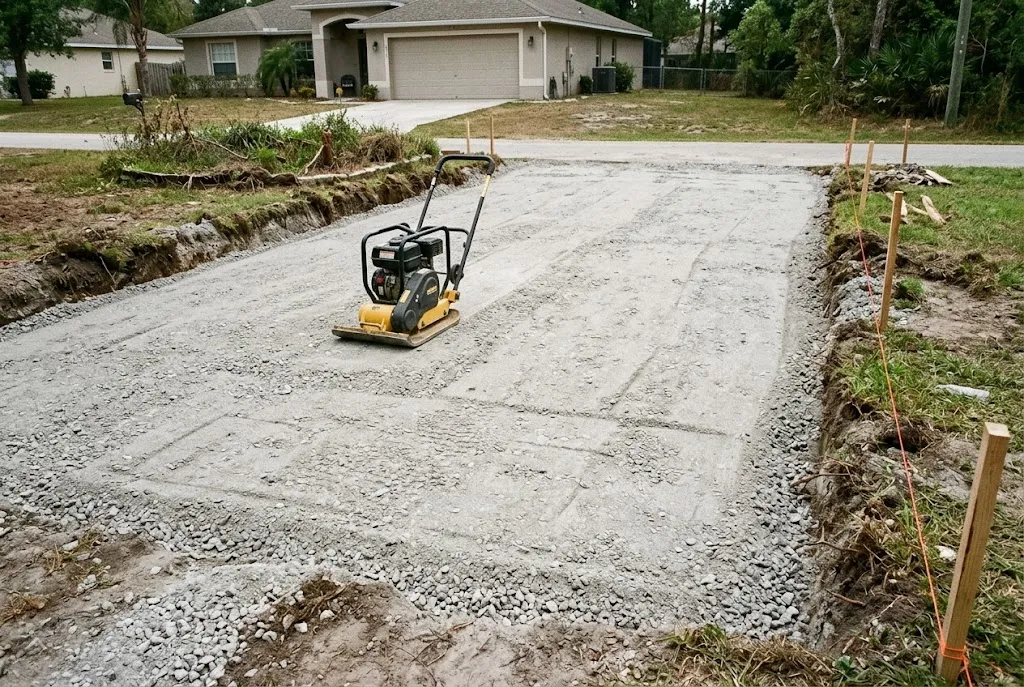
- Base condition. If the existing subgrade is soft, saturated, or full of organic material, it has to be corrected. This is where budgets move most and where cutting scope does the most long-term damage.
- Grading and drainage corrections. Reworking slope so water leaves the surface instead of pooling against the garage is engineering, not finish work, and it is priced accordingly.
- Thickness and reinforcement. A driveway that will carry a work truck, a trailer, or an RV is not built to the same section as one that sees two sedans.
- Finish selection. Broom-finished concrete and stamped or colored concrete are not the same product from a labor standpoint.
- Access. Whether a truck can reach the pour or the material has to be moved by hand changes the labor line significantly.
Within those variables, the general positioning holds: asphalt normally lands lower at installation, and concrete normally lands higher. The more useful comparison, though, is not the installation number by itself but the installation number plus what the surface will ask of you over the years you expect to own the property. A lower opening figure that carries a recurring sealing and crack-filling routine is a different proposition from a higher opening figure that mostly asks to be rinsed off. Which of those reads as the better value is a question about your finances and your patience, not about the materials.
Concrete vs Asphalt Driveway Lifespan: Why the Base Usually Outranks the Material
Published service-life ranges for both materials are wide, and they are wide for a reason. The same material installed two different ways will not last the same length of time, so treating lifespan as a fixed property of concrete or asphalt is the most common mistake in this comparison.
All else being equal, concrete typically delivers the longer single service life, and asphalt typically delivers a shorter one that can be extended through resurfacing. But all else is almost never equal. A concrete slab poured at insufficient thickness over uncompacted fill can break up in a handful of years. An asphalt driveway built over a properly prepared and compacted aggregate base, kept sealed, and drained correctly can outlive a carelessly installed concrete one by a comfortable margin.
The variables that actually determine concrete vs asphalt driveway lifespan are consistent across both materials: the character of the native soil, how thoroughly the subgrade and aggregate base were compacted, the depth of that base, whether water is being moved off and away from the surface or allowed to work underneath it, the thickness of the surface relative to the vehicle loads it carries, and whether the perimeter is supported. Concrete adds one material-specific variable — joint layout — since joints placed too far apart invite cracks in places nobody chose.
This is why concrete vs asphalt driveway durability is a question best answered on site rather than in an article. Two identical homes can sit on meaningfully different soil, and the correct recommendation can differ accordingly.
Concrete vs Asphalt Driveway Maintenance: Two Different Ownership Routines
Choosing a driveway surface is also choosing a maintenance habit, and the two materials ask for very different ones.
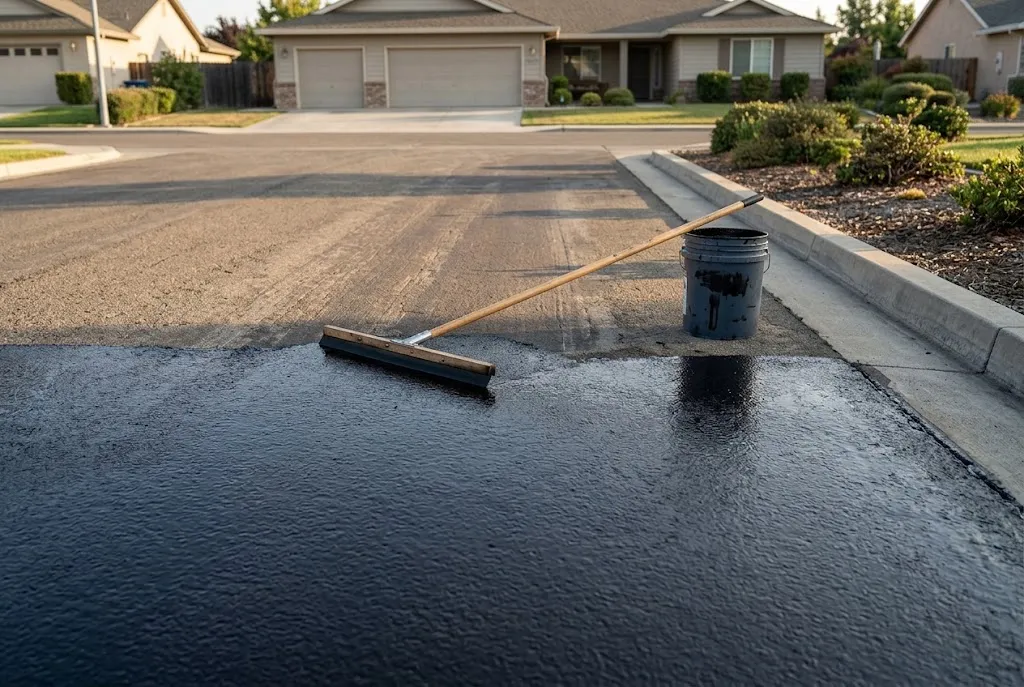
Asphalt asks for a cycle. The surface should be kept sealed on a reasonable interval so the binder is protected from ultraviolet exposure and water is kept out of the aggregate structure. Cracks should be filled while they are still narrow, because an open crack is a route for water into the base, and a compromised base is what turns a crack into a pothole. Raveling — loose aggregate working free at the surface — is the early signal that a seal is overdue. Later in its life, resurfacing over a structurally sound base is a legitimate and cost-effective renewal path.
Concrete asks for attention rather than a cycle. Most of it is cleaning: petroleum and rust stains set into a light surface and become permanent if they are left. Joints should be kept clear of debris and weeds so they can do their job of allowing movement. Sealing concrete is worthwhile in some situations, particularly for decorative or colored finishes, but it is not the structural necessity that sealing asphalt is. When a concrete driveway does need work, it is generally panel-based: the affected section is cut out and replaced rather than patched, which is more disruptive but also more permanent.
Whichever surface you end up with, it will share its life with irrigation, root systems, and planting beds that sit directly against it — which is why driveway work rarely stays purely within driveway boundaries. Our broader Hardscape Services cover the paved surfaces, borders, and structural elements that frame a driveway and keep its edges supported over time.
Still Weighing Concrete Against Asphalt? Talk It Through With Our Crew
If you are down to the last few questions, a short conversation usually settles them faster than more reading. Call us at (888) 601-1117, email info@landscaper-near-me.com, or ask for a call back and we will help you match the surface to your property and your priorities.
Best Driveway for Hot Climates: Sun, Surface Temperature, and Southern California Conditions
Climate belongs in this comparison, but it belongs there carefully. Sustained sun and warm-weather conditions are a genuine factor across much of Southern California, and they affect the two materials differently — without making either one universally required.
Dark surfaces absorb solar energy rather than reflecting it, and paving is a clear example. The U.S. Environmental Protection Agency notes in its work on cool pavements and urban heat islands that conventional paving materials such as asphalt can reach surface temperatures as high as 152°F at midday. For a driveway, that heat has practical consequences. A hot asphalt surface is softer than a cool one, which is when scuffing from a wheel turned in place is most likely, when a kickstand or a trailer jack is most likely to leave an impression, and when a recently sealed surface is most vulnerable to hot tire pickup. None of this destroys an asphalt driveway; it simply means that summer is when the surface is least forgiving.
A light concrete surface reflects more of that energy and runs cooler underfoot, which is noticeable on a driveway that people cross barefoot on the way to a pool or that pets use daily. Concrete also holds its color rather than fading, since there is no binder oxidizing at the surface.
That said, treating heat as the whole answer would be a mistake. A driveway shaded by mature trees for most of the afternoon, or a north-facing approach, or a property where the driveway sees light and predictable use, changes the weight of this factor considerably. Sun exposure shifts the asphalt vs concrete driveway question without settling it. It is one real input into choosing the best driveway material in this region, not a verdict on its own.
What Happens Under the Surface: Grading, Drainage, and Site Preparation
If there is a single point worth carrying away from this driveway material comparison, it is that both surfaces are only as good as what sits beneath them and what happens to the water that lands on them.
The subgrade comes first. Native soil varies considerably even within a single neighborhood, and soils with significant clay content expand and contract with moisture in a way that a rigid slab feels acutely and a flexible surface follows. Loose fill, buried organic material, or an old trench line under part of the driveway creates an area that will settle differently from its surroundings. Correcting those conditions before placing any surface is what separates a driveway that ages slowly from one that begins telegraphing problems in its first few seasons.
Compaction of the subgrade and of the aggregate base above it is the next piece, and it is invisible in the finished product, which is exactly why it is the easiest place for a project to quietly go wrong. Depth matters too, and appropriate base depth is a function of soil and expected loads rather than a single universal number.
Drainage decides much of the rest. A driveway needs enough fall to shed water toward somewhere that can accept it, and that destination has to be real — not simply the low corner of a planting bed that will saturate. Water that ponds on a surface finds joints and cracks; water that runs under a surface undermines the base that everything depends on. Slope also has to be reconciled with the garage threshold, the street, the sidewalk, and any adjacent beds.
Then there is everything living along the edges. Irrigation overspray onto a driveway edge keeps the base damp and works against it. Tree roots find the space beneath a warm, moist slab and lift it. Planting beds that sit higher than the driveway push soil and water onto the surface with every storm. These are landscape problems as much as hardscape ones, and our Landscape Services address the irrigation, grading, and planting decisions that sit immediately alongside a new driveway and determine how kindly it is treated.
Heavier loads deserve their own conversation. A property that regularly parks a work truck, a trailer, or a recreational vehicle needs a thicker section and a stronger base than one that sees passenger cars, regardless of which material is chosen.
So, What Is Better for a Driveway: Concrete or Asphalt? Match the Surface to Your Priorities
Here is the comparison in one place, across the factors homeowners actually weigh:
- Initial cost. Asphalt normally positions lower at installation. Concrete normally positions higher, with the gap widening on smaller areas.
- Expected service life. Concrete typically offers the longer single service life. Asphalt typically offers a shorter one that resurfacing can extend.
- Maintenance. Asphalt requires a recurring seal-and-fill routine. Concrete requires cleaning, stain management, and clear joints.
- Repairs. Asphalt patches blend well and are relatively simple. Concrete repairs are panel replacements and rarely match the surrounding color.
- Appearance. Asphalt offers one look. Concrete offers broom, exposed aggregate, color, banding, sawcut patterns, and stamped finishes.
- Installation and return to use. Asphalt returns the property to service quickly. Concrete requires a waiting period before it carries traffic.
- Heat and sun. Asphalt absorbs heat, softens at high surface temperatures, and fades. Concrete reflects more light, stays cooler, and holds its color.
- Edges. Asphalt needs perimeter support to avoid crumbling. Concrete holds a defined edge on its own.
Read down that list and the decision usually makes itself. Asphalt tends to be the stronger choice when keeping the initial expense down is the governing constraint, when the driveway needs to be back in service quickly, when the existing base is sound, and when you are genuinely willing to keep it sealed. Concrete tends to be the stronger choice when appearance and finish flexibility matter, when you want the longest practical service life from a single installation, when routine upkeep is something you would rather not schedule, and when the driveway sits in full sun all afternoon.
There is also a third path worth knowing about. Pavers are a separate family of driveway surface options with their own economics, appearance, and repair characteristics — individual units can be lifted and reset in a way neither poured surface allows. That is a comparison of its own, and we have written it up in detail: see What is the difference between pavers and concrete if you want to weigh that option properly before committing.
Whether you end up choosing a concrete driveway or asphalt, the most valuable next step is the same. Have someone look at the actual site — the soil, the existing driveway, the slope, where the water currently goes, and the loads the surface will carry — before the material question gets settled. That assessment is what turns a general comparison into a recommendation for your property, and it is where a driveway project either sets itself up to last or quietly builds in its own failure. When you are ready to talk it through, we are glad to walk the driveway with you, explain what we see, and put together a free estimate for the work that fits what you have and what you want.
FAQ's - Frequently Asked Questions
There is no single interval that fits every driveway, because sun exposure, traffic, drainage, and the condition of the existing surface all change the answer. What matters more than a calendar is what the surface is telling you: fading from black toward gray, loose aggregate working free underfoot, and water soaking in rather than beading are the signals that a seal is due. A new asphalt driveway should also be given time to cure before its first seal. We would rather look at the surface and tell you where it stands than hand you a number that may not apply.
It is occasionally done, but we generally do not recommend treating an old asphalt surface as a base for new concrete. Asphalt is a flexible material, and a rigid slab placed over something that still moves is being set up to crack. There is also the question of what condition the base under that asphalt is in, which nobody can answer without opening it up. In most cases the sound approach is removal, inspection and correction of the subgrade, then placement of the new surface on a base built for it.
Concrete shrinks as it cures, so some cracking is part of the material rather than a defect. The purpose of control joints is to decide in advance where that movement shows up, so the cracks land in straight, intentional lines instead of wandering across the slab. What is not normal is wide cracking, cracking with vertical displacement between the two sides, or a section that has settled relative to its neighbors. Those point to the base or the drainage rather than to the concrete itself.
The two materials differ sharply here. A new asphalt driveway is usable fairly quickly, though it stays soft at first and benefits from being kept clear of sharp point loads such as kickstands and trailer jacks during its first stretch of hot weather. Concrete needs meaningfully longer before it carries vehicle traffic, and the wait depends on the mix, the thickness, and the weather during curing. We will give you specific timing for your installation before the work starts so you can plan around it.
Yes, with both materials, though the results look different. Asphalt patches in well, and a repair on a sound base can blend into the surrounding surface closely enough that it stops being obvious after a season. Concrete is repaired by cutting out and replacing the affected panel, which is structurally sound but visually noticeable, because a new pour will not match the color of cured concrete beside it. If appearance is the priority on a concrete driveway, that difference is worth knowing before a repair is scheduled.
It can, and the effect is larger than most owners expect, because the driveway is often the biggest uninterrupted surface a visitor sees from the street. Asphalt reads as functional and recedes visually, which suits some homes well. Concrete offers finish, color, banding, and border options that let the driveway participate in the front elevation rather than just serve it. Neither is automatically better for driveway curb appeal; it depends on the house, the landscape around it, and the look you are after.
That depends almost entirely on whether the problem is at the surface or underneath it. Surface-level wear on asphalt over a base that is still sound is a strong candidate for resurfacing. Settlement, sections that move under load, recurring cracks in the same place, or water ponding in a low spot point to a base or drainage issue, and putting a new surface over an unresolved base problem simply buys a short delay. Looking at the failure pattern on site is what separates those two cases.
Realistically, no. Concrete is where the design options live: broom, exposed aggregate, salt finish, integral color, sawcut patterns, decorative banding, and stamped textures are all workable on a driveway slab. Asphalt is essentially one appearance, dark and uniform, and while surface treatments exist, they do not offer comparable range and they add maintenance. If a specific look is driving your project, that consideration alone often settles the concrete or asphalt question.