
Drought Tolerant Grass Southern California Lawns Can Rely On
Finding the right drought tolerant grass Southern California properties can sustain through long, rainless summers starts with an honest premise: no lawn grass lives on rainfall alone here. What the right species does is stay functional and recover on noticeably less irrigation than a conventional cool-season lawn, provided it is planted in the right spot and watered with some discipline.
For most sunny residential and commercial lawns in our region, the strongest candidates are warm-season grasses. Here is the short answer before we get into the details:
- Bermuda grass is the go-to choice for full sun and heavy foot traffic. It handles heat well, recovers quickly from wear, and goes tan in winter.
- Zoysia grass forms a dense, carpet-like lawn, needs relatively infrequent irrigation once established, and tolerates more shade than Bermuda. It is slower to establish.
- Buffalograss, including the California-developed UC Verde, is one of the lowest-water options for sunny, lightly used areas. It does not like shade or heavy play.
- St. Augustine grass is the most shade-tolerant of the warm-season group and relatively drought tolerant, though it usually needs more water than Bermuda or Zoysia to keep its best appearance.
- Tall fescue stays greener through winter and handles partial shade, but it is a cool-season grass that generally needs more summer water than the warm-season options above.
None of these is the best choice for every yard. Sunlight, shade, foot traffic, soil, coastal or inland location, and how green you need the lawn to look in January all influence which grass makes sense. The sections below walk through those decisions so you can choose a water efficient lawn grass, and a low water grass for Southern California conditions, with clear expectations, and so you know where professional help is worth it.

Plan Your Drought Tolerant Lawn With a Free Estimate
Tell us about your lawn’s sun exposure, foot traffic and current sprinklers, and we will recommend a drought-tolerant grass that fits how you use your yard. Free estimates are available for residential and commercial properties in Southeast Los Angeles County and Orange County. Call (888) 601-1117 to get started.
What Makes a Grass Drought Tolerant in Southern California?
A drought tolerant grass is one that can keep growing, or at least stay alive and bounce back, when soil moisture runs short for extended periods. That ability usually comes from a combination of deep or extensive roots, efficient water use during hot weather, and the capacity to go semi-dormant under stress and green up again when water returns. Traditional lawn grasses such as Kentucky bluegrass and perennial ryegrass have relatively shallow roots and thin out quickly when irrigation is cut back, which is why they struggle here.
Drought Tolerance, Drought Survival and Low Water Use Are Not the Same Thing
These three terms get blended together in marketing, but they describe different behaviors:
- Low water use means the grass needs less irrigation to look and perform well during normal conditions.
- Drought tolerance means the grass can keep functioning reasonably well when water is limited for a while.
- Drought survival means the grass can go brown and dormant under severe stress yet recover when watering resumes. A lawn that survives is not necessarily a lawn that looks good during that period.
St. Augustine grass, for example, can survive dry spells better than many people expect, but it usually needs more irrigation than Bermuda or Zoysia to stay attractive. When we recommend a drought resistant grass for Southern California, we look at all three traits, not just one.
One point deserves to be stated plainly: drought-tolerant grass still needs watering. Newly installed turf needs consistent moisture until its roots are established, and mature lawns still need supplemental irrigation through our dry season. The savings come from needing less water, not from needing none.
Why Our Mediterranean Climate Favors Warm-Season Turf
Southern California receives most of its rain between late fall and early spring, then goes months with little or none while temperatures and evaporation climb. Grass loses water through its leaves and the soil surface (evapotranspiration), so a lawn’s irrigation demand peaks precisely when rainfall is at its lowest.
Most drought tolerant grass Southern California homeowners install today is a warm-season species, and the reason comes down to how turfgrasses are grouped. Turfgrasses fall into two broad groups. Warm-season grasses such as Bermuda, Zoysia, buffalograss and St. Augustine grow most actively in summer and are well suited to hot, dry conditions. Cool-season grasses such as tall fescue grow best in spring and fall and stay greener in winter. University of California turfgrass research uses an annual crop coefficient of roughly 0.6 for warm-season turf and 0.8 for cool-season turf, which means warm-season grasses typically need about a quarter less water to maintain acceptable quality. That difference is the main reason warm season grasses for Southern California sit at the center of any serious water-saving lawn plan.
If you are still weighing general lawn options rather than focusing on water savings, our guide on What Type of Grass Grows Best in Southern California covers the broader picture. This article stays focused on drought performance and reduced irrigation.
Species and Cultivar Both Matter
Choosing “Bermuda” or “Zoysia” is only the first step. Within each species, individual cultivars differ in texture, color, shade tolerance, winter color retention and establishment speed. Hybrid Bermudas behave differently from seeded common Bermuda, and UC Verde behaves differently from other buffalograss selections. The more specific the cultivar choice, the more predictable the lawn’s water needs and appearance will be.
Which Drought Tolerant Grass Varieties Work Best for Southern California Lawns?
Five grasses come up in nearly every conversation about the best drought tolerant grass for Southern California. Four are warm-season species; one is a cool-season grass included because many existing lawns already use it. University of California turfgrass guidance summarizes the strengths and limitations of each in its UC IPM turfgrass species overview, and our recommendations below are consistent with that research.
Bermuda Grass
Bermuda grass drought tolerance is the reason it is so common on sunny lawns, parks and sports fields across the region. Its deep root system and spreading rhizomes and stolons let it handle summer heat and recover quickly when worn. That recovery makes it a strong drought tolerant grass for high traffic lawns used by kids and dogs.
The tradeoffs are real. Bermuda needs full sun and thins out in shade. It goes dormant and turns tan in winter when temperatures drop. It grows fast during summer, so it needs frequent mowing, and it builds thatch over time. It also spreads aggressively into planting beds unless edges are maintained. Common Bermuda can be grown from seed, while many hybrid Bermudas are sterile and are installed as sod or sprigs; hybrids typically offer finer texture and denser turf.
Zoysia Grass
Zoysia grass in Southern California is valued for its thick, carpet-like growth and relatively low irrigation needs once established. It is moderately deep-rooted, handles heat well and tolerates moderate shade better than Bermuda, which makes it useful on lots where trees or buildings block part of the afternoon sun.
Zoysia’s density also works against it during installation: it establishes and recovers more slowly than Bermuda, so damaged areas take longer to fill in. Cultivars range from fine-bladed, slower-growing types to coarser, more vigorous ones. Like Bermuda, Zoysia turns brown in winter dormancy, and it benefits from periodic dethatching to prevent scalping.
Buffalograss and UC Verde
Buffalograss is a warm-season grass with naturally low water use. UC Verde buffalograss came out of a University of California turfgrass improvement program involving the Davis and Riverside campuses and was selected for better drought tolerance, a shorter winter dormancy and better color retention than other buffalograsses. Its short growth habit means it can be mowed infrequently, or left unmowed for a meadow-like look.
Buffalograss for California lawns works best in sunny, lower-traffic spaces such as front lawns, parkways and decorative turf areas. It has poor shade tolerance and poor wear tolerance compared with Bermuda, so it is not a good fit for a backyard that doubles as a play field. UC Verde is established from plugs rather than seed, which makes installation slower and more costly up front.
St. Augustine Grass
St. Augustine grass has broad, coarse blades and forms a dense, lush-looking lawn. Among the warm-season grasses, it is the most shade-tolerant, growing in full sun or moderate shade. That makes drought tolerant St. Augustine grass a common recommendation for yards where Bermuda simply will not grow.
The nuance is that St. Augustine survives dry periods better than it looks during them. Keeping it attractive in summer usually takes more water than Bermuda or Zoysia. It is also prone to heavy thatch and often needs iron to hold its color. It is installed as sod or plugs because it spreads by stolons.
Tall Fescue
Tall fescue is the most widely used cool-season lawn grass in Southern California. It stays green through much of the winter, handles partial shade, and develops a reasonably deep root system when it is mowed at a proper height and watered deeply rather than lightly and often.
It should not be presented as equally water-efficient as Bermuda, Zoysia or buffalograss. As a cool-season grass, tall fescue generally needs more irrigation through our hot months, especially inland. It remains a reasonable choice when winter color or shade tolerance outweigh maximum water savings, but it is not the lowest-water option.
How Do These Drought Tolerant Lawn Options Compare Side by Side?
The table below compares drought tolerant lawn options in general terms. These are relative descriptions, not scores. Actual performance depends on cultivar, microclimate, soil, irrigation management and how the lawn is used.
| Factor | Bermuda | Zoysia | Buffalograss | St. Augustine | Tall Fescue |
|---|---|---|---|---|---|
| Relative water need | Low | Low | Very low once established | Moderate for good appearance | Higher in summer |
| Heat tolerance | Excellent | Very good | Very good | Good | Good for a cool-season grass |
| Full sun | Thrives | Thrives | Thrives | Performs well | Performs well |
| Partial shade | Poor | Moderate | Poor | Best of the warm-season group | Moderate |
| Foot traffic and wear recovery | Strong; recovers quickly | Good wear tolerance; slow recovery | Limited | Moderate; slow to recover | Moderate; does not spread to fill gaps |
| Establishment | Seed, sod or sprigs; fast | Mostly sod or plugs; slow | Plugs (UC Verde) or seed for some types | Sod or plugs | Seed or sod |
| Mowing | Frequent in summer; kept short | Moderate; kept short | Infrequent | Moderate; kept taller | Regular; kept taller |
| Winter appearance | Tan when dormant | Brown when dormant | Straw-colored when dormant | May lose some color | Generally stays green |
A few patterns stand out. If the lawn gets full sun and heavy use, Bermuda is hard to beat. If the lawn sees moderate use and some shade, Zoysia is often the better compromise. If the goal is the lowest possible water use on a sunny area that people mostly look at, buffalograss deserves serious consideration. St. Augustine and tall fescue earn their place mainly where shade or winter color take priority.
Low Water Turfgrass Varieties Still Have Different Personalities
Even among low water turfgrass varieties, the ownership experience differs. Bermuda asks for more mowing and edging. Zoysia asks for patience during establishment. Buffalograss asks you to accept a softer, more natural look and limited play. Being clear about which tradeoffs you are willing to live with is the most reliable way to pick grass varieties that need less watering and still suit your property.
Match Low-Water Turf to Your Sun, Shade and Foot Traffic
Bermuda, Zoysia, buffalograss and St. Augustine behave very differently once they are in the ground. We can review your site’s sunlight, soil and sprinkler coverage, then explain whether seed, sod or plugs make the most sense before you replace your lawn.

How Do Coastal and Inland Conditions Change Your Grass Choice?
Southern California does not have one lawn climate. The difference between coastal versus inland Southern California grass performance can be significant even within a short drive, and it should shape your grass selection.
Coastal Properties
Near the coast, marine air keeps summer temperatures more moderate, and seasonal low clouds reduce sunlight during late spring and early summer. Evaporative demand is lower, so lawns generally need less water than the same grass would inland. Warm-season grasses still perform well, but they may green up later in spring and grow a little less vigorously during cloudy stretches. In some coastal locations, buffalograss and other warm-season turf may hold color longer into winter.
Because sunlight can be less intense, shade from trees, fences and neighboring buildings has a larger effect on coastal lawns. Zoysia or St. Augustine can be better choices than Bermuda where light is limited. Some coastal owners also accept tall fescue’s higher water needs because the milder summers narrow the gap.
Inland Properties
Farther from the ocean, summers are hotter and last longer, and evaporative demand is noticeably higher. This is where drought tolerant grass for full sun makes the most difference. Bermuda, Zoysia and buffalograss tend to outperform cool-season grasses on inland lawns, and the water savings of warm-season turf are more pronounced. Irrigation efficiency also matters more inland, because poor sprinkler coverage shows up quickly as brown patches during heat waves.
Los Angeles County and Orange County Considerations
Our service area covers Southeast Los Angeles County and Orange County, which includes both near-coastal neighborhoods and warmer inland communities. Conditions can differ from one property to the next because of elevation, exposure, soil, slope and surrounding structures. When we evaluate drought tolerant lawns in Los Angeles County or drought tolerant turf for Orange County properties, we look at the specific site rather than assuming a single regional rule applies.
Which Drought Tolerant Grass Fits the Way You Use Your Lawn?
The best drought tolerant grass for residential lawns, and for commercial turf, is the one that matches how the lawn is actually used. A grass that looks great in a front yard can fail quickly in a backyard with two large dogs.
Front Lawns Focused on Appearance
Front lawns are seen more than they are used. Zoysia offers a dense, refined look, while buffalograss offers the lowest water use with a softer, more natural appearance. Both go brown in winter, so owners who need year-round curb appeal should discuss that expectation before installation.
Backyards for Families, Children and Pets
Recreation areas need wear tolerance and fast recovery. Bermuda is usually the strongest drought tolerant grass for high traffic lawns because it repairs itself by spreading. Zoysia handles wear reasonably well but repairs slowly. Pets add another consideration: concentrated urine spots and repeated running paths stress any grass, so recovery speed matters more than initial appearance.
Sunny Lawns With Long Afternoon Exposure
South- and west-facing lawns that bake all afternoon are ideal for warm-season grass. This is where the best grass for hot dry climates earns its reputation, and where cool-season lawns typically need the most irrigation to keep up.
Partially Shaded Residential Lawns
Drought tolerant grass for partial shade is a narrower category. St. Augustine and some Zoysia cultivars tolerate moderate shade; tall fescue handles partial shade but uses more water. In deep shade, no lawn grass performs well, and a groundcover or mulched planting area is often the more practical answer.
Low-Traffic Decorative Areas
Parkways, slopes that are not walked on, and visual turf areas are good places for buffalograss or a slower-growing Zoysia. They reward low water use and low mowing frequency without demanding wear recovery.
HOA Common Areas and Commercial Turf
For HOA and multifamily common areas, retail centers and office landscapes, water efficient turf for commercial landscapes has to balance appearance, durability, maintenance crew schedules and water budgets. Bermuda is common where turf is actively used, while lower-use turf areas may be candidates for Zoysia, buffalograss or partial replacement with low-water planting. Ongoing performance depends heavily on consistent mowing, irrigation adjustments and timely repairs, which is where professional Commercial Lawn Care Services help property managers keep turf usable without overwatering.
Weighing the Tradeoffs
Every choice trades something. Lower water use may come with winter browning. Higher wear tolerance may come with more mowing. Better shade tolerance may come with higher summer water needs. Establishment cost also varies: plugs and sod cost more up front than seed but may reach a usable lawn faster or be the only option for certain cultivars. A clear list of priorities makes those tradeoffs easier to settle.
Should You Plant Seed or Sod, and How Should the Lawn Be Prepared?
The question of drought tolerant grass seed versus sod often answers itself once the grass is chosen, because not every drought-tolerant cultivar is available as seed.
What Is Available in Each Form
- Seeded Bermuda grass is widely available and is the most economical way to establish a large sunny lawn when time allows.
- Hybrid Bermuda grasses are commonly established vegetatively as sod or sprigs because many are sterile.
- Zoysia and St. Augustine are most often installed as sod or plugs in our region; St. Augustine is essentially a vegetative-only grass for home lawns.
- Buffalograss selections differ. Some types are seeded, while UC Verde is propagated by plugs.
- Tall fescue is available as both seed and sod.
How Seed and Sod Differ in Practice
Sod gives you an immediate, finished surface and much less weed competition during establishment, but it costs more and still needs careful watering while it roots. Seed costs less but takes longer to fill in, needs frequent light irrigation to germinate, and is more vulnerable to weeds and washouts. Plugs fall in between: they are placed in a grid and spread over a growing season, so the lawn develops gradually.
Low water sod installation is often the most practical route for homeowners who want a usable lawn quickly or need a cultivar that is not sold as seed. For broader guidance on seed selection, timing and germination, see our article on Lawn Seeding in Southern California.
Establishment Time and Initial Watering
Drought tolerant grass establishment takes the most water the lawn will ever need. Seed must stay consistently moist near the surface until it germinates. Sod needs regular watering until roots knit into the soil below; our article on How Long Does It Take Sod to Root explains what to expect during that window. Warm-season grasses establish best when planted during their active growing period, generally late spring through early summer, so they have warm soil and a full season to root before winter dormancy.
Preparing Your Lawn for Drought Tolerant Grass
Preparation determines how well a new lawn handles reduced watering for years afterward. Grass that roots into loose, well-drained soil can reach deeper moisture; grass sitting on compacted soil cannot.
Evaluate What You Already Have
Start by deciding whether the existing lawn needs complete replacement. A thin lawn of a suitable species may only need better irrigation, aeration and overseeding or plugging. A lawn of poorly suited grass, or one heavily infested with weeds, usually benefits from full drought tolerant lawn replacement.
Assess Sunlight, Soil and Drainage
- Track sun exposure across the day and through the seasons, especially near trees and buildings.
- Check soil texture. Sandy soils drain fast and hold less water; clay soils hold water but compact easily and absorb it slowly.
- Look for compaction where water puddles or runs off rather than soaking in.
- Remove existing unwanted vegetation where appropriate so it does not compete with the new turf.
Soil preparation should match the site. Some properties need tilling and grading, others need targeted compaction relief, and soil amendments should be chosen based on actual conditions rather than a one-size-fits-all formula.
Check the Sprinkler System Before Planting
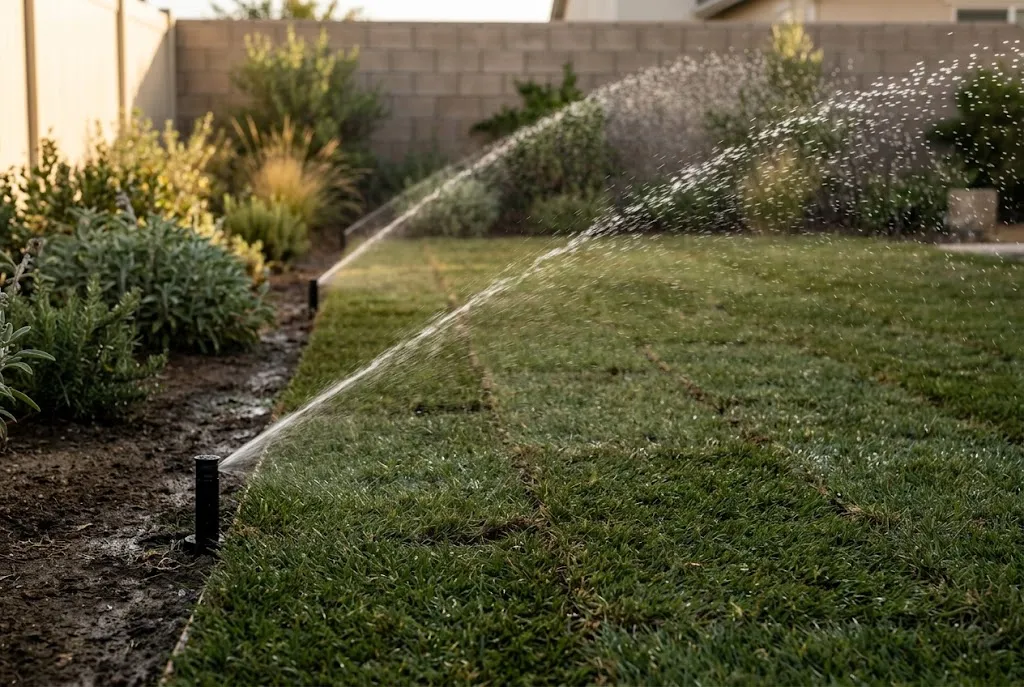
Uneven coverage will undermine any grass, drought-tolerant or not. Before installing new turf, we check head spacing, nozzle types, pressure and controller settings so the new lawn receives even water during establishment. Sod installed over a system with dry spots will show those dry spots within weeks. After installation, our guide on How to Take Care of Sod After You Lay It covers the first weeks of care.
Install a Water-Wise Lawn That Roots In Properly
From soil preparation and sod or plug installation to sprinkler adjustments during establishment, our team handles each step of your drought-tolerant lawn project. Call (888) 601-1117, email info@landscaper-near-me.com, or request a callback to talk through your plans.
How Much Should You Water Drought Tolerant Grass?
There is no single watering schedule that fits every drought-tolerant lawn, and we do not recommend copying one from a neighbor or a generic chart. Water needs change with grass species, soil, sun exposure, coastal or inland location, season and sprinkler performance. What does hold true is that water savings come from irrigation management, not simply from planting a drought-tolerant species.
Establishment Watering Versus Mature Lawn Watering
Newly installed seed, sod or plugs need consistent moisture so roots can grow. Once established, the strategy shifts: deeper, less frequent watering encourages roots to grow downward, which is what lets drought tolerant grass ride out hot spells. Shallow daily watering keeps roots near the surface and undermines the drought tolerance you paid for.
Adjust Through the Seasons
Evapotranspiration is lowest in winter and highest in mid to late summer. Controllers should be adjusted several times a year, not set once at installation. Summer lawn care in Southern California centers on this: watering early in the morning, checking coverage before heat waves, and resisting the urge to add daily cycles when a deeper, less frequent schedule would serve the roots better. Warm-season grasses entering winter dormancy need very little irrigation, and rainfall during the wet season may cover most of their needs. Weather-based or evapotranspiration-based controllers can automate many of these adjustments where they are appropriate for the site.
Coverage, Runoff and Soil Moisture
Sprinkler distribution uniformity matters as much as run time. When some areas get twice the water of others, owners tend to raise run times to fix the dry spots, overwatering the rest of the lawn. On slopes and clay soils, splitting watering into shorter cycles lets water soak in instead of running onto sidewalks and streets. Our Irrigation Services include inspections, nozzle and head corrections, and controller programming aimed at exactly these problems.
Signs of Too Much or Too Little Water
- Too little: a bluish-gray cast, footprints that stay visible, curled or folded blades and spreading tan areas in summer.
- Too much: soggy soil, mushrooms, algae, shallow roots, runoff and an increase in some turf diseases and weeds.
Water Conservation Rules and Local Guidance
Water conservation is an ongoing priority in Southern California, and many cities and water districts set landscape irrigation rules that can change with supply conditions. Requirements differ by provider, so check current guidance from your city or water district before planning a new lawn or irrigation schedule. Evaluating irrigation efficiency is often the first and least expensive step in water saving lawn irrigation, sometimes delivering meaningful savings before any grass is replaced.
What Does Drought Tolerant Grass Maintenance Involve?
Drought-tolerant lawns are lower-water lawns, not maintenance-free lawns. Good drought tolerant grass maintenance protects root depth, which protects water efficiency.
Mowing at the Right Height
Each grass has its own preferred mowing height. University of California guidelines generally place hybrid Bermuda and Zoysia among the shortest-mowed lawns, seeded Bermuda, buffalograss and St. Augustine somewhat taller, and tall fescue tallest of this group at roughly one and a half to three inches. Avoid scalping; cutting off more than about a third of the leaf blade at once stresses the plant and exposes soil to heat. Mowing frequency rises in summer for Bermuda and drops sharply for all warm-season grasses in winter.
Fertilization, Compaction and Thatch
Fertilize according to the grass’s actual needs and growing season rather than a calendar habit; warm-season grasses use nutrients during warm months, and pushing excessive growth increases water demand. Core aeration helps relieve compaction in high-use areas. Bermuda, Zoysia and St. Augustine all build thatch, which can block water infiltration if it is not managed periodically.
Inspections and Seasonal Expectations
Regular sprinkler inspections catch broken heads and misaligned nozzles before they create dry patches or waste water. Weed control is most important during establishment, when bare soil gives weeds an opening. For sod-specific routines, our Sod Care page offers additional guidance.
Common Problems and How to Address Them
Most issues we see with drought-tolerant lawns trace back to a handful of causes:
- Winter browning in warm-season grasses. This is normal dormancy, not damage. Dormant turf is evenly tan and greens up uniformly in spring. Patchy, thinning or slow-to-recover areas may point to a different problem.
- Poor establishment. Usually linked to inadequate watering in the first weeks, poor soil contact, or planting outside the active growing season.
- Uneven sprinkler coverage. Shows up as repeating dry rings or strips, often near the edges of spray patterns.
- Excessive shade. Turf thins steadily where light is insufficient for the species.
- Soil compaction and heavy foot traffic. Worn paths and bare areas, especially with slow-recovering grasses.
- Inappropriate grass selection. A species mismatched to sun, shade or use will struggle no matter how it is watered.
- Too much or too little water. Both weaken roots and invite weeds and disease.
- Weed competition and bare areas. Most common in seeded lawns and thin turf.
If a lawn keeps thinning despite reasonable care, a professional evaluation of soil, irrigation and species fit usually costs less than repeated patch repairs.
Is Drought Tolerant Grass Right for Your Property, and What Will It Cost?
The drought tolerant grass Southern California property owners get the most from is the one that fits a well-planned landscape. For many properties, the answer is a combination: keep a well-chosen, functional lawn where people actually use it, and reduce turf where it serves no purpose.
Drought Tolerant Grass Versus Lawn Alternatives
Turf makes sense for play areas, pet runs, gathering spaces and spots where a soft surface adds value. In narrow side yards, steep slopes, deep shade and purely decorative strips, drought-tolerant groundcovers, mulched planting beds and water-efficient landscape designs often conserve more water. Planting beds are frequently watered more efficiently with drip; our comparison of Drip Irrigation vs. Sprinkler System explains where each method fits. Combining a smaller, well-irrigated lawn with low-water planting is one of the most effective ways to cut outdoor water use without giving up usable space.
Cost Factors for Drought Tolerant Lawn Installation
Every project is priced individually, and costs depend on:
- Lawn area and overall project size
- The grass species and cultivar selected
- Seed, sod or plugs
- Removal of the existing lawn
- Soil preparation and grading needs
- Sprinkler adjustments or upgrades
- Site access for equipment and materials
- Establishment care and ongoing maintenance
Lower irrigation requirements can reduce long-term water consumption, but actual savings vary by property, grass choice and, most of all, irrigation practices. A drought-tolerant grass watered on an outdated schedule may save little.
How Professional Lawn Selection Helps
Professional evaluation is most valuable on difficult sites and full replacements. Through our Landscape Services, we evaluate existing turf, identify suitable drought-tolerant grass options for sun, shade and traffic, compare sod, seed and plug approaches, assess soil and drainage, review sprinkler performance, install and establish new turf, and set up a maintenance plan matched to the grass. For HOAs, multifamily communities and business properties, our Commercial Landscape Services apply the same approach across larger turf areas and water budgets.
Start Planning a Lower-Water Lawn
Choosing drought tolerant grass in Southern California comes down to matching the right species to your sunlight, use and expectations, then supporting it with sound preparation and efficient irrigation. If you would like help deciding between Bermuda, Zoysia, buffalograss or another option, or you are ready to replace a thirsty lawn, Landscaper-Near-Me.com serves residential and commercial properties throughout Southeast Los Angeles County and Orange County. Call us at (888) 601-1117, email info@landscaper-near-me.com, or request a callback to schedule a free estimate.
FAQ's - Frequently Asked Questions
Buffalograss, including UC Verde, and Bermuda grass are among the most drought tolerant lawn grasses for our region, with Zoysia close behind. Buffalograss uses the least water but tolerates little traffic or shade, while Bermuda balances drought tolerance with excellent wear recovery in full sun.
Established buffalograss generally has the lowest water requirement of common lawn grasses, followed by Bermuda and Zoysia. Actual use still depends on soil, sun exposure, location and how efficiently your sprinklers apply water.
Yes. Bermuda grass has a deep root system, handles heat well and can go semi-dormant during severe dry spells and recover when watering resumes. It needs full sun and still requires regular irrigation to stay green and usable through summer.
Neither is better everywhere. Zoysia tolerates moderate shade and forms a dense lawn with relatively infrequent irrigation, but it establishes and repairs slowly. Bermuda needs full sun but recovers much faster from heavy use. We usually recommend Zoysia for moderate-use or partly shaded lawns and Bermuda for sunny, high-traffic areas.
Yes. New seed, sod or plugs need consistent moisture until established, and mature drought-tolerant lawns still need supplemental irrigation during our dry months. They simply need less water than conventional cool-season lawns when irrigation is managed well.
Bermuda grass is the strongest full-sun performer, especially on hot inland lawns. Zoysia and buffalograss also thrive in full sun; buffalograss is best where foot traffic is light.
St. Augustine grass is the most shade-tolerant warm-season option, and some Zoysia cultivars tolerate moderate shade. No lawn grass performs well in deep shade, where groundcovers or mulched planting areas are usually a better choice.
Bermuda grass is usually the best choice for active dogs because it spreads quickly to repair worn paths and spots. Rinsing urine spots and avoiding overwatering also help any lawn hold up to pets.
Most warm-season drought-tolerant grasses will not stay fully green all year without extra measures. Bermuda, Zoysia and buffalograss typically go dormant and lose color in cooler months, though coastal lawns may hold color longer. Tall fescue stays greener in winter but uses more water in summer.
Warm-season grasses commonly turn tan or brown when temperatures cool and they enter dormancy. This is normal and the lawn greens up again in spring. Even, uniform color is a sign of dormancy; patchy thinning may indicate another problem worth inspecting.
Some types, yes. Common Bermuda and certain buffalograss selections can be seeded, and tall fescue is widely sold as seed. Many hybrid Bermudas, most Zoysia lawns, St. Augustine and UC Verde buffalograss are installed as sod, sprigs or plugs.
Sod provides an immediate surface, fewer weeds during establishment and access to cultivars not sold as seed. Seed costs less but takes longer to fill in and needs frequent light watering to germinate. The right choice depends on the grass, your budget and how soon you need a usable lawn.
Warm-season grasses establish best during active growth, generally late spring through early summer, when soil is warm. Tall fescue is better planted in fall or spring. Planting at the right time also reduces the water needed for establishment.
It varies by grass and method. Sod usually roots within a few weeks under proper watering, seeded lawns take longer to fill in, and plugs such as UC Verde or Zoysia may need most of a growing season to spread into full coverage.
Yes. Replacement typically involves removing the existing turf and weeds, preparing the soil, adjusting the sprinkler system and installing seed, sod or plugs. In some cases a thin lawn of a suitable species can be renovated instead of fully replaced.
It can, because warm-season grasses generally need less irrigation than cool-season lawns. Savings depend on lawn size, the grass selected, your water rates and, above all, whether your controller and sprinklers are adjusted to apply only the water the lawn needs.
UC Verde is a strong option for sunny, low-traffic lawns where saving water is the top priority. It was developed through the University of California, needs infrequent mowing and is installed from plugs. It is not suited to shade or heavy play areas.