
Commercial Landscape Maintenance Services
for Established Business Properties
Commercial Landscape Maintenance Services keep an established landscape in the condition it was designed and planted to reach. The beds are already in the ground, the turf is already growing, and the irrigation is already running. What the property needs now is someone who returns on a set schedule, works through the same areas in the same order, and notices when something starts to change before it becomes a complaint from a tenant, a customer, or an owner.
That is a different job from building a landscape. Installation work has a start date and a finish date. Maintenance has neither. Its value shows up slowly: a hedge line that stays the same height for three years, a parking-lot bed that never fills with windblown trash, a sprinkler head that gets reported the week it breaks instead of the month the shrubs behind it start to brown. Most of the work is unremarkable on any single visit. The results only become visible when you compare one season with the next.
Landscaper-Near-Me.com provides recurring commercial landscape care for office and professional buildings, retail centers, industrial and warehouse sites, apartment and multifamily communities, HOA common areas, and mixed-use properties within our established service territory in Southeast Los Angeles County and Orange County. This page is written for the owners, property managers, facility managers, and community association managers who are responsible for those grounds. It explains how we assess a property, which tasks normally make up a maintenance program, where routine upkeep ends and separately scoped work begins, how visits are planned around the way a property operates, and what to look for in a written maintenance scope.

See What Commercial Landscape Maintenance Services Would Cost Your Property
Share the property type, the areas you want covered, and any problem spots. After walking the site with you, we prepare a recurring maintenance scope and a free estimate built on it. Call (888) 601-1117 or email info@landscaper-near-me.com.
What Are Commercial Landscape Maintenance Services, and Where Do They Stop?
Commercial landscape maintenance is the ongoing care of a commercial property’s existing plants, turf, and planted areas so they hold a consistent standard of appearance and health. The emphasis is on the word existing. A maintenance crew mows the lawn that is there, shapes the shrubs that are there, clears weeds from the beds that are there, and watches the irrigation that waters them. It does not, as part of routine visits, redesign the entrance, regrade a slope, or install a new planting palette.
That distinction protects both the property and the budget. Recurring maintenance is priced on predictable, repeated work. New construction and major renovation are priced on materials, labor, and project scope that change from job to job. When the two are blended into one monthly number, it becomes hard to tell what the property is actually paying for. We keep them apart. If an area has declined beyond what regular care can correct, we describe the problem, recommend a fix, and price that fix as its own item for approval.
How This Page Fits With Our Other Commercial Work
Maintenance is one part of our broader commercial landscape services, which also include design, improvements, irrigation, and tree work. When a property needs new beds, new planting layouts, or a full landscape rebuild, that work belongs to our commercial landscape construction services. Everything on this page assumes the landscape is already established and the goal is to keep it that way.
In practice, most commercial landscape maintenance plans cover the following categories of work, with the specific tasks and frequencies set by the written scope:
- Turf mowing, edging, and trimming as a supporting part of whole-property upkeep
- Commercial planting bed maintenance, including weed removal and bed-edge definition
- Commercial shrub and hedge maintenance and groundcover management
- Removal of landscape debris generated by the work and collected in planted areas
- Seasonal tasks such as cleanup, cutback, and condition review of mulch and plantings
- Routine observation of irrigation performance and visible plant stress
Not every item is automatically included in every agreement. Each one should be confirmed in writing, along with how often it happens and what it covers.
What Happens During the First Property Walk?
Every maintenance proposal we prepare starts with a walk of the property, ideally with the person who will be our day-to-day contact. The purpose is to agree on what is being maintained, what condition it is in now, and what matters most to the people responsible for it. A site plan or aerial photo helps, but it rarely shows the things that drive maintenance effort: a bed that floods every time a certain zone runs, a hedge that has been sheared into a box so many times it is bare inside, or a corner where trash collects against a fence.
What We Map and Record
- Maintained areas. Which turf areas, planting beds, slopes, parking islands, and perimeter strips are included, and which belong to a neighbor, a tenant, or the city parkway.
- Existing condition. Turf density and uniformity, weed pressure in beds, overgrown or declining shrubs, bare soil, mulch coverage, and obvious irrigation problems.
- Priorities. The areas that carry the most weight for the property: the main entrance, the leasing or reception approach, the frontage seen from the street, or the courtyard tenants actually use.
- Access constraints. Gates, locked enclosures, loading zones, where crews can park and stage equipment, and any times when certain areas are off limits.
- Operating requirements. Business hours, delivery windows, quiet periods, check-in procedures, and site rules the property expects vendors to follow.
Conditions That Usually Prompt the Call
Property managers rarely call because everything is fine. The reasons behind those calls tend to be easy to recognize: the landscape looks good one week and tired the next, shrubs have grown over walkways or windows, the same weeds come back in the same beds, landscape debris piles up between visits, a few beds have been neglected for so long they look abandoned, and turf is green in some zones and thin or patchy in others. Each of these has a cause, and the first walk is where we try to separate a scheduling problem from a plant problem or an irrigation problem. The answer shapes the proposed scope of work.
Which Tasks Make Up Routine Commercial Grounds Maintenance?
Routine commercial grounds maintenance is the set of tasks repeated on every visit or on a defined cycle. On most properties it combines turf care, bed care, plant shaping, and cleanup, organized so the crew works through the site in a logical order and leaves each area finished before moving to the next.
Turf as One Part of the Whole Property
Where turf is part of the landscape, mowing, edging along walks and curbs, and string trimming around obstacles are usually central to every visit. On this page we treat turf as one component of whole-property upkeep rather than the main subject. Fertilization programs, aeration, overseeding, turf-specific weed control, and diagnosing thin or declining lawns are covered in detail on our commercial lawn care services page.
Planting Bed Upkeep and Weed Removal
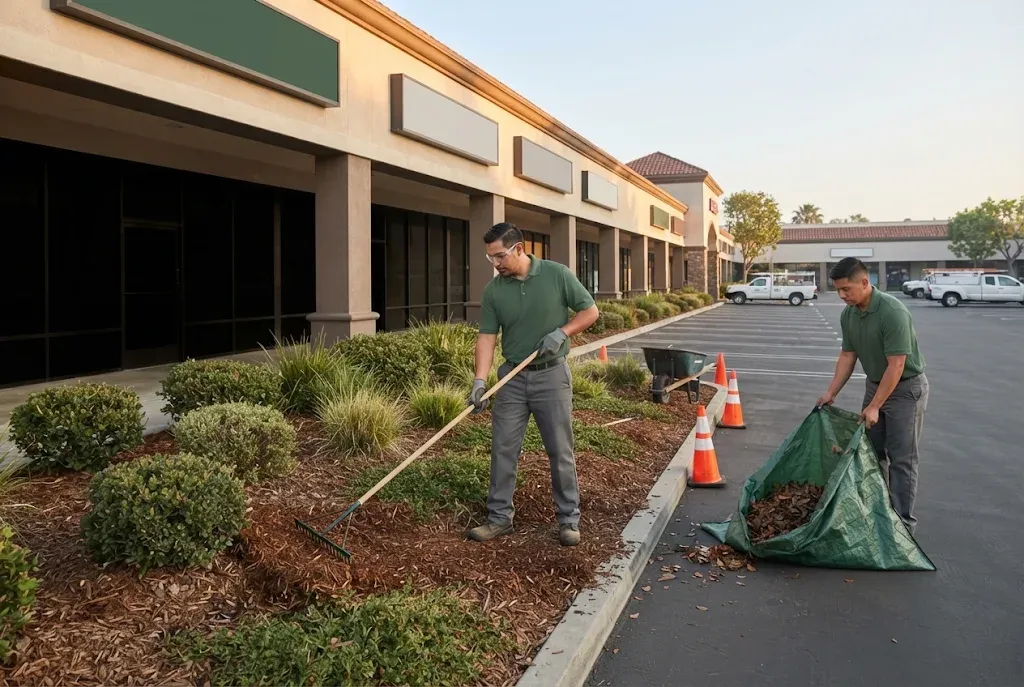
Beds are where a commercial property shows neglect fastest, because weeds, litter, and leaf drop collect in them and are easy to see against mulch or bare soil. Regular bed upkeep includes removing weeds while they are small, ideally before they set seed, pulling out volunteer seedlings, redefining bed edges where turf or groundcover is creeping in, and clearing trash and plant debris. Weeds that keep returning in the same place usually point to an underlying cause, such as thin mulch, an overwatered zone, or a perennial weed spreading from roots, and we note those patterns rather than simply pulling the same plants every visit.
Groundcover and Shrub Care
Groundcovers need to be kept off sidewalks, curbs, and drain inlets and kept from smothering neighboring shrubs. Shrubs need shaping that keeps them in scale with the space they occupy. We cover pruning in more detail in the next section, because it is the task where a one-size approach does the most damage.
Landscape Debris
Clippings, prunings, and leaf litter generated by our work are collected and removed or handled according to the scope. Debris that accumulates in planted areas between visits, such as leaves, windblown paper, and small litter, is normally cleared from beds as part of the visit. Large-volume items, illegal dumping, and general site trash collection outside landscaped areas are separate questions to settle in the agreement, because they can change the time and hauling a visit requires.
Not Sure What Your Current Maintenance Scope Covers?
Gaps in a scope show up as weeds no one owns, shrubs no one shapes, and sprinkler problems no one reports. We will walk the property, map the maintained areas, and put the tasks, frequency, and exclusions in writing so everyone knows what to expect.

How Should Shrubs, Hedges, and Groundcovers Be Pruned on a Commercial Site?
Shrubs and hedges on a commercial property should be pruned according to what each plant is, how it grows, and what job it is doing in the landscape. There is no single method or calendar that suits every species. A formal hedge lining an entry walk, a flowering shrub in a parking-lot bed, and a mass of ornamental grasses along a slope each respond differently to cutting, and treating them all the same way is one of the most common reasons commercial landscapes look worse over time.
Matching the Cut to the Plant
Formal hedges are often sheared to hold a defined shape, and shearing works for plants that tolerate it. Many other shrubs look and perform better with selective pruning, where individual stems are cut back to a branch or the base to reduce size while keeping a natural form. Repeated shearing of shrubs that are meant to be loose and open tends to produce a dense outer shell over bare interior wood, and once that happens, bringing the plant back can take several seasons or may not be practical. Flowering shrubs add another variable: pruning at the wrong point in their cycle can remove the growth that would have flowered.
Keeping Plants in Scale With the Space
Much of commercial shrub and hedge maintenance is about clearance. Shrubs should be kept off walkways, away from building walls and windows, below signage, and clear of sightlines at drive entrances. Where a plant has simply outgrown its location, repeated hard cutting is usually a poor long-term answer, and we may recommend replacing it with something better suited to the space as a separately approved item.
Seasonal Care Without a Fixed Formula
Seasonal commercial landscape maintenance includes tasks such as cutting back perennials and grasses after their growth cycle, removing spent flowers where the scope calls for it, and adjusting the intensity of pruning as growth speeds up or slows down through the year. The right timing depends on the species, the weather in a given year, and the look the property wants to maintain, so we set these tasks by plant group and observed growth rather than by a single date applied to the whole site.
How Are Mulch, Bare Areas, and Declining Plants Handled?
Routine visits include watching the condition of beds, not just cleaning them. Three conditions come up constantly on commercial properties: mulch that has thinned or washed away, bare patches where plants have died or never filled in, and plants that are visibly declining. Our job during maintenance is to notice these, keep the area tidy, and recommend a correction when one is needed. The correction itself is usually separate, approved work.
Mulch Condition
Organic mulch breaks down, shifts, and settles over time, so coverage that looked complete at installation will thin out. The UC Statewide IPM Program guidance on landscape mulches explains how mulch helps suppress annual weeds and conserve soil moisture, why it needs to be replenished, and why it should be kept back from trunks and stems. During visits we note where mulch has thinned, exposed soil, or been piled against plant crowns, and we can level or pull back existing mulch as part of normal bed care. Bringing in and spreading new mulch is typically quoted as a separate or seasonal item, unless the agreement specifically includes it.
Bare Planting Areas and Plant Decline
A bare spot in a bed may be the result of a single failed plant, foot traffic cutting a corner, poor irrigation coverage, or a plant that was never right for the location. A declining plant may be reacting to water, soil, sun exposure, root damage, or pests. We report what we see and what we think is causing it. When replacement makes sense, we provide a recommendation and a separate estimate, so replacement and enhancement spending stays a decision the owner or manager makes on purpose rather than a charge that appears inside a monthly invoice.
Where Do Irrigation and Tree Care Fit Into a Maintenance Program?
Irrigation and trees affect almost everything a maintenance crew is responsible for, but most of the specialized work on both belongs in its own scope. What routine maintenance can and should do is observe, report, and coordinate.
What Routine Irrigation Observation Covers
Crews moving through a property see problems that are invisible from the office. During normal visits we watch for signs such as:
- Leaks, broken heads, and water pooling or running onto paving
- Sprinklers that are tilted, sunk, blocked by plant growth, or spraying walls, windows, and sidewalks
- Uneven coverage, where one part of a zone is soggy and another is dry
- Plant stress patterns that line up with irrigation problems, such as browning shrubs at the edge of a spray pattern
We report these to the property contact. Diagnosing controller programming, valve failures, pressure problems, or repairs to pipe and drip lines is separately scoped work through our commercial irrigation services. Questions about water budgets, scheduling to conserve water, or reducing a property’s outdoor water use are handled through our commercial water management services. Keeping these responsibilities clear in the agreement avoids a common gap where everyone assumes someone else is watching the water.
When Tree Work Needs Its Own Assessment
Maintenance crews can typically handle low growth such as suckers at the base of a tree, small branches that interfere with mowing, and debris from normal leaf drop. Pruning mature trees, raising canopies over drive aisles, removing trees, and evaluating trees that look structurally questionable are different tasks with different equipment, skills, and safety requirements. Those are assessed and scoped separately through our commercial tree care services. If we notice a tree issue during maintenance, such as a broken limb or a canopy blocking a light pole, we report it so it can be evaluated rather than addressed informally.
Commercial Landscape Upkeep You Can Plan Around
Consistent visit days, service windows set around your tenants and customers, and clear notes when something needs attention. Call (888) 601-1117 to talk through your property, or request a callback and we will reach out to set up a walkthrough.
How Do You Maintain Customer-Facing Areas Without Disrupting the Business?
The parts of a commercial landscape that carry the most weight are usually the ones people see and walk through every day, and those are also the places where maintenance work is most likely to get in someone’s way. A good program gives those areas the most consistent attention while scheduling the work so the property keeps operating normally.
Areas That Set the Standard
- Entrances and approaches. The beds around a main entry, monument sign, or reception door are judged on every visit, so they need crisp edges, clean beds, and shrubs that frame the entry without crowding it.
- Parking-area planting beds. Medians and islands sit in the hottest, most abused part of the site, bumped by tires and car doors, so they are often the first beds to thin out when visits are hurried.
- Sidewalks next to planted areas. Groundcover creeping onto walks, overhanging shrubs, and clippings left on paving all affect how a property looks and how easily people move through it.
- Shared outdoor spaces. Courtyards, patios, and break areas need clean, usable edges and beds that do not shed debris onto seating.
Scheduling Around How the Property Runs
Business landscape maintenance has to account for tenant activity, customer traffic, business hours, deliveries, and pedestrian access. Running a blower beside an outdoor dining area at lunch, mowing near an office window during a scheduled meeting, or parking a trailer across a loading dock all create complaints that have nothing to do with the quality of the landscape. We discuss service days and time windows during the first walk and build visits around them where our routes allow. Some properties also have site-specific requirements, such as vendor check-in, restricted areas, or periods when certain work should not happen, and those belong in the written scope.
Property Types With Their Own Pages
Each type of commercial property adds its own priorities. Retail centers are judged on storefront visibility and customer parking, which we cover on our shopping center landscape maintenance page. Office properties weigh tenant impressions and employee spaces, discussed under our office building landscaping services. Residential rental communities add residents, pets, and leasing tours to the picture, which our apartment complex landscaping services page addresses. Warehouses and distribution sites bring truck traffic, wide perimeters, and limited planting, so industrial property landscape maintenance tends to center on clear sightlines at drive entrances, durable plantings, and weed control along long frontages.
What Should a Written Maintenance Scope Include, and How Are Visits Planned?
A written scope is the document that turns a maintenance relationship into something both sides can measure. Most disagreements between property managers and landscape providers come from assumptions that were never written down. Whether it is called a scope, a plan, or a set of commercial landscape maintenance contracts across several sites, it should answer the same practical questions.
Elements to Confirm in Writing
- Included areas. A clear description or map of which turf, beds, slopes, islands, and perimeter areas are maintained.
- Tasks. What is done in each area, such as mowing, edging, bed weeding, shrub shaping, groundcover control, and debris removal.
- Service frequency. How often each task happens, and whether frequency changes by season.
- Cleanup responsibilities. How clippings and prunings are handled, and what happens with trash, leaf accumulation, and paving left dirty by maintenance work.
- Exclusions. Work that is not included, such as irrigation repairs, mature-tree pruning, mulch replenishment, plant replacement, or storm cleanup, unless listed.
- Communication expectations. Who the contacts are on each side, how issues are reported, and how quickly the property expects a reply.
- Approval of additional work. How extra work is proposed, priced, and approved before it starts.
For HOA common areas, approval often runs through a board or committee on a meeting schedule, which affects how quickly recommended work can move forward. Our HOA landscape maintenance page goes into that process. Those seven items form the core of what to include in a commercial landscape maintenance scope of work, and anything specific to your property can be added on top of them.
Why Visit Frequency Varies
There is no correct visit frequency for every commercial property. The right schedule depends on how fast the plants grow at different times of year, the weather in a given season, how much of the site is turf versus planting beds, how heavily the property is used, and the standard of appearance the owner wants to hold. A busy retail frontage with seasonal color may need more frequent attention than an industrial perimeter planted with low-growth shrubs. We propose a frequency based on what we saw during the walk and adjust the plan if growth or use patterns show it is too light or heavier than needed. Planning a seasonal maintenance calendar for commercial landscapes around these factors, rather than around a fixed visit count, usually keeps the site more consistent through the year.
Reporting and Walkthroughs Worth Asking About
When you compare providers, look at how each one communicates, not only what each one charges. Useful features to ask about include routine condition notes after visits, periodic walkthroughs with the property contact, a clear way to flag problems such as irrigation leaks or declining plants, and recommendations for emerging needs before they become urgent. Ask each provider to describe how these work in practice and what is included in the base agreement. This is also where knowing how to compare commercial landscape maintenance proposals pays off: two proposals with similar prices can describe very different amounts of work.
What Affects the Cost of Commercial Landscape Maintenance Services, and How Do You Choose a Provider?
The cost of Commercial Landscape Maintenance Services depends on how much work the property actually requires on a repeated basis. We do not publish prices, because two properties of the same size can need very different effort. An estimate is built from the scope agreed during the property walk.
Factors That Shape an Estimate
- Maintained area. The total area of turf, beds, slopes, and perimeter included in the scope.
- Turf-to-planting balance. Open turf can often be maintained efficiently with mowers. Dense beds, hedges, and mixed plantings take more hand work.
- Existing condition. A landscape that has been kept up is easier to hold than one that needs heavy cutback and weed removal first. That initial recovery work is often quoted separately.
- Access. Gated areas, distances from parking to work areas, slopes, and narrow beds all affect labor time.
- Service frequency. More frequent visits mean more labor, though each visit may be shorter.
- Debris volume. Heavy leaf drop, large hedges, and accumulated litter increase hauling and disposal time.
- Separately requested work. Mulch installation, plant replacement, irrigation repairs, and tree work are priced as their own items.
Choosing a Commercial Landscape Maintenance Provider Near You
A search for commercial landscape maintenance near me will return a long list of names. The provider that fits your property is the one that will walk the site, put the scope in writing, explain what is and is not included, schedule around how your property operates, and communicate clearly when something changes. It also helps to work with a provider that already serves your area, because route scheduling affects how reliably crews can arrive on the agreed days. Landscaper-Near-Me.com provides commercial landscaping maintenance services within our established service territory in Southeast Los Angeles County and Orange County.
When the grounds have started to drift, or the current agreement leaves too much unclear, the simplest next step is a walk of the property together. We will look at the areas involved, talk through the standard the property needs to hold, and follow up with a free estimate based on a written scope. Call (888) 601-1117, email info@landscaper-near-me.com, or request a callback to get started.
FAQ's - Frequently Asked Questions
Mowing, edging, and trimming are usually part of a recurring maintenance agreement wherever turf is included in the scope. More specialized lawn work, such as fertilization programs, aeration, overseeding, and correcting thin or declining turf, may be included or priced separately depending on the agreement. We list which turf tasks are included when we write the scope.
We discuss service days and time windows during the first property walk and plan around business hours, deliveries, and tenant activity where our routes allow. Local noise rules and site rules may also limit when certain equipment can run, so we confirm the schedule in writing before service starts.
Routine visits include watching for leaks, broken or misdirected heads, and uneven coverage, and reporting what we find. Repairs to valves, pipes, drip lines, and controllers are normally quoted and approved separately unless the agreement says otherwise. Settling this in writing prevents the gap where no one is responsible for the water.
Not automatically. Leveling and pulling back existing mulch can be part of routine bed care, but bringing in new mulch and replacing dead or declining plants are usually separate items. Some properties choose to build seasonal mulch into the agreement. We note thin mulch and plant loss during visits and recommend corrections for your approval.
Maintenance crews can typically handle low growth, such as base suckers and small branches that interfere with mowing. Pruning mature trees, canopy raising, removals, and evaluating trees that may be unsafe require a separate assessment and scope through our tree care team.
Yes, though the first step is usually a recovery phase. Heavy cutback, removal of established weeds, and clearing accumulated debris take more time than ongoing visits, so we typically quote that initial work separately. Once the landscape is back to a maintainable condition, the recurring scope takes over.
It depends on plant growth through the year, the balance of turf and planting beds, how heavily the property is used, and the appearance standard you want to hold. We recommend a frequency after the property walk, put it in the scope, and discuss adjustments if the site needs more or less attention than planned.
Helpful details include the property address, which areas you want maintained, any site plan or aerial photo, access and check-in requirements, preferred service windows, known irrigation or tree issues, and a copy of your current scope if you have one. We confirm the rest during the property walk.