
Sprinkler Installation Irvine CA:
New Lawn Systems and Replacements for Homeowners
Most Irvine lawns tell you what their sprinklers are doing wrong. A brown stripe runs along the sidewalk every August. The far corner of the backyard stays soft for a day after each cycle. Water beads across the driveway while the strip beside it browns. A yard with no system at all asks something simpler of you: a hose and a timer you have to remember.
Our Sprinkler Installation Irvine CA service is for homeowners who want that solved properly, with a new in-ground sprinkler system laid out for the yard they actually have. We plan and install systems for yards that have never had automatic watering, replace aging systems that have been patched past the point of reliability, and lay out new zones when a lawn has been resized, reshaped, or rebuilt. The work covers front lawns, backyards, side yards, and renovated turf areas on residential properties across Irvine.
This page walks through how we approach lawn sprinkler system installation in Irvine: which kind of project fits your yard, what shapes the layout, what a finished installation includes, how sprinklers fit around new sod and paving, and what goes into the estimate. Our page on sprinkler system installation services covers the service more broadly across our service area. If you manage a business property or an HOA common area rather than a home, our commercial irrigation installation in Irvine page is written for that work.

Free Estimates for a New Sprinkler System at Your Irvine Home
Planning a new in-ground system or replacing one that has been patched too many times? Tell us about your yard and we will put together a written installation scope at no cost. Call (888) 601-1117 or email info@landscaper-near-me.com.
Which Sprinkler Installation Irvine CA Project Fits Your Yard?
Most residential projects fall into one of three situations, and each one starts from a different place. Knowing which one describes your property makes it easier to talk through the work and to compare estimates on equal terms.
A Yard With No Sprinkler System
Some homes have lawns that have been watered by hand for years, and some yards were left as bare soil after a move-in or a removal project. Here the job begins at the water supply. We identify where the system can connect, how much pressure and flow that connection can deliver, and where the controller and valves will sit, then design the zones outward from there. Automatic lawn sprinkler installation on a yard like this is the cleanest kind of project, because nothing old has to be worked around.
Replacing an Aging System
Older systems tend to fail gradually. A valve that sticks, a head that no longer pops up, a lateral that has been spliced in three places. Eventually the question is not which part to fix next but whether the layout itself still makes sense. A lawn sprinkler system replacement keeps what is still sound, such as a reliable connection point or a well-placed valve location, and rebuilds the rest so coverage matches the current lawn.
A Lawn That Has Been Resized or Reshaped
Yards change. A patio gets wider, a planting bed takes over part of the lawn, or a narrow side yard is converted to turf. The heads that were placed for the old outline end up spraying a new walkway or missing a new corner. In these projects we lay out new zones for the new shape, which can mean moving heads, splitting a zone in two, or adding valves for areas that never had coverage.
Repair, Partial Rework, or Full Replacement: How Do You Tell?
A system usually needs replacing when the problems are spread across the yard and keep returning after repairs, and it usually needs repair when the problem is isolated to one head, one valve, or one leak. Homeowners who want to know how to tell when a sprinkler system needs replacing can start by asking whether the failures follow a pattern or appear at random.
Signs the Layout Is the Real Problem
- Dry areas that survive every adjustment. If heads have been cleaned, straightened, and re-nozzled and the same spots still brown, spacing or zoning is usually the cause.
- Different head types sharing one valve. Spray heads apply water much faster than rotors, so a zone that mixes them will overwater one area to keep the other alive.
- Leaks that move. Repeated breaks along the same run of old pipe suggest the line itself is near the end of its life.
- A controller that cannot be trusted. Missing stations, unreadable displays, or zones that run when they should not.
When a Repair Is the Better Call
A cracked head beside the driveway, a valve that will not shut off, or a single wet spot in an otherwise healthy lawn rarely justifies a new system. For isolated faults like these, our sprinkler repair services are the more sensible place to start. We would rather fix one part than replace a system that only needs one part.
Partial Rework
Between the two sits a middle path: replacing one or two zones, or rebuilding the backyard while the front stays as it is. This works well when part of the system was installed or upgraded more recently and still covers its area evenly.
What Shapes a Sprinkler Layout on an Irvine Lot?
A sprinkler layout is shaped by the size and outline of the lawn, the water pressure and flow available at the connection, slopes, sun exposure, existing irrigation, and the location of paving and planting beds. Every one of those factors changes where heads go and how many zones the yard needs.
Lawn Dimensions and Shape
Rectangular lawns are the easiest to cover evenly. Curved edges, bump-outs around trees, and lawns that pinch down to a few feet wide all need heads chosen for those specific shapes. We measure the turf area rather than estimating from the property outline, because the lawn is often smaller and more irregular than the lot suggests.
Narrow Strips Beside Sidewalks
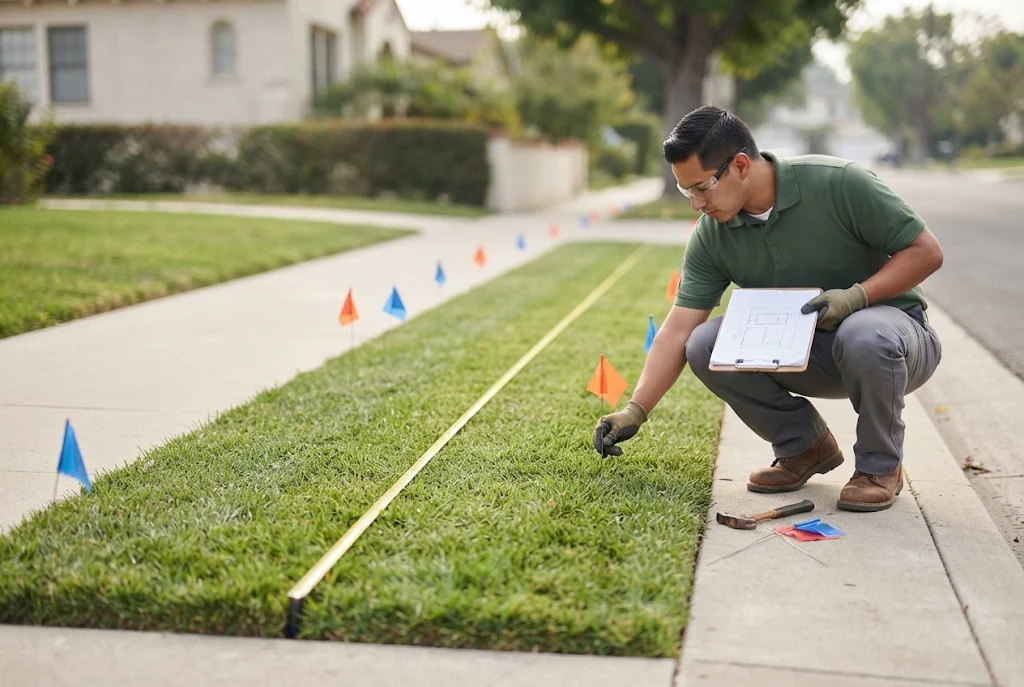
Many Irvine homes have a narrow strip of turf between the sidewalk and the street, or between a driveway and a side fence. These are among the hardest areas to water with spray heads, since even a well-adjusted head throws some water onto the concrete. Strip-pattern nozzles, careful head placement on the inside edge, or a non-spray approach can each make sense, depending on how narrow the strip is and how it is used.
Slopes and Runoff
Sloped yards lose water to runoff when it arrives faster than the soil can absorb it. The Irvine Ranch Water District’s watering guide notes that heavy clay soils are the most common type in its service area and recommends splitting run times into shorter cycles with soak periods in between. Homeowners asking how to reduce sprinkler runoff on a sloped lawn will usually get the biggest gains from three changes: lower-rate nozzles on the slope, separate zones for the top and bottom, and a controller programmed in short repeat cycles.
Sun, Shade, and Water Supply
A lawn that sits in full afternoon sun on one side of the house and in shade on the other should not share a schedule. Separating them lets each be watered for its own conditions. Water pressure and flow set the other limit. We check the static pressure at the house and the flow the connection can supply, because those numbers decide how many heads a single valve can run while still spraying at the intended distance.
Narrow Strips, Slopes, or a Reshaped Lawn? Plan the Zones First
We look at lawn shape, sun exposure, slope, and the pressure and flow at your connection, then lay out zones and heads so water stays on the grass and off the sidewalk. Call (888) 601-1117 to talk through your layout.
How Zone Layout and Head Selection Keep Coverage Even
Even coverage comes from three decisions working together: spacing heads so their patterns overlap, using heads with matched application rates within each zone, and grouping areas with similar needs onto the same valve. Overspray onto walks and driveways is reduced in the same planning step, by choosing arcs and positions that keep water on the grass.
Spacing and Overlap
Each head’s throw should land at or near the next head in the row. That overlap is what keeps the middle of the lawn from drying out between heads. When heads are spaced too far apart to save on parts, the result is the familiar pattern of green circles with tan rings between them.
Choosing Heads for Each Area
- Fixed spray heads suit small and medium lawn areas with short throw distances, such as most front yards.
- Rotary nozzles fit on spray bodies but apply water more slowly, which helps on slopes and in clay soil where water needs time to soak in.
- Rotors cover longer distances and suit larger, open backyard lawns.
Within a zone, heads should share the same application rate. A zone that mixes them puts down water unevenly no matter how carefully its run time is set.
Keeping Water Off the Hardscape
Heads along walkways and driveways are set on the turf side with partial arcs aimed inward, and their radius is adjusted so the spray stops at the edge. Placement matters as much as adjustment: a head set a few inches back from the concrete edge, with a nozzle sized for the space, wastes far less water than one that relies on being turned down.
Where Sprinklers Stop and Drip Begins
Turf is where sprinklers do their best work. Shrub beds, groundcover areas, and planters usually do better on low-volume irrigation that delivers water to the root zone without wetting foliage or the walk beside them. If you are weighing the two for part of your yard, our guide to drip irrigation versus sprinklers explains where each one fits.
What Does a Residential Sprinkler Installation Include?
A complete residential sprinkler installation includes the underground piping, the zone valves, the sprinkler heads and their connections, the controller and its programming, and testing of every zone for leaks, dry spots, and overspray. The exact parts list depends on the layout, but the components below appear on almost every project.
- Connection and backflow prevention. A sprinkler system tied into a home’s drinking-water supply needs a backflow prevention device so irrigation water cannot be drawn back into the household line. Requirements for the device and its location should be confirmed for the property before installation.
- Mainline and laterals. The mainline carries water under constant pressure to the valves. Lateral lines run from each valve to its heads and carry water only while that zone is running.
- Zone valves. Valves are usually grouped in a manifold inside an in-ground valve box, where they can be reached for service without digging.
- Heads and flexible connections. Heads connect to the laterals through flexible fittings that let them sit at the correct height and give a little when stepped on or bumped by a mower.
- Controller and wiring. Valve wire runs from each valve to the controller, which is set up with a starting schedule for each zone.
Before and During Trenching
Underground utilities need to be marked through California’s 811 notification system before any trenching begins. Trenches are cut along the planned pipe routes, with turf set aside where it can be relaid. Lines are flushed before the heads are installed so debris from assembly does not end up clogging nozzles.
Testing Before Backfill
Each zone is run while the trenches are still open so joints can be checked for leaks. After backfill, we run every zone again to look for dry spots and overspray, adjust arcs and distances, and confirm the controller operates each valve.
Reusing Existing Components
On replacement projects, parts of the old system can sometimes stay. Whether a mainline, valve, or controller is reused depends on its condition, whether it has the capacity the new layout needs, and whether it sits where the new design needs it. We note which components are kept and which are replaced so the estimate is clear about both.
Planning Sprinklers Around New Sod and a Yard Renovation
The best time to plan irrigation in a renovation is before anything else is built, because pipe routes, valve locations, and head heights all depend on where paving, beds, and lawn will end up. When sprinklers are part of a larger redesign, our team for landscape design and installation in Irvine can coordinate the irrigation with planting and hardscape in a single plan.
Route Pipe Before Paving Goes In
A new patio or walkway poured over an irrigation route makes that pipe difficult to reach for good. Where a lawn or bed will sit on the far side of new paving, we place sleeves under the planned hardscape before it is built so pipe and valve wire can pass beneath it. Valve boxes are kept out of future paving and placed where they will stay accessible.
Test Coverage Before the Sod Goes Down
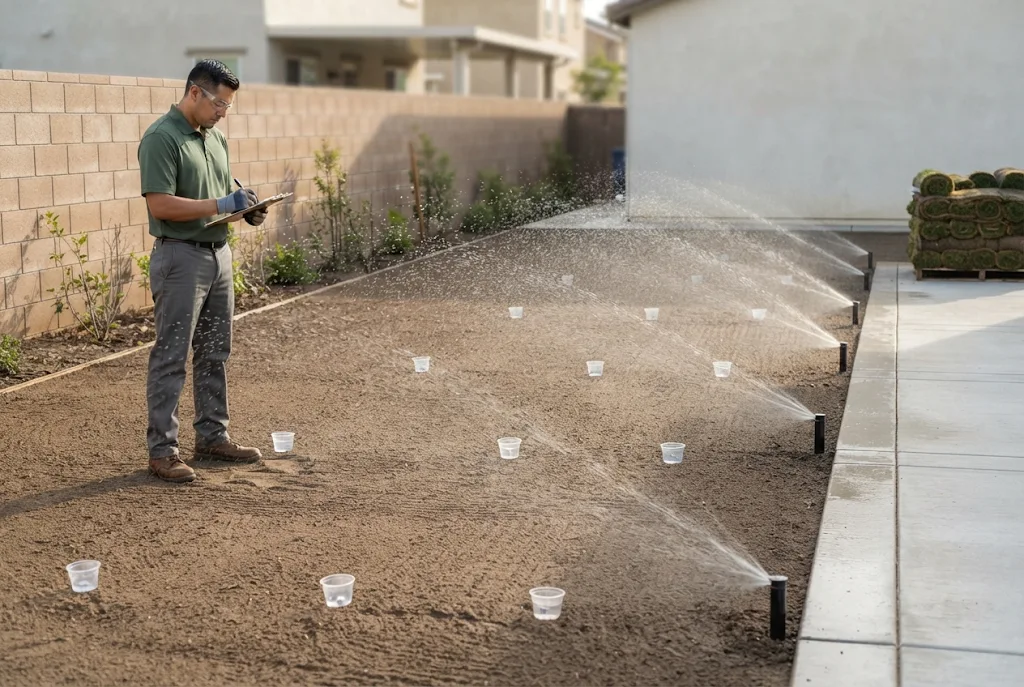
Sprinkler installation for new sod follows a specific order. The system is installed after rough grading, the heads are set, and every zone is run over the bare, graded soil. That is the moment to see the full spray pattern, spot gaps, and correct them, because once sod is laid, moving a head means cutting into a brand-new lawn.
Set Heads to the Finished Sod Height
Heads need to sit at the height of the finished lawn surface, not the bare soil, so the thickness of the sod has to be accounted for when they are set. Heads left too low get buried and spray into the grass; heads left too high get clipped by mowers. If new turf is part of your project, our sod installation in Irvine can be scheduled right after the system has been tested.
Give Planting Beds Their Own Zone
Beds next to a new lawn usually need far less water, applied more slowly. A separately controlled drip zone for those beds lets the lawn and the plants each be watered on their own schedule, instead of soaking the shrubs to keep the grass green.
Know What Your Sprinkler Installation Covers Before Digging Starts
Every zone tested, heads set to the finished lawn height, and a controller walkthrough at handoff. Call (888) 601-1117, email info@landscaper-near-me.com, or request a callback to discuss your Irvine sprinkler project.
What Affects a Sprinkler Installation Estimate in Irvine?
The main factors are the size and shape of the lawn, the number of zones, site access, how much of the existing system can be reused, the controller you choose, and how much of the yard needs to be restored after trenching. Anyone looking into what affects the cost of installing a lawn sprinkler system will find that two estimates for similar-looking yards can differ for any of these reasons.
- Lawn area and shape. More turf means more heads and pipe. Irregular outlines and narrow strips take more heads per square foot than an open rectangle.
- Number of zones. Each additional zone adds a valve, wiring, and a controller station. Slopes, sun and shade, and separate beds all add zones.
- Site access. Side yards with gates, narrow paths, or no route around the house affect how trenching and material handling are done.
- Existing components. Reusing a sound connection, backflow device, or valve location can reduce the scope. Replacing worn components adds to it.
- Controller selection. A standard timer, a weather-based controller, or reuse of an existing controller each lead to a different line item.
- Restoration needs. Relaying cut turf, repairing trench lines through beds, or crossing under existing paving all belong in the scope.
Reading an Estimate Line by Line
A useful estimate lists the number of zones, the head types, what is being reused, the controller, and what restoration is included. When those details are written down, you can compare one proposal against another and see where they actually differ.
Controller Setup, Handoff, and Seasonal Adjustments
A new system is only as efficient as its schedule. When the installation is finished, we program the controller with a starting schedule for each zone and walk you through how it works, so you can make adjustments without calling for help each time the weather turns.
What You Receive at Handoff
- A tour of the controller: how to run a zone manually, change start times, and pause watering.
- A record of which zone serves which area of the yard.
- The location of the valve box and the shutoff for the irrigation system.
Adjusting Through the Year
Irvine lawns need noticeably more water in midsummer than in winter, so a schedule left unchanged from August will overwater for much of the year. The Irvine Ranch Water District, which serves all of Irvine, publishes suggested monthly run times for spray and drip systems on its watering guide. Watering rules and allocations can change, so check current requirements with the district before setting a schedule.
Is a Weather-Based Controller Worth Considering?
Weather-based controllers use local weather information to adjust watering as conditions change, which reduces the number of manual seasonal changes. They suit homeowners who would rather not reprogram the timer each season. They still need a sound layout underneath them, because no controller can fix a head that sprays the sidewalk. We can talk through whether one fits your system when we prepare the estimate.
How to Request a Sprinkler Installation Estimate in Irvine
The fastest way to get an accurate sprinkler installation estimate in Irvine is to tell us about the yard up front. A few details help us plan the visit and give you a clearer scope:
- Whether a system exists now, and roughly how old it is.
- Which parts of the yard need coverage: front lawn, backyard, side yard, or a renovated area.
- Whether new sod, a patio, or other paving is planned.
- Any problem areas you already know about, such as a slope that runs off or a strip that never stays green.
Photos of the yard and the existing controller are helpful if you have them. From there, we look at the property, check the water supply, and put together a written scope that spells out the zones, the components, and what is included.
A well-planned system should make the lawn easier to live with, not something you have to keep an eye on. Whether you are starting from bare soil, replacing a system that has outlived its layout, or reshaping the yard around new turf, call us at (888) 601-1117, email info@landscaper-near-me.com, or request a callback, and we will set up a free estimate for your Sprinkler Installation Irvine CA project.
FAQ's - Frequently Asked Questions
It depends on the scope of the work, particularly the connection to your water supply and the backflow prevention device. Requirements can change, so they should be confirmed with the City of Irvine for your property before installation begins. We will raise the question during the estimate so it is settled before any trenching.
Turf cut from the trench lines is set aside and relaid after backfill, and narrow trench lines usually blend in as the grass grows back together. How quickly that happens depends on the season, the grass type, and how the lawn is watered afterward.
Often, yes. Where a line has to reach a lawn on the other side of existing concrete, it can frequently be run beneath the paving instead of cutting through it, depending on the distance and the soil. If you are planning new paving, sleeves placed before it is poured make this much simpler.
Early morning is generally the best time to water a lawn, because there is less wind and evaporation and the grass dries as the day warms. We set the starting schedule with that in mind and show you how to change start times on the controller.
Yes, if the system is planned for it. Choosing a controller with spare stations and leaving room in the valve manifold makes it straightforward to add a drip zone or a new lawn area later. Let us know about possible future changes when we prepare the estimate.
Old heads are removed. Lines that will not be reused are disconnected and capped so they cannot leak or carry water, and they are removed when they are in the way of the new layout. The estimate notes which existing components are reused and which are taken out of service.
Not for the entire installation. It helps to be available at the start to confirm the layout and the location of the controller and water connection, and again at the end for the controller walkthrough. We also need access to the yard, the water shutoff, and the controller location while we work.
Yes. We provide free estimates for sprinkler installation in Irvine. The estimate describes the zones, the head types, the controller, what is being reused, and what restoration is included, so you know what the project covers before you decide.