
Commercial Landscape Maintenance Irvine CA:
Recurring Grounds Care for Offices, Retail Centers, and Mixed-Use Sites
Good commercial landscape maintenance Irvine CA property managers can count on is rarely about one dramatic visit. It is the steady routine that keeps a building entrance tidy at 7:45 a.m. when tenants start arriving, stops parking lot islands from becoming litter traps, and catches a broken sprinkler head before the shrubs behind it begin to brown. When the routine works, nobody thinks about the landscape. When it slips, tenants and shoppers are usually the first to notice.
This page is for owners, property managers, and facilities managers who are sourcing recurring landscape maintenance for Irvine businesses: office buildings and business parks, shopping centers and retail properties, and mixed-use sites with shared commercial grounds. Some readers are putting a property out to bid for the first time. Others already have three proposals on the desk, or are planning a move away from a provider that no longer fits the site.
Landscaper-Near-Me.com connects Irvine commercial properties with recurring maintenance service as part of our established service territory in Orange County and Southeast Los Angeles County. For a wider view of the commercial landscape work available across the city, start with our overview of commercial landscapers in Irvine. Our main commercial landscape maintenance services page explains the program in terms that apply at every location we serve. This page is narrower. It looks at how a recurring Irvine maintenance agreement is usually structured, what deserves attention on a walkthrough, how to read a proposal, and what information helps us prepare an accurate free estimate.
A note before the details: every commercial site is different. The tasks, visit frequencies, and reporting practices described below are items to confirm in writing during estimating. They are not a fixed package that applies to every property.

Start Your Irvine Commercial Landscape Maintenance Scope With a Free Estimate
Send us the property address and the areas you need maintained. We will arrange a walkthrough, note current conditions, and provide a written recurring scope with a free estimate. Call (888) 601-1117 or email info@landscaper-near-me.com.
What Does a Commercial Landscape Maintenance Agreement in Irvine Usually Cover?
A recurring agreement covers the routine work that keeps established landscape areas in their intended condition. That generally means turf care where turf exists, planting bed care, routine shrub trimming, removal of landscape debris from maintained areas, and, where the scope includes it, observation and reporting on how the irrigation system is performing. It does not usually include building new landscape, replacing systems, or correcting problems that existed before service started. Those are quoted on their own.
The more useful question is not whether a task is “included” in the abstract. It is which parts of your property each task applies to, and how often it happens. A clear agreement ties every task to a location and a frequency.
Turf areas
Where a property has lawn, recurring service usually includes mowing at a height suited to the grass type and season, edging along walks and curbs, string trimming around posts and utility boxes, and blowing clippings off the hardscape. Commercial lawn and planting bed maintenance are often priced together, but turf brings its own decisions about mowing height, wear from foot traffic, and feeding. Our page on commercial lawn care services goes further into turf-specific care.
Planting beds and shrubs
Bed maintenance typically covers hand weeding or another agreed weed-control method, clearing leaf litter and trash from under shrubs, keeping bed edges defined, and routine trimming that holds shrubs at their intended size and keeps them clear of walkways, signage, and sight lines. Growth is stronger at some times of year than others, so seasonal shrub trimming can be noticeably heavier. Confirm whether the agreement includes those heavier cuts or treats them as an additional service.
Landscape debris
The agreement should say what debris is removed and from where: clippings, leaves, fallen fronds, and litter inside maintained landscape areas. Most properties also want entry walks and adjacent hardscape blown clear after each visit. Parking lot sweeping and trash enclosure cleanup are separate questions, and they are often handled by a different vendor.
Irrigation observation and reporting
Where the agreed scope includes it, the maintenance team watches for visible irrigation problems during regular visits, such as broken or tilted heads, overspray onto pavement, standing water, and dry patches, and reports them to the property contact. Routine observation is not the same as repair. Replacing valves, rerouting lines, or reprogramming a controller the property manager controls is normally priced and approved separately, so the agreement should state who may make adjustments and under what conditions.
What Should a Site Walkthrough Cover Before You Request an Estimate?
A walkthrough should take in every area the agreement will touch, and it should record existing conditions so both sides agree on the starting point. It is also where scope mistakes get caught: the forgotten slope behind a loading dock, a row of planters on an upper terrace, or a strip of landscape along the public sidewalk that may or may not belong to the property.
On a typical Irvine commercial site, we suggest walking these areas in order:
- Building entrances. These carry the most visual weight. Note shrub height relative to doors and windows, how clean the beds are, and any planters or pots that need regular attention.
- Parking lot islands and medians. Islands collect wind-blown trash and often catch irrigation overspray. Check whether plantings block a driver’s view at drive aisles and exits.
- Common walkways and courtyards. Look for plants crowding the walking surface, low branches over paths, and corners where debris keeps gathering.
- Turf and planting beds. Identify which areas are turf and which are shrubs and groundcover, and roughly how large each is. Thin turf, bare spots in beds, and weed pressure all belong in the notes.
- Irrigation coverage. If it can be arranged, a short run of each zone shows coverage gaps, misaligned heads, and spray hitting walls or paving.
- Conditions that need separate correction. Dead plant material, hedges that need a hard cutback, eroded slopes, and broken irrigation are recorded as baseline items rather than folded into routine maintenance.
Keep the photos from the walkthrough. Months later, they make any conversation about what changed, and when, much shorter.
How Often Should Commercial Grounds Maintenance in Irvine Be Scheduled?
Many commercial properties are serviced weekly or every other week, but the right frequency for commercial grounds maintenance in Irvine depends on how fast the plants grow, how large the site is, how much foot traffic it carries, and how closely the owner wants the landscape kept. A prominent office entrance and a back-of-house service area on the same parcel can reasonably be held to different standards, and some agreements schedule them differently.
Growth and the seasons
Irvine’s mild climate keeps landscapes growing through most of the year, though not at a steady pace. Warmer months tend to push faster turf and shrub growth, while cooler months shift attention toward leaf drop and debris. Coastal Southern California gets most of its rain between late fall and early spring, and beds often respond with a flush of weeds. Seasonal wind events in Orange County can also scatter leaves and litter across parking areas and walkways. A sensible schedule plans for these swings, for example by adding heavier shrub trimming when growth peaks, instead of repeating the same visit all year.
Working around tenant access hours
At office buildings and business parks, when a visit happens matters almost as much as how often. A mower and blowers beside the main entrance at 8:30 a.m. are not the welcome tenants want. Many managers ask for entrance areas to be finished before peak arrival or saved for midday, with louder work moved away from occupied suites. Ask how a provider plans its route so the same areas are serviced at about the same time each week. Our page on office building landscaping services covers other considerations specific to office properties.
Coordinating around busy retail periods
Retail centers face the opposite problem. Their busiest hours are exactly when crews would most like to work. Early-morning service before stores open is common, and some centers pause noisy work during the holiday shopping season or around large on-site events. Confirm in writing whether the agreement allows shifted service days during those periods, and how a missed visit is made up.
Put Overspray, Overgrown Shrubs, and Entrance Debris on Record Before Service Starts
A documented baseline keeps routine maintenance separate from corrective work. Tell us which entrances, parking islands, and beds concern you most, and we will plan a walkthrough that records them before a recurring schedule is set.
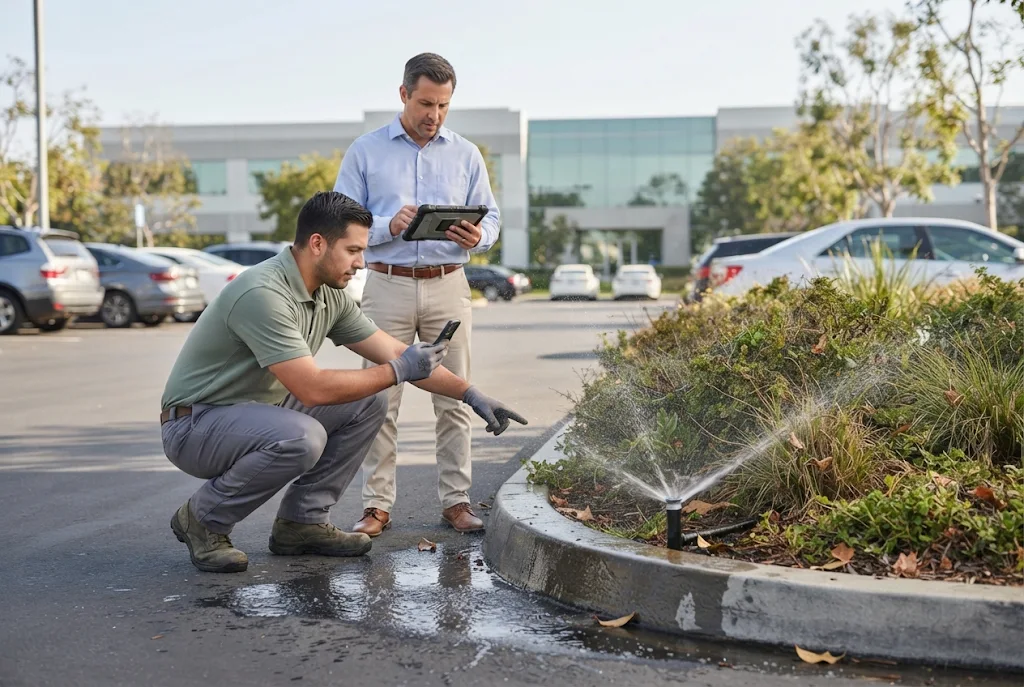
Which Landscape Conditions Should Be Documented During Routine Service?
Routine service should do more than mow and clean. The maintenance team is on the property more often than almost anyone else, which puts it in a good position to notice conditions that are getting worse. The agreement should say what gets reported, to whom, and how, and it should keep observation separate from repair.
Conditions worth documenting on Irvine commercial sites include:
- Shrubs encroaching on walkways. Plants that narrow a walkway or reach into a path of travel hurt the property’s appearance and can become an access concern. Routine trimming usually handles this, while severe overgrowth may need a one-time cutback quoted separately.
- Debris building up near entrances. Leaves and litter that keep collecting in the same corner usually point to a wind pattern, a nearby tree, or a gap in the service route.
- Dry or saturated planting areas. A bed that stays wet may have a leaking valve or a zone running too long. A dry strip may have a clogged nozzle or a coverage gap. Either pattern is easier to diagnose when it is reported early.
- Sprinkler overspray. Water landing on sidewalks, parking surfaces, or building walls is wasted, can stain surfaces, and can leave slick spots where people walk.
Irvine is served by the Irvine Ranch Water District, which also supplies recycled water for landscape irrigation at many commercial sites. Both are good reasons to have a clear, quick process for reporting irrigation problems. IRWD’s landscape and irrigation tips, including its downloadable landscape checklist are a practical reference for managers who want to understand what a periodic irrigation check involves. The district points out that one broken or missing sprinkler part can waste a surprising amount of water in a single week.
Observation and reporting versus repair
Spotting a problem and fixing it are different line items. Within a typical agreement, a technician might straighten a tilted head or clear a clogged nozzle during a visit, while broken lateral lines, failing valves, controller replacement, and system redesign are estimated and approved separately. Properties that want more structured attention to irrigation can look at commercial water management services, which handle the system side: scheduling, audits, and efficiency improvements. Whatever the arrangement, the property manager should know in advance which fixes can be made on the spot and which need approval first.
How Do Office Parks, Retail Centers, and Mixed-Use Properties Differ?
The core tasks are much the same from one property type to the next. What changes is where attention goes, when work can happen, and who needs to be kept informed.
Office park grounds maintenance in Irvine
Many business parks in the city, including campuses around the Irvine Spectrum area and the Irvine Business Complex near John Wayne Airport, have generous setbacks, long runs of turf and groundcover, and shared courtyards or outdoor seating. Office park grounds maintenance in Irvine often comes down to consistency: several buildings with different tenants, but one landscape standard across the campus. Shared paths and gathering areas tend to need closer attention than the perimeter, and visits are timed around the working day.
Recurring landscape upkeep for retail properties
Retail centers concentrate their landscape in the parking field and along storefront walks. Parking lot islands, drive-aisle medians, and the planters beside shop entrances take the most wear from foot traffic, carts, and litter, and they are the first thing shoppers see. Recurring landscape upkeep for retail properties also means watching sight lines at driveway entries and around monument signs, where overgrown plants can hide traffic or tenant names. For more on center-specific needs, see our page on shopping center landscape maintenance.
Mixed-use properties with shared commercial grounds
Mixed-use sites add a layer of coordination. Commercial frontage, residential courtyards, and shared paseos may answer to different stakeholders, and quiet hours may apply near homes. An agreement for a mixed-use property should state which areas are commercial common area, which belong to a residential association or another party, and when power equipment may run.
How Should You Compare Commercial Landscape Maintenance Contracts?
Compare proposals line by line against the same list of areas and tasks, not by the monthly total alone. Two bids can look far apart simply because they describe different scopes. A low price that leaves out seasonal trimming or debris removal from parking islands can end up costing more over a year once the extras are added.
When reviewing commercial landscape maintenance contracts, check five things:
- Areas covered. Does the proposal name every area from the walkthrough, including slopes, planters, and street frontage?
- Recurring tasks and frequency. Mowing, edging, weeding, trimming, and debris removal should each have a stated frequency.
- Seasonal work. Heavier shrub trimming, leaf-drop cleanup, and similar items should either be included and scheduled or listed clearly as additional.
- Exclusions. Irrigation repairs, plant replacement, mulch, tree work, and storm cleanup are common exclusions. They are reasonable exclusions as long as they are written down.
- Communication. Who is your contact, how are issues reported, and how is extra work proposed and approved before it begins?
A commercial landscape maintenance scope-of-work checklist that lists each area and the tasks you expect there makes it much easier to hold every bidder to the same standard. If you are still working out how to compare commercial landscape maintenance bids from several providers, start with the five points above. They are where workable proposals and vague ones usually part ways.
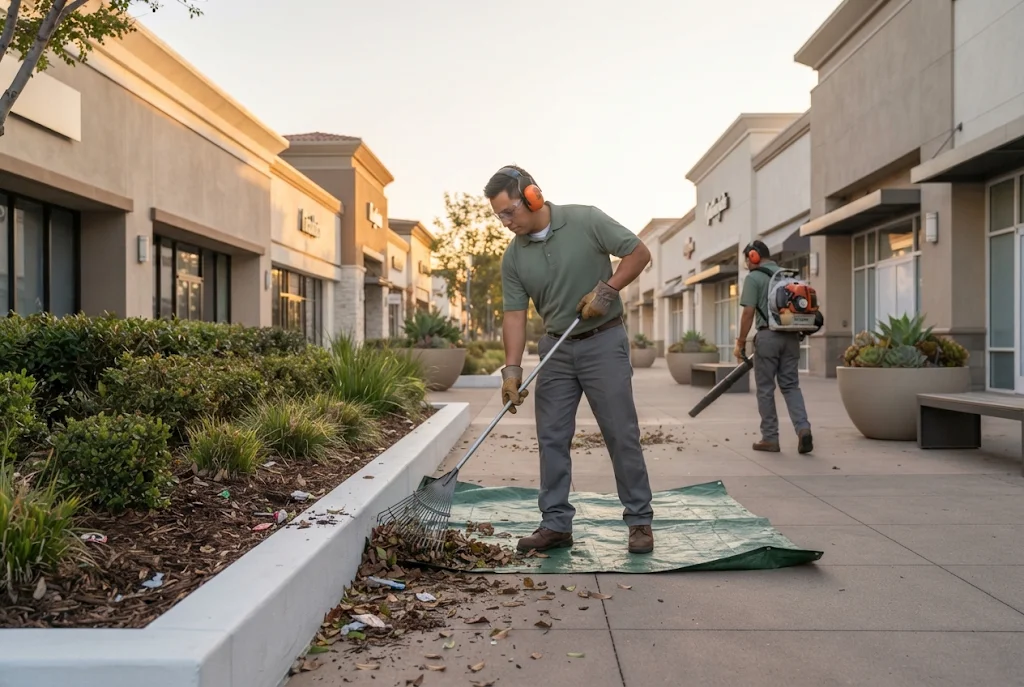
Compare Your Current Grounds Service Against a Clear, Written Scope
If your Irvine property is up for renewal or you are weighing a change of provider, we can talk through your areas, visit timing, and exclusions before you commit. Request a callback or call (888) 601-1117.
What Happens When You Switch Landscape Maintenance Providers?
Switching providers goes most smoothly when the new scope starts from a documented baseline. Without one, any problem left over from the previous vendor can become a disagreement within the first few weeks.
A transition walkthrough should record the current state of turf, beds, shrubs, and visible irrigation, with photos tied to specific locations. Items that need correction, such as a hedge line allowed to grow well past its intended height, beds full of established weeds, or a zone that has not run properly in months, are listed separately from routine maintenance. That gives the owner a choice: address them right away, phase them in, or leave them for a later budget.
Before the changeover date, it also helps to:
- Review the notice and termination terms in your current contract, so one agreement ends when the next begins.
- Gather what you know about the irrigation system: controller locations, any zone maps, the water source, and who currently has controller access.
- Confirm gate codes, access hours, and any building rules about where equipment and vehicles can park.
- Write down tenant complaints or recurring problems you want the new provider to keep an eye on.
The first month is when the new routine settles in. Expect more communication early on, and ask for a short summary after the first few visits showing what was done and what was found.
Where Do Tree Work, Irrigation Upgrades, and Landscape Construction Fit?
These usually sit outside a recurring maintenance agreement, even though routine visits are often where the need for them first shows up.
Specialized tree work, including structural pruning of large trees, work at height, removals, and canopy clearance over parking areas and roofs, typically needs its own scheduling and equipment. Our commercial tree care services page covers that work. Major irrigation upgrades, such as converting spray zones to drip or replacing controllers across a site, are projects with their own estimates. Landscape construction and hardscape installation are priced as separate projects as well.
For the maintenance agreement, the goal is simply to keep those boundaries clear. When a technician notices a tree concern or a failing irrigation section, it should be reported with enough detail for the property manager to decide what happens next, rather than absorbed into routine work without approval.
What Information Helps Prepare Commercial Landscape Maintenance Estimates in Irvine?
The more we know before the walkthrough, the more accurate the scope and the free estimate will be. For commercial landscape maintenance estimates in Irvine, these details help most:
- The Irvine property address, plus the buildings or parcels included
- The property type: office building, business park, shopping center or retail property, or mixed-use site
- The areas you want maintained, and any areas maintained by someone else
- Your current service schedule and visit days, if you know them
- Access constraints, such as gate codes, tenant hours, store opening times, or quiet hours
- Recurring concerns, such as debris at one entrance, overspray, overgrown shrubs, or dry beds
A site plan or aerial image with the maintained areas marked is helpful but not required. If the property is under contract with another provider, a copy of the current scope, with pricing removed if you prefer, shows us what the site is used to receiving.
When you are ready to review commercial landscape maintenance Irvine CA options for your property, call us at (888) 601-1117, email info@landscaper-near-me.com, or request a callback. Tell us about the site and the issues you most want solved. We will arrange a walkthrough and prepare a written scope and free estimate for recurring maintenance that fits how your Irvine property operates day to day.
FAQ's - Frequently Asked Questions
Yes. Irvine is part of our established service territory in Orange County and Southeast Los Angeles County. We arrange recurring maintenance for office buildings, business parks, retail centers, and mixed-use properties, starting with a walkthrough and a written scope.
Visit timing is one of the items we confirm during estimating. Many properties ask for entrance areas to be finished before peak arrival or opening hours, with louder work moved away from occupied spaces. What is possible depends on the site, its access rules, and route scheduling.
Usually only minor adjustments, if the scope allows them. Reporting visible problems such as broken heads or overspray is common, while valve, line, and controller repairs are typically estimated and approved separately. The agreement should spell out the difference.
Routine maintenance tasks are the same on recycled-water sites. Changes to the irrigation system itself should be coordinated with the property’s designated contact and follow the water supplier’s requirements for recycled-water systems.
That is the goal. A useful estimate names the maintained areas, the recurring tasks and their frequency, seasonal work, and exclusions, so you can compare it directly against other proposals.
Multiple properties can often be scoped together, especially when they share a manager or owner. Each site still needs its own list of areas, tasks, and access details, because conditions and schedules rarely match exactly.
Debris from a significant storm or wind event is often handled as additional work rather than part of a routine visit. Ask how storm cleanup is requested, priced, and approved, and whether routine visits pick up light storm debris.
Call (888) 601-1117, email info@landscaper-near-me.com, or request a callback. Share the property address, property type, and main concerns, and we will arrange a time to walk the site.