
Sod Installation Beverly Hills CA
Planned Around Your Yard's Sun, Shade, and Slope
Two lawns on the same Beverly Hills street can need very different sod projects. One front yard sits in open sun from late morning on, while the backyard behind it spends most of the day under a mature tree and a tall hedge. Another home has a lawn that tips toward the sidewalk, or a backyard that can only be reached through a narrow side gate. Those details decide how a new lawn should be prepared, which grass belongs where, and how the sod physically gets into the yard.
That is the lens we bring to Sod Installation Beverly Hills CA projects. We install natural-grass sod for homeowners and residential property managers in two situations: a new lawn on bare ground, and the replacement of turf that has worn thin, turned patchy, or settled unevenly. Our professional sod installation services cover the full sequence, from removing the old lawn and preparing the soil to checking sprinkler coverage, fitting sod around paving and beds, and watering it in.
The sections below explain how we decide whether a lawn needs patching or replacement, how sun, shade, slope, and access shape the work, what a new lawn needs while it roots, and what to send us when you request a free estimate.
Planning New Sod for Your Beverly Hills Home? Start With a Free Estimate
Send us your lawn’s approximate size and a few photos. We will visit to check sun exposure, soil, grade, and sprinkler coverage, then prepare a free estimate for your new lawn or lawn replacement. Call (888) 601-1117 to get started.
Does Your Beverly Hills Lawn Need a Patch or a Full Replacement?
A lawn usually needs full replacement when the damage is spread across the whole area rather than confined to one spot. A single bare patch where a planter sat, or a worn strip beside a walkway, can often be repaired with a few pieces of sod cut to fit. Widespread thinning, a lawn that rises and dips underfoot, or the same dry spots returning every summer point to a problem underneath the grass, and new sod laid over that problem tends to repeat it.
That is why we look at the cause before recommending lawn replacement in Beverly Hills CA. During a site visit we check for:
- Thinning across most of the lawn, which often traces back to shade, compacted soil, or irrigation that never reached the area evenly.
- Uneven soil, such as low spots that hold water, high spots that dry out first, or settling along old trenches.
- Persistent dry spots that line up with a sprinkler head that is clogged, tilted, blocked, or spaced too far from its neighbors.
- Weedy or mixed turf where the original grass has largely been crowded out.
If the soil, grade, and sprinklers are sound and the damage is limited, a targeted repair may be enough, and we will say so. Knowing how to tell whether a lawn needs patching or full replacement saves homeowners from paying for more lawn than they need, and it also prevents a patch from being laid over a problem that will spread.
New lawn installation in Beverly Hills CA on bare ground follows a similar logic. After a remodel, a pool project, or the removal of old plantings, the soil is often compacted from equipment and mixed with construction debris. It needs an assessment before it is treated as a ready lawn bed.
How Do Sun and Shade Change a Beverly Hills Front Lawn and Backyard?
Sun and shade change how much water a lawn uses, how quickly sod roots, and which grasses will hold their density over time. Many residential lots here combine both conditions, so we map exposure area by area rather than treating the yard as one lawn.
Front Lawns With More Than One Exposure
A front lawn may receive full afternoon sun near the street while the strip closest to the house stays shaded for much of the day. Sunny sections dry out faster after watering, especially during warm stretches, while the shaded band near the house stays damp longer. When we plan the lawn, we note where those zones meet, because the same sprinkler run time can leave one area dry and the other soggy.
Shaded Backyards Under Mature Trees
Backyards framed by established trees and tall hedges often have the most difficult turf conditions on the property. Grass under a dense canopy competes with tree roots for water and receives limited light. Some shade can be managed with the right grass and careful watering. Deep, all-day shade is a different matter, and we will tell you if a section is better suited to mulch, groundcover, or a planting bed than to sod.
On mixed-exposure lots, these notes become part of every Sod Installation Beverly Hills CA plan we prepare, guiding grass selection, sprinkler adjustments, and the watering instructions we give you after installation.
Which Grass Fits Your Foot Traffic, Water Supply, and Year-Round Look?
The right sod depends on four practical questions: how much sun the area gets, how much foot traffic it will carry, how well your irrigation can water it, and how you expect the lawn to look through the year. Answering those questions narrows the choice quickly.
- Sun exposure. Some warm-season grasses need full sun and thin out in heavy shade. Others tolerate partial shade better.
- Foot traffic. A play area, a dog run, or a path children cut across every day needs a grass that recovers from wear, while a front lawn seen mostly from the street can prioritize appearance.
- Irrigation capacity. A grass that needs frequent summer watering is a poor fit for a zone with weak pressure or limited coverage.
- Seasonal appearance. Warm-season grasses commonly slow down and can lose color during cooler months, while cool-season grasses tend to stay greener in winter but generally need more water in summer heat.
Because each grass type involves trade-offs, we walk through the options with you on site. For a deeper comparison of varieties, see our guide on choosing grass for Southern California lawns. When a yard has very different conditions in front and back, it can make sense to treat each area as its own decision rather than forcing one grass to fit both.
Shaded Backyard or Split-Sun Front Lawn?
Let's Match the Turf to the Site
The grass that thrives in your sunny front strip may struggle under the backyard trees. We map light, foot traffic, and irrigation capacity area by area, so each part of your lawn gets sod that suits the conditions it will actually face.
What Happens to the Old Grass Before New Sod Goes Down?
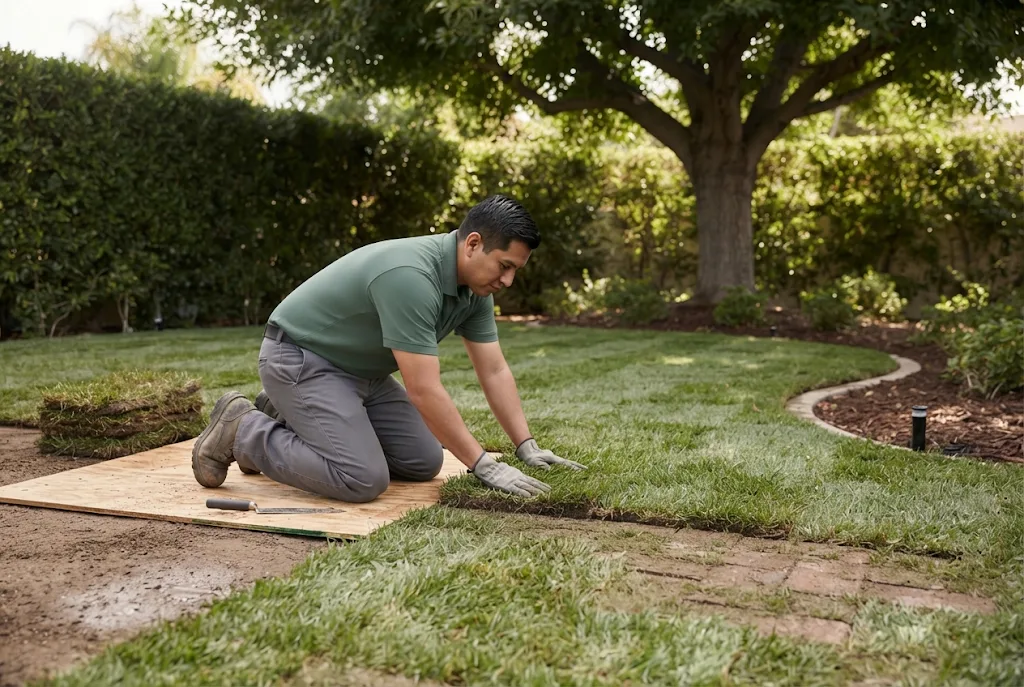
Old grass removal and sod replacement work as one project. New sod needs direct contact with loose, prepared soil, so the existing turf, its roots, and the thatch layer have to come out rather than being covered.
On most residential lawns, removal means cutting out the old turf and hauling it away, along with roots, rocks, and debris turned up in the process. Where an old lawn was heavily infested with aggressive grasses or weeds, we discuss whether additional steps are needed so they do not grow back through the new sod.
Soil preparation for new sod follows removal. The goal is a bed that roots can move into easily and that holds moisture without staying waterlogged. Depending on what we find, preparation can include:
- Loosening compacted soil so roots and water can penetrate.
- Removing rocks, old irrigation fittings, and construction debris.
- Working in soil amendments where the native soil needs them.
- Raking and rolling the surface so it is firm, smooth, and free of soft pockets.
We assess the soil during the site visit, so the estimate reflects the preparation your yard actually needs. A lawn bed that looks fine on the surface can hide a hard layer a few inches down, and finding it before installation is far easier than diagnosing it after the new lawn starts to struggle.
How Are Grade, Drainage, and Paved Edges Prepared for New Sod?
Before any sod arrives, the finished soil surface has to slope water away from the house, sit at the right height next to paving, and blend smoothly into planting beds. Small grading errors become obvious once a lawn is installed, because water collects in the low spots and sod dries out on the high ones.
Grade and Drainage Checks
We look at where water goes after irrigation or rain, whether it moves away from the foundation, and whether any area holds puddles. Corrections can be as simple as reshaping the surface, or they may call for a broader drainage discussion if water has nowhere to go.
Sloped Lawn Sections
Some Beverly Hills front lawns fall toward the sidewalk or step down between terraces. On a moderate slope, we lay the sod rows across the grade and may pin pieces in place until they root. Slopes need extra watering attention because the top tends to dry out quickly while the bottom collects runoff. If a section is too steep to mow or water safely, we will suggest alternatives.
Edges Along Walks, Driveways, and Beds
Next to driveways and walkways, we set the soil low enough that the finished sod sits flush with the paving instead of forming a raised lip. Along planting beds, we shape a clean transition so mulch and soil do not wash onto the lawn. During installation, we stagger the joints like brickwork and butt each piece tightly against the next. Close-fitting sod seams help keep the edges from drying out and shrinking back before the roots take hold.
Why Check Sprinkler Coverage Before Laying Sod?
New sod depends completely on even watering while it roots, and once the lawn is down, irrigation problems become harder to see and harder to fix. Checking sprinkler coverage for new sod before installation is one of the most useful steps in the entire project.
With the old lawn removed, we run each zone and watch it closely. Common problems include:
- Heads that are tilted, sunken, clogged, or blocked by shrubs.
- Gaps where the spray from one head does not reach the next, leaving a dry band.
- Mismatched nozzles in a single zone, causing some areas to receive far more water than others.
- Overspray onto walkways, driveways, or the street.
- Runoff from slopes or compacted soil that cannot absorb water as quickly as it is applied.
Runoff is a practical issue and a local one. Beverly Hills municipal code prohibits irrigation that sends water onto adjoining sidewalks, driveways, streets, or gutters, so heads that spray onto paving should be adjusted or replaced before the new lawn depends on them. Heads also need to sit at the finished grade so they pop up above the sod rather than being buried by it.
When repairs are needed, it makes sense to schedule sprinkler repair before installing new sod so the system is working correctly on day one. We list irrigation corrections separately in the estimate, so you can see exactly what the sprinklers need.
Give Your Beverly Hills Lawn Replacement a Solid Foundation
Grade, drainage, sprinkler coverage, and access are settled before the first roll arrives. Call (888) 601-1117, email info@landscaper-near-me.com, or request a callback, and we will plan your sod installation from the ground up.
How Do You Water, Protect, and First Mow a Newly Sodded Lawn?
During the first weeks, new sod needs steady moisture, as little foot traffic as possible, and patience before its first mowing. The exact routine depends on the grass, the season, and the weather, so we review a starting plan with you when installation is complete.
Initial Watering
We water the sod as it goes down so it is not left to dry on the soil surface. In the early days, the sod and the top layer of soil beneath it should stay consistently moist, which usually means more frequent, shorter watering. As roots grow, watering gradually shifts toward deeper, less frequent cycles that encourage the roots to grow downward.
Following Local Watering Rules
Before you set a watering schedule, check the current City of Beverly Hills outdoor watering schedule. The city publishes assigned watering days, which have been tied in part to whether a property sits north or south of Santa Monica Boulevard, and its code limits the hours when outdoor watering is allowed. Rules can change with water conditions, so confirm the current requirements with the city before installation, especially if a new lawn will need more frequent watering than the regular schedule permits.
Rooting Checks and Foot Traffic
Keep children, pets, and everyday traffic off the new lawn while it roots, and walk on it only when you need to check the watering. To test rooting, gently lift a corner of a piece. If it resists, roots are growing into the soil. Hold off on the first mowing until the sod is firmly anchored and the grass has grown taller than its normal cutting height. For a fuller guide covering the weeks after installation, read our article on how to care for newly installed sod.
What If the Only Way Into Your Backyard Is a Side Gate?
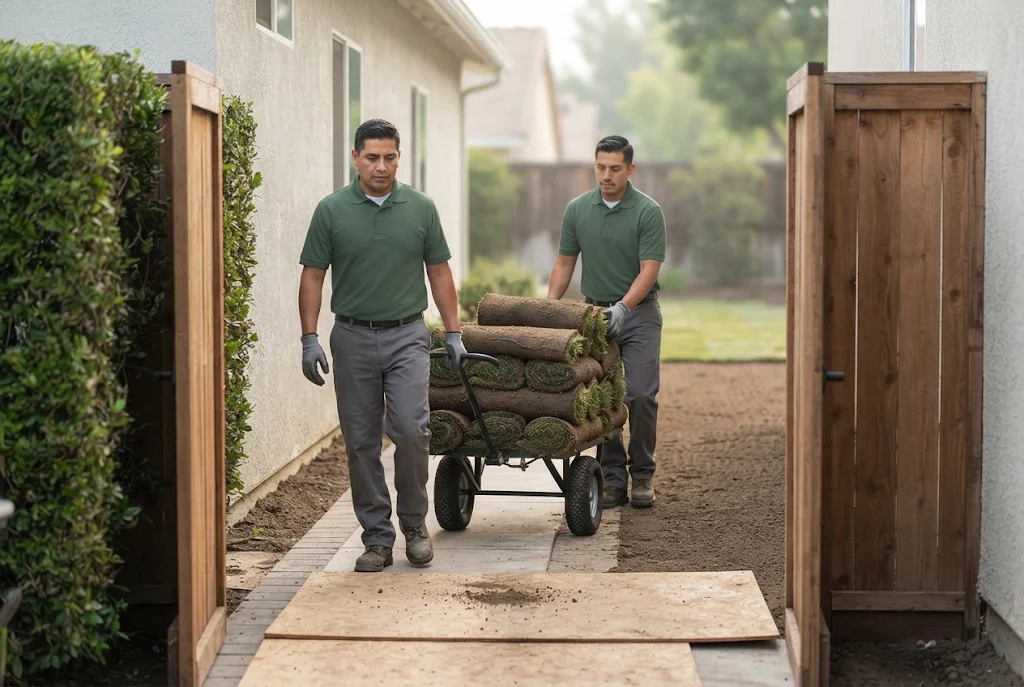
Limited access does not prevent a sod installation, but it does change how the work is planned and, often, how long it takes. Sod is heavy, especially when it is fresh and moist, and it is delivered in stacked rolls or slabs on pallets. When equipment cannot drive into the backyard, that material, and the old turf and soil coming out, has to be moved by hand or with compact carts.
During the site visit, we measure gate widths, look for steps, slopes, and tight turns along the side yard, and note anything fragile along the path, such as planters, lighting, or decorative paving. That helps us plan:
- Where the sod pallets can be staged without blocking the driveway or damaging the parkway.
- How removed turf and debris will leave the yard.
- Whether surfaces along the route need protection.
- How to sequence delivery so sod is laid soon after it arrives instead of sitting in the sun.
That last point matters. Sod begins to lose moisture and heat up once it is cut and stacked, so a backyard with a long carry route is planned so pieces move from pallet to prepared soil without delay. If your property has an alternative access point, such as a rear gate or a second side yard, mention it when you contact us, because it can simplify the job.
What Shapes a Sod Installation Estimate in Beverly Hills, and What Should You Send Us?
A sod installation estimate in Beverly Hills is built from the yard itself rather than a flat rate. Square footage is the starting point, but these factors usually account for most of the difference between one project and another:
- Lawn square footage and the number of separate lawn areas.
- Existing turf removal, including haul-away of old grass, roots, and debris.
- Soil and grading work, such as loosening, amendments, and drainage corrections.
- Access, including side-gate carries, steps, and staging space.
- Irrigation corrections found during the sprinkler check.
When you request an estimate, a few details help us prepare before we visit:
- Approximate dimensions of each lawn area. Rough length and width measurements are enough.
- Photos of the lawn, any problem spots, and the route to the backyard.
- The existing lawn’s condition, such as thinning, uneven ground, weeds, or bare soil.
- Known sprinkler issues, including dry corners, broken heads, overspray, or puddles after watering.
With that information, we can arrive ready to measure, test the irrigation, assess the soil and grade, and discuss grass options for each part of the property. The estimate then separates removal, preparation, installation, and any sprinkler work, so you can see what is included before anything is scheduled.
Whether you are planning residential sod installation in Beverly Hills on bare ground or replacing a lawn that has struggled for years, the result of any Sod Installation Beverly Hills CA project depends on the preparation beneath the sod. Call Landscaper-Near-Me.com at (888) 601-1117, email info@landscaper-near-me.com, or request a callback, and we will arrange a visit and prepare a free estimate for your new lawn.
FAQ's - Frequently Asked Questions
It depends on how much light reaches the ground and how many surface roots the tree has. Light or partial shade can often support a shade-tolerant grass with careful watering. Dense, all-day shade usually cannot sustain a healthy lawn, and in that case we may suggest mulch, groundcover, or a planting bed for that section instead of sod.
When we repair part of a lawn, we try to use the same type of grass, but an exact match in color and texture is not always possible, especially with older or mixed lawns. Replacing a complete lawn area gives a uniform appearance. We will explain the likely result before you decide.
That depends on lawn size, how much old turf has to be removed, the soil and grading work involved, any sprinkler corrections, and access to the yard. Smaller lawns with easy access move faster than larger yards that need grading, irrigation work, or a long carry through a side gate. We outline the expected schedule in your estimate after we have seen the property.
Not always. We do need access to the work areas, a working outdoor water supply, and the sprinkler controller so we can test zones and water the new sod. If you will be away, let us know in advance so we can arrange gate access and go over the watering plan with you or your property manager.
The mild Southern California climate allows sod to be installed through much of the year. Warm-season grasses generally root fastest in warm weather, while cool-season grasses often establish more easily in spring or fall. Summer heat increases how often new sod needs water, so watering rules and the season should be considered together.
When removal is part of the job, the estimate states how the old turf, roots, and debris will be taken off the property. Excess soil from grading is handled the same way. If you want any material left on site, such as soil for a garden bed, tell us during the estimate visit.
Keep pets off new sod until it has rooted firmly into the soil, because digging, running, and concentrated urine can damage pieces that are not yet anchored. If your dog needs daily yard access, we can talk about leaving a separate area available or installing the lawn in phases.
Moderate slopes can usually be sodded. We lay the rows across the slope and may pin pieces in place while they root, and watering often needs to be split into shorter cycles to limit runoff. Steeper sections can be difficult to mow and water evenly, so we may recommend planting or groundcover for those areas.