
Sod Installation San Marino CA:
New Lawns and Lawn Replacement for Front and Back Yards
A new lawn in San Marino usually begins with a question about the old one. Some homeowners are looking at bare soil after a remodel or a tree removal. Many more are looking at a front or back lawn that has thinned, browned in the same places every summer, or never quite recovered from a dry year. Our approach to Sod Installation San Marino CA projects is to sort out which of those situations you have before anyone orders a pallet, because the answer changes the preparation, the sod variety, and what your estimate needs to include.
This page walks through the decisions San Marino homeowners face when planning a new natural-grass lawn: whether the lawn needs a full replacement, which yard conditions should be corrected first, how sun, shade, foot traffic, and summer heat affect the choice of grass, and what the first weeks after installation require. For a broader overview of how we handle sod projects in general, see our professional sod installation services page.
Does Your San Marino Lawn Need New Sod or a Full Replacement?
Most yards fall into one of two categories, and it helps to know which one yours is in before requesting an estimate. Installing sod on bare ground is mainly a construction task: the soil is prepared, graded, and covered. Replacing an existing lawn is partly a removal job and partly an investigation, because whatever weakened the old grass is often still present in the yard.
Installing Sod on Bare or Newly Cleared Soil
Bare-soil projects are common after a home renovation, a hardscape change, the removal of a large tree, or a planting bed the owner wants to turn into lawn. There is no old turf to strip, but there is usually something else to deal with. Construction traffic compacts soil. Tree removal can leave roots and wood debris below grade. Former beds may sit higher or lower than the surrounding lawn and need to be brought to a consistent level. The work centers on loosening, cleaning, and shaping the ground so the sod has an even, receptive surface to root into.
Replacing a Lawn That Is Already Failing
Lawn replacement in San Marino CA is a different job. The old turf, its root mat, and any weeds that have moved in need to come out first, and that material has to be hauled away. Before the soil is prepared, we want to understand why the lawn declined. A lawn that thinned evenly over many years may simply have reached the end of its useful life. A lawn that keeps failing in particular spots is telling you something about the site, and laying fresh sod over that problem rarely changes the outcome for long.
Not every tired lawn needs to come out. A lawn with a few isolated damaged areas and healthy grass elsewhere may be a candidate for targeted repair instead of a full tear-out. Deciding when to patch damaged sod or replace the whole lawn depends on how much of the area is affected, whether the surviving grass matches what you would plant today, and whether the underlying cause can be corrected in place.
Which Yard Problems Should Be Checked Before Laying New Sod?
Three warning signs deserve attention before any new sod goes down: bare spots that return in the same places, water that stands on the lawn after irrigation or rain, and sprinkler coverage that leaves some areas soaked and others dry. Each one points to a condition in the yard rather than a weakness in the grass, and each is far easier to correct while the old lawn is out and the soil is exposed.
Recurring Bare Spots
When grass dies back in the same location year after year, the cause is usually local. Common explanations include a sprinkler head that is blocked, broken, or tilted; a route that family members, pets, or service workers cross every day; a pocket of compacted soil left from earlier construction; or a section that receives far less light than the rest of the lawn. We look at where the bare areas sit in relation to sprinkler heads, trees, gates, and walkways, because that relationship usually narrows down the cause quickly.
Standing Water and Soggy Areas
Water that pools on the surface, or ground that stays spongy for days, suggests a grading problem, heavy compacted soil, or a leaking irrigation line. New sod placed in a low spot tends to stay wet, root poorly, and invite disease. These areas are typically regraded so water moves across the lawn and away from the house, and suspected leaks are traced before new turf covers the ground.
Uneven Sprinkler Coverage
A lawn can only be as uniform as the water it receives. Heads that have sunk below grade, nozzles that do not match within a zone, low pressure, overspray onto paving, and gaps between spray patterns all produce a lawn with strong and weak sections. New sod is especially sensitive to these gaps because its roots start out shallow. When we find coverage problems, we recommend handling them through our sprinkler repair services before installation, while heads can still be raised, moved, or replaced without disturbing a freshly laid lawn.
Matching Sod to Sun, Shade, Foot Traffic, and Summer Heat
The right sod for a San Marino yard depends on how that particular lawn is used and the conditions it lives in. No single variety performs best everywhere, and the front lawn and backyard on one property can call for different answers. Four factors drive most of our recommendations for natural grass installation for front and back yards.
Sun Exposure
Many of the warm-season grasses commonly sold as sod in Southern California, hybrid Bermudagrass in particular, perform best in full sun and decline noticeably when shaded for much of the day. We note how many hours of direct sun each part of the lawn receives and how that changes through the year as the sun angle shifts. A lawn that looks bright in June may sit in shadow for much of December.
Shade From Mature Trees and Structures
Established residential streets often have large trees whose canopies have widened over the decades, along with walls, hedges, and two-story homes that cast long shadows. Some sod options tolerate partial shade better than others; certain tall fescue blends and St. Augustinegrass are often considered for these areas. Even the more shade-tolerant choices need some direct light, so deep shade may be better suited to groundcover or planting than to turf. Understanding how to prepare a shaded yard for sod installation also matters, since shaded ground tends to hold moisture longer and needs careful watering adjustments once the sod is down.
Foot Traffic and Play Areas
A front lawn that is mostly admired from the street and a backyard where children and dogs run every afternoon place very different demands on grass. Varieties that spread by runners can recover from wear more readily, while others hold up less well to repeated traffic along the same routes. We ask how each area is used so the recommendation fits the household, not just the soil.
Summer Heat and Irrigation
Summers in the San Gabriel Valley can run considerably warmer than along the coast, and that heat affects both variety choice and establishment. Warm-season grasses grow actively in hot weather and generally use less water, but many lose color and go dormant in winter. Cool-season grasses stay greener through the cooler months but usually need more water to look good through a hot summer. Your sprinkler coverage and the watering schedule allowed by your water provider belong in that decision as well. Our guide to choosing a grass type for Southern California compares the common options in more detail.

Planning Sod Installation in San Marino? Start With a Free Estimate
Tell us roughly how large the lawn is, what is growing there now, and how much sun it gets. We will look at the yard and prepare a free estimate that spells out removal, soil preparation, sod selection, and any sprinkler work.
Project Example: A Front Lawn With Sunny and Tree-Shaded Sections
The following scenario is hypothetical, but it reflects a layout that appears often on established residential lots. Picture a front lawn running from the street to the house, with an open, sunny section near the curb and a mature tree beside the walkway whose canopy shades roughly a third of the lawn through most of the afternoon. The sunny section is dense. The shaded section has thinned, and bare soil has started to show near the trunk.
A homeowner in this position might assume that one new sod variety across the whole lawn will solve the problem. Before recommending that, we would evaluate:
- How much direct light the shaded section actually receives, and whether that will change after any planned tree pruning.
- Surface roots and root competition near the trunk, which limit how much soil preparation is practical without harming the tree.
- Whether one sprinkler zone waters the sun and shade the same way, which usually leaves the sunny section underwatered or the shaded section overwatered.
- The walkway edge, where new sod has to meet the concrete cleanly and finish at the right height.
Depending on what we find, the plan might use a single variety that tolerates partial shade across the entire lawn so color and texture stay consistent, or it might pull the lawn back from the densest part of the canopy and convert that ring to mulch or shade planting. If one zone serves both conditions, adjusting nozzles or splitting the zone may be worth discussing so each section can be watered according to its needs. The aim is a front lawn that reads as even from the street, rather than one that is lush near the curb and patchy by the front door.
Project Example: A Worn Backyard With Uneven Sprinkler Coverage
This second scenario is also hypothetical. Imagine a backyard lawn that serves as the family’s main play space. A worn track runs from the patio to a side gate, a bare strip follows the fence where the dog patrols, and two corners turn brown each summer while an area near the middle stays soft after every watering cycle.
Several of those symptoms point to irrigation. Brown corners often mean the spray is not reaching the edges, and a soggy middle can come from overlapping heads, a mismatched nozzle, or a slow leak. The worn track and the fence line, on the other hand, are traffic problems that new sod alone will not prevent.
For a backyard like this, the work would usually follow a sequence along these lines:
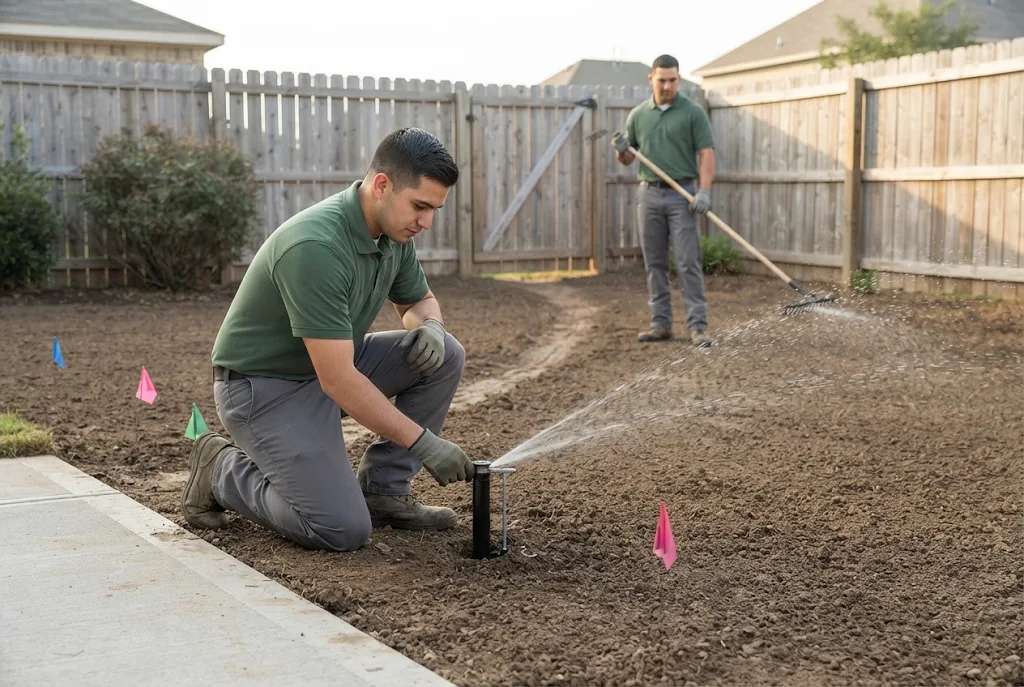
- Run each irrigation zone and observe coverage, marking dry and overwatered areas.
- Repair, raise, or replace heads and nozzles so the lawn receives more even coverage.
- Remove the old turf, then loosen compacted soil along the worn track and the fence line.
- Correct the low area in the middle so water no longer collects there.
- Select a sod variety suited to heavier use and to the amount of sun the yard receives.
- Consider whether stepping stones to the gate or a narrow mulch strip along the fence would protect the new lawn from the same wear.
This example shows why an estimate for a backyard lawn replacement often includes more than sod and labor. When the conditions that wore out the original lawn are part of the plan, the new one has a much better chance of lasting.
How Residential Sod Installation Works, Step by Step
Residential sod installation follows a sequence in which each step depends on the one before it. Cutting preparation short to save time usually shows up later as uneven ground, visible seams, or sod that is slow to root.
1. Old Lawn Removal and Disposal
For old lawn removal and sod replacement, the existing grass and its root layer are cut out, typically with a sod cutter, and removed along with weeds and debris. Old turf is heavy, so disposal is a real part of the job and should appear in the estimate. Where an aggressive grass such as common Bermudagrass has invaded a lawn of another type, extra control steps may be needed so it does not grow back up through the new sod.
2. Soil Preparation
Once the area is clear, the soil is loosened to relieve compaction and give new roots room to grow downward. Depending on the soil’s condition, organic amendment may be worked in. Rocks, roots, and construction debris are removed so they do not create high spots or dry pockets beneath the new lawn.
3. Grading and Drainage
The surface is shaped so water drains away from the house and does not collect in low areas. Finished grade is set slightly below the edges of walkways, driveways, and patios so the top of the sod ends up flush with the paving instead of standing above it. The soil is then firmed and raked smooth, because footprints or wheel ruts left in the soil will show through the finished lawn.
4. Sprinkler Coverage Check
Before the sod arrives, sprinkler heads are set to the new finished height and each zone is run to confirm that spray patterns overlap and reach the edges. Adjustments are much simpler at this stage than after the lawn is laid.
5. Laying Sod, Tight Seams, and Fitting Along Walkways
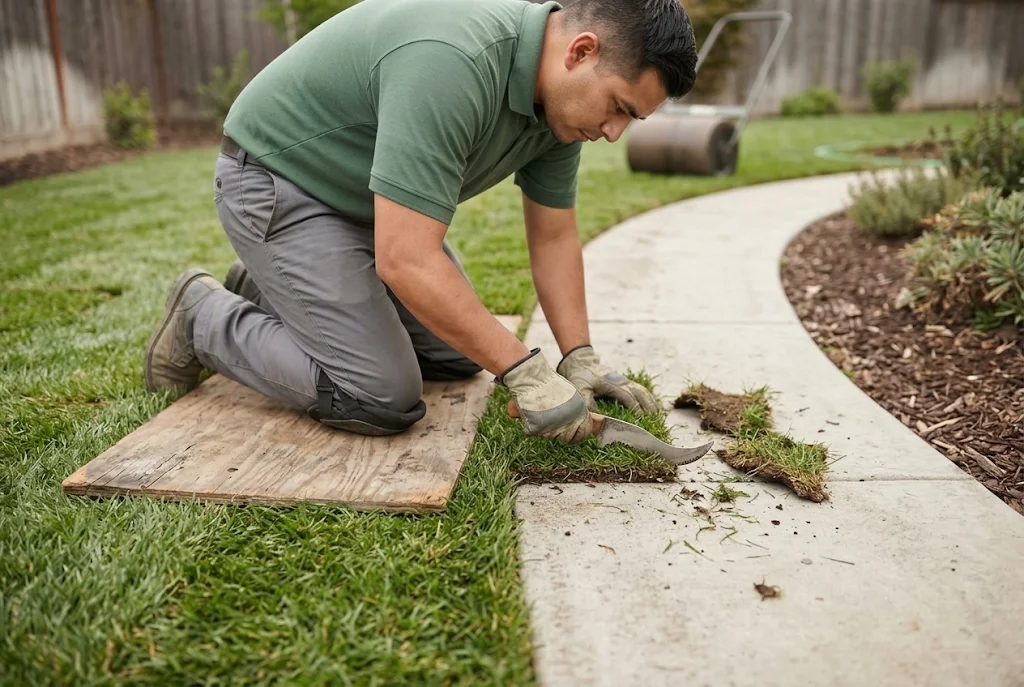
Sod is installed promptly after delivery, since rolls left stacked in the sun can heat up and dry out. On hot days the prepared soil may be lightly moistened just before laying so roots are not placed on a hot, dry surface. Pieces are set in a staggered, brick-like pattern with the ends pushed snugly together, leaving no gaps and no overlaps. Along walkways, curved beds, and around sprinkler heads, the sod is trimmed with a sharp knife so the edges fit tightly. Small pieces are kept away from the outer edges, where they would dry out fastest.
6. Rolling and Initial Watering
After laying, the lawn is rolled to press the sod into firm contact with the soil, then watered thoroughly so moisture reaches the ground beneath it. That first watering starts the establishment period, which is where the homeowner’s role becomes important.
Shade, Worn Paths, or Dry Corners? Plan Your New Lawn Around Them
Mixed sun and shade, a backyard that gets daily play, or sprinklers that miss the edges all change how a lawn should be prepared and which sod belongs where. We assess those conditions first so the new lawn does not inherit the old one’s problems.
The First Weeks: Watering, Foot Traffic, and the First Mow
New sod arrives with a short, shallow root system, so the first few weeks decide whether it knits into the soil or struggles. During this period the goal is to keep the sod and the soil directly under it consistently moist without turning the ground into mud.
Adjusting Watering as the Sod Roots
In general, new sod is watered frequently at first, sometimes more than once a day in hot weather, and then less often but more deeply as roots extend into the soil. The University of California’s UC IPM guidance on irrigating new lawns also recommends avoiding evening watering to reduce disease problems. Sunny sections and edges along hot paving dry out first, while shaded sections may need less water than the rest of the lawn. Grass that turns a dull bluish-gray, or seams that start to shrink, are signs the sod is drying.
Local watering rules matter here. Most San Marino homes are served by California American Water and some by Sunny Slope Water Company, and outdoor watering schedules have changed with drought conditions in recent years. Before installation, check the current watering days and time limits for your address and ask your provider whether any allowance exists for establishing new turf. We plan installation timing and the early watering schedule around what is permitted.
Keeping Foot Traffic Off the New Lawn
Walking on new sod while it is soft and wet can leave footprints, shift pieces apart, and slow rooting. Keep children, pets, and visitors off the lawn as much as possible during establishment, and route deliveries and service workers around it. If a backyard has a route the family cannot avoid, a temporary walkway of boards helps spread the weight.
When to Discuss the First Mow
The first mow should wait until the sod is firmly rooted. A simple check is to tug gently on a corner: if the piece lifts easily, it is not ready. Timing varies with the variety, the season, and the weather, so we recommend talking with your installer before the first cut rather than mowing on a fixed date. The lawn should be fairly dry for that first pass, and the mower blade should be sharp and set high. Our article on caring for newly laid sod covers watering, mowing, and early fertilizing in more detail.
What Shapes a Sod Installation Estimate in San Marino?
A sod installation estimate in San Marino is built from the yard itself, so two lawns of similar size can produce noticeably different numbers. These are the factors that most affect the scope and the price:
- Lawn area. The total square footage and the shape of each section, since narrow strips and curves require more cutting and fitting than open rectangles.
- Site access. Whether sod pallets and equipment can be brought close to the work area, or whether materials have to be carried through a side yard or gate by hand.
- Old turf removal and disposal. How much existing grass, root mat, and weed growth must be removed and hauled away.
- Soil and grading needs. Loosening compacted soil, adding amendment, filling low spots, and adjusting grade along paving.
- Sod variety. Different grasses vary in cost and availability.
- Sprinkler work. Raising sunken heads, replacing broken parts, adjusting nozzles, or correcting coverage gaps before installation.
When you review a quote, confirm which of these items it actually includes. One proposal may cover removal, disposal, soil preparation, and sprinkler adjustment, while another prices only the sod and the labor to lay it. Ask whether amendments are part of the quote, whether disposal is included, who is responsible for watering during establishment, and how any sprinkler repairs discovered during the work will be handled. A clear written scope makes proposals easier to compare and avoids surprises once the project begins.
A few basic details help us prepare when you request an estimate: the approximate lawn size, the condition of the existing turf, how much sun or shade each area receives, and whether the sprinklers have any known problems. Photos of the front and back lawns are useful too.
Ready for a New Front or Backyard Lawn in San Marino?
Call (888) 601-1117, email info@landscaper-near-me.com, or request a callback. We will go over your lawn’s size, current condition, sun exposure, and sprinkler setup, then schedule a time to see the yard.
Choosing Sod Installers in San Marino and Requesting Your Estimate
When you compare sod installers in San Marino, the conversation before the work tells you a great deal. A careful installer will ask how the lawn is used, look at the sprinkler system, note where the shade falls, and explain what the preparation involves. Be cautious about a quote prepared without anyone looking at the yard, or one that does not say whether old turf removal and grading are included.
At Landscaper-Near-Me.com, we approach residential sod projects in a consistent order: confirm whether the yard needs sod on bare ground or a full replacement, address the conditions that would undermine a new lawn, recommend sod that suits the sun, shade, traffic, and water available, and set clear expectations for the first weeks of care. Whether you are replacing a front lawn that has thinned beneath a growing tree or a backyard worn down by daily play, that groundwork gives the new grass its best start.
To request a free estimate for your San Marino lawn, call us at (888) 601-1117, email info@landscaper-near-me.com, or request a callback through our contact page. Tell us the approximate lawn size, the current turf condition, how sunny or shaded the yard is, and how your sprinklers are performing, and we will arrange a time to look at the property and talk through a plan for your new lawn.
FAQ's - Frequently Asked Questions
Yes. Sod can be laid at any time of year, although stretches of very hot or very cold weather are best avoided. Warm-season grasses root more slowly in winter and may look tan while semi-dormant, while cool-season varieties often establish well in fall. We will discuss timing based on the grass you choose.
We do not recommend it. Old grass and roots break down under the new sod, leave an uneven surface, and keep new roots from making good contact with the soil. Removing the old turf and preparing the ground gives the new lawn the direct soil contact it needs to root.
Light use can usually resume once the sod is firmly rooted and has been mowed, which often takes a few weeks. Heavy play and running dogs should wait longer, especially in areas that wore out before. We will give you a realistic window based on the variety, the season, and how quickly the lawn is rooting.
Seams usually open when sod dries out and shrinks, most often along edges and in sunny sections. Tight installation helps, but steady moisture during the first weeks matters most. If you notice gaps or edges turning tan, water that area more thoroughly and let us know so we can take a look.
Not necessarily, but we will need access to the yard, the irrigation controller, and an outdoor water supply. Many homeowners like to walk the finished lawn with us so we can review the watering schedule and point out areas to watch.
Sod gives you a finished lawn right away, covers bare soil immediately, and usually has fewer weed problems during establishment. Seed costs less up front but takes longer to fill in and needs careful moisture management through germination. For front yards and family play areas that need to look finished and be usable sooner, many homeowners choose sod.
Yes, a partial replacement can work when the rest of the lawn is healthy and the new sod closely matches the existing grass. A new section rarely blends perfectly at first, and if the surrounding lawn is weak or a different grass type, replacing the whole area may look better over time.
Once the old turf is removed, hidden issues such as cracked lines or buried heads sometimes appear. We explain what we found and what the repair involves before going further, so the decision stays with you. Fixing it before the sod goes down is much easier than digging up a new lawn later.