
Irrigation Construction for New Landscapes and Major Renovations
Most irrigation problems that show up years after a landscape is finished were decided before the first plant went in. A lateral line buried under a new patio with no way to reach it, a single valve asked to water both a shaded lawn and a sunny slope, a controller placed where nobody can see the display: none of these are repair issues. They are construction decisions, and they are far easier to get right while the ground is still open.
Irrigation Construction is the project-level work of building, or substantially rebuilding, the watering infrastructure that a landscape depends on. It covers the planning, the trenching and piping, the valves and controls, and the testing that confirms the finished system actually does what the landscape plan needs it to do. We approach it as one part of a larger landscape project, coordinated with planting, turf, and hardscape rather than squeezed in around them.
This page is written for homeowners and property owners planning a new landscape or a substantial renovation, for builders, developers, and project managers coordinating landscape installation, and for commercial property managers and HOA representatives weighing new irrigation infrastructure or an expansion of what is already there. It explains what landscape irrigation construction involves, how the work is planned and sequenced, and what to clarify before you request an estimate.
What Is Irrigation Construction?
Irrigation construction is the installation or substantial reconstruction of landscape watering infrastructure for a new landscape, a property improvement, or a renovation project. The defining feature is scope. Instead of fixing or adding to a system that already works for the landscape, the project lays out how water will move across the property, from the supply to the last emitter, and builds that layout into the ground.
On a typical project, irrigation construction services can include reviewing the landscape plan and site conditions, laying out zones, trenching for mainline and lateral piping, setting valves and valve boxes, installing sprinkler outlets or drip components, connecting the controller, and testing and adjusting the completed system. Underground irrigation piping installation is usually the largest share of the physical work, but the planning around it determines whether the finished system is efficient and serviceable.
How It Differs From Related Irrigation Work
Irrigation work tends to get described with one word, which makes it easy to ask for the wrong service. These are the distinctions we draw:
- Irrigation construction builds or rebuilds the system as a whole, or a large connected portion of it, to fit a new or redesigned landscape.
- Sprinkler or drip installation focuses on a particular application method, often in a defined area where the rest of the system stays as it is.
- Repairs restore an existing component or zone to working order without changing how the system is laid out.
- Ongoing water management covers scheduling, monitoring, and adjustments after a system is in service.
Many projects touch more than one of these categories. Our Irrigation Services page gives an overview of the full range of work, from repairs to new systems. If your project is limited to adding or replacing spray coverage in a lawn or bed, our Sprinkler System Installation Services page is the more specific resource. Irrigation construction is the right frame when the layout itself is changing.
When Does a Property Need Irrigation Construction Instead of Repairs?
A property generally needs irrigation construction when the landscape is new, when the landscape layout is changing substantially, or when the existing infrastructure no longer fits the landscape it is supposed to serve. Repairs make sense when the design is sound and individual components have failed. When the design itself is the problem, repeated repairs rarely solve it.
Common Project Scenarios
- Undeveloped landscape areas. A new home, an addition, or a newly graded section of a commercial site has no irrigation at all. These new construction irrigation systems are planned from the water supply outward.
- Redesigned planting beds. A former lawn becomes a mixed planting bed, or beds are reshaped and replanted. Spray heads that suited turf may overspray the new plants, wet walls and walkways, or leave gaps.
- Expanded turf areas. A lawn grows into an area that was previously paved, planted, or bare, and the existing zones were never sized to cover it.
- Infrastructure that no longer suits the layout. Zones mix plants with very different water needs, valves are buried or inaccessible, or past patches and add-ons have left the system difficult to operate and maintain.
Irrigation installation for landscape renovation falls somewhere between these cases. Part of the existing system may be worth keeping, while other parts need to be capped, rerouted, or replaced to match the new design. On larger sites, the irrigation scope is often one piece of a broader project; our Commercial Landscape Construction Services page explains how we approach new developments and commercial renovations as a whole.
Signs the Layout, Not the Parts, Is the Problem
Some symptoms point to a design issue rather than a broken part: one area stays soggy while another on the same valve stays dry, coverage changed after hardscape was added, or the controller has more zones running than anyone can identify. When we see these patterns during an assessment, we explain whether a repair, a partial rebuild, or a full construction scope is the more practical path, and why.
What Happens During the Irrigation Site Assessment?
The site assessment establishes what the system has to work with and what it has to accomplish. Irrigation system construction planning depends on actual site conditions, so we look at the property itself rather than relying on assumptions about a typical yard or commercial lot.
Plans and Existing Infrastructure
We start with whatever landscape plans exist, whether that is a formal planting plan from a designer or a sketch of the intended layout. On renovation projects we also locate the existing controller, valves, and visible components, and we note what can reasonably be reused. Old systems often hold surprises, so this step tells us how much of the current infrastructure is reliable enough to build around.
Water Supply, Pressure, and Flow
The available water supply sets the limits for the whole design. We identify the point of connection and evaluate static pressure and available flow, because those figures determine how many outlets a zone can run at once and how many zones the system will need. A layout that looks good on paper but asks for more flow than the supply can deliver will underperform no matter how carefully it is installed.
Soil, Slopes, and Planting Needs
Soil type affects how quickly water soaks in and how it should be applied. Slopes influence where water runs and which application methods are appropriate. Sun exposure and the planting plan determine how much water each area will need. We record these conditions area by area so that zones can be grouped sensibly in the design.
Access and Constraints
Finally, we look at how crews and equipment can reach work areas, where trenches can and cannot run, which trees and existing features must be protected, and what other work is planned on the property. On occupied properties, pedestrian routes and resident or tenant access are part of this review from the start.
Free Estimates for Irrigation Construction Projects
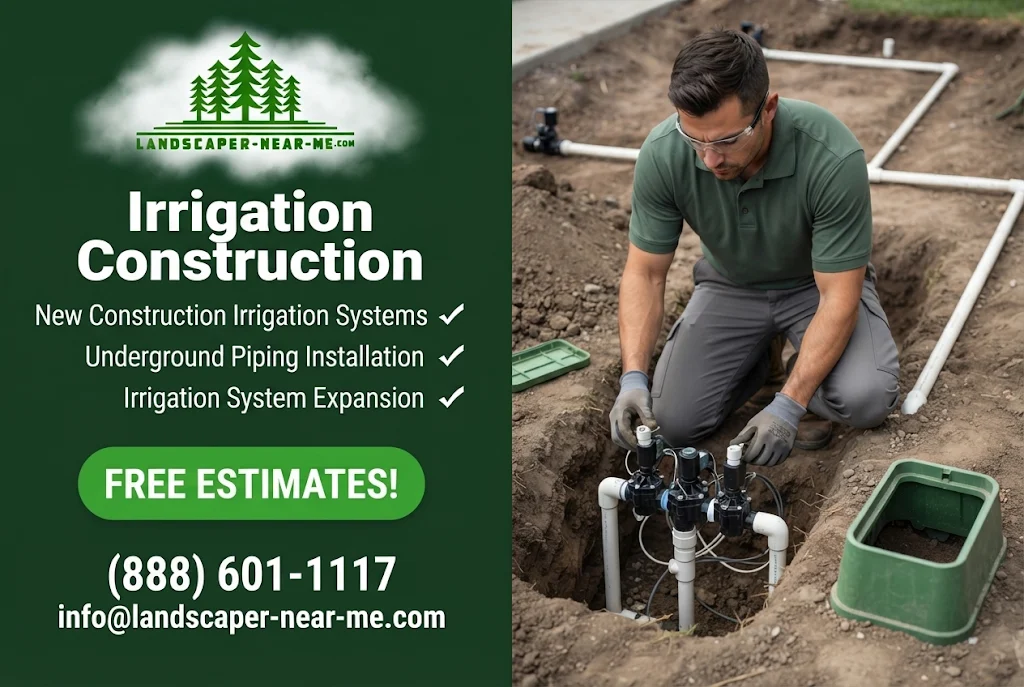
Planning a new landscape or a major renovation? Share your landscape plans and site details, and we will review the water supply, layout, and site conditions before preparing a free estimate for your irrigation construction scope. Call (888) 601-1117 or email info@landscaper-near-me.com.
How Is Irrigation Coordinated With Planting, Turf, and Hardscape?
Irrigation is coordinated with the rest of the landscape through sequencing. Underground work has to happen while the ground is open and before finished surfaces close over it, and outlets have to be set to the final positions of plants, lawn edges, and paving. When those pieces are scheduled independently, something usually has to be dug up again.
Building Around the Landscape Plan
The irrigation layout follows the planting plan, not the other way around. Lawn areas, shrub beds, trees, and slopes each need their own approach, so the plan has to be settled before zones are finalized. Where the landscape itself is still being designed, irrigation belongs in that conversation; our Landscape Design and Installation work is planned with irrigation needs in mind from the first layout.
Typical Sequencing on a Landscape Project
- Rough grading and any demolition are completed.
- Pipe routes, crossings under future paving, and valve locations are marked.
- Trenching and underground irrigation piping are installed, then tested before backfill where practical.
- Hardscape is built over the planned crossings.
- Planting and turf installation proceed, and outlets are set or adjusted to final positions.
- The system is tested, adjusted, and programmed for establishment.
Real projects rarely run in a perfectly straight line, especially when several trades share a site. That is why we confirm sequencing with the property owner, builder, or project manager before work starts, and why we flag schedule conflicts early.
Sleeves and Crossings Before Paving
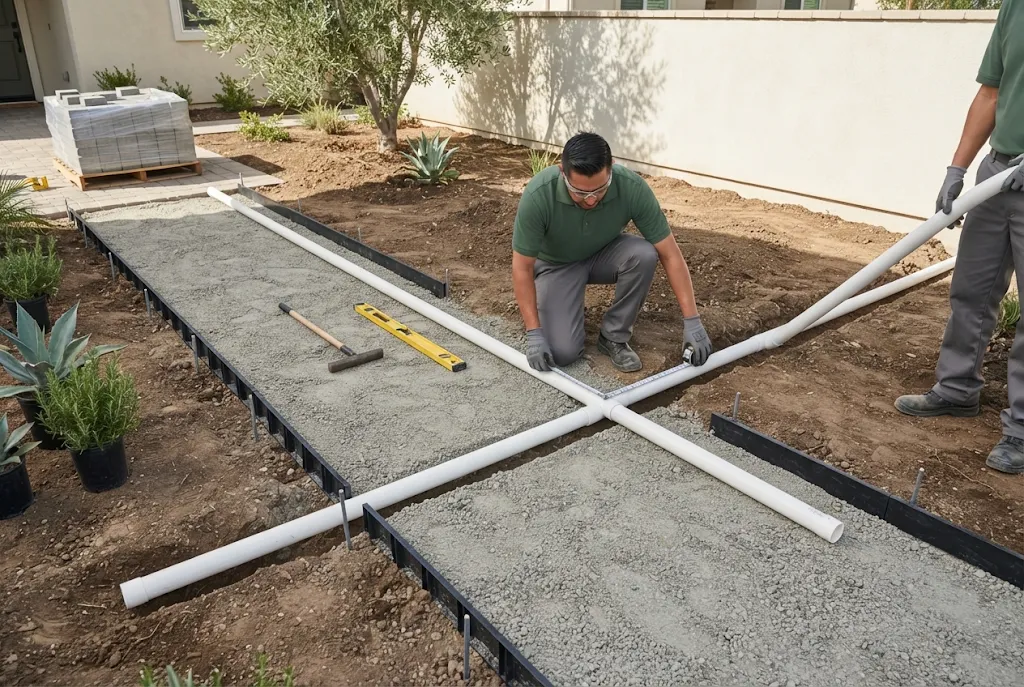
Sleeves are open conduits placed under walkways, driveways, and patios so that pipe and control wire can pass beneath them, both now and in the future. Planning irrigation sleeves before installing patios and walkways costs little at the time and avoids cutting finished paving later. We identify every crossing the design needs, and where future expansion is plausible, we discuss whether an extra sleeve is worth placing while the base is open.
How Are Irrigation Zones Planned and Watering Methods Chosen?
Zones are planned by grouping landscape areas with compatible watering needs onto the same valve, then choosing an application method that suits each group. The goal is that every area receiving water from a valve needs roughly the same amount, delivered in a way the soil and plants can use.
Grouping Areas With Compatible Needs
A lawn in full sun, a shaded shrub bed, and a planted slope have very different requirements. Putting them on one valve forces a compromise in which some areas are overwatered so that others receive enough. We separate areas by plant type, exposure, slope, and application method, and we keep spray and drip on separate valves. More zones add some cost, but they give the property far better control over water use for the life of the system.
Selecting the Application Method
There is no single correct method for every property. Spray and rotor outlets are common for turf, where even coverage across a continuous surface matters. Drip is often a strong choice for shrub beds, groundcovers, and plantings where water should reach the root zone with less overspray. Narrow areas, slopes, and spaces next to buildings or walkways each call for their own judgment. Where a planting area suits drip, our Drip Irrigation Installation Services page covers that method in more detail.
Property owners weighing the trade-offs can also compare drip irrigation and sprinkler systems in our dedicated guide. On a construction project, the choice is made area by area based on the landscape plan and site conditions, and the zone layout is built to match.
What Components Make Up a New Irrigation System?
A new irrigation system is a network of supply piping, control components, and outlets that move water from the point of connection to the landscape on a controlled schedule. Knowing the major parts at a practical level makes it easier to read an estimate and to talk through design options.
- Mainline. The supply pipe that carries water from the point of connection to the valves. It typically remains under pressure, so its routing and protection deserve careful planning.
- Lateral piping. The lines that run from each valve to the outlets in that zone. They carry water only when the valve is open.
- Valves. Control valves open and close each zone on the controller’s signal. Grouping valves into accessible locations simplifies future service.
- Valve boxes. Protective enclosures set to grade so valves can be reached without digging.
- Controller. The timer or control unit that runs the schedule. Its location, power source, and wiring are planned along with the rest of the system.
- Sprinkler outlets. Spray heads, rotors, and nozzles selected for the size and shape of each area.
- Drip components. Tubing, emitters, and fittings that deliver water at low flow near plant roots.
- Filtration and pressure regulation. Where appropriate, particularly on drip zones, filters protect small emission devices and pressure regulators keep components operating within their intended range.
Backflow Prevention and Connection Requirements
Irrigation systems connected to a potable water supply are subject to backflow prevention requirements set by local water suppliers and building authorities. The specific device, its installation, any required permits or inspections, and periodic testing obligations vary by jurisdiction. We confirm these requirements with the relevant authority for each project and identify which parts of the connection must be handled by a qualified, appropriately authorized provider. We do not assume one set of rules applies everywhere.
Plan Irrigation Before Paving and Planting Begin
Sleeves, pipe routes, and valve locations are easiest to get right before hardscape and planting close the ground. Request a callback and we will talk through your zone layout, crossings, and how irrigation fits your project schedule with the other trades on site. Call (888) 601-1117.
How Do We Route Piping, Protect the Site, and Tie Into Existing Systems?
Pipe routes are chosen to reach every zone efficiently while protecting existing features, avoiding buried utilities, keeping the system accessible for future service, and, on renovation projects, tying into existing infrastructure only where it can support the new work. Irrigation infrastructure installation is only as good as the routes it follows, and a shortcut that saves a few feet of trench can create years of inconvenience.
Underground Utilities
Before any trenching, underground utilities are identified and marked through the appropriate utility notification process, and private lines on the property are located where records or visible evidence allow. Routes are then planned around them. Gas, electrical, communication, and water lines are not something to discover with a trencher, and the property owner should share any knowledge of private lines, such as feeds to outbuildings or lighting.
Trees, Roots, and Existing Features
Trenching close to established trees can damage roots the tree depends on. Where pipe needs to pass near a tree worth keeping, we look for alternate routes and discuss options that reduce disturbance in the root zone. Retained planting beds, hardscape, lighting, and drainage features are also mapped so that the irrigation work does not create a second repair project.
Pedestrian Access and Shared Job Sites
On homes that stay occupied during construction, HOA common areas, multifamily properties, and commercial grounds, open trenches affect how people move through the property. We plan work areas, temporary routes, and the order of trenching so that access is maintained, and we coordinate with property managers and other contractors so that irrigation work fits the broader project schedule rather than competing with it.
Planning for Future Maintenance
Accessibility is designed in. Valves are grouped where practical, boxes are set to grade and kept clear of planting, and the controller is placed where it can be reached and read. A record of where lines and valves were actually installed makes future repairs faster and less disruptive.
Connecting New Work to an Existing System
New irrigation work can often connect to existing infrastructure, but only after the existing system has been checked for capacity, condition, and compatibility. An irrigation system expansion that simply ties new zones into an old mainline can overload the supply, reduce pressure across the property, or inherit hidden problems from the original installation.
Checking Supply Capacity for Added Zones
We compare the water requirements of the new areas with the pressure and flow available after the existing zones are accounted for. If the supply cannot support the additional zones as planned, the options may include redistributing zones, adjusting run sequences, or modifying infrastructure, and we explain the trade-offs of each.
Checking Component Compatibility
Older controllers may not have enough stations for new zones or may not support the scheduling the new landscape needs. Existing valves, wiring, and outlets may also be worn or mismatched. We identify which components can stay, which should be replaced as part of the project, and whether additional zones are appropriate.
Commercial sites, HOA common areas, and multifamily properties often have large, aging systems that have been modified many times. For properties with ongoing system needs beyond a construction project, our Commercial Irrigation Services cover repairs, upgrades, and system care on larger landscapes.
How Is a Completed Irrigation System Tested and Handed Over?
A completed system is tested by flushing the lines, checking for leaks, running each zone, evaluating coverage, setting up the controller, and making adjustments within the approved project scope. Handover then gives the property owner or manager what they need to operate the system and plan its ongoing care. Testing is the step that confirms the construction matches the design.
Flushing, Leak Checks, and Operational Testing
Lines are flushed before outlets and drip components are finalized, so that debris from installation does not clog nozzles or emitters. Connections and valves are checked for leaks, and each zone is run to confirm that valves open and close as intended and that the controller operates every station.
Coverage Evaluation and Adjustment
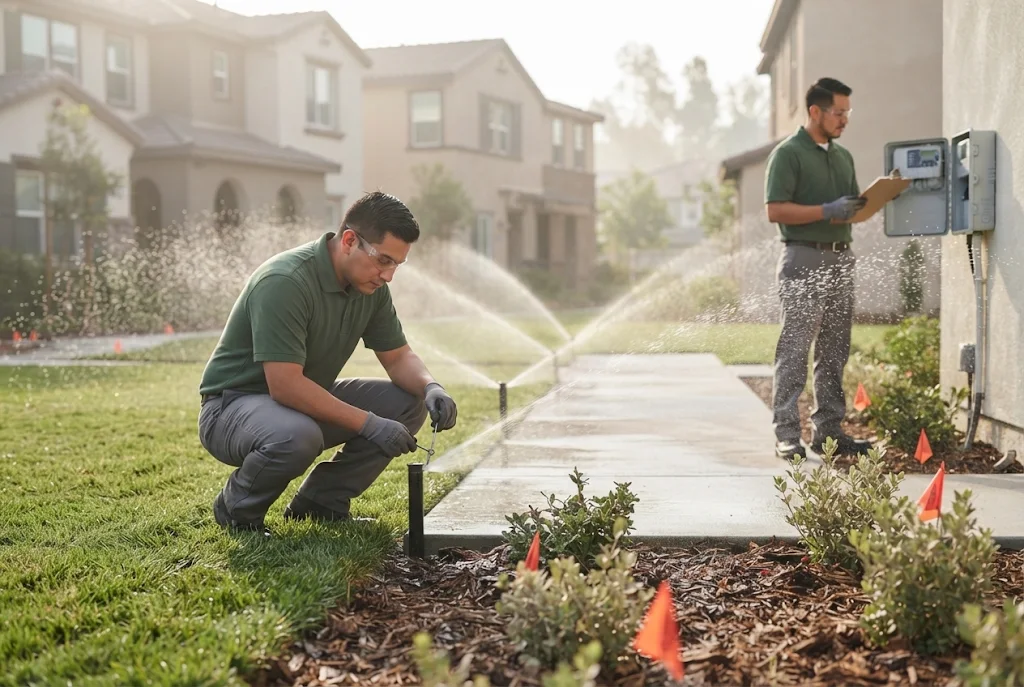
We watch each zone operate to check coverage, adjust spray patterns and arcs, correct heads that hit walkways or walls, and confirm that drip components are delivering water where plants are located. The Landscape Irrigation Best Management Practices published by the Irrigation Association describes this same principle of verifying that an installed system meets its design criteria, along with guidance on system design and ongoing water management. These steps are also central to what to expect during an irrigation system installation inspection when one is required.
Controller Setup and Establishment Watering
The controller is programmed for the current season and for establishment, since new plantings and new turf usually need more frequent watering while roots develop. Establishment schedules are temporary by design and should be reduced as plants mature.
What You Receive at Handover
- Zone identification showing which valve and controller station serve each area.
- Available system documentation, such as a record of valve locations and component information for the installed equipment.
- Operating guidance covering the controller, seasonal adjustments, and what to watch for in the first weeks.
- A clear explanation of how establishment watering should transition to ongoing management.
Once the landscape is established, the system needs regular attention to stay efficient as the seasons change and plants grow. Commercial properties and HOAs looking for that ongoing oversight can review our Commercial Water Management Services.
Talk Through Your Irrigation Construction Scope
Whether you are building a new system, expanding an existing one, or rebuilding irrigation for a renovated landscape, we can walk you through the scope, testing, and handover before work begins. Call (888) 601-1117, email info@landscaper-near-me.com, or request a callback for a free estimate.
What Affects an Irrigation Construction Estimate, and What Should You Ask?
Irrigation construction estimates depend on the size and layout of the irrigated area, the condition of the site, and the scope of work required to build a system that fits the landscape. We do not publish standard prices because two projects of similar size can differ significantly once access, existing infrastructure, and crossings are accounted for. Understanding how much irrigation construction costs starts with understanding the factors behind it.
Factors That Shape the Estimate
- Irrigated area and system layout. The total area, the number of zones, and how spread out the zones are.
- Site accessibility. Whether equipment can reach work areas or trenching must be done by hand around tight spaces, slopes, or existing features.
- Existing infrastructure. How much of the current system can be reused, and what must be removed, capped, or replaced.
- Hardscape crossings. The number of sleeves and crossings, and whether any pass under surfaces that already exist.
- Component selection. Controller type, outlets, drip components, valves, and any filtration or pressure regulation the design requires.
- Restoration needs. Repairing turf, soil, and planting disturbed by trenching, where that is part of the scope.
Questions to Ask Before Work Begins
A clear proposal answers these questions in writing. Knowing what to include in an irrigation construction project scope helps you compare proposals from irrigation construction contractors on equal terms.
- Which areas and zones are included, and what is specifically excluded?
- Who is responsible for coordinating with the builder, designer, hardscape contractor, or other trades?
- Which approvals, backflow requirements, or inspections apply, and who is responsible for each?
- How will the system be tested, and will you be present for a walk-through of each zone?
- What documentation and operating guidance will be provided at handover?
- What post-installation support is included, and how are adjustments handled during establishment?
Jurisdiction-specific approvals, backflow requirements, inspections, and water-use rules should always be verified with the relevant local authority and a qualified service provider before construction starts. Requirements vary between cities and water suppliers, and they can change.
Planning Your Irrigation Construction Project
Landscaper-Near-Me.com serves residential and commercial properties within our established service territory in Southeast Los Angeles County and Orange County. If you searched for irrigation construction near me while planning a new landscape, a renovation, or an expansion, the most useful first step is a conversation about the site and the plan. We will look at the landscape layout, the water supply, and the conditions on the ground, explain how we would approach the irrigation construction, and provide a free estimate based on what the project actually requires.
Call (888) 601-1117, email info@landscaper-near-me.com, or request a callback, and we will help you plan an irrigation system that is built to fit the landscape it serves.
FAQ's - Frequently Asked Questions
Duration depends on the size of the irrigated area, the number of zones, site access, the amount of hardscape crossing work, and how the irrigation is sequenced with other trades. We provide a project-specific timeline with the estimate rather than a general figure, and we update it if the overall landscape schedule changes.
Yes, but it is usually more involved. Without sleeves under the paving, pipe has to be routed around the surface, bored beneath it where conditions allow, or run through a section that is cut and repaired. When hardscape is still in planning, placing sleeves first is generally the simpler option.
Trenching close to a tree can damage roots, so we plan routes to avoid root zones of trees you want to keep wherever the layout allows. When a line has to pass near a tree, we discuss alternate routing and ways to limit disturbance before any digging begins.
Not always. If the existing controller has enough available stations, works reliably, and supports the scheduling the new landscape needs, it may be kept. If it lacks stations or suitable features, replacing it as part of the project is often more practical than working around its limits.
Many projects can be phased, particularly larger residential properties, HOA common areas, and commercial grounds. Phasing works best when the mainline, sleeves, and controller are planned for the full build-out from the start, so each later phase connects cleanly instead of requiring rework.
Requirements depend on the city and water supplier. We confirm with the relevant authority what applies to your project and identify in the proposal which items are handled by us, by the property owner, or by another qualified provider, so responsibilities are clear before construction starts.
Restoration is defined in the project scope. On new landscapes, trenching normally happens before turf and planting go in, so little restoration is needed. On established properties, we identify which disturbed areas will be restored and how, so there are no surprises when the trenches are closed.
Look for soggy spots, dry areas, water reaching walkways or walls, and any zone that does not seem to run. New plantings typically need establishment watering, so schedules will change as roots develop. Let us know about anything unusual so we can adjust the system within the agreed scope.