
Commercial Water Management Services
for Landscape Irrigation and Outdoor Water Use
Commercial Water Management Services, as we use the term, deal with one thing: the water that goes onto a property’s landscape. That means the irrigation controllers, valves, sprinklers, and drip lines that keep turf, shrubs, planting beds, and trees alive, along with the decisions about how much water they apply, when, and where. It does not mean industrial water treatment, drinking-water systems, building plumbing, wastewater service, or stormwater engineering. Those are separate disciplines handled by separate specialists.
Within that landscape scope, commercial landscape water management is less about any single repair and more about keeping watering matched to what the site needs as conditions shift. Plants mature. Tenants move in and out. One summer runs hotter than the last, a bed gets replanted, or a controller resets itself after a power outage and nobody notices for a month. Each change can push water use up or leave part of the landscape short. Ongoing management is the practice of catching those shifts, adjusting the schedule, and coordinating the corrective work that brings watering back in line.
This page is written for the people who carry that responsibility: commercial property owners, property and facility managers, asset managers, HOA and community association managers, and multifamily managers. Landscaper-Near-Me.com serves commercial properties within our established service territory in Southeast Los Angeles County and Orange County. Below, we explain what the service includes, how we look at a property and its records, how water budgets and seasonal schedules are used, which improvements tend to matter, and how results should be judged before anyone credits a lower bill to savings.
What Do Commercial Water Management Services Include?
At its core, the service covers the planning and oversight of outdoor watering on a commercial site. Landscape water management services typically include reviewing how the irrigation system is set up and programmed, comparing that setup against the landscape it serves, looking at available usage records, identifying visible waste, adjusting schedules through the seasons, and keeping a written list of recommended repairs and improvements so they can be planned rather than discovered one emergency at a time.
The emphasis is on continuity. A single site visit can reveal a great deal, but commercial landscape water-use management works best as a repeating cycle of observing, adjusting, documenting, and reviewing. That cycle is what separates management from a one-time fix.
How Management Differs From Repairs and New Construction
Three kinds of irrigation work are easy to blur together, and the difference matters when you are comparing proposals or deciding who to call.
- Ongoing water management is the planning layer: schedules, seasonal adjustments, records review, priorities, and follow-up. It decides what should happen and checks whether it worked.
- Individual repairs correct a specific failure, such as a broken head, a leaking valve, or a damaged lateral line. Repairs are often what management recommends, but they are a separate task with their own scope and cost.
- New irrigation construction means designing and installing new systems or replacing major portions of an existing one. That work is described on our Irrigation Construction page.
Our Commercial Irrigation Services page outlines the full range of system work. This page stays with the management side: deciding how water should be used across the landscape and keeping that plan current.
Service Options We Confirm Up Front
Some owners ask about formal irrigation audits, detailed written reporting, remote monitoring, certified assessments, or specialized controller management. These can be part of a water management arrangement, but whether they apply depends on the property, the equipment already installed, and the scope we agree on. We confirm what is included during the estimate rather than assuming any of it by default.
Which Commercial Properties Need Ongoing Landscape Water Management?
Any property with an irrigated landscape and someone paying the water bill can benefit, but the need becomes clearer as the landscape gets larger, more varied, or harder to watch. Water management for commercial properties tends to be most useful in settings like these:
- Office buildings and business parks with large turf panels, entry plantings, and parking-lot islands spread across many irrigation zones.
- Retail and shopping centers where planters sit tight against sidewalks and storefronts, so overspray and runoff land where customers walk.
- Industrial and warehouse properties with landscaped frontages and setbacks that can go weeks without anyone looking at them closely.
- Apartment and multifamily communities with courtyards, building perimeters, and shared lawns watered on schedules that rarely get revisited.
- HOA common areas such as entries, greenbelts, slopes, and medians, usually overseen by a board or community manager who answers to residents on costs.
- Mixed-use properties where residential, retail, and office landscapes share one site and sometimes one meter.
For community associations, water management usually runs alongside regular grounds care, which our HOA Landscape Maintenance page covers in more detail.
Why the Need Grows With Property Size
On a small site, a manager can walk the grounds and spot a soggy bed or a sprinkler hitting a window. On a business park with dozens of zones, most watering happens before dawn when nobody is there to see it. Problems can run for weeks before they show up as a dead patch, a stained walkway, or a higher bill. Commercial landscape water conservation on larger properties depends on someone checking deliberately instead of waiting for symptoms.
When Ownership or Management Changes Hands
A change in ownership, management company, or landscape provider is a practical point to start. Controller programs, zone maps, and repair histories often get lost in the handoff, and the new team inherits a system it did not set up. Establishing early on how the property is actually being watered saves a lot of guesswork later.
How Do We Evaluate a Property’s Landscape Watering Needs?
The evaluation starts on the ground, because the right amount of water depends on what is planted, what it is planted in, and where it sits. Two zones with identical run times can have very different needs. We look at the landscape and the irrigation system together and note where they do not match.
The Landscape Itself
- Irrigated area: how much of the property receives water, and which portions are turf, shrub beds, groundcover, or tree wells.
- Plant water needs: established shrubs and many trees generally need far less frequent watering than cool-season turf, while new plantings need closer attention until they root in.
- Established trees: mature trees with roots spread under turf or paving respond to watering patterns differently from the plants around them.
- Sun exposure: a bed against the south face of a building and a bed shaded by a parking structure dry out at very different rates.
- Slopes: sloped areas shed water quickly, so run times that suit flat ground can send runoff to the bottom of the slope.
Soil and Infiltration
Soil determines how fast water soaks in and how long it stays available to roots. Heavy clay accepts water slowly and holds it longer; sandy soil absorbs quickly but dries out sooner. Compacted soil along walkways and parking edges may barely absorb water at all. Knowing how soil conditions affect landscape watering explains many of the puddles, runoff streaks, and dry spots that appear on commercial sites.
The Irrigation System as It Exists Today
We review the existing irrigation zones, what each zone actually waters, the type of emission device on each (spray, rotor, drip, or bubbler), and the current controller settings, including start times, run times, watering days, and any seasonal adjustment in use. It is common to find zones that mix turf with shrubs, controllers still running a summer program in winter, or stations that no longer serve the plants they were installed for.
Start With a Free Commercial Water Management Estimate
Tell us about the property, the landscape areas involved, and any recent water bills or meter readings you have on hand. We will walk the site with you, look at how the irrigation is programmed, and prepare a free estimate for ongoing landscape water management. Call (888) 601-1117 or email info@landscaper-near-me.com.
What Records Help Establish a Landscape Water-Use Baseline?
Records turn general impressions into numbers that can be compared over time. A baseline does not have to be perfect to be useful; it has to be consistent enough that next year’s figures can be read against this year’s. A landscape water-use analysis usually draws on whichever of the following are available:
- Water bills covering at least a full year, so seasonal swings are visible instead of being mistaken for problems.
- Irrigation-meter readings, taken from bills or read directly, which can show use between billing periods.
- Maintenance and repair records showing when heads, valves, or lines were fixed and which zones keep coming up.
- Controller programs and zone maps left by a previous provider or the original installer.
- Notes on landscape changes, such as turf removed, beds replanted, or trees added, since each one changes what the system should be applying.
Dedicated Irrigation Meters vs. Mixed-Use Meters
The first question about any water record is what the meter measures. A dedicated irrigation meter records only outdoor landscape water, so its readings give a fairly direct view of irrigation use. A mixed-use meter also records indoor consumption: restrooms, kitchens, cooling equipment, and, on multifamily properties, residents’ daily use. On a mixed-use meter, a jump in the bill could come from irrigation, a leaking fixture inside a building, or a lease-up that added occupants. Separating those takes more care, and the conclusions are less certain.
Learning how to read a commercial irrigation water bill, including the billing units, the service period, and which meter each charge belongs to, makes this step far easier for managers who oversee several sites.
Seasonal Patterns and Sudden Changes
Outdoor water use normally climbs through the warm months and drops in winter. A baseline shows what that curve looks like for a particular property, and once it exists, departures stand out. The explanation for why irrigation water use suddenly increases usually comes from a short list: a leak or broken line, a controller reset to its default program, a valve stuck open, a new planting watered heavily during establishment, or an unusually hot, dry stretch. The records show when the change began, which narrows where to look.
How Does Landscape Water Budgeting Work for a Commercial Property?
Landscape water budgeting estimates how much water a specific landscape reasonably needs, based on its size, its plants, and the local climate, so that actual use can be compared with a reasoned target. It is a planning tool. It is not a guaranteed bill amount, a fixed watering allowance, or a prediction of what any month will cost.
What Goes Into a Water Budget
A budget generally starts with the amount of water lost from soil and plants to the local climate over a period, a combined figure known as evapotranspiration. That figure is then adjusted for the plants on the site, since low-water shrubs need a fraction of what turf does, and for the irrigated area of each plant group. Many budgets also allow for how efficiently the system applies water, because no system places every drop exactly where roots can use it.
How We Use the Budget
The value of a budget lies in comparison. If actual use runs well above the estimate, that points toward overwatering, leaks, or poor coverage worth investigating. If use runs below the estimate and the plants look healthy, the current schedule may simply be working. If use runs below and plants are struggling, the cause may be coverage gaps rather than total volume. In each case the budget gives us a reason to look closer, not a verdict.
Limits Worth Understanding
Budgets rely on assumptions about plant types, irrigated area, and weather, and those assumptions are estimates. A budget built from outdated plans, or from a mixed-use meter that cannot isolate irrigation, will be rough. We treat each budget as a working figure that gets refined as better information arrives, and we do not present it as a number the property is obligated to hit.
What Are the Warning Signs of Inefficient Commercial Landscape Watering?
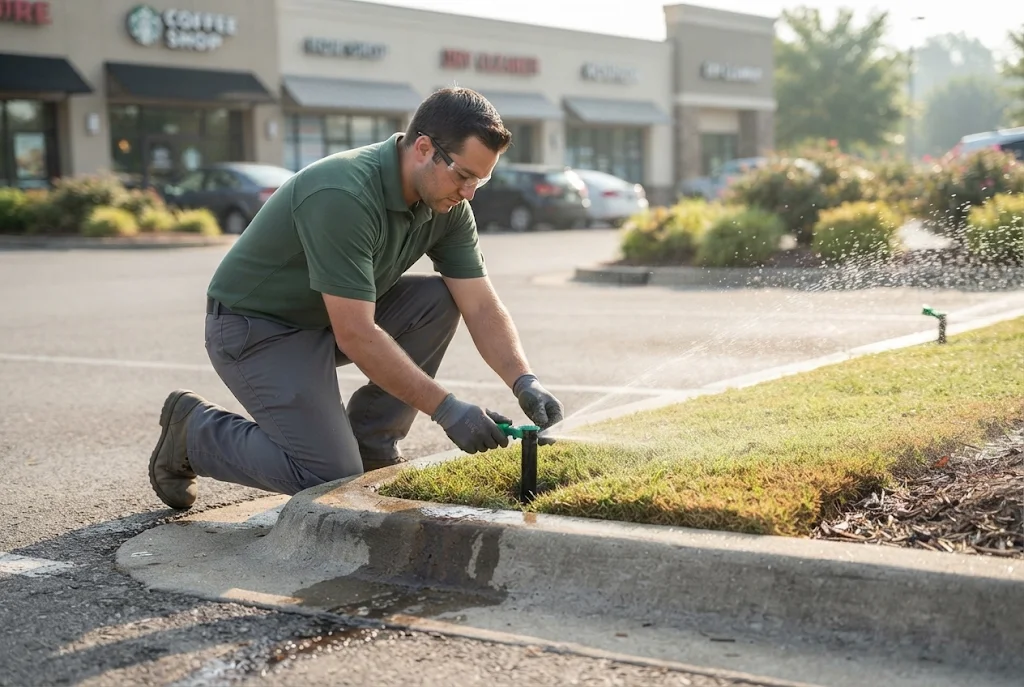
Most waste on commercial properties is visible to anyone who knows what to look for, especially early in the morning while systems are running or shortly afterward. Reducing landscape water waste starts with recognizing these signs and tracing each one back to its cause.
- Overspray onto pavement: sprinklers wetting sidewalks, parking stalls, walls, or windows instead of the planted area.
- Runoff: water flowing over curbs, down slopes, or into gutters because it is applied faster than the soil can take it in.
- Persistent wet areas: soggy turf, algae on hardscape, or saturated beds that stay wet long after watering ends, which can point to a leak, low-head drainage, or excessive run time.
- Dry patches: brown spots inside otherwise healthy turf, which are often a coverage problem rather than a shortage of total water.
- Damaged sprinkler heads: broken, tilted, sunken, or missing heads, frequently caused by mowers, vehicles, or foot traffic.
- Overlapping or mismatched coverage: spray and rotor heads mixed on one zone, or nozzles that apply water at different rates side by side.
- Unexplained increases in recorded consumption: a rise in metered use with no change in weather, landscape, or schedule.
Why One Dry Spot Can Lead to More Waste
A single brown patch in a lawn is often handled by adding run time to the entire zone. The patch may recover, but every other part of that zone now gets more water than it needs. Correcting the coverage issue behind the dry spot, whether that is a clogged nozzle, a tilted head, or low pressure, is usually the better answer.
From Observation to Repair
When we find damaged or misaligned equipment, the repair is a separate task, and our Sprinkler Repair Services page explains that work. Within water management, our role is to identify the problem, note its location, recommend the correction, and confirm afterward that the zone is watering properly.
Trace Rising Water Use Back to the Zones Causing It
Higher readings with no change in weather or landscape usually have a cause on the ground. Share your recent bills or meter readings, and we will review how each irrigation zone is performing, document overspray, runoff, and coverage problems, and outline the corrections worth doing first.
How Should Commercial Watering Schedules Change Through the Year?
No universal watering schedule suits every commercial landscape, and any fixed number of minutes or days applied across a whole property will be wrong for parts of it. Commercial landscape watering management means adjusting schedules as conditions change, zone by zone, instead of setting a program once and leaving it alone.
What Drives Seasonal Irrigation Scheduling
- Weather and seasonal demand: plant water use rises with heat, sun, and wind and falls during cooler, shorter days. A schedule that suits midsummer applies far more water than plants need in winter.
- Rainfall: after meaningful rain, many landscapes need no supplemental water for a while. Systems without rain shutoff or weather adjustment keep running unless someone steps in.
- Soil infiltration: where soil absorbs slowly, splitting a run time into shorter cycles with soak periods in between can reduce runoff.
- Plant establishment: new plantings and freshly laid sod need more frequent watering at first, followed by a gradual reduction as roots develop. Establishment schedules left in place too long are a common source of waste.
- Local watering rules: water suppliers and cities may limit watering days, hours, or practices, and those rules can change, particularly during drought. We schedule around the rules that apply to your property once they are confirmed with your water supplier or city, rather than assuming them.
Grouping Plants With Similar Water Needs
A good schedule depends on zones that make sense. When turf, shrubs, and trees share one valve, every run time is a compromise: enough for the turf is too much for the shrubs, and enough for the shrubs leaves the turf stressed. Understanding landscape hydrozones, meaning areas grouped by similar plant water needs, sun exposure, and soil, is the basis for watering turf, beds, and trees according to what each one requires.
Where existing zones mix plant types, the options range from nozzle and run-time adjustments as a partial fix to rezoning or converting part of the area during a later improvement. Trees deserve separate attention. Mature trees growing in turf often depend on the lawn’s irrigation, so any plan to reduce or remove turf watering around them should include a way to keep those trees healthy.
Which Improvements Increase Landscape Irrigation Efficiency?
Improvements work best in a sensible order: stop the visible waste, get the controller programming right, repair what is broken, and only then decide whether equipment or planting changes are worth the investment. Many properties can make real progress on landscape irrigation efficiency without replacing the whole system.
Prioritizing Corrective Work
- Address visible water waste: broken heads, leaks, overspray onto pavement, and runoff.
- Review controller programming: run times, start times, watering days, cycle-and-soak settings, and seasonal adjustment.
- Coordinate repairs: schedule the valve, line, and head repairs identified during the review.
- Evaluate improvements: consider irrigation upgrades or planting changes where the site would genuinely benefit.
Controller and Monitoring Options
Weather-based controllers adjust run times using weather information. Soil-moisture sensors can skip a cycle when the root zone is already moist. Flow monitoring can flag unusual flow that may signal a break, and remote-management platforms allow schedules to be reviewed and changed without a site visit. Each of these tools depends on compatibility with the existing controller, wiring, valves, and water supply, and on the service scope agreed for the property, so we confirm what a given site can support before recommending any of them. The EPA WaterSense at Work guidance on irrigation for commercial and institutional facilities gives property managers a useful overview of these practices.
Drip, Sprinkler Adjustments, Mulch, and Planting Changes
Shrub and groundcover beds watered by overhead spray are frequent candidates for drip irrigation, which delivers water at the root zone with less overspray and evaporation. Our Drip Irrigation Installation Services page covers that conversion, and our article comparing drip irrigation and sprinkler systems explains where each approach fits. Where turf stays, nozzle changes, head alignment, and pressure correction often improve sprinkler coverage. Mulch reduces evaporation from bed soil and helps hold moisture between cycles.
Planting changes are the most involved step and are not right for every property. Replacing a narrow, hard-to-water turf strip beside a parking lot with a suitable low-water bed, for example, can remove a recurring overspray problem entirely. Planning a commercial turf-to-planting-bed conversion involves design, soil preparation, irrigation conversion, and an establishment period, and our Landscape Bed Design and Installation page covers the planting side. Done carefully, water-efficient commercial landscaping keeps the property presentable while reducing the water that ends up on pavement instead of roots.
How Are Results Reviewed, and What Affects a Commercial Water Management Estimate?
Results are reviewed by comparing current use against the baseline and the water budget while accounting for everything else that changed. A lower water bill on its own is not proof of water savings, and a higher one is not proof that management failed.
Reading Results Carefully
- Weather: a cool, wet year lowers outdoor use regardless of management, and a hot, dry year raises it.
- Landscape changes: removed turf, new plantings, and maturing trees all change what the landscape needs.
- Occupancy-related meter use: on mixed-use meters, vacancies, lease-ups, and tenant changes can move the numbers more than irrigation does.
- Water rates: a rate increase can raise a bill even while consumption falls, so we look at the volume used, not only the dollars.
We do not promise percentage savings, guaranteed bill reductions, rebates, or regulatory compliance. What we can do is help keep watering matched to the landscape, document what was changed and why, and make the property’s records easier to interpret.
Working With Property Managers
Landscape water management for property managers has to fit the way commercial properties operate. That means predictable planning, so recommended work can be built into a maintenance budget instead of arriving as surprise expenses. It means protecting property appearance while schedules are tightened, timing irrigation checks around tenant and visitor access, parking, and entrances, and keeping communication clear with whoever handles grounds care. It also means keeping recommended improvements documented in one place so owners and boards can review them. Where water management runs alongside routine grounds care, our Commercial Landscape Maintenance Services page describes that ongoing work.
What Shapes the Estimate
- Property size and the amount of irrigated landscape
- The current condition of the irrigation system
- The number of irrigation zones and controllers
- Available usage records, and whether the property has a dedicated irrigation meter
- The depth of assessment requested
- Ongoing monitoring and review needs
- Whether recommended repairs or upgrades are priced separately, which they usually are
Commercial Water Management Services do the most good when they become part of how a property is run rather than a reaction to one bad bill. If you manage an office park, retail center, industrial site, apartment community, HOA, or mixed-use property within our service territory and want a clearer picture of how its landscape is being watered, call (888) 601-1117, email info@landscaper-near-me.com, or request a callback. We will walk the property with you, review the records you have, and prepare a free estimate for the scope that fits.
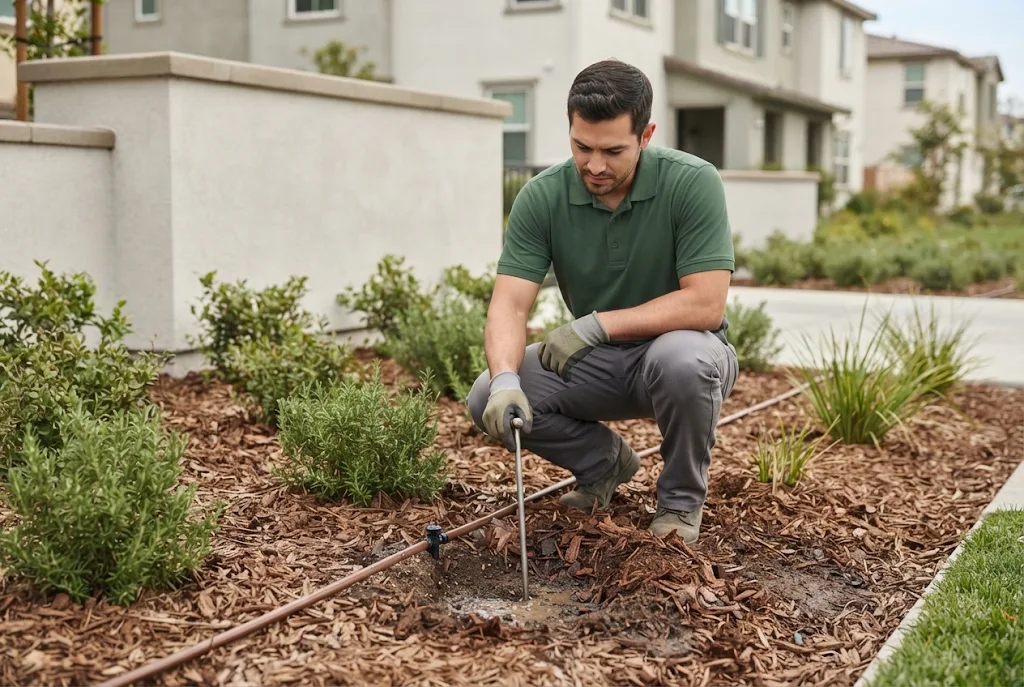
Put Your Property's Landscape Watering on a Plan
Whether you oversee one site or several, we can review the irrigation, the records, and the landscape together, then lay out a water management plan with priorities your team can schedule and budget. Call (888) 601-1117, email info@landscaper-near-me.com, or request a callback.
Still deciding whether ongoing water management fits your property? The answers below deal with scope, records, guarantees, and where this service stops. For anything we have not covered, reach us by phone at (888) 601-1117 or by email at info@landscaper-near-me.com.
FAQ's - Frequently Asked Questions
It covers the planning and oversight of outdoor irrigation: reviewing how the system is zoned and programmed, comparing it with the plants it serves, reviewing available water records, identifying visible waste, adjusting schedules by season, and documenting recommended repairs and improvements. Specific options such as detailed reporting or remote monitoring are confirmed during the estimate, since they depend on the site and its equipment.
Irrigation maintenance keeps the equipment working: replacing broken heads, clearing clogged nozzles, fixing leaks. Water management decides how that working equipment should be used, including which zones need how much water, how schedules change through the year, and whether use is trending in the right direction. The two overlap, and management often generates the maintenance list.
At least twelve months of water bills is the most helpful starting point, along with any irrigation-meter readings, controller programs, zone maps, and repair or maintenance records. Note whether the property has a dedicated irrigation meter or a mixed-use meter that also records indoor use. Incomplete records are still useful; we work with what exists and note the gaps.
Often, yes. Correcting overspray, repairing leaks and damaged heads, aligning and re-nozzling sprinklers, reprogramming the controller, and adding cycle-and-soak settings can make a real difference on an existing system. Larger changes such as drip conversion, rezoning, or controller upgrades are evaluated afterward, based on what the site actually needs.
We start with visible waste such as breaks, leaks, runoff, and overspray, then correct controller programming, then coordinate the repairs identified during the review. Equipment upgrades and planting changes come last, because they cost more and their value is easier to judge once the basics are working properly.
No. Bills are affected by weather, landscape changes, occupancy on mixed-use meters, and water-rate changes, none of which irrigation management controls. We focus on keeping watering matched to the landscape and on documenting changes, and we review results against those other factors before drawing any conclusion about savings.
No. Our water management work is limited to outdoor landscape irrigation and water use. Building plumbing, potable water systems, industrial water treatment, wastewater, and stormwater engineering are separate specialties, and property owners should engage qualified providers in those fields for that work.
Rebate programs and watering rules are set by water suppliers and cities, and they change. We recommend confirming current programs and restrictions directly with your water supplier or city. Once you know which rules apply, we can schedule irrigation around them, and if you are pursuing a rebate, we can talk through whether a proposed improvement suits the site.