
Office Building Landscaping Services
for Professional Offices, Complexes, and Office Parks
Office Building Landscaping Services keep the grounds of an occupied professional property in steady, presentable condition while tenants, visitors, and staff use the site every working day. Most of the work is recurring: mowing and edging where turf exists, keeping planting beds clean and weeded, pruning shrubs back from walkways and windows, clearing landscape debris, and keeping an eye on the irrigation that keeps everything alive. A smaller share is targeted improvement work, such as replacing a tired entrance bed, refreshing a courtyard that employees have stopped using, or replanting a parking island that has thinned to bare soil.
Landscaper-Near-Me.com provides commercial office landscaping for single-tenant and multitenant office buildings, professional office properties, office complexes, and office parks within our established service territory in Southeast Los Angeles County and Orange County. This page is written for the people who carry responsibility for those exteriors: building owners, commercial property managers, facility managers, asset managers, and owner-occupied businesses that look after their own grounds.
An office landscape is judged in small moments. A prospective tenant pulls into the lot and notices whether the monument sign is framed by planting or swallowed by it. An employee carrying lunch outside decides whether the courtyard bench is worth using. A property manager fields a complaint about a sprinkler soaking the front walk just as people are arriving. The sections below explain how we approach those details: what the service covers, which areas matter most, how a scope is set, what a routine visit includes, how plantings and irrigation are handled, how we work around building operations, where recurring maintenance ends and separately scoped work begins, and how to compare proposals before requesting an estimate.

Request a Free Estimate for Office Building Landscaping Services
Tell us about your office property, including its entrances, courtyards, parking islands, and the areas that are hardest to keep looking right, and we will prepare a free estimate based on the actual site. Call (888) 601-1117 or email info@landscaper-near-me.com to get started.
What Do Office Building Landscaping Services Cover?
Office building landscaping services cover the care of the planted and turf areas that make up a property’s exterior, organized into two kinds of work. The first is recurring office building landscape maintenance performed on an agreed schedule. The second is targeted improvement work that is scoped, estimated, and approved separately when an area has declined beyond what routine care can correct.
Recurring Office Building Landscape Maintenance
Recurring care is the core of the service and the reason most property managers contact us. Regular visits hold an established landscape in place: turf is cut and edged, beds are weeded and kept tidy, shrubs are shaped before they crowd a path or a window, fallen leaves and clippings are removed, and irrigation is watched for obvious problems. The goal is consistency. A landscape that looks the same late in the year as it did at the start of the agreement is usually the sign of a maintenance program that is working.
Targeted Office Landscape Improvements
Improvements are deliberately limited in scope. They might include replacing declining shrubs along the frontage, replanting a bed beside the main entrance, installing new sod in a worn turf panel, or reworking a courtyard planting so it suits the shade it actually receives. These projects refresh the property without turning it into a redesign, and they are priced separately so the cost of recurring maintenance stays predictable.
Office properties sit within the wider range of commercial landscape services we provide for managed properties. What sets landscaping for office buildings apart is the daily rhythm of an occupied workplace: predictable arrival periods, tenants who walk past the same entrance every morning, outdoor break areas, and a building manager who needs the grounds handled without becoming one more item to supervise.
Medical and dental buildings share many of these traits but add patient drop-off areas, accessibility concerns, and appointment-driven traffic. Those properties are covered on our page about medical office landscaping services. The rest of this page focuses on general office buildings, professional office properties, office complexes, and office parks.
Which Parts of an Office Property Need the Most Attention?
The areas closest to how people arrive and move through the site deserve the most consistent care: the main entrance, the monument sign, the street frontage, the walkways from parking to the door, and any courtyard or outdoor seating employees use. Parking islands and perimeter beds matter as well, although they are usually held to a different standard than the front door.
Entrances, Frontage, and Monument Signs
Office entrance landscaping is the part of the property most tenants and visitors actually look at. Beds beside the doors are kept clean, edged, and in scale with the building, and shrubs are held low enough that glass, address numbers, and entry signage remain clear. Planting around a monument sign should frame the sign rather than cover it. Groundcovers and shrubs that slowly creep across a sign face are a common problem on established office properties, and they are easy to miss because the change happens a few inches at a time. Along the frontage, the aim is a continuous, orderly edge that reads well from a passing car.
Courtyards and Employee Outdoor Areas
Office courtyard landscaping has a different job. These spaces are experienced up close, by people sitting for twenty minutes rather than walking past in ten seconds. Plants near benches and tables should look healthy, seating and paving should be kept clear of leaf litter, and any tree or shrub that drops fruit, sap, or heavy litter onto seating deserves a closer look. Courtyards are also frequently shaded by the building for much of the day, which affects what will grow there. That subject comes up again under replacement planting below.
Pedestrian Approaches and Parking Islands
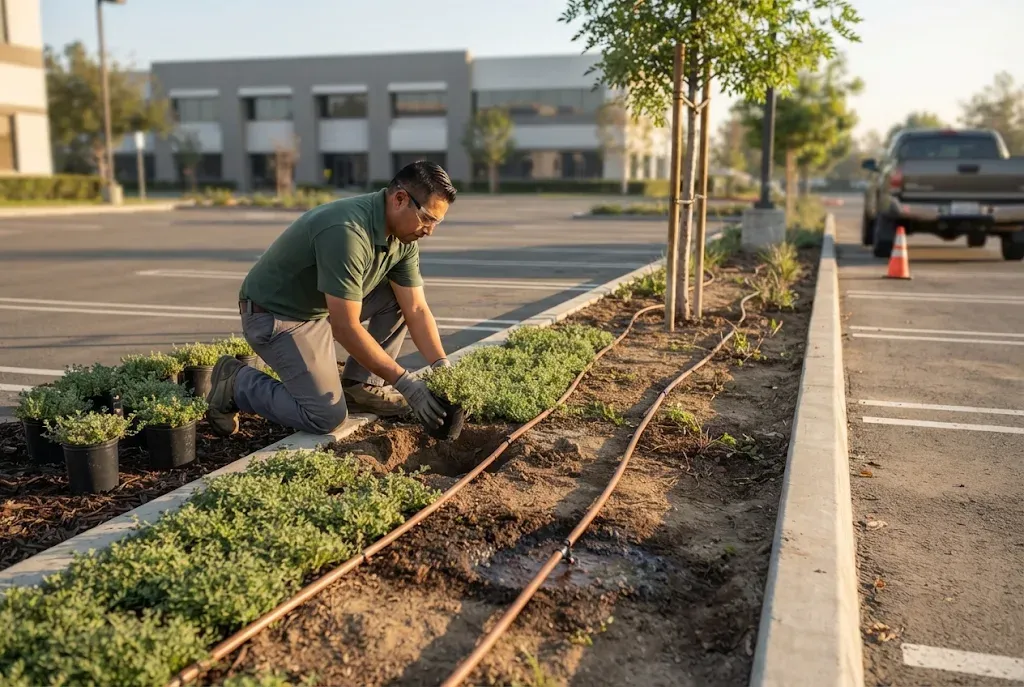
Walkways from the parking lot to the entrance should feel open. Shrubs are pruned back from path edges, groundcover is kept off the concrete, and low branches over walks are raised so no one has to duck. Parking islands are tougher environments: reflected heat from asphalt, car doors swinging into plants, people cutting across beds, and irrigation that is often older than the plants it serves. They are maintained for clean edges, contained plantings, and clear sight lines for drivers.
Perimeter Beds and Back-of-Property Areas
Perimeter beds, side yards, and planting near service doors are seen less often, but neglect there tends to spread. We keep them weeded, trimmed, and free of accumulated landscape debris so they do not turn into a problem that eventually shows from the street.
Trees add another layer. Clearance around entrances, signs, walkways, and drive aisles is part of keeping an office site usable, and crews watch for low limbs and for branches growing toward the building. Structural pruning, crown work, and larger trees are handled through our tree trimming services rather than as part of routine bed maintenance.
How Do Property Size, Layout, and Tenant Use Shape the Scope?
No two office properties need exactly the same scope of office building landscaping services. The recommended program depends on how much landscape there is, how it is laid out, what is planted, how the irrigation is performing, how heavily the site is used, and the appearance standard the owner or manager expects. We evaluate those factors on site before recommending a schedule or a task list.
- Property size and maintained area. The total area of turf, beds, slopes, and planted medians sets the baseline for crew time.
- Landscape layout. Many small, separated beds take longer to service than the same square footage in a few large beds, and narrow planters between curbs and parking stalls add hand work.
- Plant types and maturity. Fast-growing hedges, flowering shrubs that need regular shaping, and turf set a different pace than slow-growing, low-water plantings.
- Irrigation condition. A system with frequent broken heads or patchy coverage needs more attention than one that has been well kept.
- Tenant activity. High-traffic entrances, busy courtyards, and steady visitor traffic call for a higher standard in the places people use most.
- Appearance goals. A multitenant building competing for new leases may expect a different level of detail than an owner-occupied building where function comes first.
Single Buildings, Office Complexes, and Office Parks
A single-tenant building with one entrance and a modest frontage can often be maintained in a focused visit. Office complex landscaping services involve more coordination: several entrances, shared courtyards, multiple parking fields, and sometimes tenants with different expectations. Office park landscape maintenance adds common areas such as entry drives, medians, perimeter slopes, and shared open space, where responsibility may be divided between an owners’ association and individual parcel owners. For these larger properties, a map of included areas is part of a sound scope, because it settles in advance who maintains each bed, slope, and median.
Ownership structure matters too. In some multitenant buildings, the owner or manager handles all landscaping; in others, a lease may assign certain areas to a tenant. We confirm who is responsible for which areas, and who approves work, before the scope is written.
Is Your Office Entrance Making the Impression You Want?
Shrubs crowding the doors, thinning beds around the monument sign, or a courtyard employees no longer use can all be corrected. We will look at the areas tenants and visitors see most and recommend the upkeep or targeted improvements that fit your property.
What Happens During a Routine Office Grounds Maintenance Visit?
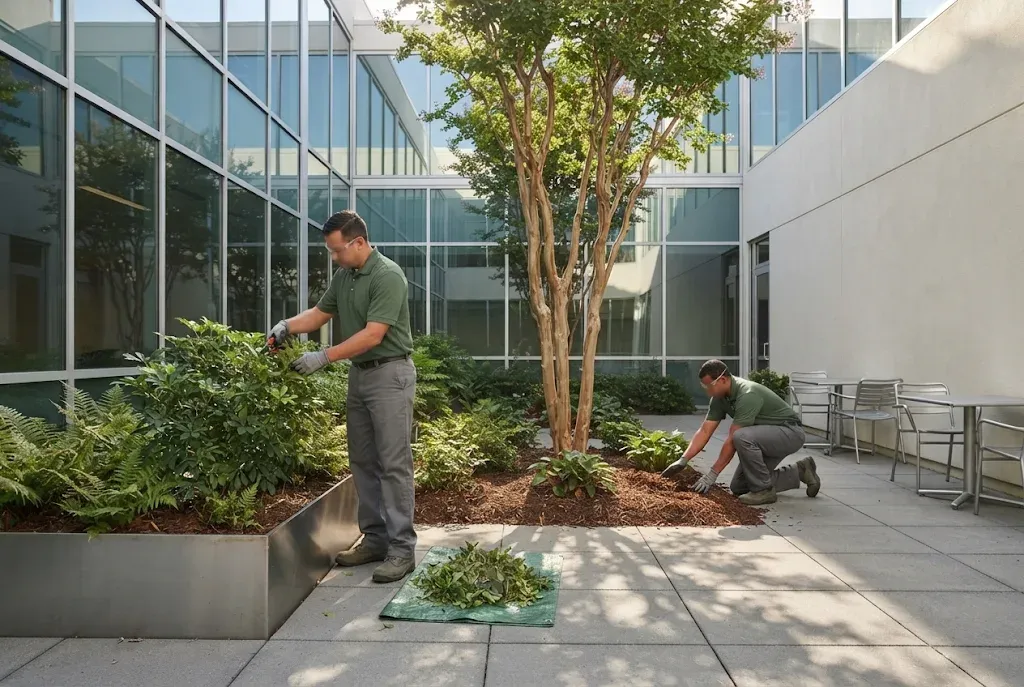
A routine office grounds maintenance visit carries out the tasks listed in the agreed scope, in an order planned around the building. On a typical visit, crews take care of turf, beds, shrubs, and cleanup, and they note anything that needs the property manager’s attention.
Mowing and Edging Where Turf Exists
Not every office property has lawn, and some have only a few panels near the entrance or along the street. Where turf exists, office building lawn care includes mowing at a height suited to the grass type and season, edging along walks and curbs, string-trimming around posts and utility boxes, and blowing clippings off hard surfaces. Fertilization, aeration, and turf-specific weed or pest treatment can be added through our commercial lawn care services when a lawn needs more than mowing.
Planting-Bed Upkeep and Weed Management
Beds are cleared of weeds, litter is picked out of planted areas, and groundcovers are kept within their borders. Consistent hand removal, good mulch coverage, and irrigation that wets plant roots rather than open soil do most of the work of keeping beds clean. The University of California Statewide IPM Program’s Pest Notes guide to weed management in landscapes describes this integrated approach and explains why mulch and cultural practices form the foundation, with herbicides reserved for particular situations. Where any herbicide is used on an office property, label directions and applicable regulations govern how it is applied.
Shrub Pruning
Shrubs are pruned to keep them healthy, in scale with their space, and clear of walkways, windows, signs, light fixtures, and building walls. Where the plant allows, selective pruning that keeps a natural form is usually preferable to repeated shearing into tight shapes, which tends to leave a dense outer shell over bare interior stems. Formal hedges that are designed to be sheared are maintained that way.
Debris Removal and Seasonal Cleanup
Clippings, leaves, and other landscape-generated debris are removed from beds, walks, and paved areas before the crew leaves. Seasonal cleanups go further: heavier leaf drop, cutting back perennials and ornamental grasses, removing spent seasonal color where it is used, and resetting beds after a stretch of fast growth. Whether general trash in parking lots is part of the scope is worth clarifying, because properties handle it differently and it is not landscape debris.
How Often Visits Happen
Visit frequency comes from the agreed scope, not a universal schedule. Plant growth, season, irrigation, and the property’s expectations all affect it. Many office properties need more frequent attention during the warm growing months and less during cooler months, and a property whose entrance carries most of its first impression may have that area serviced more often than its perimeter. We recommend a frequency after seeing the site, and the agreement should state it plainly.
How Do We Keep Plantings Healthy and Replace What Is Declining?
Healthy plantings depend on regular observation as much as on pruning and weeding. During maintenance visits, crews watch for plants that are declining, beds that have become overgrown, areas where soil is showing, and mulch that has thinned, and we report those conditions to the property manager with a recommendation.
Reading Plant Health
Yellowing foliage, dieback, sparse growth, and scorched leaf edges can point to several causes: too much or too little water, a broken or clogged irrigation line, poor drainage, compacted soil, the wrong sun exposure for the plant, pests, or a plant that has simply reached the end of its useful life. Finding the likely cause matters before anything is replaced. A new shrub planted on the same failing drip line will usually decline the same way.
Overgrown Plantings and Bare Areas
Many office landscapes were installed years ago with plants that have since outgrown their spaces. Shrubs that have been sheared hard for a long time may no longer respond well to pruning, and removing and replacing them is often more practical than continuing to cut them back. Bare areas in beds, on slopes, or beneath trees invite weeds and erosion, and they are usually the second thing a tenant notices after a dead plant.
Mulch Refreshes
Organic mulch breaks down, blows around, and gets kicked onto walkways. A periodic mulch refresh restores coverage in beds, helps soil hold moisture, and suppresses weed germination. Mulch is kept back from plant stems and tree trunks, and it should not be piled against building walls or over irrigation valve boxes.
Replacement Planting Suited to the Site
Replacement planting should match the conditions the plant will actually live in. A west-facing frontage bed and a north-facing courtyard tucked against a three-story building are entirely different environments, even on the same property. Choosing plants for shaded office courtyards, for example, means selecting species that keep their form and color with limited direct sun instead of repeating sun-loving plants that may have been installed before nearby trees matured. Replacement is also an opportunity to choose plants that need less water or less frequent pruning where they suit the setting.
Patchy turf can sometimes recover with better irrigation coverage and routine care, but where a panel has failed or been damaged, replacing it may be the better option. Our sod installation services cover targeted replacement of individual lawn areas, which is usually scoped separately from routine maintenance.
What Should Irrigation Care Look Like on an Office Property?
Within office building landscaping services, irrigation care starts with routine checks during maintenance visits and extends to repairs and schedule changes when the system needs them. Water that lands on walkways, runs into the parking lot, or misses part of a bed is a landscape problem and a highly visible one.
What Crews Watch for During Visits
- Broken, tilted, or sunken sprinkler heads, especially along curbs where cars and mowers strike them.
- Visible leaks, soggy spots, or water running down curbs and gutters.
- Overspray onto walkways, building walls, windows, and parked cars.
- Uneven coverage that shows up as dry patches in turf or struggling plants at the far end of a line.
- Clogged drip emitters and damaged drip tubing in planting beds.
Overspray at Entrances and Walkways
Overspray near office entrances deserves particular attention. Wet sidewalks during arrival periods annoy tenants, and repeated spray can stain walls, glass, and paving over time. Adjusting spray patterns, correcting head positions, and reviewing when zones near walkways are scheduled to run are usually the first steps.
Scheduling Adjustments
Watering needs shift with season, weather, plant type, sun exposure, and soil. A controller program set once and left alone tends to overwater during cool months and can fall short during heat. Schedules should be reviewed periodically based on what the landscape is showing and on any watering rules set by the local water provider, which differ across the region.
When Repairs or Conversions Are Needed
Minor adjustments are often handled during a maintenance visit, while repairs such as replacing valves, fixing a mainline leak, or correcting a zone are typically treated as approved additional work. Our commercial irrigation services cover assessment, maintenance, and repair when problems are larger or keep recurring.
Some areas are poor fits for spray irrigation altogether. Narrow parking islands, beds bordering walkways, and shrub plantings against building walls often perform better on drip, which delivers water at the root zone and keeps it off paving. Where a conversion makes sense, our drip irrigation installation services handle that work as a separate project.
Ready for Office Landscape Maintenance With a Clearly Defined Scope?
Know exactly which areas are covered, how often crews visit, and how additional work is approved before it begins. Request a callback or call Landscaper-Near-Me.com at (888) 601-1117 to talk through maintenance for your office building, complex, or office park.
How Do We Work Around Tenants, Visitors, and Daily Building Operations?
Providing office building landscaping services on an occupied property means planning each visit so the building keeps functioning normally. Before service begins, we coordinate with building management on the details that affect tenants and visitors, and we adjust the plan as the property’s patterns become clear.
Keeping Pedestrian Approaches Usable
A clear route to each entrance in use should remain open while crews work. Where possible, one side of a walkway is worked at a time, temporary work areas are marked, and hoses, tarps, and debris are kept off the main walking paths. Clippings and blown debris are cleared from walks as each area is finished rather than left for the end of the visit.
Equipment Placement and Crew Vehicles
Equipment and trailers are positioned where they will not block entrances, fire lanes, accessible parking, or loading areas. Where the property has designated contractor parking, we use it.
Noise, Arrival Periods, Visitors, and Deliveries
Blowers, mowers, and hedge trimmers are loud. On many office properties, the most sensitive times are morning arrivals, lunch periods in the courtyard, and stretches when visitors are coming and going. We work with the property manager to sequence tasks so the noisiest work near entrances, open windows, and outdoor seating happens at better-suited times where the schedule allows, and delivery and loading areas are worked around their usual activity. Visits generally take place during normal working hours; specific timing is discussed during scoping rather than promised in advance.
Communication With Building Management
Clear communication keeps small issues from becoming tenant complaints. A good arrangement names a primary contact at the property, gives that person a way to report landscape concerns between visits, and sets out how observations are passed along, whether that is a damaged sprinkler head, a dying shrub, or a limb growing toward the roofline, together with a recommendation.
What Is Included in Recurring Maintenance, and What Is Scoped Separately?
Recurring maintenance covers the routine tasks needed to keep the existing landscape in its current condition. Work that changes the landscape, replaces significant parts of it, or repairs its systems usually falls outside that recurring scope and is estimated and approved on its own.
Recurring maintenance commonly includes:
- Mowing, edging, and trimming where turf exists
- Weeding and litter pickup in planted areas
- Shrub pruning for plant health and clearance
- Removal of landscape-generated debris
- Routine irrigation observation and minor adjustments
- Seasonal cleanup tasks named in the agreement
Work that is usually scoped separately includes:
- Replacement planting and new plant installation
- Sod replacement in worn or failed turf areas
- Irrigation repairs beyond minor adjustments, and drip conversions
- Larger tree pruning or removal
- Hardscape repairs or improvements
The exact line varies between agreements. Some include an annual mulch refresh or seasonal color; others list those as extras. What matters is that the line is written down, so the property manager knows what the recurring price covers and when approval is needed.
Modest Improvements to Entrances and Courtyards
Office landscape improvements do not have to be large to be noticeable. Replacing a few declining shrubs at the entrance, filling a bare bed with groundcover, swapping struggling sun plants for shade-tolerant ones in a courtyard, or reshaping a bed edge can change how a property reads without a full redesign. When an occupied property needs more extensive change, planning a phased landscape renovation for an occupied office property lets the work move area by area, so entrances and courtyards stay usable throughout.
Some improvements involve built elements rather than plants: damaged bed curbs, uneven walkway pavers, or a courtyard seating area that needs new paving. Those are handled through our hardscape services and scoped as their own project.
How Should You Compare Proposals and Request an Office Building Landscaping Estimate?
The most useful way to compare proposals is to line them up task by task and area by area, not by monthly price alone. Two proposals with similar totals can describe very different levels of service. Knowing how to compare commercial landscape maintenance proposals starts with a handful of direct questions.
What to Look for in a Proposal
- Included areas. Does the proposal identify which beds, turf areas, parking islands, slopes, and common areas are covered, ideally with a site map?
- Tasks. Are mowing, edging, weeding, pruning, cleanup, and irrigation checks each described, or folded into one vague line?
- Visit frequency. Is the schedule stated, and does it change by season?
- Landscape-debris handling. Is removal of clippings, leaves, and pruning debris included?
- Communication expectations. Who is the contact, how are concerns reported, and how are observations shared?
- Approval of additional work. How are repairs and improvements proposed and approved before they are performed?
What Affects an Office Building Landscaping Estimate
Office building landscaping estimates depend on the maintained area, planting density, access, the current condition of the landscape, irrigation needs, and any improvements requested. A property with well-kept beds and dependable irrigation is scoped differently from one that has gone a season without consistent care and needs an initial cleanup before routine maintenance can hold it. Access affects time on site as well; gated areas, steep slopes, and narrow planters add labor. Because these variables differ so much from one property to the next, we prepare estimates after reviewing the site instead of quoting a general price.
Getting Started
If you own or manage an office building, office complex, or office park and want professional office landscaping services with a clearly defined scope, we can review the property with you, talk through the areas that matter most to your tenants, and prepare a free estimate covering recurring maintenance and any targeted improvements you are considering. Call Landscaper-Near-Me.com at (888) 601-1117, email info@landscaper-near-me.com, or request a callback, and we will arrange a time to look at the grounds together.
FAQ's - Frequently Asked Questions
Yes. A mid-year transition is common. We review the property before the start date, note any areas that need catch-up work, and confirm the scope and visit schedule so there is as little gap in service as possible. Any cleanup needed to bring the landscape back to a maintainable condition is identified separately in the estimate.
It can, provided the agreement clearly identifies which buildings, parcels, and common areas are included. In office parks where an owners’ association maintains shared areas and individual owners maintain their own parcels, we write the scope around those boundaries so responsibilities do not overlap or fall through the gaps.
Yes. Many office buildings are owned by the business that occupies them, and the person responsible for the grounds may be an office manager or the owner rather than a property management firm. The process is the same: we review the site, discuss priorities, and prepare a scope and estimate that fit the property.
Concerns should go to the property’s designated contact, who passes them to us. We review the issue, address it on the next visit if it falls within the maintenance scope, or recommend a solution for approval if it requires additional work, such as an irrigation repair or plant replacement.
Often, yes. If building management lets us know ahead of time about an event, open house, or important visit, we can try to shift the service day or adjust what is done so the grounds are tidy beforehand. Availability depends on the schedule, so earlier notice gives us more options.
The basic tasks are similar, but office lawns are usually maintained to support how the property looks to tenants and visitors, on a fixed schedule, around walkways and parking areas. Clippings must be cleared from hard surfaces promptly, and work is planned around building activity rather than a homeowner’s preferences.
In many cases, yes. When plants are replaced, we consider sun exposure, soil, available irrigation, and the look the property wants. Lower-water plants can work well in many office beds and parking islands, although the irrigation in that area may need adjustment so new and existing plants are not watered the same way.
A site map or aerial image, a copy of the current scope if you have one, a list of problem areas, any planned improvements, and the name of the person who approves work are all useful. We confirm details during our review of the property, but having this ready makes the estimate more accurate.