
Retail Property Landscaping Services for Storefronts and Retail Buildings
Retail Property Landscaping Services cover the planted areas a retail business shares with the street: the beds beside the entrance, the strip along the storefront glass, the planting around a monument sign, the islands in the parking lot, and the edges where the property meets its neighbors. Customers pass these areas on every visit. Kept in scale and in good condition, they frame the building and leave the storefront, signage, and walkways clear. Left to drift, shrubs creep over windows, mulch thins to bare soil, and a sprinkler that was knocked crooked months ago keeps wetting the same section of sidewalk.
Landscaper-Near-Me.com provides retail landscaping services for standalone retail buildings, street-front retail properties with their own landscape areas, neighborhood retail strips, and the retail portions of mixed-use properties within our established service territory in Southeast Los Angeles County and Orange County. The work falls into two broad categories: recurring retail property landscape maintenance that holds an established landscape steady, and targeted improvements that correct a frontage bed, entrance, or island that has declined past what routine care can fix.
This page is written for the people who make those decisions: property owners, retail asset managers, commercial property managers, facility managers, and business owners who are responsible for the landscaping outside their own storefront. If you lease your space, your lease determines whether landscape care and improvements are yours to arrange, and we explain further down how that is usually sorted out. The sections below describe what the service covers, how we evaluate a retail site, how plant and irrigation decisions are made for tight spaces, and what goes into an estimate. If you already know what your property needs, call (888) 601-1117 or email info@landscaper-near-me.com.

Free Estimates for Retail Property Landscaping Services
Tell us which parts of your retail property need attention, from storefront beds to parking lot islands, and we will review the site and prepare a free estimate covering routine care, targeted improvements, or both. Call (888) 601-1117 or email info@landscaper-near-me.com.
Where Retail Property Landscaping Services Start and Stop
Retail property landscaping is the care and improvement of the outdoor landscape areas that serve a retail business. On most retail sites those areas are smaller and more scattered than people expect, and each has a slightly different job to do.
- Storefront and frontage beds. Planting strips along the building face, often narrow and often backed by glass or stucco that reflects heat back onto the plants.
- Entrances and pedestrian approaches. Beds and planters lining the walk from the parking area or public sidewalk to the door.
- Monument and pylon sign plantings. The beds around the base of a freestanding sign, where plant height matters more than almost anywhere else on the property.
- Parking lot planting islands. Curbed islands and end caps with limited soil, frequent vehicle contact, and heat from the surrounding pavement.
- Perimeter and boundary plantings. Screening shrubs, groundcover, and trees along property lines, drive entries, and street frontage.
- Turf, where present. Many retail properties have little or no lawn. Where turf exists, it is usually a panel near the street or a strip beside a drive.
Our scope covers the planted areas and the irrigation that serves them. Parking lot sweeping, pressure washing, janitorial work, exterior lighting, security services, and structural construction are not part of what we provide, and we leave them out of our proposals so there is no confusion about who handles what.
Property size shapes the conversation too. This page focuses on storefronts, standalone retail buildings, and smaller retail properties. Larger centers with many tenants, shared common areas, and center-wide programs involve a different kind of planning, which we describe on our shopping center landscape maintenance page. For the broader range of work we perform beyond retail sites, see our commercial landscape services overview.
Does Your Retail Property Need Routine Maintenance, an Improvement, or Both?
The answer depends on whether the landscape is fundamentally sound. Recurring maintenance keeps an established landscape at the standard it already meets. A targeted improvement changes what is in the ground, because the existing planting can no longer meet that standard however often it is serviced.
When recurring maintenance is the right fit
If the plants are healthy, reasonably sized for their spaces, and adequately watered, the work is about consistency: pruning before growth crowds walkways or signs, keeping beds free of weeds and landscape debris, replenishing mulch as it breaks down, mowing and edging any turf, and checking irrigation for problems between visits. That is retail grounds maintenance in its ordinary form, and on a well-planted site it can carry the landscape for years.
When a targeted improvement makes more sense
Some conditions do not respond to maintenance. A frontage bed that has gone sparse after several plants died, shrubs sheared back so many times they are woody and bare inside, a patchwork left by years of one-off replacements, or an entrance that has simply been neglected usually call for retail landscape improvements rather than another round of trimming. Typical improvement work includes replacement planting, removal of declining or oversized plants, bed reshaping, fresh mulch, and irrigation adjustments to suit the new material. Larger landscape renovations for retail properties may reconfigure an entire frontage or entrance; this is the kind of work that falls under commercial landscape renovation services, and we scope and price it separately from routine care.
How the two fit together
Most retail sites end up with a mix. A property might need one entrance bed rebuilt and a pair of parking islands replanted, followed by a recurring program that keeps the new work from sliding back into the condition that prompted it. We recommend separating the two in writing: the improvement as a defined, separately approved project, and the maintenance as the ongoing scope. Budgets stay clear, and everyone can see what the regular service does and does not include.
What Matters Most in a Retail Landscape?
Landscaping for retail businesses is judged by people who are there for some other reason. They are trying to find the store, park, read the sign, and get to the door. The landscape priorities follow from that.
A consistent exterior appearance
Shoppers and passing drivers see the property on ordinary days, not just the afternoon after a service visit. The practical goal of storefront landscaping services is a landscape that looks about the same from one week to the next: edges held, debris cleared, plants in scale. That steadiness depends more on timing and follow-through than on any single visit.
Visible storefronts and signage
Glass frontage, window displays, wall signs, and monument signs are part of how a retail business identifies itself. Plantings in front of them need to stay below sightlines, or be chosen so they never grow into them in the first place. Cutting back a shrub that has grown over a sign is maintenance. Choosing a plant that cannot reach the sign at maturity is planning, and over time it usually costs less.
Clear pedestrian routes and customer access
Walkways, curb ramps, crossings from the parking area, and entry doors should stay free of encroaching branches, groundcover spilling over edges, and plant debris. Our pruning and bed edging on retail sites are aimed at keeping those routes open. To be clear about the limits: landscape maintenance supports clear walkways, but it is not an accessibility compliance service, and compliance questions belong with the property’s design and legal advisors.
Coordination with tenants and property management
Retail sites often have several parties with a stake in the landscape: an owner, a property manager, one or more tenants, and sometimes a neighboring parcel owner sharing a drive or boundary planting. Clear records of who requested work, who approved it, and when it will happen prevent most of the friction that would otherwise land on the landscaper.
Shrubs Crowding Your Storefront, Sign, or Walkway?
Overgrown frontage beds and sparse entrance plantings rarely recover with one more trim. We can look at the beds, tell you whether selective pruning or replacement planting is the better path, and keep any improvement work separate from your routine scope. Call (888) 601-1117 to arrange a review.
How We Assess a Retail Property Before Recommending Work
We start with a site visit, because the same request can mean very different work on two properties. “Clean up the front beds” might be a few hours of pruning on one site and a replanting project on another. Retail building landscaping on a standalone pad may wrap all four sides of the structure, while a strip property may have little more than a frontage bed and a handful of islands. During an assessment we look at:
- Landscape area and layout. How many separate planted areas there are, their sizes, and how they connect. Ten small islands take more time per square foot than one large bed.
- Existing plant condition. Which plants are healthy, which are declining, which have outgrown their space, and where gaps have opened.
- Sun exposure. Full sun, shade cast by the building or neighboring structures, and the reflected heat that comes off storefront glass, light-colored walls, and asphalt.
- Available soil space. Bed width, soil depth, and whether roots are competing with curbs, footings, or utilities.
- Irrigation coverage. Whether each area is watered, by what method (spray, rotor, or drip), and whether coverage matches what the plants actually need.
- Customer traffic. Where people really walk, including the shortcuts across beds that show where a path was never provided.
- Vehicle exposure. Bumper overhang into islands, tire damage along bed edges, and turning paths that clip plantings.
- Maintenance access. Where crews can park and unload, how equipment reaches each area, and any restrictions on when work can happen.
From that walk we can tell you which areas need only routine care, which would benefit from an improvement, and where the irrigation or a tree deserves a closer look. If we notice issues outside landscaping, such as damaged paving or a lighting problem, we mention them so you can route them to the right party.
Caring for Storefront Planting Beds, Shrubs, Groundcover, and Turf
Storefront planting bed maintenance is the core of most recurring retail programs. The beds are small, highly visible, and close to the customers the business is trying to serve, so modest problems show quickly.
Planting beds and landscape debris
Routine bed care includes pulling weeds before they set seed, clearing leaves and plant debris, removing dead or broken plant material, and keeping bed edges defined against walks and curbs. Retail beds also catch litter from foot traffic and wind. We remove landscape debris and the litter that collects within planted areas during service; general cleaning of paved areas is a separate service that we do not provide.
Shrub pruning that fits the space
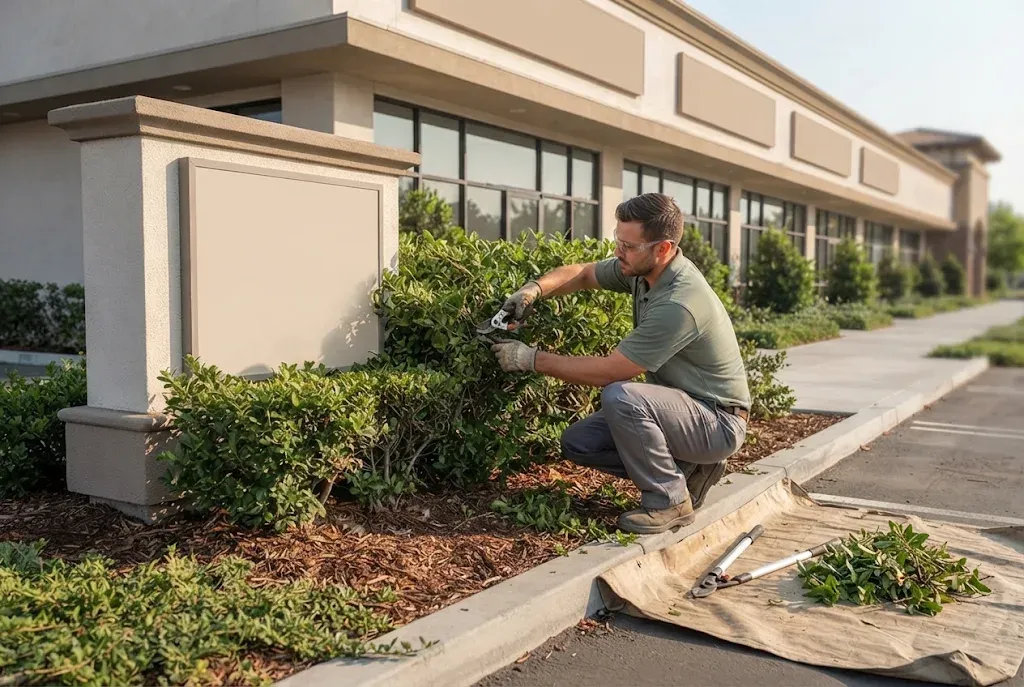
The most familiar shrub problem along retail frontage is repeated shearing into tight boxes and balls. Shearing concentrates growth at the outer surface, the interior thins out, and the plant keeps getting wider no matter how often it is cut. Where the plant allows it, we favor selective pruning that removes growth back to a branch or bud inside the canopy, which keeps a more natural form and slows the creep toward walkways and signs. Some plants are meant to be kept as formal hedges and are sheared on purpose. The point is to match the method to the plant and the location rather than apply one technique everywhere.
Groundcover and mulch
Groundcover needs regular trimming at bed edges so it does not spill onto walks or over curbs, along with thinning where it has begun to smother shrubs. Mulch helps hold soil moisture and suppress weeds, but it decomposes and gets kicked or washed out of beds, particularly near entrances. We monitor its condition and replenish it as needed, keeping it pulled back from shrub stems and tree trunks rather than piled against them.
Turf where it is present
Where a retail property has lawn, we mow at a height suited to the grass type, edge along walks and curbs, and watch for thinning, wear paths, and irrigation stress. Properties with larger turf areas or recurring lawn problems can find more detail on our commercial lawn care services page.
Choosing Plants for Retail Entrances, Narrow Frontage Beds, and Parking Lot Islands
No single plant list works for every retail property, and a useful recommendation has to start with the site. Plant selection for retail entrance landscaping and frontage beds involves several factors weighed together:
- Visibility. Expected height and spread at maturity, especially near signs, windows, and driveway sightlines.
- Mature size. A plant that fits a narrow bed in its first year may need constant cutting by its fourth. Choosing for the size of the space reduces pruning and keeps the bed looking intentional.
- Site exposure. Sun, shade, reflected heat, wind channeled between buildings, and proximity to traffic.
- Irrigation compatibility. Plants sharing a valve should have similar water needs. The Water Use Classification of Landscape Species (WUCOLS) database maintained by UC Davis rates landscape plants by relative water need for different California regions, which makes it a practical reference when grouping plants on a shared irrigation zone.
- Ongoing upkeep. Flower or fruit litter near entrances, thorns beside walkways, and how much shaping a plant needs to look right.
Narrow frontage beds
Beds along a storefront are frequently only a few feet wide, backed by a wall and edged by a walkway. Root space is limited, reflected heat can be considerable, and anything that grows wide will press against both the building and the walk. These beds generally call for compact, slow-spreading plants, and they are often better served by drip irrigation than by spray heads that wet glass and pavement.
Parking lot planting islands
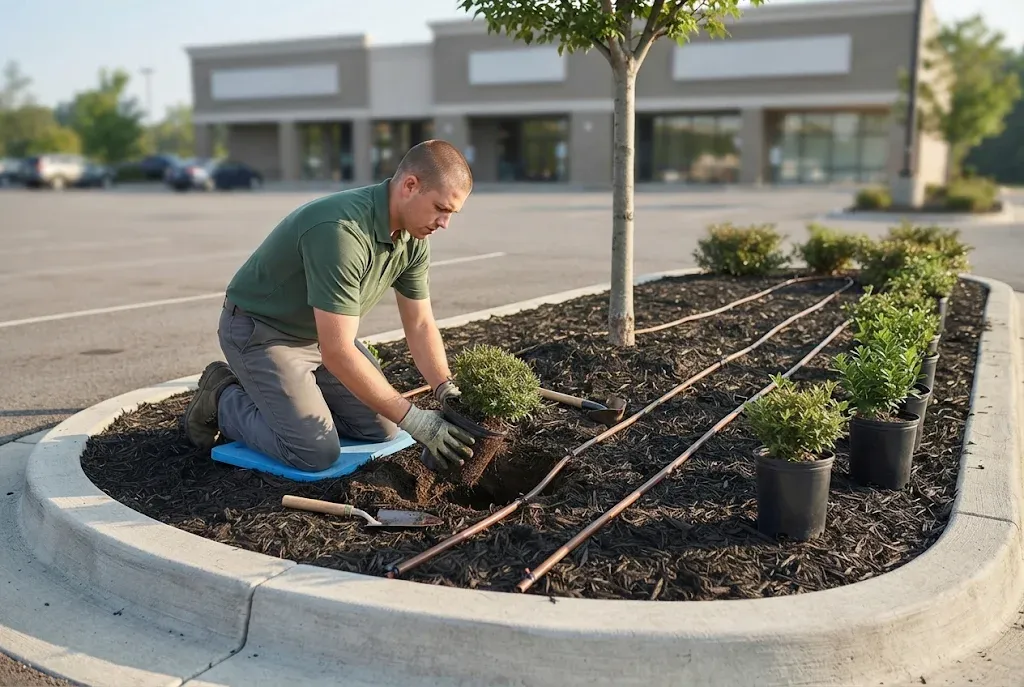
Retail parking lot island landscaping deals with some of the hardest growing conditions on the property. Curbs restrict soil volume, pavement heat raises temperatures around the plants, vehicles overhang the edges, and customers cut across on their way to the door. We treat each island as its own small site: what has survived, where damage keeps recurring, and whether the plant choice or the island layout is the real problem. Sometimes the answer is tougher low plants along the curb with taller material held to the center. Sometimes it is a change in irrigation method. And sometimes a heavily crossed corner simply needs a non-plant surface, which is a decision for the owner and, if paving is involved, for a separate contractor.
Where an owner wants seasonal color near the entrance, we treat it as a planned addition rather than something added visit by visit. Commercial seasonal planting services work best when the beds have irrigation to support them and the replacement schedule is agreed in advance.
Get a Clear Retail Landscape Scope Before Work Begins
We put maintained areas, visit content, and separately approved projects in writing, so owners, managers, and tenants know exactly what is covered. Reach us at (888) 601-1117 or info@landscaper-near-me.com to start with a site review.
Irrigation and Tree Issues That Call for a Closer Look
Irrigation and trees affect a retail landscape out of proportion to the space they occupy. Both deserve professional evaluation when problems appear, and both have dedicated service pages for detailed coverage.
Retail property irrigation maintenance
Irrigation problems that commonly turn up on retail sites include:
- Leaks from broken heads, cracked fittings, or damaged drip tubing, often caused by vehicles, foot traffic, or work in tight beds.
- Overspray onto pedestrian areas, where spray heads wet sidewalks, storefront glass, or parked cars.
- Uneven watering, with dry pockets beside soggy ones, usually from misaligned heads, mixed head types on one valve, or plants with different water needs sharing a zone.
- Outdated scheduling, where the controller has not been reviewed since the plants were installed or since the season changed.
During maintenance visits we watch for visible signs of these problems and report them. Diagnosis, repair, controller programming, and system upgrades are covered on our commercial irrigation services page. In narrow frontage beds and islands where spray heads keep wetting pavement, a conversion to drip is often worth evaluating, and our drip irrigation installation services page explains how that work is planned.
Local water agencies may also set watering rules that affect how a controller should be scheduled. Those rules vary by provider and change over time, so we check the current requirements that apply to your property rather than assume a schedule.
Trees that affect access and visibility
Trees are a supporting part of retail landscape care. They become a priority when low branches hang over walkways or parking stalls, when canopy growth hides signage or the storefront, or when limbs interfere with access to the building. We identify those conditions during service and coordinate the needed work. Larger pruning, elevated work, and tree-specific concerns are handled through our tree trimming services, where that work is covered in detail.
Coordinating Landscape Work With Customers, Deliveries, and Tenants
The best time to work on a retail landscape is whenever the work interferes least with the business, and that window differs by property. A café with a morning rush, a store whose deliveries arrive mid-morning, and a strip that is busiest on evenings and weekends all call for different arrangements.
When we set up service, we ask about:
- Business hours and peak customer periods for each tenant.
- Delivery schedules and loading areas that need to stay clear.
- Approved work windows set by the owner, manager, or lease.
- Limits on noise, blower use, or equipment near entrances and outdoor seating.
- Where crews may park without taking customer spaces.
We plan service around the approved windows the property gives us and confirm any changes in advance. We do not commit to particular days or times before we know the site and our schedule; that is settled with you during setup. Where possible, noisier tasks are kept away from entrances during open hours, and work areas near walkways are kept orderly while crews are on site.
Owner, manager, and tenant responsibilities
On multi-tenant retail properties, the owner or manager commonly controls the shared landscape, while individual leases may assign certain areas, such as a patio planter or a tenant-installed bed, to the tenant. Outdoor dining is a frequent example: restaurant landscape maintenance around a patio is sometimes the tenant’s job and sometimes the landlord’s. Before work begins, it helps to agree on:
- Maintained areas. A marked-up site plan or aerial image showing exactly which beds, islands, and turf areas are included.
- Who authorizes work. Which person approves routine service, and which approves anything beyond it.
- Tenant involvement. Whether a tenant may request work directly, and whether the lease permits improvements. When a tenant asks us to improve a shared area, we typically confirm with the owner or manager first.
- Reporting expectations. How you want to hear about issues found during service, such as an irrigation leak or a damaged island, and whether photos are helpful.
- Routine versus additional work. Which tasks belong to the recurring scope and which are quoted as separate projects.
Putting these points on paper at the start avoids the most common retail landscaping disagreement, which usually turns out to be about an area nobody was sure was included.
How Often a Retail Landscape Needs Service, and What Shapes Your Estimate
Maintenance frequency is set by the landscape rather than by a standard calendar. The main factors are:
- Plant growth. Fast-growing shrubs and groundcovers need attention more often than slow, compact plantings.
- Season. Growth, leaf drop, and irrigation demand change through the year, so the content of each visit, and sometimes the frequency, shifts with the season.
- Landscape complexity. Many small beds and islands require more time than a simple frontage.
- Irrigation conditions. Older or frequently damaged systems benefit from more regular checks.
- Presentation expectations. The standard the owner or tenants want held at the entrance and along the frontage.
Common reasons to request an assessment
Most requests start with something visible: shrubs grown over windows or a walkway, a monument sign partly hidden by plants, bare or thinning beds, plants yellowing or dying back, water running off beds onto paving, landscape debris collecting in corners and islands, or upkeep that has been inconsistent from month to month. Any one of these is reason enough to have the property looked at.
What determines the estimate
Our free estimates are based on what we find at the property. The main considerations are:
- Property size and the number of separate landscape areas.
- Landscape features such as turf, hedges, trees, and the type of irrigation.
- Existing condition and how much corrective work is needed up front.
- Access constraints and approved work windows.
- The recurring maintenance scope and visit frequency.
- Replacement plants, mulch, and other materials.
- Any improvement work, which we price and present separately for approval.
To help us prepare an accurate estimate, have the property address ready, along with the name of the person who approves landscape work, a description or marked-up image of the areas to be included, any known irrigation problems, and preferred or restricted work times. If you are a tenant, the lease language covering landscaping helps confirm what you can authorize.
Starting with your property
Whether you are responsible for a single storefront, a standalone retail building, or a neighborhood strip, the first step is the same: a look at the site and a straightforward conversation about what it needs now and what it should need going forward. Landscaper-Near-Me.com provides Retail Property Landscaping Services within our service territory in Southeast Los Angeles County and Orange County. Call (888) 601-1117, email info@landscaper-near-me.com, or request a callback, and we will arrange a time to review the property and prepare a free estimate for the maintenance, the improvements, or both.
FAQ's - Frequently Asked Questions
Yes. Storefronts, standalone retail buildings, and small neighborhood strips are the focus of this service. A single storefront with a few beds can be set up on a recurring schedule or handled as a one-time cleanup or improvement, and the scope is sized to what is actually on the property.
In most cases, yes. We plan service around the work windows the owner, manager, or lease approves, keep quieter tasks near entrances during open hours where possible, and schedule louder equipment for times you agree to. If your property has set hours for contractors, we follow them.
No. Our retail landscaping scope covers planted areas and the irrigation that serves them, including landscape debris and litter that collects within beds and islands. Parking lot sweeping, pressure washing, janitorial work, lighting, and security are separate services that we do not provide.
Often, yes, if your lease makes the landscaping at your space your responsibility or authorizes improvements. If the area is controlled by the owner or property manager, we will need their approval before working on shared areas. Having the relevant lease language available speeds up that confirmation.
That depends on how the scope is written. Routine maintenance normally covers care of the existing plants. Replacing plants that have died or been damaged is usually quoted as additional work with the materials listed, unless your agreement includes a set allowance for replacements. We recommend deciding this before service begins.
It depends on who controls the landscape around that building. In many centers, landscaping is handled under a center-wide program managed by the owner or management company. If a specific area is assigned to an individual building owner or tenant, we can discuss that area directly with the responsible party.
We agree on reporting when service is set up, including who receives reports and in what form. When we find something outside the routine scope, such as an irrigation leak, a vehicle-damaged island, or a branch over a walkway, we report it and provide a separate quote before doing any additional work.
Start timing depends on our current schedule, the scope of work, and any materials that need to be ordered, so we confirm a start date when the estimate is approved rather than promise one in advance. Improvement work is often completed first so recurring maintenance begins with the beds in the condition you want to hold.