
Palm Tree Trimming Services
for Homes, HOAs, and Commercial Properties
A palm is not a small tree with an unusual shape. It grows from a single point at the top of its trunk, it cannot close over a wound the way an oak or a ficus can, and every green frond it carries is part of how it feeds itself. That is why Palm Tree Trimming Services call for a different approach than ordinary tree work. The job is to take off what is dead, broken, or in the way while leaving the palm the canopy it needs.
At Landscaper-Near-Me.com, we trim palms for homeowners, apartment and condominium communities, HOA common areas, and commercial properties throughout our service territory in Southeast Los Angeles County and Orange County. This page explains what the work involves, how we decide what should and should not be cut, what shapes an estimate, and what to have ready when you ask for one. Free Estimates are available by calling (888) 601-1117.

Request a Free Palm Tree Trimming Estimate
Tell us how many palms you have and what you are seeing, whether it is hanging dead fronds, broken fronds, or fruit litter. We will review the palms, explain the scope we recommend, and provide a Free Estimate for your home or managed property.
What Do Palm Tree Trimming Services Include?
Palm trimming is selective maintenance. On most properties it means removing fronds that are completely dead, fronds that have snapped or are hanging, and, where the species and the site call for it, flower stalks, fruit clusters, or seed pods. The scope comes from the species, the condition of each palm, and how the ground beneath it is used. It is not a fixed haircut applied to every trunk on the property.
It helps to be clear about what the service is not. The methods used in our tree trimming services for broadleaf trees, such as thinning a crowded canopy or reducing the length of overextended limbs, have no real equivalent on a palm. A palm has no branch framework to thin or shorten. Its crown is one cluster of fronds rising from one bud, so there is nothing to reduce without stripping away the leaves the palm depends on. Topping is not an option at all. Cutting through the top of a single-trunk palm removes its only growing point, and the palm does not grow a replacement.
Palm tree pruning services are also a different matter from taking a palm out entirely. Removal is its own decision with its own planning, and we come back to it later on this page for palms that pruning cannot help.
Why Do Property Owners Ask for Palm Frond Removal?
Most calls start with something a person can see from the ground. The reasons are practical, and they fall into a short list:
- Hanging dead fronds. Brown fronds that have folded down against the trunk look neglected and eventually fall on their own schedule rather than yours. Dead palm frond removal is the core of most palm work.
- Broken fronds. Wind can kink a living frond so that it dangles, partly attached, over a driveway, a walkway, or a parked car.
- Accumulated skirts. Some fan palms hold many seasons of dead fronds in a dense skirt below the crown. A heavy skirt can shelter rodents and other pests, and it represents a large amount of dry material sitting above the property.
- Fruit and seed litter. Queen palms and date palms can drop a steady supply of fruit that stains paving, makes walking surfaces slick, draws pests, and sprouts seedlings in planting beds.
- Clearance conflicts. Low fronds brush roofs and gutters, hide signs and light fixtures, or lean into the path people use to reach a door.
A homeowner searching for palm tree trimming near me is usually dealing with one or two of these. A property manager may have all five spread across dozens of palms. In both cases the visible problem tells us where to look first. It does not tell us how much should come off, and that question is answered by looking at the palm itself.
How Do We Assess a Palm Before Recommending Any Cutting?
We look at each palm before we describe a scope, because two palms standing side by side can need very different amounts of work. Three things carry most of the weight.
Species
Knowing how palm species affect pruning needs prevents a great deal of unnecessary cutting. King palms have a smooth green crownshaft and typically release their old fronds cleanly without help. Queen palms tend to hang on to dead fronds and can carry heavy fruit clusters. Mexican fan palms are the ones most often seen with long skirts of dead leaves. Canary Island date palms have very large crowns and stiff spines near the base of each frond, and they are susceptible to a wilt disease that can be carried from palm to palm on pruning tools. The species tells us what is normal for that palm and what is not.
Height and crown condition
From the ground we count roughly how many green fronds the palm is holding, how many are fully dead, and what the oldest living fronds look like. We also look at the newest growth at the center of the crown. A crown that is full and evenly green needs little. A crown with very few fronds, undersized new leaves, or discoloration is telling us to be careful about removing anything that is still alive.
Access and what sits underneath
Gates, slopes, parked vehicles, roofs, fences, pools, glass, and planting beds all affect how the work can be done and where cut material can come down. Overhead utility lines matter more than anything else on this list, and we note them at the start. Once these pieces are understood, we can describe a scope that fits the palm instead of guessing at one from a photograph of the trunk.
Not Sure Which Fronds Should Come Off? Ask Us First
Yellowing fronds, heavy fruit clusters, and thinning crowns each call for a different answer. Have us look at the palm before anything green is cut, so the work protects its growing point and leaves it with the canopy it needs.
Which Fronds Should Stay on the Palm?
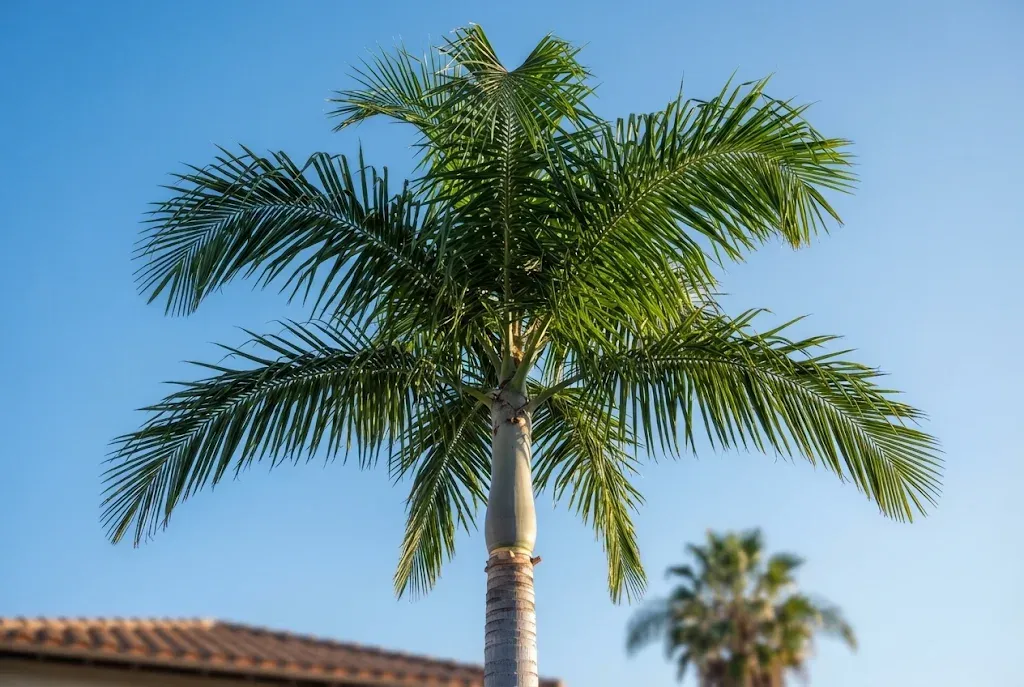
Healthy green fronds should generally stay. A palm produces a limited number of new leaves each year, and every green frond is making food that supports the trunk, the roots, and the next round of growth. Taking green fronds off does not make a palm grow faster or tidier. It leaves the palm with less to work with. A widely used pruning guideline is to leave any frond that sits at or above horizontal, the nine o’clock and three o’clock positions on a clock face, and our default is more conservative than that: dead and broken fronds first, living ones only when there is a specific reason.
Yellowing fronds deserve a closer look before anyone cuts them. On many landscape palms, older fronds that turn yellow, bronze, or spotted while still attached are showing a nutrient shortage, often potassium or magnesium, and the palm is drawing on those older leaves to feed its new growth. Cutting them off for appearance removes that reserve and tends to move the same symptoms up to the next set of fronds. Discoloration can also come from irrigation problems, root trouble, or disease. Recognizing palm health problems before pruning is the difference between helping a palm and speeding its decline.
Disease is the other reason for restraint. University of California guidance on palm diseases in the landscape advises keeping pruning to a minimum, avoiding wounds, and cleaning tools between palms, because some serious palm diseases travel on pruning equipment. We are not offering diagnosis or treatment of palm disease on this page. If a palm looks unwell during our visit, we will tell you what we see and recommend that it be evaluated before more fronds are removed.
Do Flower Stalks, Fruit Clusters, and Seed Pods Need to Be Removed?
Only where they cause a problem. Flowering and fruiting are normal, and the amount of litter a palm produces depends heavily on its species and its age. A queen palm over a pool deck or a date palm beside a storefront entrance can make a real mess. A small fan palm in a back corner may produce very little that anyone notices.
University research indicates that removing flower and fruit stalks does not appear to harm a palm, so this is one part of the job where the decision rests mostly on how the site is used. Palm tree seed pod removal makes sense above paving, parking stalls, entries, play areas, and anywhere fallen fruit becomes a slipping or staining concern. Timing matters as well. Stalks are far lighter and easier to handle before the fruit fills out, so removing them early is usually cleaner than waiting until clusters are heavy and already dropping.
Because none of this applies evenly to every palm, we treat stalk and seed pod work as a line to be discussed for each palm or each group of palms. If it is not needed, it should not be in the scope.
Why Are Hurricane Cuts and Heavy Pruning Hard on Palms?
A hurricane cut strips a palm down to a small tuft of its youngest fronds pointing straight up. It is sometimes requested in the belief that it lasts longer between visits or helps the palm in wind. Neither holds up well. University observations following major storms found that palms pruned this way were more likely to lose their crowns than palms left with a fuller canopy, and a palm that has given up most of its leaves has far less capacity to feed itself while it regrows them.
Understanding why excessive palm pruning can damage palms comes down to two facts about how they are built. First, the growing point sits at the top of the trunk, surrounded by the bases of the youngest fronds. Cutting too close, or removing the fronds that shield it, puts the one part the palm cannot replace at risk. Second, a palm trunk does not add new wood over an injury. A gouge from a saw, a torn leaf base, or a puncture from climbing spikes stays for the life of the palm and can become an entry point for decay. Professional palm trimming is as much about what is left untouched as what is cut.
Trunk skinning and decorative shaping are separate decisions
Peeling old leaf bases to produce a smooth trunk, or carving the base of a date palm crown into a rounded shape, are cosmetic procedures. They are not part of routine frond maintenance, they are not something a palm requires, and they create large cut surfaces of the kind university guidance recommends avoiding. We do not assume them in a trimming scope, and an estimate for frond work should not be read as including them.
Put Your Palms on a Sensible Trimming Plan
Whether you care for one palm at home or dozens across a community or commercial site, we will explain what we would trim, what we would leave alone, and how debris will be handled. Call (888) 601-1117, email info@landscaper-near-me.com, or ask us to call you.
How Is Trimming Planned for Tall Palms and Occupied Properties?
Height changes the job. Fronds on a mature palm are heavier than they look from below, a dead skirt can let go and slide down the trunk without warning, and everything that is cut has to land somewhere. Tall palm tree trimming is planned work for trained crews, and it is not a project for a ladder and a hand saw. During the estimate we consider how each crown can be reached, where material will come down, and what has to be moved or protected first. If a palm is beyond what we can responsibly take on because of its height, its access, or its surroundings, we will say so plainly.
Overhead utility lines get their own mention. Work close to energized lines is restricted to specifically qualified line-clearance personnel, and the utility may need to be involved before anything is cut. Fronds touching or hanging near a line should be reported, not handled by the property owner.
Residential properties
Residential palm tree trimming usually centers on appearance, a clear path to the door or driveway, and keeping fruit and fronds out of pools, gutters, and the neighbor’s yard. Planning is mostly about protecting what sits under the palm, including roof tile, patio covers, fences, and planting, and about agreeing ahead of time where vehicles should be parked on the day of the work.
Apartment, HOA, and commercial properties
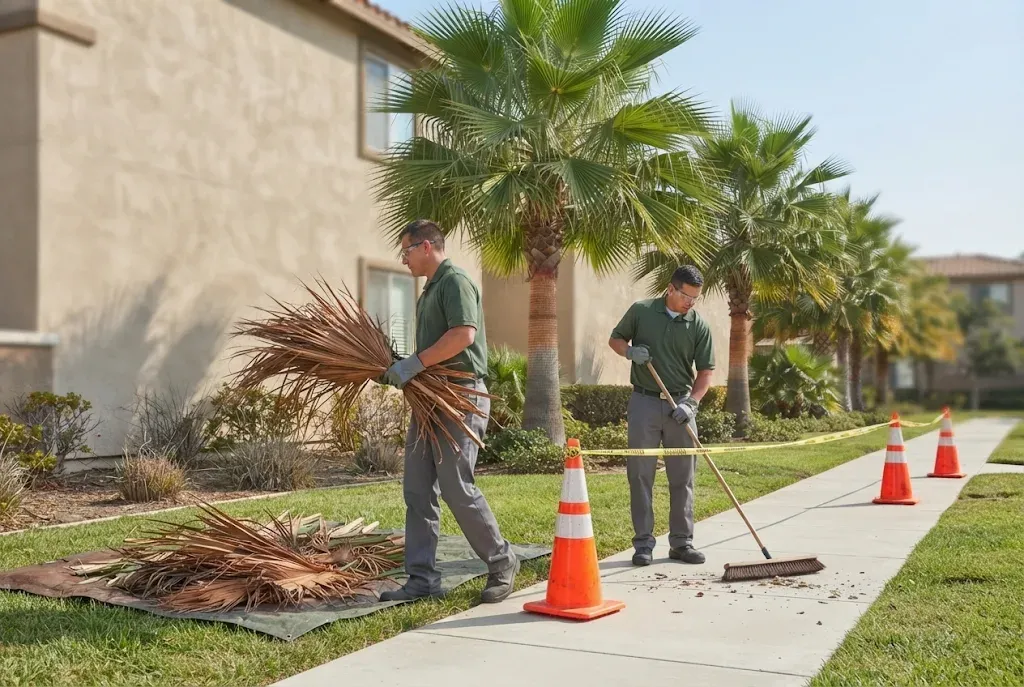
On shared and public-facing sites the palms are often the easy part. The harder part is the people. Commercial palm tree trimming has to account for pedestrians, residents, deliveries, and parked cars, so the work area is blocked off, walkways are rerouted for a short time where needed, and scheduling is coordinated with the manager so that entrances and parking remain usable.
For associations, palm work fits naturally alongside ongoing HOA landscape maintenance, where notices to residents and common-area access are already part of the routine. Retail centers, office properties, and industrial sites that want palms handled together with the rest of the grounds can review our commercial landscape services.
How Often Do Palms Need Trimming, and When Is Pruning the Wrong Answer?
There is no single schedule that suits every palm, and we would be wary of anyone who quotes one without seeing the property. A palm that sheds its own fronds may need nothing for long stretches. A palm that holds dead fronds and fruits heavily over a busy entrance may need attention much more often. Deciding when palm trees need trimming depends on the species, how quickly dead fronds build up, whether fruit is a concern, the condition of the crown, and how the space below is used. Palm tree maintenance services work best as periodic assessment followed by trimming when there is something to remove, not a calendar date that sends a crew up every palm regardless of need.
Some palms should not be pruned further at all. New fronds that emerge smaller each year, a center spear that is discolored or collapsing, a crown that has begun to lean or droop, or soft and weeping areas on the trunk are signs of a problem that cutting will not correct. Removing more fronds from a palm in that condition takes away resources it can no longer spare. Those palms need further evaluation, and in some cases the realistic conversation is about tree removal when trimming is not appropriate.
Most properties with palms also have shade trees, ornamentals, and hedges nearby. When the visit turns up concerns about trees other than palms, our broader tree care services cover that work separately so that each kind of tree is handled according to its own needs.
What Affects Palm Tree Trimming Estimates, and How Do You Request One?
We do not publish prices for palm work, because the same number of palms can mean a short visit on one property and a full day on another. The main palm tree trimming cost factors are these:
- Number of palms and how they are grouped on the property.
- Height, which affects how each crown is reached and how long each palm takes.
- Species, since crown size, frond weight, spines, and fruiting differ widely.
- Accumulated material, such as a few dead fronds compared with a skirt built up over many seasons.
- Access for the crew and for moving cut material out.
- Site protection for roofs, paving, vehicles, planting, and pedestrian areas.
- Debris handling, meaning what happens to everything that comes down.
That last item deserves a direct question. Palm fronds are bulky, and a handful of mature palms can generate a surprising volume of material. Before you compare palm tree trimming estimates, confirm whether each one includes removing cut material from the property, hauling it away, and a final cleanup of paving and planting beds. We state how debris will be handled in our estimates so that the scope you approve matches what you find when the work is finished.
What to have ready when you contact us
- How many palms you want us to look at.
- Their approximate height. Comparing them to the building, such as roof height or two stories, is enough.
- Photographs taken from the ground that show the full crown and the area beneath each palm.
- How the palms are reached, including gate widths, slopes, and parking.
- Nearby structures, pools, glass, and any overhead lines.
- What prompted the call, whether that is dead fronds, fruit litter, clearance, or a palm that looks unhealthy.
Good Palm Tree Trimming Services leave a palm cleaner and safer to walk under without leaving it weaker. If that is the result you want for your home, community, or commercial property, call Landscaper-Near-Me.com at (888) 601-1117, write to info@landscaper-near-me.com, or use the Request Call Back button on this page. We will review your palms, explain what we recommend and what we would leave alone, and provide a Free Estimate.
FAQ's - Frequently Asked Questions
Our palm trimming focuses on removing dead, broken, and hanging fronds. Where the species and the site call for it, the scope can also include flower stalks, fruit clusters, or seed pods. Healthy green fronds are generally left in place. Each estimate describes what will be removed and how cut material will be handled.
No. Some species release their old fronds on their own and need very little attention, and a palm with a full green crown and no dead material may not need any work. We look at each palm and recommend trimming only where there is something that should come off.
It varies with the species, how quickly dead fronds collect, whether fruit drop is a concern, and how the area below the palm is used. We suggest periodic assessment and trimming when it is warranted. A fixed schedule that ignores the condition of the palm often leads to cutting that is not needed.
The number of palms, their height and species, the amount of accumulated dead material, access for the crew, the protection needed for nearby structures and paving, and the agreed handling of debris. Because these differ on every property, we provide a Free Estimate after reviewing the palms instead of quoting a flat price.
Our estimates state whether removal of cut material, hauling, and final cleanup are included, so you know what to expect before work begins. If you are comparing estimates, check this item on each one. Palm fronds are bulky, and disposal is a meaningful part of the job.
Removing healthy green fronds reduces the palm’s ability to feed itself, and repeated heavy pruning can weaken it over time. We keep green fronds unless there is a specific reason to remove one, such as a broken frond or a real clearance conflict with a structure or walkway.
Work close to energized lines is restricted to specifically qualified line-clearance personnel, and the utility may need to be involved. We note overhead lines when we review the property and will tell you whether a palm is something we can address or whether the utility should be contacted first.
Yes. On occupied properties we plan the work with the manager so that walkways, entrances, and parking areas are blocked off only as long as needed. Scheduling, notices to residents or tenants, and the staging of debris are discussed before the work date is set.