
Tree Trimming Irvine CA
for HOA Communities and Office Properties
Tree Trimming Irvine CA requests from property managers rarely involve a single tree. More often, a board or facilities team is looking at a whole site: a row of trees leaning into a parking aisle, a canopy dropping low over a paseo, a few dead limbs above a building entrance, and a dozen more trees nobody has looked at closely in a while. Handling that kind of work well starts long before anyone picks up a pole saw. It starts with a clear picture of which trees need attention, what each one needs, and how the work will fit around the people who live, work, and park on the property.
This page is written for HOA board members, community association managers, commercial property managers, and facilities managers who are planning tree pruning in Irvine across multiple trees. We explain how a site assessment shapes the scope, what to gather before you request a multi-tree trimming estimate, how to coordinate work by building, parking row, or common area, and how tree condition and site constraints influence timing. Landscaper-Near-Me.com works with HOA common areas and office properties in Irvine as part of our Orange County service territory, and we confirm coverage for your specific property when you contact us. For an overview of our broader tree work, see our Tree Trimming Services page.

Request a Free Multi-Tree Trimming Estimate
Send us your Irvine property address, an approximate tree count, and your pruning priorities. We will walk the site and prepare a free estimate for planned tree trimming across your HOA common areas or office grounds.
What Does Planned Multi-Tree Trimming Mean for an Irvine Property?
Planned multi-tree trimming means the trees on a property are evaluated and pruned as a coordinated project rather than one emergency call at a time. Instead of reacting each time a resident complains about a branch scraping a car, the manager works from a defined list of trees, a stated set of pruning objectives, and a schedule the board or ownership has approved. For managers comparing Tree Trimming Irvine CA proposals, that planned structure is often the clearest way to see what each provider is actually offering.
The difference matters most on managed properties. An HOA common area or an office campus may have trees along entry drives, in parking-lot islands, beside walkways, around pools or courtyards, and next to buildings. Each location carries its own concerns. A tree in a parking island affects vehicle clearance and lighting. A tree along a paseo affects pedestrians, strollers, and anyone using a mobility device. A tree beside an entrance affects signage, door clearance, and the first impression visitors get of the property.
When those trees are handled together, the manager gains several practical advantages:
- One scope of work that can be reviewed, approved, and budgeted at once.
- A sequence that groups trees by area, so disruption stays contained to one section at a time.
- A single set of resident or tenant notices instead of repeated surprise visits.
- A written record of what was pruned and why, which helps with future planning.
Planned work also gives the people approving it something concrete to evaluate. A board can see which trees are included, what the crew intends to do with each one, and how access will be handled. That clarity usually makes approvals move faster and reduces questions after the crew leaves.
How Does a Site Assessment Decide Which Trees Need Pruning?
A site assessment answers two questions: which trees need work now, and what kind of work each of those trees actually needs. Not every tree on a property needs the same treatment, and some may not need pruning this cycle at all. Walking the site tree by tree keeps the scope tied to real conditions instead of a blanket instruction to trim everything.
Branches Encroaching on Walkways, Parking Spaces, and Entrances
Clearance problems are usually the easiest to spot and the most likely to generate complaints. During an assessment we look for limbs hanging low over sidewalks and paseos, branches extending into parking stalls or drive aisles, growth crowding building entrances or blocking wayfinding signs, and canopies that shade or obscure exterior light fixtures. Each of these is noted by location so the pruning objective is clear: raise the canopy over a walkway, reduce a limb reaching toward a building, or clear a sign line.
Dead Branches That Need a Professional Look
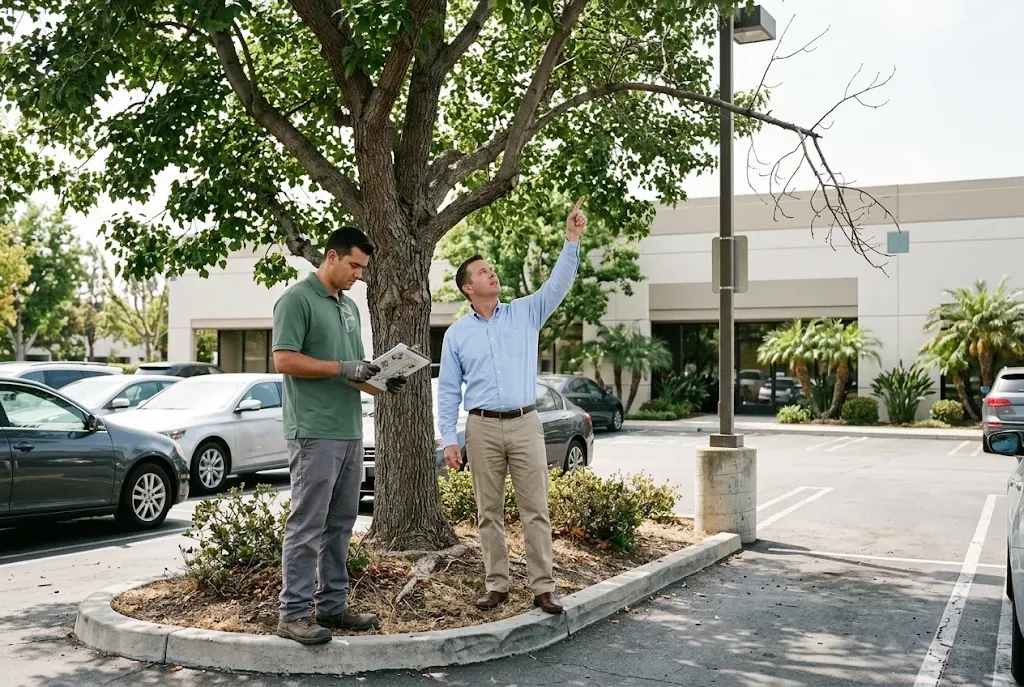
Dead or declining branches deserve careful attention, especially above areas where people walk, sit, or park. Some dead wood is small and simply part of normal canopy aging. Larger dead limbs, branches with cracks, or wood with visible decay should be evaluated by a trained professional before work is planned, because the right approach depends on the branch’s size, its position, and the condition of the wood it is attached to. Removing dead wood where appropriate is a common part of planned pruning; our article on deadwooding in tree trimming explains what that work involves and why it is done selectively.
Recording What Each Tree Needs
The most useful assessments produce a simple record for each tree: its location, its general type, the pruning objective, and any access concerns. That record becomes the backbone of the estimate. It also lets the manager compare the proposed scope against the property’s priorities and decide whether everything should happen at once or in phases. If a tree shows signs that go beyond routine pruning, such as significant lean, root disturbance, or extensive decay, we flag it so the manager can decide on next steps rather than folding it quietly into a trimming scope.
What Should You Send When Requesting a Multi-Tree Trimming Estimate?
The more complete your request, the more accurate and useful your multi-tree trimming estimate will be. Managers do not need to produce a formal arborist report before contacting us, but a few pieces of information help us understand the property and prepare a scope that reflects how the site actually works.
When you request an estimate, please include:
- Property address and the name of the HOA community or office property.
- Approximate tree count. An estimate is fine; we confirm the count during the site visit.
- Marked tree locations or a site map, if one is available. A marked-up aerial image or a landscape plan works well.
- Photos of the trees or areas causing the most concern, such as a crowded parking row or a low canopy over a walkway.
- Pruning priorities, for example walkway clearance, parking lot clearance, deadwood removal where appropriate, or clearing signs and lights.
- Access restrictions, including gate codes, loading-zone limits, quiet hours, pool or amenity closures, and areas that must stay open.
- The site contact who will meet the crew and answer questions on the day of work.
- The approval process, such as board review, management-company sign-off, or ownership approval, along with any timeline you are working against.
Some managers prefer to build a short spreadsheet before reaching out. Learning how to prepare a tree inventory for a pruning quote can save time on larger sites, but it is not required. If you only have an address and a general concern, we can start there and build the details together during the walkthrough.
Identifying the site contact and approval path early prevents one of the most common delays: an estimate that is ready, but no one knows who can sign off on it. When we know who reviews the scope, we can format the estimate so it answers the questions that person or board is likely to ask.
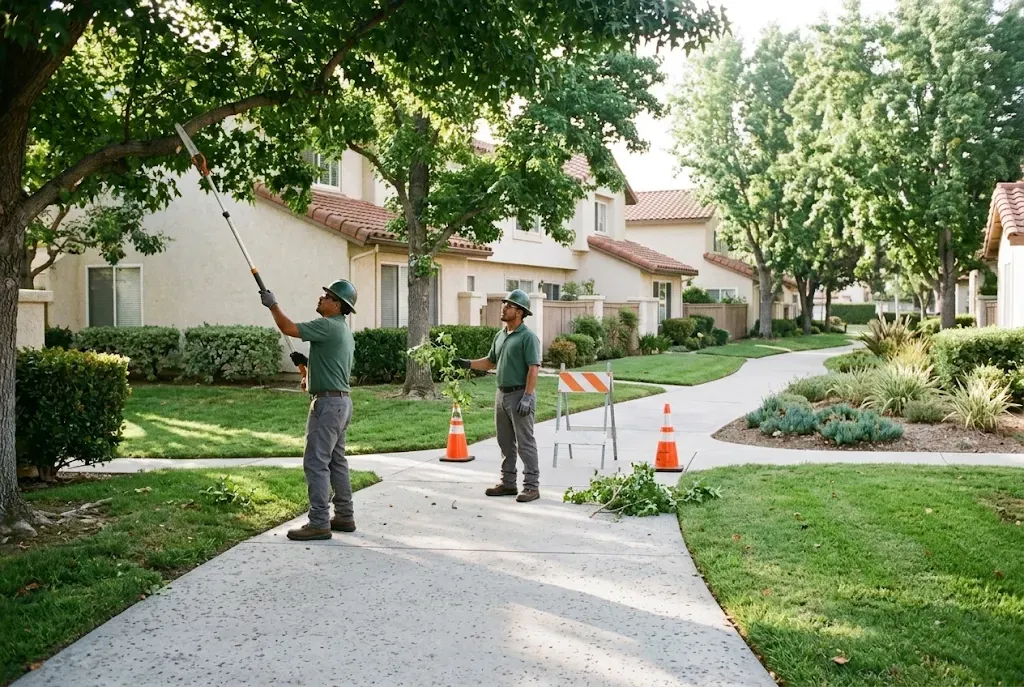
Clear Parking Rows, Walkways, and Entrances in Phases
When branches crowd parking stalls, paseos, or building entrances, we can help you rank which trees come first and phase the pruning around residents and tenants so only one area is affected at a time.
How Is Tree Pruning in Irvine Prioritized Across a Large Property?
Tree pruning in Irvine on a managed property works best when the trees are ranked by need rather than handled in whatever order the crew reaches them. A clear priority order helps the board or ownership decide what must happen in this cycle and what can wait.
A practical way to rank trees is to sort them into a few groups:
- Safety and access first. Dead branches over walkways or seating areas, limbs obstructing drive aisles, and growth blocking accessible routes.
- Clearance and function next. Canopies crowding parking stalls, signs, exterior lighting, building walls, or roofs.
- Structure and long-term health. Selective pruning that helps younger trees develop a sound branch structure or reduces weight on long limbs.
- Appearance last. Shaping that improves how the property looks but does not address a functional concern.
Ranking trees this way also makes phased work possible. A property with a large tree count, or a budget that has to stretch across fiscal years, may choose to complete the highest-priority trees first and schedule the rest later. Knowing how to plan phased tree pruning across a commercial property lets managers spread the cost and disruption while still addressing the most pressing conditions promptly.
Selective pruning is the guiding idea throughout. Removing too much live canopy at once can stress a tree, and practices such as topping are widely discouraged by university and extension horticulture programs. Our goal is to make the cuts that meet the stated objective, not to remove as much foliage as possible.
Tree Pruning for Parking Lot and Walkway Clearance
Tree pruning for parking lot and walkway clearance addresses the conflicts people notice every day: branches brushing car roofs, sap and debris dropping onto parked vehicles in specific stalls, and low limbs that force pedestrians to duck or step off the path. These areas often carry the highest volume of complaints, so they tend to rise to the top of a manager’s list.
Parking Rows and Drive Aisles
In parking lots, the objective is usually to raise the canopy enough for vehicles to pass and park comfortably, and to reduce limbs extending over drive aisles where taller vehicles, delivery trucks, or service vehicles travel. We also look at how trees interact with pole lighting, because a canopy that has grown into a light fixture can leave parts of the lot noticeably darker at night.
Walkways, Paseos, and Accessible Routes
For walkways, clearance is about people. Low branches over sidewalks, paseos, and courtyard paths can be a hazard for pedestrians and an obstacle for anyone using a wheelchair, walker, or stroller. Pruning in these areas focuses on lifting the canopy over the walking surface and removing limbs that intrude into the path, while keeping enough canopy to preserve shade along routes residents and employees use often.
Building Entrances, Signs, and Sight Lines
Around entrances, trees can crowd doors, cover address numbers, and hide wayfinding or monument signs. Clearing these areas improves both function and appearance. At driveway exits, trimming that opens sight lines for drivers can also be part of the scope when the trees are on the property and the manager identifies it as a priority.
HOA Tree Trimming in Irvine: Planning Around Residents and Board Approval
HOA tree trimming in Irvine involves a layer of communication that office properties may not have. Residents park in assigned or open stalls, walk dogs along paseos, use pools and parks during the day, and often have strong opinions about the trees near their homes. A well-planned project accounts for all of that before work begins.
For HOA communities, we recommend confirming several points with the board or management company before scheduling:
- Which trees are association-maintained common-area trees and which, if any, belong to individual homeowners or another party.
- How residents will be notified, and how far in advance the community’s governing documents or policies require notice.
- Whether any parking areas will need temporary restrictions, and how residents will be told where to park instead.
- Which amenities, such as pools, tot lots, or greenbelts, may need brief closures while crews work nearby.
- Who on the board or management team will be the point of contact for resident questions during the project.
Associations that already have ongoing grounds care can align tree work with their regular maintenance calendar. Our HOA Landscape Maintenance page describes how we support community associations beyond tree pruning, including routine care of the common areas around those trees.
Clear notices tend to make the biggest difference. Residents who know when crews will arrive, which areas will be affected, and when their parking will be available again are far less likely to be caught off guard on the day of work.
Talk Through Your Irvine Tree Trimming Plan With Us
Call (888) 601-1117 or email info@landscaper-near-me.com to review your tree list, access limits, and approval timeline. We will confirm coverage for your property and outline the next steps.
Commercial Tree Trimming in Irvine for Office Properties
Commercial tree trimming in Irvine on office properties centers on tenant operations. Employees arrive and leave on predictable schedules, visitors need clear access to lobbies, and delivery or service vehicles need room to move. Planning the work around those patterns keeps the property functioning while the trees are pruned.
Facilities managers often find it helpful to decide in advance:
- Whether work should take place during lower-occupancy periods, such as early in the day or on days when fewer tenants are on site, where the property’s rules allow it.
- Which entrances must stay open at all times, and which secondary entrances can be temporarily redirected.
- How tenants will be notified about parking changes, and whether the notice should come from property management or the building’s tenant portal.
- Where crews can stage equipment and vehicles without blocking fire lanes, loading areas, or accessible parking.
Office campuses with multiple buildings can be divided into zones so that only one building’s surroundings or one section of the parking lot is affected at a time. This approach also works well when the property has several tenants with different schedules.
Tree pruning for office properties is often one piece of a larger grounds program. If you are also reviewing shrub care, irrigation, or ongoing landscape service, our Commercial Landscapers Irvine CA page explains how we support Irvine commercial sites with broader grounds maintenance alongside pruning.
How Do Species, Tree Condition, and Site Constraints Affect Timing?
Timing depends on what the tree is, what condition it is in, what the pruning is meant to accomplish, and what the site will allow. There is no single calendar date that fits every tree on a mixed property.
- Species. Different trees respond differently to pruning at different times of year, and some flower or fruit in ways that affect when shaping makes the most sense.
- Tree condition. A dead branch hanging over a walkway is generally addressed when it is identified rather than held for a preferred season.
- Pruning objectives. Clearance work, deadwood removal, and structural pruning of young trees may each have a different ideal window.
- Site constraints. Resident activity, tenant schedules, events, and parking availability can narrow the practical window even when the tree itself would tolerate work at several points in the year.
We keep seasonal guidance brief here because it varies by species. For more detail, see our article on when to schedule tree trimming.
Ownership and approval should also be settled before work is scheduled. Trees along public streets or in the public right-of-way may be maintained by the City rather than the property, and some trees are subject to City requirements. If you are unsure whether a tree belongs to the association, the property owner, or the City, review the City of Irvine tree maintenance and pruning information and verify the tree’s status with the City of Irvine or the appropriate property authority before including it in a scope of work.
Coordinating Access, Cleanup, and Next Steps for Your Tree Trimming Project
Coordination is what turns an approved scope into a smooth workday. Managers who plan the work by building, parking row, or common area give residents and tenants predictable expectations and give the crew a clear sequence to follow.
Working by Building, Parking Row, or Common Area
Breaking the property into sections lets us finish one area before moving to the next. A parking row can be cleared of vehicles, pruned, cleaned, and reopened before the next row is restricted. On an HOA property, one greenbelt or building cluster can be completed at a time. On an office campus, work can move building by building.
Notices, Parking Restrictions, and Pedestrian Routing
Advance notices should state the date, the affected areas, and any temporary parking restrictions. On the day of work, pedestrians need to be routed safely around active work zones with cones or barriers, and building entrances and accessible routes should remain available or have a clearly marked alternate path. Scheduling around tenant or resident activity, such as avoiding peak arrival times or busy amenity hours, reduces conflicts further.
Cleanup and Debris Handling
Ask that cleanup and debris handling be described in the estimate itself. A clear scope states whether branches and leaves will be removed from the site, how walkways and parking surfaces will be cleared, and when each area will be ready to reopen. Confirming this in writing avoids misunderstandings once the work is complete.
Your Next Step
If your Irvine HOA community or office property has trees crowding walkways, parking rows, or entrances, we can help you turn that list into a planned, phased scope. Gather your property address, approximate tree count, photos, priorities, and access details, then call us at (888) 601-1117, email info@landscaper-near-me.com, or request a callback. We will confirm service coverage for your property, schedule a site walk, and prepare a free estimate your board or ownership can review with confidence.
FAQ's - Frequently Asked Questions
No. Trees in the public right-of-way are generally maintained by the City of Irvine, and we do not prune City trees. If you are unsure whether a tree along your frontage belongs to the City, the association, or the property owner, please verify it with the City before adding it to your scope.
No. An approximate count is enough to get started. We confirm the actual number of trees, their locations, and what each one needs during the site walk, then reflect that in the written estimate.
In most cases, yes. We plan the work one parking row or section at a time so only part of the lot is restricted. Advance notice to residents or tenants helps make sure the affected stalls are empty when the crew arrives.
Cleanup and debris handling should be spelled out in every estimate we prepare. We describe how branches and leaves will be removed and how walkways and paved areas will be cleared, so you know what to expect before you approve the work.
Requirements depend on the tree and its location. The City of Irvine regulates certain trees, such as those in the public right-of-way and some significant trees, and associations may have their own rules. We recommend confirming requirements with the City and your governing documents before work begins.
We coordinate with the site contact to keep main entrances and accessible routes open, or to mark a clear alternate path while crews work nearby. Work near entrances can also be timed around lower-traffic periods when the property allows it.
Yes. Many properties schedule tree pruning alongside ongoing grounds care so the work fits the existing maintenance calendar. We can discuss how tree trimming fits with landscape maintenance, shrub pruning, and seasonal cleanup at your property.
Boards typically review the list of trees included, the pruning objective for each, the proposed schedule or phases, resident notice plans, parking restrictions, and cleanup details. We format the estimate so those items are easy to find and discuss.