What is Deadwooding in Tree Trimming?
Deadwooding is the selective removal of dead, dying, and broken branches from a tree’s canopy, leaving the living structure of the tree intact. If you have been quoted for “deadwooding” and were not sure what you were buying, that sentence is the short answer. It is a targeted safety and clearance operation, not a general haircut for the tree.
The word trips people up because two similar terms get used interchangeably. Deadwood is the material — the gray, brittle, leafless limbs already present in the canopy. Deadwooding is the work of taking that material out. So the answer to what is deadwooding in tree trimming is really an answer about scope: a crew doing this work is looking for wood the tree has already given up on, and is under instruction to leave everything else alone.
This page covers what deadwood is and why it forms, the signs a tree needs deadwooding, how professionals remove deadwood from trees, when the work should happen, and the point at which dead branches stop being a pruning question and start being a tree-risk question. We are a landscaping company serving Southeast Los Angeles County and Orange County, and dead branch removal is one of the most common requests we get from homeowners, HOA boards, and commercial property managers alike — usually after something lands in a driveway.
Free Estimates for Deadwood Removal
Tell us which trees concern you and we will walk the property, identify the dead material, and price the work in writing before anything is scheduled. The visit and the estimate cost nothing. Call (888) 601-1117 or email info@landscaper-near-me.com.
What Is Deadwooding in Tree Trimming?
Deadwooding in tree trimming is a defined, limited operation: a trained crew works through the canopy and removes branches that are already dead, dying, hung up, or broken, making each cut at the correct point so the tree can respond to the wound. Nothing living and healthy is taken unless it is physically in the way of reaching something dead. When the crew leaves, the tree should look like itself — only without the gray material.
That restraint is what separates it from most other work performed under the banner of Tree Trimming Services. Thinning, reduction, and clearance pruning all involve deliberate decisions about live wood. Deadwooding does not. It is closer to housekeeping than to shaping.
Deadwood and Deadwooding Are Not the Same Word
Deadwood is a noun describing a condition. Every mature tree has some. A branch that has been shaded out by the branches above it will die back and eventually fall — that is normal tree behavior, not a symptom of anything. Deadwooding is the verb: the act of getting that material out of the canopy on a schedule you control instead of one the wind controls.
Property owners often use the phrases deadwooding trees, tree deadwood removal, dead branch removal, and deadwood pruning to mean the same thing, and in practice they do. All four describe removing dead branches from trees rather than reshaping them.
Where It Sits Between Trimming, Pruning, Crown Cleaning, and Removal
It helps to place the work on a scale of how much the tree changes.
- Deadwooding — only non-living material comes out. The tree’s size, shape, and density are unchanged.
- Crown cleaning — deadwooding plus a short list of defective live material: broken limbs, stubs left by a previous poor cut, water sprouts, and sometimes crossing branches. Many arborists treat deadwooding as the core of crown cleaning.
- Trimming and pruning — live wood is removed on purpose to change clearance, density, or dimension. This is where the difference between tree trimming and tree pruning becomes a real conversation about objectives.
- Tree removal — the whole tree comes down. A separate decision, driven by structure and risk rather than by tidiness.
Confusing these categories is expensive in both directions. We have walked properties where an owner paid for a full reduction when three hours of deadwooding would have solved the actual complaint, and properties where a decade of deadwooding was quietly postponing a conversation the tree needed someone to have.
Why Branches Die on Trees That Look Perfectly Healthy
Dead limbs in a green canopy alarm people, and sometimes they should. Often they should not. Understanding why tree branches die is what tells you whether you are looking at routine maintenance or an early warning.
The most common cause is competition for light. As a tree grows, its own upper canopy shades the interior and lower branches. Those branches stop returning energy to the tree, the tree stops investing in them, and they die. Foresters call the result natural branch shedding, and on a large shade tree it produces a steady supply of small deadwood indefinitely. Nothing is wrong.
Beyond that, dead branches accumulate for reasons worth taking seriously:
- Water stress. Trees under prolonged drought, or on irrigation that was reduced without the tree being accounted for, shed branch tips first. Successive dry years leave abundant dead branches behind.
- Wind and storm loading. Limbs crack, split, or tear partway and then die attached to the tree — a hanging limb is deadwood in the making.
- Boring insects and disease. Cankers and vascular pathogens kill the tissue in an individual branch, cutting off water to everything past the injury. Leaves yellow, drop, and the limb goes gray while the rest of the tree carries on.
- Root damage. Trenching for a new driveway, a fence line, a utility run, or a pool commonly severs roots. The canopy responds months later, usually as dieback concentrated on one side.
- Decay and structural defect. Internal rot reduces what a limb can supply and what it can hold. Increasing deadwood combined with a thinning canopy is one of the recognized outward signs of extensive sap rot.
- Soil and grade changes. Fill soil piled over a root zone, or compaction from repeated equipment traffic, suffocates roots and shows up in the canopy later.
A few dead twigs in an old sycamore is a maintenance item. Dieback that is spreading year over year, concentrated on one limb, or paired with fungal growth at a branch union or the trunk base is a different signal, and it deserves a closer look than a trim quote. That is the point at which our broader Tree Care Services start with an assessment of the whole tree rather than a scope for the canopy.
What Are the Signs of Deadwooding in Trees?
The signs a tree needs deadwooding are visible from the ground in almost every case, and the clearest one is a branch that carries no leaves during the growing season while the branches around it are full. You do not need to climb anything or own a single tool to spot the signs of deadwood in trees. You need to stand back far enough to see the whole canopy and look at it for a minute.
Here is what we check on a walkthrough, roughly in the order it becomes obvious:
- Bare limbs in a leafed-out canopy. During active growth, a branch with no foliage and no swelling buds is finished. This is the single most reliable indicator.
- Color and texture change. Dead wood weathers to gray or silver, loses its sheen, and reads as visually different from live wood even at a distance.
- Bark that is loose, peeling, or gone. Bark separating in sheets or already dropped, exposing smooth wood underneath, means that section died some time ago.
- Brittleness. Live twigs bend before they break. Dead ones snap cleanly and dry, with no green underneath.
- Dieback that starts at the tips. Death moving inward from the ends of branches toward the trunk is progressive, and worth monitoring rather than dismissing.
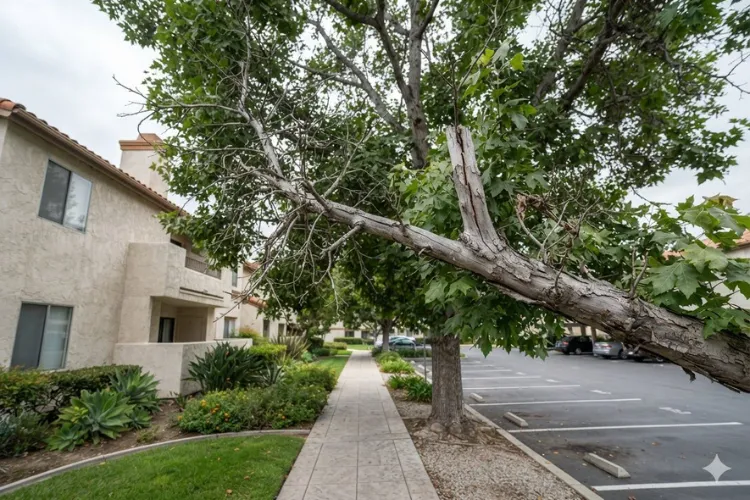
- Broken or hanging limbs. A limb detached but caught in the canopy is the most urgent version of this list. It is unsupported weight above whatever is below it.
- Cracks, seams, and cavities. Open cracks along a limb, or a cavity at a branch union, indicate the wood has lost strength whether or not the foliage looks normal.
- Mushrooms, conks, or brackets. Fungal fruiting bodies on a limb, a branch scar, or the root collar generally appear only after decay is well established internally.
- Debris on the ground. If you are picking up sticks after every wind event and you did not used to be, the canopy is telling you something.
How to Tell If a Tree Is Dead or Dormant
This is the question we field most often between December and March, when a bare deciduous tree looks alarming to someone who has only seen it in leaf. Two checks settle it. First, look at the twigs: a dormant branch carries plump, firm buds set along its length, and a dead one carries either shriveled buds or none. Second, scratch a small area of bark on a young twig with a thumbnail. Green or pale, moist tissue underneath means the branch is alive and waiting. Tan, dry, and brittle means it is not.
Run that check on several branches in different parts of the tree, not just the one that worries you. And give a struggling tree until early summer before drawing conclusions — some species leaf out considerably later than their neighbors, and we have talked more than one owner out of removing a tree that was simply slow. Learning how to tell if a tree is dead or dormant saves a lot of unnecessary work.
Have the Deadwood in Your Canopy Identified
Bare limbs, hangers, and tip dieback are hard to judge from the patio, and dormant branches get mistaken for dead ones every winter. We will look at the canopy from underneath, sort what is dead from what is simply resting, and note what sits beneath each limb. Reach us at (888) 601-1117.
How Do You Properly Remove Deadwood From a Tree?
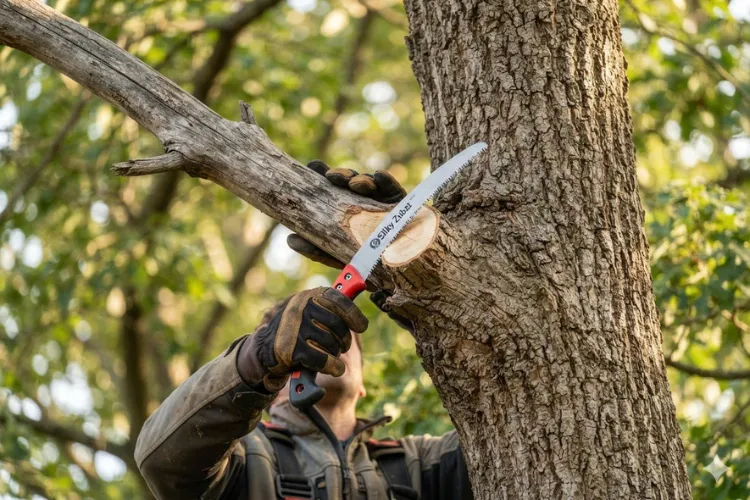
You remove deadwood by cutting each dead branch back to its point of attachment, placing the cut just outside the branch collar so the trunk or parent limb is never wounded, and lowering anything heavy under control rather than dropping it. That is the technical answer. The practical answer is that how professionals remove deadwood from trees has more to do with sequence and judgment than with the cut itself.
The Canopy Assessment Comes First
Before anything is cut, we walk the tree and look at it from several angles — ideally including from directly underneath, which is where hangers become visible. We identify the species and its habit, note the size and height of each dead limb, and record what sits beneath the canopy: roof, walkway, driveway, parking stalls, patio furniture, play equipment, irrigation heads, fencing, signage, lighting. We also look for anything that changes the plan, including cavities, cracks, conks, and evidence that the deadwood is a symptom of something larger. Anything near energized conductors is utility work and gets referred rather than attempted.
Cut Placement Is the Part That Matters
Where the cut lands determines whether the tree closes the wound or carries an open one for years. A collar of trunk tissue grows out around the base of a dying branch, and that collar is living tissue belonging to the trunk. The cut goes just outside it.
- No flush cuts. Cutting tight against the trunk removes the collar and the branch bark ridge, taking out the tree’s natural defense boundary and leaving a much larger wound than necessary.
- No stubs. A protruding remnant cannot be sealed over, dies back on its own, and becomes an entry point.
- Three cuts on anything substantial. On a limb larger than roughly two inches, an undercut a foot or two out, a second cut slightly beyond it to drop the weight, then a final cut at the collar. Skipping the undercut lets the falling limb tear a strip of bark down the trunk.
- No wound dressing. Sealers and pruning paints are not recommended; they do not speed wound closure or prevent decay, and in some cases appear to encourage it. University of California guidance on wood decay fungi in landscape trees sets out both the cut placement and the case against dressings in detail.
- No topping, no live-wood bonus. Deadwooding is not an opportunity to reduce the tree. If the scope was deadwood, live growth stays.
Access, Rigging, and Cleanup
How the crew reaches the branch depends on the tree and the site. Small deadwood within reach comes out with pole tools from the ground. Higher work is done from a climbing system or an aerial lift where access allows. Limbs over a roof, a vehicle, a pool, or a planted bed are rigged and lowered on rope rather than released — a dead limb is unpredictable in freefall and tends to shatter on impact.
The job ends with debris hauled out, hard surfaces blown clean, and a final look up into the canopy from the ground to confirm nothing was missed and no hangers were created during the work. That last inspection catches more than people expect.
Why This Is Professional Work and Not a Weekend Project
We are frequently asked whether deadwooding is something a capable homeowner can handle. For low, small-diameter material reachable with both feet on the ground and nothing valuable underneath, sometimes. Above that, the honest answer is no, and the reasons are specific rather than defensive.
Dead wood does not behave like live wood. It has lost moisture and flexibility, so it fails suddenly and without the warning flex a green limb gives. It fractures rather than bending, which means a limb can break in a place you were not cutting. Its attachment point is often already compromised by decay, so the branch may be carrying far less holding strength than its diameter suggests — a modest loss of wood weight to decay can cost the great majority of the wood’s strength.
Then there is the working position. Deadwooding puts a person directly underneath the exact material most likely to release, frequently while managing a saw at height. Ladder work in a canopy compounds it, because a ladder has to lean on something, and the something is usually a branch of unknown condition. Our crews plan a drop zone, keep people and property out of it, and choose access methods that keep the cutter clear of what is coming down. That planning is most of the job.
Which Dead Branches Get Priority
Not all deadwood carries the same weight, literally or in terms of risk. When we build a scope for a property, we sort hazardous dead branches from the material that can wait, and the sorting depends on three things: what the branch is, where it is, and what is underneath it.
Size and height. A one-inch twig at fifteen feet and a four-inch limb at forty feet are not the same object. Mass and fall distance both scale the consequence.
Attachment condition. A limb still firmly held is different from one already detached and resting in the canopy. Hangers come out first, every time.
What it would land on. This is the deciding factor. A dead branch over an unused back corner of a lot and an identical branch over a preschool play structure, a tenant walkway, a parking stall, a patio, or an entry drive represent completely different exposures. Arborists call what sits below a target, and targets are why deadwooding gets scheduled.
Certain conditions we treat as prompt rather than routine: limbs cracked, split, or hanging after wind; dead limbs directly over an occupied or trafficked area; branches obstructing sight lines at a driveway, gate, or crosswalk; anything blocking a fire lane or emergency exit; and a sudden increase in dead material after a storm. That last one is worth a proper storm-damaged tree assessment rather than a quick cleanup, because wind reveals defects that were already there.
Trees near buildings and other high-value targets should be inspected on a regular basis by someone qualified to evaluate structural weakness, not only when something visibly breaks. If you would rather have a professional make that call than guess from the patio, that is exactly the kind of visit our Tree Service Near Me page describes.
Ready to Clear the Deadwood From Your Trees?
Whether it is one limb over a driveway or a full site on a maintenance cycle, we will tell you plainly what we would remove, what we would leave, and what should be looked at more closely. Call (888) 601-1117, email info@landscaper-near-me.com, or request a callback below.
When Should Deadwood Be Removed?
Most pruning advice is organized around the calendar, because cutting live wood interacts with a tree’s growth cycle. Deadwooding largely sidesteps that. The tissue being removed is no longer part of the tree’s living system, so taking it out does not cost the tree stored energy or leaf area, and the seasonal timing rules that govern thinning and reduction do not apply with the same force. In practice, deadwooding can be done year-round, and condition sets the schedule rather than the month.
A handful of factors still influence when we would rather be on site:
- Visibility. On deciduous trees, dead limbs are easiest to identify against a full canopy in the growing season. In winter, everything is bare and telling dead from dormant takes longer. This is the reverse of structural pruning, where winter visibility is the advantage — our guidance on When Is the Best Time of Year to Trim Trees covers that distinction across pruning types.
- Disease pressure. Where a specific pathogen or insect is involved, pruning is sometimes best confined to particular conditions or seasons, and prunings may need to be removed from the site rather than chipped and left. We follow current guidance for the species and problem involved.
- Wildlife. Dead limbs and cavities are used for nesting. When active nests are present we adjust sequencing where we can.
- Weather and access. Aerial work stops for wind. Saturated soil rules out heavy equipment on turf. Commercial sites have delivery windows and business hours that dictate the schedule regardless of horticulture.
- Ahead of wind season. Many of our customers prefer to have deadwood cleared before the windy months rather than after, which is a reasonable way to sequence non-urgent work.
None of that changes the underlying principle: a compromised limb over a space people use is a condition-based decision, and holding it for a preferred month trades a small convenience for a real exposure.
What Deadwooding Actually Achieves — and What It Does Not
The benefits of deadwooding are real, and they are also narrower than some marketing suggests. We would rather set the expectation correctly.
What it does. It removes the material in the canopy most likely to fall, which directly reduces the chance of a branch landing on a person, a vehicle, a roof, or a walkway. It restores clearance and sight lines where dead limbs were in the way. It makes a tree look cared for — on commercial frontages and HOA common areas, gray deadwood in an otherwise green canopy reads as neglect from the street even when the property is well maintained. And it makes the tree easier to inspect, because once the obvious dead material is gone, anything new stands out immediately.
What it does not do. Removing dead branches does not cure whatever killed them. If the cause was drought stress, root damage, a soil problem, or a pathogen, the deadwood will return until the cause is addressed. It does not restore a declining tree to health. It does not make a structurally defective tree safe. And no pruning of any kind guarantees a tree will not fail in a storm — it removes the material most likely to go, which is a meaningful reduction in risk and not an elimination of it. Any contractor promising more than that is overselling.
On Residential Properties
Homeowners typically call about one or two specific trees and a specific complaint: sticks all over the lawn, a gray limb visible from the kitchen window, something dropped near where the kids play. The work is usually a single visit. Because a residential canopy is looked at every day, we tend to find deadwooding requested earlier here than on commercial sites, which is a good thing. When it is part of a broader property refresh, we fold it into the rest of the Landscape Services scheduled for the visit so the crew is on site once.
On Commercial, HOA, and Multifamily Properties
Larger sites treat it as a program rather than an event. A retail center, industrial park, apartment community, or office campus is managing dozens or hundreds of trees against consistent standards, with pedestrian routes, parking, loading areas, and tenant frontage all underneath. Deadwooding on a defined cycle keeps that predictable and budgetable, and it produces a record — which is often what a board or a facility manager actually needs. For accounts already using our Commercial Landscape Services, tree work is scheduled into the existing rotation. Managers of larger portfolios can see how we approach multi-site work on our Commercial Landscaping Los Angeles page.
When Deadwooding Is Not the Right Answer
Sometimes the dead branches are the least interesting thing about the tree. Removing them would tidy the canopy and leave the actual problem untouched, and we would rather say so than take the job as scoped.
Conditions that call for a broader tree-risk evaluation before any pruning is scheduled include dieback affecting a large share of the canopy rather than scattered limbs; decay, cavities, or fungal conks on the trunk or a major structural limb; a trunk crack or open seam; a lean that has appeared or worsened recently, particularly with soil lifting or cracking on the opposite side of the root plate; roots severed by nearby excavation; and repeated branch failures from the same tree. Any one of these moves the question from pruning to assessment. Several of them together is usually where the conversation about when a tree should be removed instead of trimmed begins — a decision that belongs to a qualified professional assessing the specific tree, not to a general rule.
We would rather tell a customer that a tree needs a proper evaluation, or that the honest recommendation this year is to monitor and do nothing, than sell a round of deadwooding that makes a declining tree look presentable for a season.
If you have gray limbs in a canopy and you are not sure which category you are in, that is a normal place to start. We will walk the property, tell you what we see, explain what we would remove and what we would leave, and give you written pricing before anything is scheduled. Estimates are free and there is no charge for the visit that produces one.
Landscaper-Near-Me.com handles deadwooding, dead branch removal, and general tree trimming for residential and commercial properties across Whittier, Irvine, Newport Beach, Costa Mesa, Santa Ana, Anaheim, Garden Grove, Orange, Fullerton, Long Beach, Cerritos, Commerce, City of Industry, and Downey. Whittier-area customers can find local specifics on our Tree Trimming Whittier CA page, and coastal commercial accounts can review our Commercial Landscaping Newport Beach work. If you found us searching for a landscaper near me because something came down in the yard last week, call (888) 601-1117 or email info@landscaper-near-me.com and we will get someone out to look at the tree.
FAQ's - Frequently Asked Questions
Close, but not identical. Deadwooding removes dead, dying, and broken branches only. Crown cleaning normally includes that work plus a short list of defective live material — stubs left by earlier poor cuts, water sprouts, and sometimes crossing limbs. If your quote says crown cleaning, expect slightly more to come out. If it says deadwooding and live wood is being removed, ask why before the crew starts.
No, when the cuts are placed correctly. Dead wood is no longer connected to the tree’s living systems, so removing it costs the tree nothing in stored energy or leaf area. The risk is entirely in the cut. A flush cut removes the branch collar and wounds the trunk itself; a stub cannot close and invites decay. Both cause more harm than leaving the branch alone would have.
Some is normal in every mature tree. Lower and interior branches get shaded out by the canopy above them and die as part of ordinary growth, which produces a continuous supply of small dead twigs. What is not normal is dieback that spreads year over year, is concentrated on one limb or one side, involves larger structural branches, or appears alongside fungal growth or bark loss. Volume matters less than the pattern.
Small dead material you can reach standing on the ground, with nothing valuable underneath, is reasonable to handle yourself if the cut is made just outside the branch collar. Anything requiring a ladder, a chainsaw at height, or work over a roof, vehicle, walkway, or pool is worth handing off. Dead wood fractures without warning and its attachment point is frequently weaker than its diameter suggests, so the person underneath is in the wrong place.
Dead and declining wood does attract wood-boring insects and provides a foothold for decay organisms, and fruiting bodies on dead limbs can produce spores that infect wounds elsewhere. Prompt removal reduces that pressure. It is fair to call it good practice; it is not fair to promise that deadwooding will keep a tree healthy on its own, because the underlying cause of the dieback still has to be addressed.
It should look essentially unchanged, only cleaner. The material coming out carries no leaves, so the tree’s density and outline stay the same. If a canopy looks noticeably thinner after a deadwooding visit, live wood was removed — either the scope was broader than described or the crew overreached. We define what is coming out before the work starts so there are no surprises.
They are dead material, but palms are handled differently. A palm cannot regrow a damaged crown or compartmentalize wounds the way a broadleaf tree does, so the work is limited to fully dead and clearly declining fronds along with fruit and seed stalks. Stripping a palm back to a narrow plume removes fronds the tree is still using and leaves it worse off. It is a separate discipline from deadwooding a shade tree.
We haul everything off the property as part of the job and blow the hard surfaces clean before we leave. Sound wood is generally chipped and recycled. Where a branch was killed by a specific pest or pathogen, the material may need to be removed from the site rather than chipped and reused on it, and we handle it that way when the situation calls for it.