Tree Trimming Services for Residential and
Commercial Properties
Most properties inherit their trees. Someone planted them decades ago, and by the time you own or manage the site, those trees already shape the shade, the curb appeal, the sidewalk, and sometimes the roofline. Our Tree Trimming Services exist to keep those trees healthy, structurally sound, and appropriate for the space they occupy.
Professional tree treimming is less about cutting than about deciding. Every visit starts with looking at what a tree is doing, what the property needs from it, and what will still be true in five years. Sometimes the right answer is a light round of dead branch removal. Sometimes it is clearance work over a walkway. Often it is watching a tree through another season before touching it at all.
We provide residential tree trimming and commercial tree trimming throughout our service area in Southeast Los Angeles County and Orange County, including Whittier, Downey, Cerritos, Long Beach, Anaheim, Fullerton, Orange, Santa Ana, Garden Grove, Irvine, Costa Mesa, Newport Beach, Commerce, and City of Industry. What follows is how we approach tree maintenance, what we look at, and what you can expect when we work on your property.
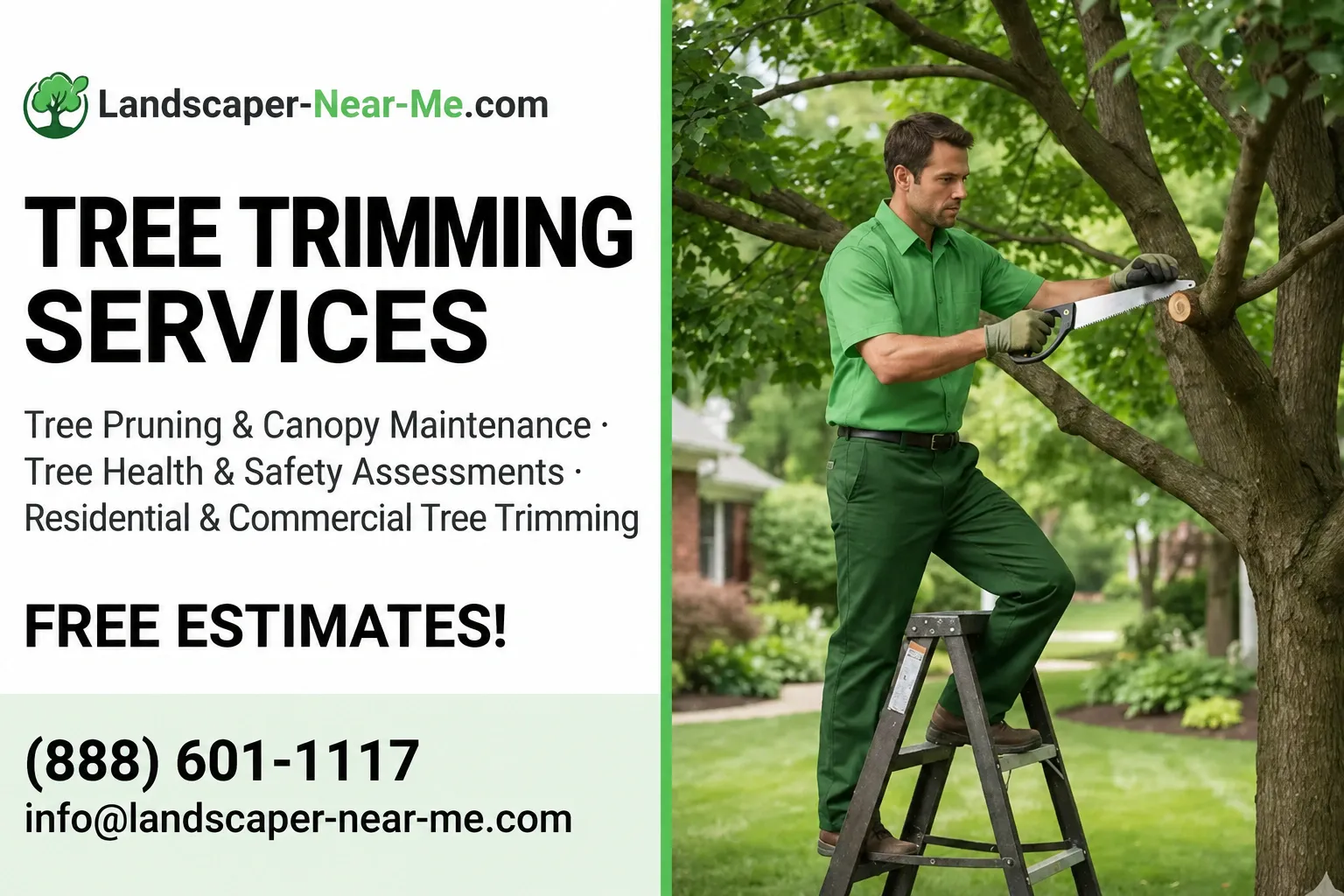
Start With a Tree Condition Walkthrough
Not sure whether your trees need work now or simply need watching? We will walk the property, assess condition and clearance, and tell you plainly what we would do and what we would leave alone. Call (888) 601-1117 or email info@landscaper-near-me.com to arrange a visit.
What Tree Trimming Services Actually Cover
Tree trimming is the ongoing work of keeping a tree healthy, structurally sound, and suited to the space it grows in. It is broader than any single task. On a typical property, our tree trimming services include tree condition assessment, tree health care, structural pruning, crown cleaning and crown thinning where warranted, dead branch removal, clearance work around buildings and walkways, tree canopy maintenance, and tree planting and establishment when a new tree is going in.
The distinction worth understanding is between tree care and tree trimming. Trimming is a task. Tree trimming is the decision-making that determines whether trimming should happen at all, how much, where, and when. A property that receives regular trimming without assessment can end up with trees that look tidy for a season and decline over a decade. A property that receives real tree maintenance services ends up with trees that need less intervention as they age, not more.
That framing changes how we look at a job. A mature ficus leaning over a driveway and a young crape myrtle in a parkway strip are two different problems with two different answers, even though both might arrive on a work order described the same way.
Our work stays within landscape tree maintenance: the health, structure, appearance, clearance, and safety of the trees on a maintained property. We are landscapers who care for trees as part of the landscape, and we are direct about the point where a tree’s condition calls for a different kind of specialist. Knowing where that line sits is part of the service.
How We Read a Tree Before We Touch It
Every engagement begins with a tree condition assessment. We would rather spend twenty minutes looking than an afternoon making cuts that cannot be undone. Pruning removes leaves, and leaves are how a tree feeds itself, so the assessment is what keeps the work proportionate to the need.
What we look at on the tree
- Vigor and foliage. Leaf size, leaf density, and shoot growth compared with what that species normally does in this climate.
- Structure. Where the main limbs attach, whether two stems are competing for the lead, and whether any attachment looks weak or included.
- Deadwood. How much dead material is in the canopy, how large it is, and where it sits relative to anything below.
- Wounds and old cuts. Previous pruning, mechanical damage from mowers or vehicles, torn bark, and how well earlier cuts have closed.
- Canopy balance. Whether growth is distributed evenly or has piled up on one side, often toward light or away from a building.
What we look at around the tree
- Root zone conditions. Compacted soil, raised or sunken grade, paving over roots, and how the tree is being watered.
- Clearance. Distance to roofs, walls, windows, signage, light fixtures, walkways, drive aisles, and parking stalls.
- What sits underneath. Turf, planting beds, irrigation heads, valve boxes, low-voltage lighting, hardscape, and site furnishings.
- Overhead conflicts. Anything above the canopy that changes how, or whether, work can be performed safely from the ground.
This combined tree health assessment and tree safety assessment gives us a defensible reason for every recommendation we make. When something is uncertain, we say so and suggest monitoring rather than guessing. A recommendation you can question is more useful than a confident one you cannot.
The Signals That Tell You a Tree Needs Attention
Property owners and managers usually notice something before we do, because they see the tree every day. These are the observations worth calling us about.
- Declining vigor. Smaller leaves, thinner canopy, early leaf drop, or noticeably less new growth than the same tree produced a year or two ago.
- Accumulating deadwood. A few dead twigs are normal. Dead branches of any size, especially over a walkway, patio, or parking area, are worth an assessment.
- Broken or hanging limbs. Anything that has failed but has not fallen, particularly after wind.
- Poorly distributed growth. Long, heavy, unsupported limbs reaching well past the rest of the canopy, or dense growth concentrated at the ends of branches.
- Rapid sprouting from the trunk or major limbs. A flush of vertical shoots from old wood often follows heavy pruning or stress and is a signal, not a cosmetic problem.
- Clearance conflicts. Branches contacting a roof or wall, blocking a sign or light, forcing pedestrians off a walkway, or scraping delivery vehicles.
- Visible structural concerns. Splits, cracks, cavities, bark separating from the wood, mushrooms at the base, or a lean that appears to have changed.
- Root zone changes. Recent trenching, grading, paving, or heavy equipment traffic near the tree, which can affect a tree long before the canopy shows it.
None of these automatically means work is required. Several of them mean the tree should be looked at before the next round of routine maintenance, which is a very different and much less expensive conversation.
Put Your Property's Trees on a Maintenance Plan
Ongoing tree maintenance costs less than repeated corrective work. We will map the trees on your site, note what each one needs, and schedule the work when the trees actually call for it. Reach us at (888) 601-1117 or info@landscaper-near-me.com to talk it through.
Pruning Decisions: Structure, Clearance, and Restraint
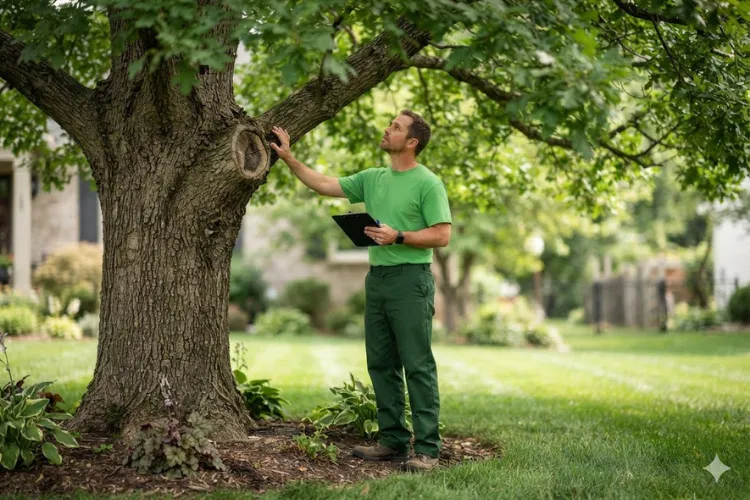
Tree pruning is where tree care becomes visible, and it is also where the most damage gets done. The underlying principle is straightforward: pruning slows growth. Removing foliage removes the tree’s ability to produce and store energy, so the more that comes off, the less the tree has to work with. That is why our default is to remove the least amount that accomplishes the goal.
The kinds of pruning we plan for
- Structural pruning. Guiding a young or developing tree toward one dominant leader and well-spaced, well-attached limbs. This is the highest-value work we do, and it is nearly invisible when done well.
- Crown cleaning. Removing dead, broken, and clearly damaged branches without reducing the healthy canopy.
- Crown thinning. Selectively removing branches to improve light and air movement through a dense canopy. Used sparingly, and never as a routine annual habit.
- Clearance pruning. Raising or shortening specific limbs to resolve a conflict with a building, walkway, drive aisle, sign, or light.
- Dead branch removal. Targeted work driven by what the assessment found, rather than a blanket reduction of the canopy.
What we avoid, and why
We do not top trees. Cutting a canopy back to stubs does not keep a tree smaller. It triggers a dense flush of weakly attached shoots from dormant buds, and those shoots grow back quickly and poorly, which means more work and worse structure every cycle. We also make cuts outside the branch collar rather than flush to the trunk, because the collar is the tissue the tree uses to close the wound, and we do not use pruning paints or wound sealers, which research has not shown to help. Readers who want the horticultural background can review the University of California Cooperative Extension explanation of how trees and shrubs respond to pruning, which covers plant response, cut placement, and wound closure in detail.
Tree trimming and pruning is one component of this page’s broader subject. If your immediate need is scheduled trimming on trees that are already in good condition and on a known maintenance cycle, our Tree Trimming Services page covers that narrower work directly. If you are not sure which you need, the assessment answers the question.
Young Trees and Mature Trees Are Different Jobs
The same property often contains both, and treating them the same way is a common and expensive mistake.
Tree planting and establishment
A newly planted tree is not a small mature tree. Its priority for the first several years is root growth, which is why heavy pruning at planting is no longer standard practice; removing foliage at that stage slows the root development the tree needs to survive. Our work on new trees focuses on planting depth, an appropriate root zone, staking only when the tree genuinely cannot stand on its own and removing it as soon as it can, consistent watering during establishment, and light structural pruning as the tree begins to grow. Small decisions made in the first five years determine how much pruning that tree needs for the next fifty.
Mature tree trimming
A mature tree that was selected well, planted well, and trained well should need relatively little. Mature tree trimming is mostly inspection, deadwood management, occasional clearance, and protection of the root zone. The temptation with large trees is to do something visible during every maintenance visit. Resisting that is often the most valuable service we provide, because a mature canopy that took forty years to grow cannot be restored on a maintenance schedule.
Tree preservation, in practice, is usually about what does not happen: not over-pruning, not paving the root zone, not trenching through roots for an irrigation repair, not letting a mower strike the trunk every week. Those are the things that quietly shorten a tree’s life on a maintained property.
Protecting What Grows and Sits Beneath the Tree
Tree work happens above a landscape that someone paid for. Limbs, chips, and equipment all land somewhere, and the condition of the property after the crew leaves is part of the job, not an afterthought.
Before work begins we identify irrigation heads, valve boxes, drip tubing, and low-voltage lighting in the drop zone, along with any hardscape, planters, furnishings, or utility fixtures that need protection. Cuts are planned so that limbs come down where we intend rather than where gravity prefers. On turf, we manage the weight and traffic that cause rutting and compaction. In planting beds, we work around established material rather than through it.
Because we also handle Landscape Services, Irrigation Services, and Sod Care on many of the same properties, we tend to notice the downstream effects that a tree-only crew would not: a rotor that has been blocked by a low limb for two seasons, a bed that stopped filling in because the canopy closed over it, or turf thinning under a tree that is now casting far more shade than it did when the lawn went in. Those observations often matter more to the property than the pruning itself.
After the work, debris is cleared, hard surfaces are blown clean, and we walk the area with you if you are on site. If we damaged something, we tell you.
Request a Free Estimate for Tree Trimming Services
Estimates are free and based on what we see on your property, not on a generic price sheet. Tell us what prompted the call and we will schedule an assessment. Phone (888) 601-1117, email info@landscaper-near-me.com, or request a callback below.
Tree Care for Commercial Properties, HOAs, and Multi-Tenant Sites
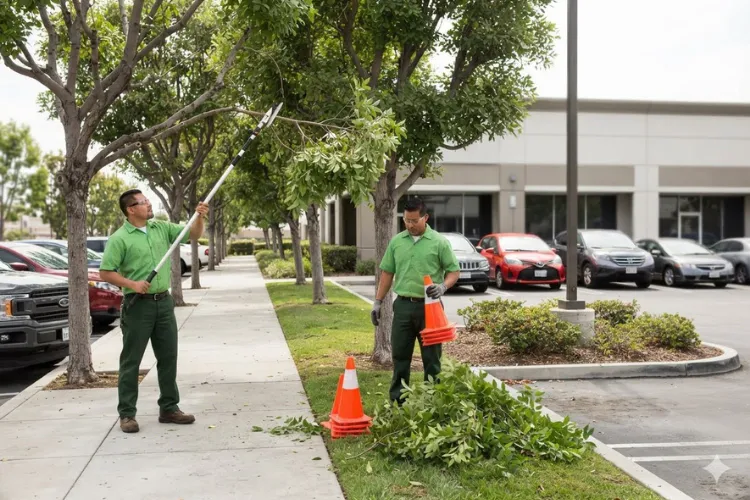
Commercial tree care carries obligations that residential work does not. Tenants, customers, delivery drivers, and residents move through the property all day, and the trees are part of how the site presents itself to every one of them.
What changes on a commercial property
- Pedestrian and vehicle clearance. Walkways, entries, drive aisles, and loading areas need consistent, maintained clearance rather than occasional correction.
- Visibility. Monument signs, building signage, wayfinding, security cameras, and pole lighting all lose their function when a canopy grows into them.
- Parking areas. Canopy trees over stalls provide the shade tenants value, and they also drop material onto vehicles. That balance is a maintenance decision, not a design flaw.
- Scheduling. Work often has to happen outside business hours, around tenant operations, or in phases so that a portion of the lot stays usable.
- Consistency across the site. On multi-building and multi-property portfolios, trees should be maintained to one standard rather than whichever crew reached them last.
For property managers, facility managers, and HOA boards, the practical value of tree trimming for commercial properties is documentation and predictability. We tell you what we saw, what we did, what we deliberately left alone, and what we expect to revisit. That gives you something to put in front of an owner or a board, and it makes the following year’s budget a projection instead of a guess. Where trees sit inside a larger maintenance program, this work coordinates with Commercial Landscape Services and Commercial Lawn Care Services on the same site.
Building a Preventive Tree Maintenance Rhythm
Preventive tree maintenance is not a fixed calendar. Species, age, location, irrigation, and how the tree has been treated in the past all change what it needs and how often. We are skeptical of anyone who quotes a rigid interval for tree work before looking at the trees.
What we recommend instead is a rhythm built around observation. Trees on the property are looked at during regular landscape maintenance visits. Anything that changes gets noted. Work is scheduled when the assessment supports it, not because a date arrived.
Seasonal tree trimming in Southern California
Our climate gives more flexibility than colder regions. Many of the evergreen and short-season deciduous trees common here can be worked on across a wide window without harming the tree. Deciduous trees are generally best pruned during dormancy, when structure is visible and the tree is not actively growing. Timing also shifts with the goal: pruning after a growth flush has a stronger growth-limiting effect than dormant pruning, which is useful when a tree needs to be held back from a structure. Clearance and deadwood work, by contrast, is driven by condition rather than season.
The habit that matters most is monitoring after service. A tree that was pruned responds over the following season, and how it responds tells us whether the next round should be lighter, later, or unnecessary. That feedback loop is the difference between tree maintenance services and repeated tree cutting.
Working With Our Tree Trimming Services Team
Most conversations start the same way: something about a tree changed, or a property inspection flagged it, or a canopy finally reached a roof. From there the process is short. We look at the trees, tell you what we see, explain what we would do and what we would leave alone, and put a written estimate in front of you at no cost.
What we will not do is recommend work a tree does not need. On a fair number of visits, the honest answer is that the trees are in good shape, one limb needs clearing, and the rest should be looked at again next year. Saying that costs us a larger invoice and earns the property, which is the trade we would rather make.
If you are comparing options and searching for a tree service near me, the questions worth asking any provider are simple: Will you assess the tree before quoting? What exactly will you remove, and why? What will you leave alone? A provider who answers those clearly is worth more than a lower number on a proposal.
To get started, call Landscaper-Near-Me.com at (888) 601-1117, email info@landscaper-near-me.com, or request a callback and we will arrange a time to walk the property. Whether you manage a single home with two mature shade trees or a portfolio of commercial sites, our tree trimming services are built to keep those trees healthy, safe, and worth what they add to the property.
FAQ's - Frequently Asked Questions
Condition drives the answer. Dead or broken limbs over an area people use, a branch contacting a roof or blocking a sign, or a noticeable change in vigor are all reasons to have the tree assessed. Slower growth, a slight lean that has not changed, or a few dead twigs in a mature canopy are usually reasons to monitor. We are comfortable telling you that the right action this year is no action, and we say it often.
Our climate is more forgiving than most. Many evergreen and short-season deciduous trees here can be pruned across a wide window without harm. Deciduous trees are generally best pruned while dormant, when the structure is visible. Timing also depends on the goal, since pruning after a growth flush restrains growth more than dormant pruning does. Removing dead or damaged limbs is driven by condition rather than by season.
Less than most people expect. Leaves are how a tree produces and stores energy, so every branch removed reduces what the tree has to work with, and heavy removal can visibly stunt a tree or trigger a dense flush of weak regrowth. We plan the smallest amount of removal that achieves the goal and stage larger work across more than one visit when a tree needs it. We do not commit to a fixed percentage before assessing the specific tree.
No. Cutting a canopy back to stubs removes the tree’s leaf area and stimulates dormant buds along the remaining wood, which produces a burst of fast, weakly attached shoots. The tree returns to height quickly with worse structure than it had, and it needs more work each cycle. Where a tree genuinely does not fit its space, we look at clearance pruning, selective reduction to a suitable lateral, or a candid conversation about whether the right tree is in the right place.
Not as a routine practice. Trees do not heal wounds the way animals do; they compartmentalize them and grow wound wood over the cut from tissue at the branch collar. Sealers and pruning paints have not been shown to improve that process. What does help is a properly placed cut just outside the branch collar, made with sharp tools, and a three-part cut on larger limbs so the bark does not tear.
Tree care is the broader program: assessment, health, structure, clearance, planting and establishment, preservation, and the decision about whether any cutting should happen. Tree trimming is one task inside that program. If you already know the trees are healthy and want them maintained on a cycle, trimming may be all you need. If something has changed, or you are not sure what the trees need, start with tree care and let the assessment decide.
It should not, and preventing it is part of the plan. Before work begins we locate irrigation heads, valve boxes, drip lines, lighting, and anything else in the drop zone, and we plan cuts so limbs land where we intend. We manage equipment traffic to avoid rutting and compaction on turf and work around established plant material in beds. Debris is cleared and hard surfaces are blown clean before we leave. If something does get damaged, we tell you rather than waiting for you to find it.
Yes. We work with property managers, facility managers, HOA boards, and community managers across office, retail, industrial, multifamily, institutional, and mixed-use properties. Commercial work usually adds requirements around pedestrian and vehicle clearance, sign and lighting visibility, scheduling around tenant operations, and consistent standards across multiple buildings or sites. We provide written notes on what we observed, what we performed, and what we expect to revisit, so the information is usable at an owner or board level.