Commercial Landscaping Los Angeles for Office,
Retail, Industrial, Multifamily, and HOA Properties
Commercial Landscaping Los Angeles services exist to solve a specific problem: a commercial property has landscaped areas that tenants, customers, employees, and visitors see every day, and those areas either strengthen the impression the property makes or quietly work against it. Landscaper-Near-Me.com provides commercial landscape installation, landscape improvements, and recurring landscape maintenance for office, retail, industrial, warehouse, multifamily, HOA, institutional, hospitality, and mixed-use properties in Los Angeles. This page explains what commercial landscaping in Los Angeles involves, how we evaluate a property before recommending work, which problems we see most often, and how irrigation, trees, hardscape, and water-use considerations fit into a sound commercial landscape program.
If you manage a property and would rather talk through a specific site than read, call us at (888) 601-1117 or email info@landscaper-near-me.com. Otherwise, the sections below are organized around the questions property and facility managers ask us most.
What Does Commercial Landscaping in Los Angeles Include?
Commercial landscaping covers three related kinds of work: assessing and planning what a commercial property’s landscape should be, installing or improving landscape features, and maintaining those features on a recurring schedule. On most Los Angeles commercial properties all three overlap. A retail center may need a planting-bed renovation at the main entrance, an irrigation repair in the parking-lot islands, and a mowing and pruning program that keeps everything presentable between projects.
Our commercial landscape services in Los Angeles include:
- Landscape assessment and planning for entrances, common areas, parking-lot landscaping, walkways, and perimeter plantings.
- Commercial landscape installation and improvement projects, including planting beds, shrubs, groundcover, turf and sod, and landscape-related hardscape such as walkways, pavers, edging, and retaining walls.
- Recurring commercial landscape maintenance: mowing, edging, pruning, weed control, seasonal cleanup, mulch, and general grounds care.
- Commercial lawn care and turf management.
- Irrigation inspection, maintenance, and repair.
- Tree care and professional tree trimming where trees are part of the property’s landscape.
Our Commercial Landscape Services page describes our commercial capabilities across the full service territory. This page focuses on how those services apply to commercial properties in Los Angeles specifically.
Which Los Angeles Commercial Properties Do We Serve?
We work with commercial property owners and the people who manage properties on their behalf: property managers, facility managers, HOA and community association managers, and on-site staff. Property types include office and professional buildings, retail centers and shopping properties, industrial buildings, warehouses and distribution facilities, apartment and multifamily communities, HOA common areas, institutional properties, hospitality properties, and mixed-use developments. Each of these has a different relationship with its landscape, and we cover several of those differences below.
Why Does a Commercial Property Need a Different Landscaping Approach Than a Home?
Commercial landscaping in Los Angeles is not residential landscaping done at a larger scale. The priorities are different, and a commercial landscaper in Los Angeles who does not recognize that will produce results that look fine in a photograph and fail the property in practice.
The main differences we plan around:
- Appearance is continuous, not occasional. A homeowner can let a lawn go for a couple of weeks. A retail center, an office lobby entrance, or an apartment leasing office is judged every business day, so a commercial landscape maintenance program has to hold a consistent standard rather than peak for one event.
- Access and sightlines matter. Shrubs that block a monument sign, groundcover that creeps onto a walkway, or tree limbs hanging over a drive aisle are appearance issues on a residential lot and access issues on a commercial one. We keep entrances, walkways, parking-lot landscaping, and signage clear as a standing priority.
- Scheduling has to respect operations. Mowing during peak customer hours at a shopping center, blowing debris near an outdoor dining patio, or running loud equipment beside an occupied office window creates complaints. Commercial grounds maintenance in Los Angeles works best when service windows are set around how the property is actually used.
- Someone has to answer to owners, boards, or tenants. Property managers and HOA managers need a landscaping company that documents what was done, flags problems before a board member or tenant does, and gives clear recommendations rather than surprises.
- Scale changes the math. On a large property, a small irrigation inefficiency or an uncorrected turf problem is repeated across many zones, so early diagnosis matters more than it would on a single yard.
Our approach to commercial property landscaping in Los Angeles starts from these priorities rather than from a generic maintenance checklist adapted from residential work.
How Do We Evaluate a Los Angeles Commercial Property Before Recommending Work?
Before we quote an installation project or propose a maintenance scope, we walk the property. A commercial landscape contractor in Los Angeles who prices from an aerial photo or a square-footage number alone is guessing, and the guess usually shows up later as change orders or as a maintenance schedule that does not match the site.
What We Look At During a Commercial Landscape Assessment
- Turf condition: thin or bare areas, compaction in high-traffic zones, weed pressure, mowing height history, and whether the turf type suits its exposure and use.
- Planting beds: plant health, overgrowth, bare spots, mulch depth, weed infiltration, and whether plants are appropriate for the bed’s sun, shade, and irrigation.
- Irrigation: controller programming, coverage, broken or misaligned heads, leaks, drip-line condition, runoff onto pavement, and overspray onto buildings or windows.
- Trees: clearance over walkways, drive aisles, and roofs; deadwood; crowding; and any signs of decline that call for a closer look.
- Hardscape and edges: lifted pavers, failing edging, settling walkways, and retaining-wall condition where hardscape is part of the landscaped area.
- Soil, grading, and drainage: standing water after irrigation, erosion on slopes, and spots where water runs across sidewalks or into parking areas.
- Property-use factors: entrances, tenant patios, dumpster enclosures, loading areas, and other places where landscape and daily operations meet.
What You Receive After the Assessment
The result is a prioritized picture of the property: what needs correction now, what should be scheduled, and what belongs in a longer-range improvement plan. For a property manager, that translates into a maintenance scope that reflects the actual site and an improvement list that can be budgeted rather than reacted to. It also lets us give a free estimate that is based on the property in front of us rather than an assumption about it. Every Commercial Landscaping Los Angeles estimate we prepare starts with this walk-through.

Request a Free Commercial Landscaping Estimate for Your Los Angeles Property
Tell us about the property—office, retail, industrial, multifamily, HOA, or mixed-use—and what you want the landscape to do. We will review the site, discuss installation, improvement, or recurring maintenance needs, and prepare a free estimate based on what we actually find. Call (888) 601-1117 or email info@landscaper-near-me.com.
What Landscape Problems Do We See Most Often on Los Angeles Commercial Properties?
Most calls we receive about commercial landscaping in Los Angeles start with a visible symptom. The symptom is usually straightforward; the cause often is not. Here are the problems we encounter most, with what typically sits behind each one.
Declining or Patchy Turf
Thin turf on a commercial property is rarely just a mowing problem. Compaction along walkways where people cut corners, irrigation heads that no longer reach the edges, shade from trees that have grown since the lawn was installed, and mowing too short in summer heat all contribute. Correction can range from adjusting irrigation and mowing practices to aeration and overseeding, or to sod replacement where turf has failed outright. Our Commercial Lawn Care Services and Sod Care pages go deeper on turf recovery and establishment.
Overgrown Vegetation
Shrubs and hedges that were sized for a planting plan years ago eventually crowd walkways, cover windows, hide signage, and create dark corners near entrances. Restorative pruning can often bring plants back into scale, but some overgrown material is better removed and replaced with plants whose mature size fits the space, so the problem does not return in two seasons.
Poorly Maintained Planting Beds
Beds with thin mulch, weeds, dead plants, and exposed drip line make an entire property look neglected even when the turf is perfect. Bed restoration usually combines cleanup, plant replacement, mulch, and irrigation correction, followed by a maintenance schedule that keeps beds from sliding back.
Irrigation Issues
Broken heads spraying the parking lot, zones that run while it rains, dry pockets beside wet ones, and controllers nobody has reprogrammed in years are common on commercial sites. Irrigation problems waste water, damage plants, and on Los Angeles properties can also put the owner out of step with local water-use rules. We cover irrigation in its own section below.
Bare or Damaged Landscape Areas
Vehicle damage to parking-lot islands, foot-traffic paths worn through groundcover, and areas killed by irrigation failure leave bare soil that erodes and grows weeds. Repair means addressing the cause—adding a hardscape path where people insist on walking, or protecting an island with curbing or tougher plants—not just replanting the same thing.
Inconsistent Appearance
Often the biggest complaint from a property manager is that the property looks good some weeks and rough others. That is typically a scheduling and scope problem rather than a horticultural one, and it is addressed in the next section.
How Often Should a Commercial Property in Los Angeles Be Serviced?
There is no universal schedule for commercial landscape maintenance in Los Angeles, and we are cautious of any landscaper who offers one without seeing the property. The right frequency depends on what is on the site, how visible it is, the season, and the scope of services included.
Factors That Drive Maintenance Frequency
- Turf area and growth rate: irrigated turf grows quickly through the warm months and slows in winter, so mowing frequency for commercial lawn care in Los Angeles typically changes with the season rather than staying fixed year-round.
- Visibility and use: a hotel entrance or retail storefront generally warrants closer attention than a rear service yard at a warehouse.
- Landscape features present: extensive planting beds, hedges, and groundcover need pruning, weeding, and mulch attention that a turf-only property does not.
- Trees: leaf drop, fruit, and limb clearance add seasonal work.
- Irrigation complexity: larger or older systems benefit from more frequent inspection.
- Property standards: an HOA with a documented appearance standard or a Class A office building has different expectations than an industrial property whose priority is clean, safe, and controlled.
What a Commercial Maintenance Scope Usually Includes
For most properties, a recurring commercial grounds maintenance program combines mowing and edging, shrub and hedge pruning, bed weeding, seasonal cleanup, mulch replenishment as needed, irrigation checks, and clearing of debris from walkways and entrances. Landscape maintenance for commercial properties in Los Angeles should also include a process for reporting problems—an irrigation leak, a declining tree, vehicle damage to a bed—so small issues are handled before they become budget items. We build the scope to the property, then adjust it as the site changes over time.
How Do Irrigation and Water-Use Rules Affect Commercial Landscaping in Los Angeles?
Irrigation is where commercial landscaping in Los Angeles differs most from landscaping in wetter regions. Southern California’s long dry season means nearly every landscaped commercial property depends on irrigation, and water-use rules add a compliance layer that property managers are responsible for. We discuss the specifics in broadly supportable terms here and recommend confirming current requirements with your property’s water provider.
Water-Use Rules and Watering Schedules
Properties served by the Los Angeles Department of Water and Power fall under the City of Los Angeles water conservation ordinance, which sets rules such as permitted sprinkler watering days, restrictions on watering during midday hours, and prohibitions on runoff onto sidewalks and streets. The current details are published on the LADWP water conservation ordinance page, and the phase in effect can change with regional water conditions. Commercial properties in the Los Angeles area served by other water agencies should verify their own agency’s current rules. We program and adjust irrigation schedules to fit the rules that apply to your property rather than assuming one schedule works everywhere.
Irrigation Inspection, Maintenance, and Repair
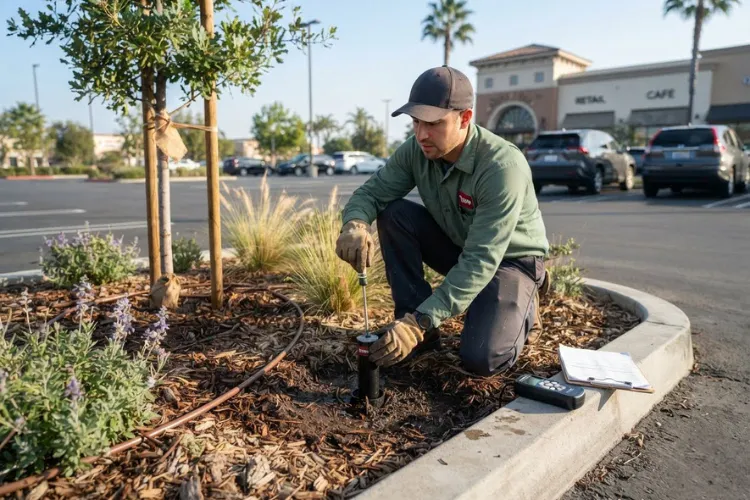
Our commercial irrigation services in Los Angeles begin with a system inspection: controller settings, valve operation, head coverage and alignment, pressure, drip-line condition, and evidence of leaks or runoff. Common repairs include replacing damaged heads and nozzles, repairing lateral leaks, correcting overspray onto pavement or buildings, and reprogramming controllers by season. Where a property is ready for improvement, converting planting beds from spray to drip and updating controllers can reduce water use and improve plant health, though actual savings depend on the existing system and how it was being run. Details on system work are on our Irrigation Services page.
Water Management as Part of Maintenance
The most effective water management on a commercial property is routine: checking the system during regular maintenance visits, adjusting run times as seasons change, and repairing problems promptly instead of at the next annual inspection. On a large property, that routine attention is usually the single biggest factor in both plant health and water cost.
Commercial Landscape Maintenance Built Around Your Los Angeles Property
Inconsistent appearance, declining turf, and irrigation problems are usually scheduling and scope issues rather than bad luck. We set up recurring maintenance based on how your property is used, what is planted, and the season, then adjust as the site changes. Request a callback to discuss a maintenance program that fits your property.
When Do Trees and Hardscape Belong in a Commercial Landscape Project?
Trees and hardscape are supporting elements of commercial landscaping rather than separate subjects, but on many Los Angeles commercial properties they determine whether a landscape improvement actually solves the problem.
Commercial Tree Care and Trimming
Trees on commercial properties need clearance over walkways, drive aisles, parking stalls, signage, and roofs; removal of deadwood that could drop on people or vehicles; and thinning where canopies have grown dense enough to shade out turf or crowd buildings. Commercial tree care in Los Angeles also includes watching for decline, since a large tree in a parking lot is both an asset and a liability. Professional tree trimming is done to protect the tree’s structure, not just to clear the immediate problem; topping or indiscriminate cutting creates weak regrowth and long-term hazards. Certain tree species and sizes within the City of Los Angeles are protected by local ordinance, and removal or significant work on those trees can require approval, so we recommend verifying tree-protection requirements with the appropriate city department before any removal is planned. Our Tree Care Services and Tree Trimming Services pages describe this work in more depth.
Hardscape as a Landscape Solution
Commercial hardscape services in Los Angeles come into a landscaping project when a plant-only fix keeps failing. Typical examples: a paver or concrete path where foot traffic has worn a trail through turf or groundcover; edging that keeps mulch and soil out of a walkway; a low retaining wall that stabilizes a slope losing soil into a parking lot; or an expanded entrance plaza that replaces a bed nobody could keep looking good. Hardscape also reduces the area that needs irrigation and routine maintenance, which matters on a large property. When hardscape is part of a landscape improvement, we look at drainage, grading, and how water will move across the finished surface before selecting materials. See Hardscape Services for the range of hardscape work we perform.
How Do We Plan a Commercial Landscape Installation or Improvement in Los Angeles?
A commercial landscape installation in Los Angeles—whether a full renovation or improvements to a few key areas—goes better when the planning is done before anything is dug. Here is how we approach it.
Define What the Landscape Is Supposed to Do
The starting question is not “what should we plant” but “what does this property need from its landscape.” Answers we hear from Los Angeles property managers include: make the entrance more visible from the street, reduce complaints about a tired common area, lower irrigation costs, stop erosion along a slope, or bring a leasing area up to the standard of competing properties. Those goals shape every later decision.
Select Plants, Turf, and Materials for the Site
Plant selection for commercial landscape improvements in Los Angeles is driven by sun and shade exposure, soil, irrigation type, mature size, maintenance demand, and how the area is used. Low-water and drought-tolerant plants are a sensible default for much of the region’s climate, but the right plant is the one that fits the specific location and can be maintained to the property’s standard. Where turf is appropriate—a play area at a multifamily community, a lawn at an office campus—sod installation gives an established look faster than seeding and is easier to keep uniform on a commercial site, provided the soil is prepared, irrigation is confirmed, and the establishment period is managed—commercial sod care in Los Angeles is largely a matter of irrigation discipline and traffic control during the first weeks. Where turf is not serving a purpose, converting it to planted beds, groundcover, or hardscape often improves both appearance and water use.
Address Soil, Grading, and Drainage First
Compacted soil, poor grading, and drainage problems undermine new plantings and turf regardless of plant quality. Correcting them during installation is far less costly than correcting them afterward, and it is the step most often skipped when a project is priced without a site visit.
Phase Work Around an Occupied Property
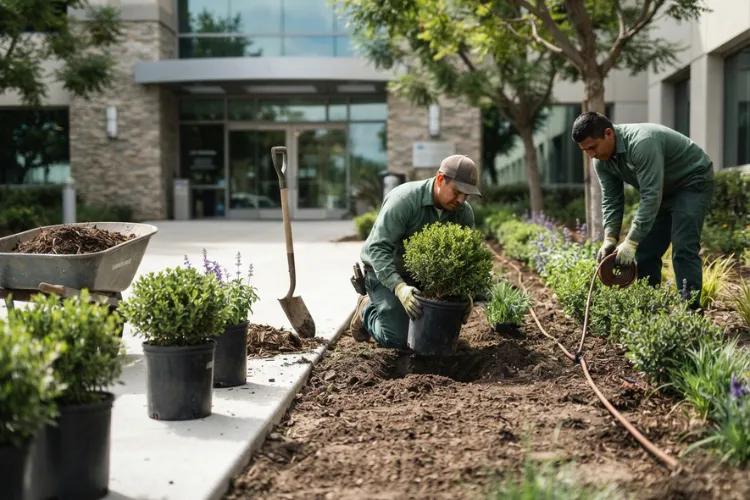
Commercial installations happen on properties that stay open. We plan sequencing, access, staging, and service windows so tenants, customers, and employees can keep using the property, and we coordinate with property management on timing that avoids peak periods.
Verify Requirements Before Work Begins
Depending on the project’s scope and location, municipal permitting, water-efficient landscape requirements, or tree-protection rules may apply. These vary by jurisdiction and change over time, so we recommend confirming applicable requirements with the relevant city or agency as part of project planning. Our broader Landscape Services page describes the design, installation, and renovation work that feeds into commercial projects.
How Do You Choose a Commercial Landscaping Company in Los Angeles?
Property managers comparing proposals from more than one commercial landscaping company in Los Angeles usually find that the proposals look similar on paper. The differences show up in questions like these:
- Did they walk the property before pricing it, and does the proposal reflect what is actually there?
- Is the maintenance scope specific about what is included, how often, and how seasonal changes are handled?
- How are irrigation problems, tree concerns, and landscape damage reported to you, and how quickly are they addressed?
- Can the same company handle lawn care, irrigation, tree trimming, hardscape, and sod work, or will you be coordinating several vendors?
- Do they understand commercial priorities—access, sightlines, scheduling around operations, and accountability to owners and boards?
We work as a single commercial landscaper for the properties we serve, coordinating installation, improvement, and maintenance so the property manager has one point of contact and one accountable company. Landscaper-Near-Me.com serves commercial properties across an established territory in Southeast Los Angeles County and Orange County; our full range of residential and commercial services is described on our landscaper near me home page.
Related Commercial Landscaping Service Areas
Property managers with portfolios that extend beyond Los Angeles can review our location-specific commercial pages, including Commercial Landscaping Newport Beach, Commercial Landscapers Anaheim, CA, Commercial Landscapers Santa Fe Springs CA, and Commercial Landscapers Cerritos CA.
Getting Started
If you are responsible for a commercial property in Los Angeles and the landscape is not doing what it should—whether that means a neglected entrance, turf that keeps declining, an irrigation system that needs attention, or a property that simply needs a dependable maintenance program—we would like to look at it with you. Call (888) 601-1117, email info@landscaper-near-me.com, or request a callback and a free estimate. We will walk the property, tell you what we see, and recommend commercial landscaping in Los Angeles that fits the site, the budget, and the standard the property needs to hold.
Ready to Discuss Commercial Landscaping for Your Los Angeles Property?
You have seen how we assess a commercial property, what we look for, and how we approach installation, irrigation, trees, hardscape, and ongoing maintenance. The next step is a conversation about your site. Call (888) 601-1117, email info@landscaper-near-me.com, or request a callback and we will schedule a walk-through and a free estimate.
The frequently asked questions below address additional details property and facility managers often raise about commercial landscaping in Los Angeles. If your question is not covered, we are glad to answer it directly at (888) 601-1117 or info@landscaper-near-me.com.
FAQ's - Frequently Asked Questions
Yes. We handle stand-alone commercial landscape installation and improvement projects, recurring landscape maintenance programs, and combinations of the two. Many Los Angeles property managers start with a specific project, such as an entrance renovation or an irrigation repair, and then move to a maintenance program once the property is in the condition they want to hold.
In most cases, yes. During the property assessment we ask how the property is used—when customers arrive, when tenants are present, where outdoor seating or entrances are busiest—and set service windows around those patterns. The exact schedule depends on the property and the scope of work, so we confirm it with you before service begins.
A typical agreement defines the areas covered, the services included (mowing, edging, pruning, bed care, cleanup, irrigation checks, and so on), how service frequency changes with the season, and how problems such as irrigation leaks or plant losses are reported and handled. The specifics are built for each property rather than copied from a standard form, and we review them with the property manager before anything is signed.
We program and adjust irrigation schedules to comply with the rules that apply to your property. Properties served by LADWP fall under the City of Los Angeles water conservation ordinance; properties served by other water agencies follow their own agency’s rules. Because these rules can change with water-supply conditions, we recommend the property owner or manager also confirm current requirements directly with the water provider.
Yes. HOA common areas, apartment and multifamily communities, office buildings, retail centers, industrial and warehouse properties, institutional properties, hospitality properties, and mixed-use developments are all part of our commercial landscaping work in Los Angeles. Each type has different priorities, and we plan maintenance and improvements around them.
Tree trimming for clearance, safety, and appearance is a normal part of our commercial landscaping services in Los Angeles. Tree removal is handled case by case. Some trees within the City of Los Angeles are protected by local ordinance, and removal or major work on those trees may require approval, so we recommend verifying tree-protection requirements with the appropriate city department before removal is scheduled.
Properties on a recurring maintenance program can report problems to us directly, and we prioritize items that waste water or create a safety concern, such as an active irrigation leak or a broken head spraying a walkway. Response timing depends on the nature of the problem and our service schedule, and we discuss the reporting process with you when the maintenance program is set up.
No. Estimates for commercial landscaping in Los Angeles are free. We walk the property, discuss what you want the landscape to accomplish, and prepare an estimate for the installation, improvement, or maintenance work involved. Call (888) 601-1117, email info@landscaper-near-me.com, or request a callback through our website to arrange it.