What is Hardscaping Services?
A Property Owner’s Guide to Hardscape Design and Installation
isAsk several property owners what is hardscaping services and the answers rarely match. One pictures a paver patio behind the house. Another thinks of the retaining wall holding a slope in place beside the driveway. A property manager usually thinks first of the walkways that carry foot traffic across a commercial site every day of the year. Every one of those answers is partly right.
So what is hardscaping services, exactly? They are the planning, site preparation, and installation of the permanent, non-living parts of a landscape: patios, walkways, driveways, steps, retaining walls, edging, and similar structures built from concrete, pavers, natural stone, brick, and gravel. If a landscape were a room, hardscaping would build the floor, the walls, and the routes between them. Planting, turf, and irrigation furnish what sits inside.
We wrote this guide for homeowners, commercial property owners, HOA and community association boards, and property managers who are weighing an outdoor improvement and want a clear picture of the work before they request estimates. It covers what hardscaping is, what a professional service actually includes, the features and materials involved, why preparation and drainage carry so much weight, and how to think through a project on your own property.
What Is Hardscaping Services?
Hardscaping services are the professional design and installation of a landscape’s built elements — the surfaces and structures that do not grow. That single distinction is the clearest way to explain what is hardscaping and what is not. Everything living in a landscape, from turf and ground cover to shrubs and shade trees, is the softscape. Everything permanent and constructed is the hardscape.
The two halves lean on each other. A planting bed without an edge slowly migrates into the lawn. A lawn without a defined path develops a worn dirt track wherever people actually walk. Slopes without structure shed soil onto the surfaces below them. Hardscaping gives a property its organization: where people walk, where they gather, where water goes, and where one use of the yard ends and the next begins.
Outdoor hardscape features generally fall into a handful of categories:
- Patios and other outdoor living surfaces
- Walkways, pathways, and entry landings
- Driveways, parking pads, and service access surfaces
- Steps, stairs, and other grade transitions
- Retaining walls, seat walls, and low garden walls
- Edging and borders that separate lawn, bed, and paved surface
- Gravel and decomposed granite areas, plus the drainage features tied to all of the above
What separates professional hardscape services from a weekend project is mostly invisible once the job is finished. The visible material — the paver, the slab, the stone — is the last thing installed and often the smallest share of the labor. Excavation, compaction, base depth, slope, and edge restraint determine whether that surface still looks straight and sits flat several years later.
What Does a Hardscaping Service Include From First Visit to Final Cleanup?
Scope varies with the project, but the sequence is consistent. A walkway replacement and a full backyard renovation move through the same stages; one simply takes longer and involves more decisions along the way.
Site Assessment and Hardscape Design
Work begins with a visit to the property. We look at how the space is used now, where water travels during heavy rain, how the grade falls, what condition existing surfaces are in, and what access a crew and its equipment will have to the work area. Measurements and elevations follow. Hardscape design then turns that information into a plan: the shape and size of the surface, the material and pattern, whether steps or a wall are needed to manage a change in grade, and how the new construction will meet existing structures, driveways, turf, and planting beds.
Site Preparation and Installation
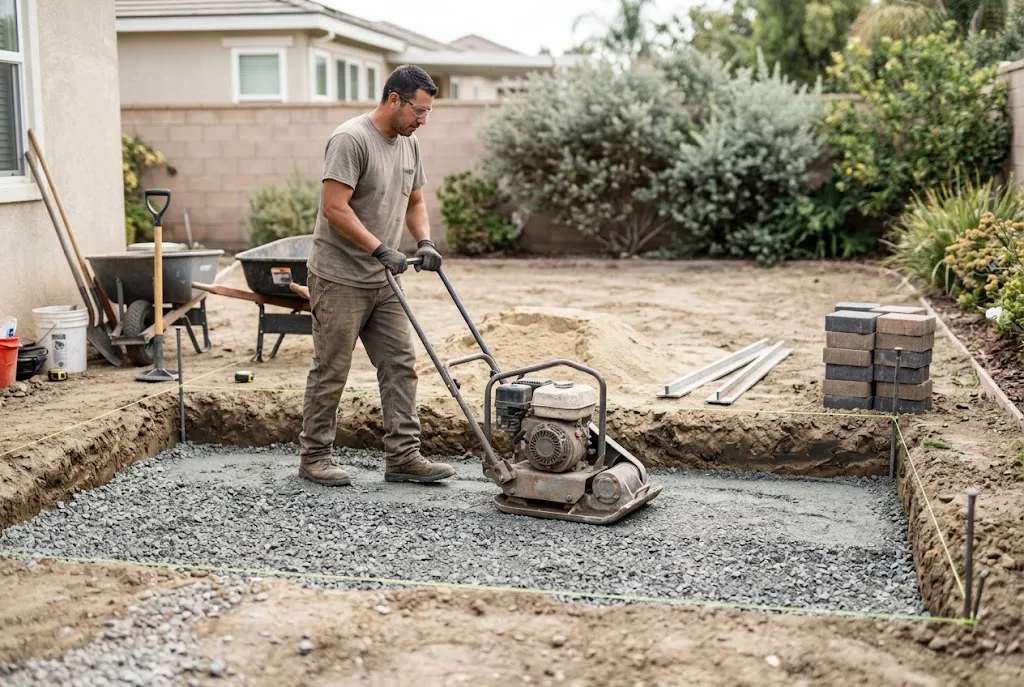
Preparation accounts for more labor than most property owners expect. Existing surfaces come out, the area is excavated to the depth the design calls for, and the subgrade is shaped and compacted. Aggregate base goes in next, placed in lifts, with each lift compacted before the next is added. Only then does the visible material arrive: pavers set on a screeded bedding course, formed and poured concrete, stone laid on the prepared base, or block courses stacked and backfilled for a wall.
Finishing and Cleanup
Finishing is where a hardscape installation either locks together or begins to loosen. Edge restraint secures the perimeter of a paver surface so units cannot creep outward under traffic. Joint sand is swept in and the surface compacted again. Concrete is jointed and allowed to cure. Walls are backfilled with drainage aggregate and capped. Then the site is cleaned, surplus material hauled off, and any turf or bed damaged by equipment traffic repaired. Our Hardscape Services page lists the specific installations our crews perform.
Types of Hardscaping: The Features Property Owners Ask About Most
The types of hardscaping on a given property range from a single entry landing to an entire circulation plan tying a building, a parking area, and several outdoor spaces together. A few features come up in nearly every conversation.
Patios and Outdoor Living Surfaces
Paver patios are the request we hear most often from homeowners, usually because an existing slab has cracked, sits too low, or was never large enough for the way the family uses the yard. Size is driven by furniture and circulation more than by square footage on a plan; a dining table with chairs pulled out needs considerably more room than the table itself. Poured and stamped concrete, natural stone, and concrete pavers all work here, and paver patio installation has the practical advantage that individual units can be lifted and reset later if a utility repair or a settled area requires it.
Walkways, Paths, and Entry Landings
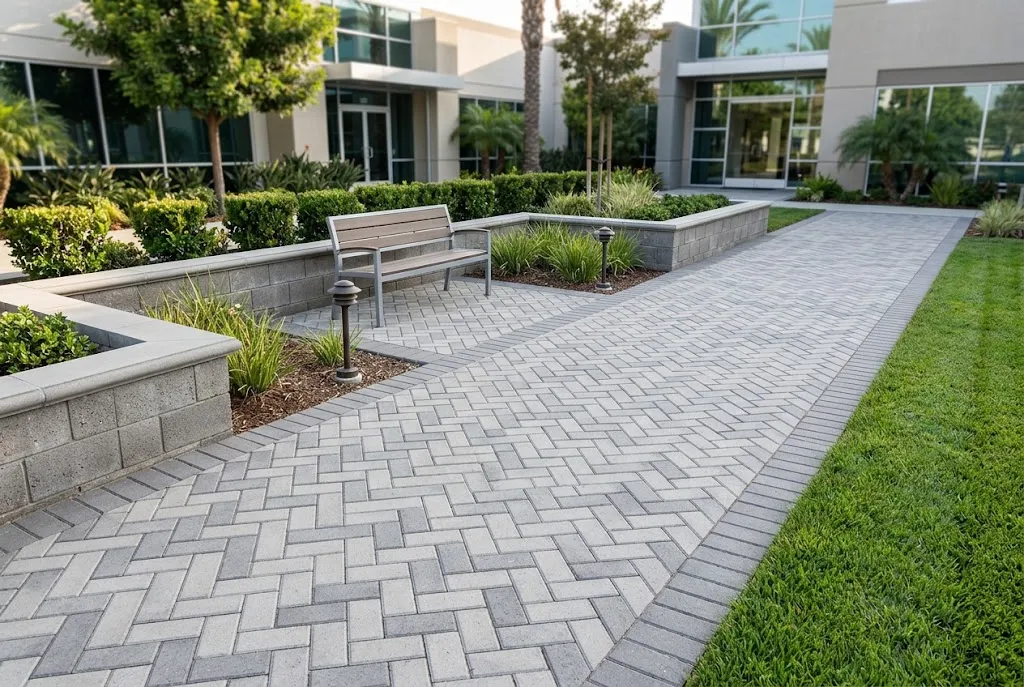
Hardscape walkways solve circulation problems that landscaping alone cannot. Primary entry walks are commonly built around four feet wide so two people can pass comfortably, while secondary garden paths are often narrower. The route matters as much as the material: a path that ignores where people actually walk gets bypassed, and the shortcut shows up in the turf within a season. Hardscape walkway installation also gives us a chance to correct trip hazards, uneven joints, and standing water that built up around an older surface.
Retaining Walls and Grade Changes
Retaining walls hold soil in place where a grade would otherwise slide, erode, or waste usable area. Segmental concrete block, poured concrete, and natural stone are all common. Height changes the job substantially: low garden walls are largely a landscape element, while taller structures involve engineered design, reinforcement, and permitting in many jurisdictions. Behind every wall, drainage aggregate and an outlet matter more than the face material, because water trapped behind a wall is the most common reason retaining wall installation fails over time. Steps and seat walls frequently accompany a wall and turn an awkward slope into level, usable space.
Driveways, Edging, and Supporting Features
Driveways and parking surfaces carry loads that patios never see, so base depth and material selection change accordingly. Smaller elements matter too. Edging holds bed lines and keeps gravel where it belongs. Decomposed granite creates an informal path at lower cost than a paved surface. Equipment pads, trash enclosure surfaces, mailbox and light pads, and column bases all fall under hardscape installation on both residential and commercial sites.
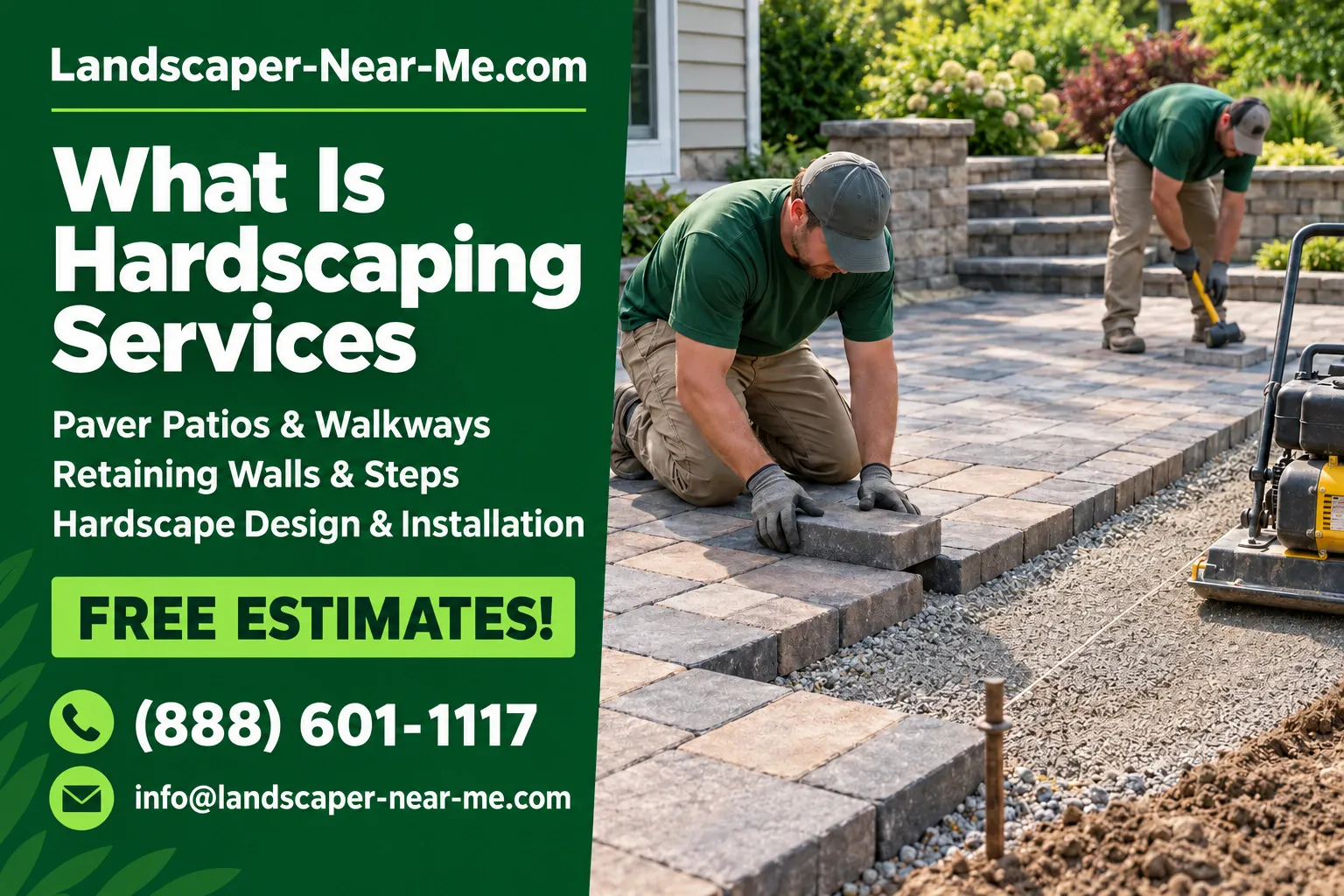
Free Estimates for Patios, Walkways, and Retaining Walls
Tell us how the space is used today and what is not working. We will walk the property, take measurements and elevations, talk through materials and layout options, and give you a free estimate for the hardscape installation you have in mind. Call (888) 601-1117 or request a callback and we will schedule a visit.
Hardscape Materials: Concrete, Pavers, Natural Stone, Brick, and Gravel
Material selection shapes appearance, cost, repairability, and the work required to keep a surface looking right. Understanding hardscape materials and their differences early in a project prevents most of the second-guessing that happens once installation is underway.
- Poured concrete. A continuous surface, economical for large areas, and available in broom, stamped, and colored finishes. Concrete hardscaping is straightforward to clean, but cracking is normal over time, and a repair is usually a visible patch or a replaced section rather than an invisible fix.
- Concrete pavers. Manufactured units set on a compacted base and bedding course, with joints filled with sand. Paver installation offers a wide range of colors, shapes, and patterns, and individual units can be lifted and reset. Joints need occasional attention, and settling shows up sooner on a poorly prepared base than on any other material.
- Natural stone. Flagstone, slate, and similar materials give stone hardscaping a character no manufactured product duplicates. Thickness and surface texture vary from piece to piece, which increases labor, and material cost is generally higher.
- Brick. Traditional appearance, small unit size, and good repairability. Brick suits classic architecture and narrow walkways well, and it is frequently combined with concrete or pavers as a border.
- Gravel and decomposed granite. The least expensive way to make an area walkable. Both need edging to stay contained and periodic replenishment, and neither works well on a steep slope or under heavy wheeled traffic.
Choosing between the two most common options deserves its own look, and we covered the comparison in detail in our article on pavers versus concrete. In short, concrete tends to win on installed cost for a plain surface, and pavers tend to win on flexibility, repair, and pattern options.
Site Preparation, Grading, and Drainage: The Part of the Job You Never See
If one section of this page deserves extra attention, it is this one. Nearly every hardscape problem we are called to look at — sunken pavers, a patio that ponds water against the house, a cracked walkway, a bulging wall — traces back to how hardscape drainage and grading affect an installation rather than to the surface material itself.
Hardscape site preparation begins with removing whatever is there and excavating to a depth appropriate for the use and the soil. The exposed subgrade is then compacted. Soft, wet, or heavily organic soils may call for additional excavation, a geotextile separation fabric, or extra base depth, and those conditions are worth identifying before a price is set rather than after a crew has started digging.
Base depth is a function of what the surface has to carry. A garden path, a dining patio, and a driveway are three different structures even when they use the same paver. Aggregate base is placed in lifts and compacted; skipping compaction to save a day is the shortcut that shows up as a low spot two winters later.
Hardscape grading controls where water goes. Paved surfaces are built with a deliberate slope so runoff moves away from foundations, doorways, and planting areas that cannot absorb it. Because a new patio or driveway replaces ground that once took in some rainfall, a hardscape project changes a property’s drainage pattern whether or not anyone plans for it. Redirecting that water responsibly may involve surface grading, a channel drain at a garage apron, a catch basin in a low area, or a subsurface line carrying water to an appropriate outlet.
Permeable systems are another option worth asking about. The U.S. Environmental Protection Agency’s overview of permeable pavements and other green infrastructure practices explains how surfaces built with pervious concrete, porous asphalt, or permeable interlocking pavers allow rainfall to soak into the layers below rather than running off. Permeable construction requires suitable soils and a properly designed aggregate reservoir, so it fits some sites and not others.
Choosing Hardscape Features and Materials for the Way a Property Is Used
Most people start with a picture of a finished patio. A more useful starting point is the list of problems the project needs to solve. Once that list exists, material and layout decisions get much easier.
We generally walk through the following with property owners:
- How the space will actually be used. Dining, cooking, foot traffic between two doors, vehicle parking, and equipment access all imply different sizes, slopes, and base depths.
- Traffic volume and load. A residential path and a commercial entry sidewalk may look alike and perform very differently over a decade.
- Appearance and architecture. Color, unit size, and texture should relate to the building and to nearby surfaces. Residential hardscape design considerations often come down to how a new surface meets an existing driveway or entry.
- Existing grades and elevations. Door thresholds, driveway aprons, irrigation heads, and established tree roots all constrain what a new surface can do.
- Maintenance tolerance. Gravel, pavers, stone, and concrete each ask for a different level of attention.
- Access for equipment and materials. A narrow side yard or a gated courtyard changes the method, the schedule, and the cost.
- Future plans. Phasing a project is common and sensible, as long as the first phase is designed with the second in mind rather than rebuilt to accommodate it.
Budget belongs in that conversation too, though not only as an installed price. A surface that can be repaired in sections, or one that needs less frequent attention, may cost more on day one and less across the years that follow.
Base Preparation and Drainage Decide How Long a Hardscape Lasts
Sunken pavers, water standing against a patio edge, and cracked walkways almost always start below the surface. We evaluate soil, grade, and drainage before a single unit is set, then build the base the site actually needs. Call (888) 601-1117 to talk through the conditions on your property.
Residential Hardscaping and Commercial Hardscaping: Where the Priorities Differ
The construction methods overlap almost completely. The decision-making does not. Residential hardscaping and commercial hardscaping answer to different people, different schedules, and different definitions of success.
On a home, the driving concerns are usually comfort, appearance, and getting more use out of the yard. Projects are frequently phased across seasons. The owner sees the work every day, so finish details, color matching, and how the new surface meets the house carry real weight.
On commercial, multifamily, retail, office, and HOA common-area properties, the emphasis shifts toward durability, safety, and predictable upkeep. Walkways see continuous foot traffic. Uneven joints and settled slabs become trip hazards and liability concerns rather than cosmetic annoyances. Accessibility requirements apply to routes of travel. Commercial hardscape installation also has to be sequenced around tenants, residents, business hours, and parking, which often means phased work, temporary routing, and clear communication with a property manager or board. Repairability matters more than on a residence, because a surface that can be opened and reset in a single afternoon keeps a site usable. We coordinate this kind of work alongside our Commercial Landscape Services so that construction and ongoing grounds care stay on the same schedule.
How Hardscape Surfaces Connect to Planting, Irrigation, and Long-Term Maintenance
A hardscape is never installed in isolation. It borders turf, beds, trees, and an irrigation system that was laid out before the new surface existed, and it changes how all of them behave.
Planting is the most immediate connection. Bed lines usually get redrawn when a patio or walkway goes in, plants too close to a new edge outgrow the space, and the soil disturbed during construction needs restoration before anything is planted back into it. Our Landscape Services team handles that transition so a finished hardscape is not framed by bare, compacted ground.
Irrigation deserves equal attention. Lines and lateral runs frequently sit exactly where excavation needs to happen, heads end up stranded in the middle of a new patio, and spray patterns that worked across an open lawn now throw water onto a wall or a walkway. Mineral-laden overspray also leaves staining on concrete, stone, and pavers. Adjusting head locations, capping abandoned runs, and reworking zones after construction is normal, and our Irrigation Services crews handle those changes as part of the project rather than leaving them for later.
Hardscape maintenance is modest but not zero. Knowing how to maintain pavers and other hardscape surfaces keeps a project looking new far longer than any product claim:
- Sweep and rinse surfaces regularly so organic debris does not break down into the joints and feed weeds.
- Replenish joint sand on paver surfaces when joints look low, which is also what keeps units interlocked.
- Address weeds and ants in joints early, before they open a path for further loss of sand.
- Clean stains promptly. Efflorescence, the white haze that can appear on new concrete and pavers, generally fades on its own and can be treated if it persists.
- Reset settled areas rather than ignoring them. On a paver surface, a low spot is usually a half-day repair; left alone, it collects water and spreads.
- Keep wall drainage outlets clear, and watch for soil washing out at the base of a slope.
- Consider sealing where a specific manufacturer’s guidance supports it, understanding that sealers change appearance and need periodic reapplication.
Planning a Hardscape Project on Your Property
By this point the answer to the original question should be clear enough to act on. Hardscaping services cover the design, preparation, and installation of the built structure of a landscape, and the quality of that structure is decided long before anyone sets the first paver.
If you are considering a project, a few steps make the process smoother. Write down what is not working now: a patio too small for the furniture, a side yard nobody uses, a slope that erodes onto the driveway, a walkway that has become uneven. Note where water collects after a storm. Take photographs, including the areas you dislike. Think about how long you plan to keep the property, since that shapes how much of the work makes sense to complete at once. And request estimates that spell out excavation depth, base material, edge treatment, and drainage, not just the surface material and a square-foot price — the differences between bids usually live in those lines.
Landscaper-Near-Me.com installs hardscape features for homeowners, commercial property owners, property managers, and community associations throughout our service territory in Southeast Los Angeles County and Orange County, including Whittier, Downey, Cerritos, Long Beach, Anaheim, Fullerton, Orange, Garden Grove, Santa Ana, Costa Mesa, Newport Beach, and Irvine. Because we also maintain landscapes, we plan hardscape work around the planting, turf, and irrigation that surround it instead of treating the two as separate projects.
When you are ready to talk it through, call us at (888) 601-1117, email info@landscaper-near-me.com, or request a callback through our website. We will walk the property, listen to how you use the space, discuss realistic options for the conditions we find, and provide a free estimate for the work you are considering.
Plan Your Hardscape Installation With an Experienced Landscaping Team
From a single walkway to a full outdoor living area, we handle hardscape design, site preparation, and installation along with the planting and irrigation work around it. Call (888) 601-1117, email info@landscaper-near-me.com, or request a callback and we will follow up to schedule a site visit.
Lorem ipsum dolor sit amet, consectetur adipiscing elit. Ut elit tellus, luctus nec ullamcorper mattis, pulvinar dapibus leo.
FAQ's - Frequently Asked Questions
Hardscaping is one part of landscaping. Landscaping covers the whole property, living and built. Hardscaping refers specifically to the permanent, non-living elements — patios, walkways, driveways, steps, retaining walls, and edging. Most projects involve both, because a new surface almost always changes the planting, turf, and irrigation around it.
It depends on size, access, and how much demolition and excavation the site needs. A modest walkway may take a few days, while a patio with a retaining wall and drainage work commonly runs one to three weeks. Weather, material availability, permitting, and utility locates can extend that, so we give a realistic schedule with the estimate rather than a fixed promise up front.
Requirements vary by city and county. Ground-level patios and walkways often do not require a permit, while retaining walls above a certain height — frequently around three or four feet, measured differently in different jurisdictions — usually do, as does work involving drainage into a public system or changes within a setback. HOA properties may also have architectural approval requirements. We identify what applies to your property before work begins.
Yes, and planning for it matters. Irrigation lines and heads often sit where excavation has to occur, and spray patterns that suited an open lawn will not suit a patio edge. We locate and protect what can stay, reroute or cap what cannot, and adjust heads and zones after installation so the surrounding landscape still gets watered correctly.
Our climate allows hardscape work through most of the year, which is one advantage of building here. Winter storms are the main scheduling factor, since saturated soil makes excavation and compaction difficult and can push a start date. Spring and fall tend to book quickly, so reaching out a few weeks ahead of when you would like the work done is helpful.
Some minor movement is normal in any surface built on soil. Significant settling almost always points to insufficient compaction, a base that was too shallow for the load, missing edge restraint, or water moving under the surface. When a properly built paver surface does develop a low spot, the units can be lifted, the base corrected, and the same pavers reset — a repair that poured concrete does not allow.
Sometimes. An overlay can work when the existing slab is structurally sound, drains correctly, and has enough clearance at doors, thresholds, and adjoining surfaces to absorb the added height. When the slab is cracked, heaving, or holding water, covering it usually transfers the same problem to the new surface. We evaluate the slab and tell you honestly which approach makes sense.
We do. We visit the property, review the conditions, discuss the options that fit the site and the way you use it, and provide a free written estimate. Call (888) 601-1117, email info@landscaper-near-me.com, or request a callback through our website to get on the schedule.