
What Is the Difference Between Pavers and Concrete?
When property owners ask us what is the difference between pavers and concrete, they are usually standing in a backyard or a driveway trying to picture two very different surfaces in the same space. The short answer is structural. Pavers are individual manufactured or quarried units set over a compacted base and held in place by interlock and edge restraint. Poured concrete arrives wet and cures into one continuous slab. Nearly every other difference people compare when weighing pavers vs poured concrete — installation time, upfront cost, repairability, drainage behavior, how the surface looks after a decade of use — follows from that one distinction.
This page works through the comparison the way we would work through it standing on your property. We look at how each surface is built, what materials and finishes are available, how installation cost differs from long-term ownership cost, how each surface responds to soil movement, what a repair actually involves, and how drainage and site conditions can push a project firmly in one direction. Patios, walkways, and driveways are covered separately, because the right answer for a narrow garden path is rarely the right answer for a driveway carrying vehicles every day. Landscaper Near Me installs and maintains both materials on residential and commercial properties across Southeast Los Angeles County and Orange County, and our interest is in matching the surface to the property rather than promoting one material over the other.
What Is the Difference Between Pavers and Concrete at the Structural Level?
Strip away the color charts and the pattern samples and the comparison comes down to how each surface carries load and how each surface deals with the ground underneath it.
A Segmented Surface Versus a Continuous Slab
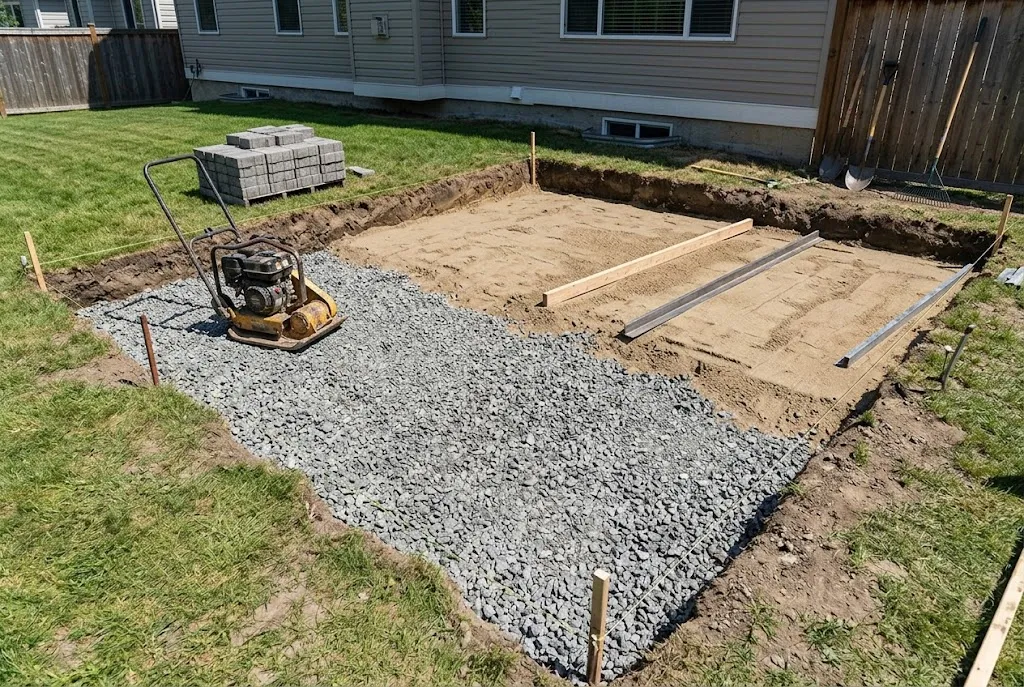
A paver surface is an assembly. Below the finished units sits compacted subgrade, then a compacted aggregate base, then a thin bedding layer that the pavers are set into. Joint material is swept between the units, and an edge restraint locks the perimeter so the field cannot spread outward. Load applied to one paver transfers through the joints into neighboring units and down into the base. The surface flexes in small increments rather than resisting movement as a single piece.
Poured concrete behaves differently by design. Compacted subgrade and base still matter, but the slab above them is monolithic. Reinforcement and control joints are used to manage where the concrete is expected to crack as it cures and as the ground moves beneath it. Control joints are not decorative; they give a rigid material a planned place to release stress. A well-placed slab distributes load across its full area, which is one reason concrete remains a common choice for large, uninterrupted surfaces.
Why the Joints Change Everything
Joints are the practical dividing line between the two materials. Paver joints allow the surface to accommodate minor ground movement without visible failure, permit individual units to be lifted and reset, and, in permeable systems, allow water to pass through the surface. They also require attention over time, since joint material can wash out and openings can collect debris or support weed growth.
Concrete has no joints other than the ones placed during construction, which produces a cleaner, quieter visual field and a surface that is simple to sweep or hose off. The trade-off is that when a rigid slab does move, it has only one way to respond. Understanding pavers versus concrete at this level makes the rest of the comparison much easier to follow.
How Each Surface Is Actually Installed
Installation is where the difference between concrete and pavers becomes visible, and it is also where the quality of the finished project is largely determined.
The Groundwork Both Materials Share
Excavation, grading, and compaction come first regardless of material. The area is cut to depth, the subgrade is compacted, and slope is established so water moves away from structures. Depth requirements change with the intended use: a garden walkway carries almost nothing, while a driveway carries repeated vehicle loading and needs a deeper, more thoroughly compacted section. Soil type matters here as well, since expansive clay soils behave very differently from sandy or well-draining soils when they take on moisture.
Existing surfaces, tree roots, utility lines, and irrigation components all have to be identified before the first cut. These are the details that cause most retrofit surprises, and they are a large part of why we recommend a site evaluation before a material is selected. Our Hardscape Services crews handle this preparation phase directly rather than treating it as a formality.
Paver Installation
After base preparation, a thin bedding course is screeded flat, the pavers are set in the chosen pattern, and cuts are made at borders, curves, and obstructions. Edge restraint is installed along the perimeter, joint material is swept in, and the field is compacted so the units settle into the bedding and lock together. Paver installation is a labor-intensive, unit-by-unit process, and a large field takes time. The advantage is that the surface is generally ready for use immediately after the final compaction and joint filling.
Concrete Placement
Poured concrete requires forms, reinforcement appropriate to the application, and a placement window that depends on the weather and the volume of material. The concrete is placed, screeded, floated, finished, and jointed, then left to cure. Curing is not optional downtime; the surface gains strength over a period during which foot traffic and vehicle traffic have to be kept off. For a driveway replacement, that curing period is a real scheduling consideration for the property owner.
Paver Materials and Concrete Finishes: What the Options Look Like
Both materials offer more visual range than most people expect, but they offer it in different ways, and comparing hardscape materials fairly means looking at what each one can actually be made to do.
Common Paver Materials
- Concrete pavers. Manufactured units produced in a wide range of shapes, sizes, thicknesses, textures, and colors. Interlocking pavers are the most common choice for driveways because their geometry helps transfer load between units.
- Clay brick pavers. Fired clay units with color that comes from the material itself rather than a surface treatment, which is why brick tends to hold its tone well. Shape and size options are more limited than with concrete units.
- Natural stone pavers. Quarried stone cut into regular units or used in irregular flagstone form. Stone brings variation that manufactured units cannot fully reproduce, and it usually asks for more careful layout and cutting during installation.
Finish Options With Poured Concrete
A concrete hardscape is not limited to a gray broom finish. Integral color, surface-applied color, exposed aggregate, salt finishes, sawn or tooled joint patterns, and decorative banding all change the character of a slab substantially. Stamped concrete deserves its own mention: it is textured and colored while plastic to imitate stone, brick, or tile, and it is often the right answer for a property owner who wants visual interest but prefers a continuous surface. Stamped concrete is worth comparing directly against pavers when appearance is the deciding factor, and it is a subject we will cover more fully in its own article.
Design Flexibility and Curb Appeal
Pavers offer flexibility through arrangement. Running bond, herringbone, basketweave, and circle patterns read very differently from one another, and borders, soldier courses, and contrasting banding let a patio or walkway define its own edges and pathways. Curves and radius work are straightforward because the surface is built from small units. Mixing sizes within a single field is normal rather than exceptional.
Concrete offers flexibility through surface treatment and joint layout instead. A large slab with a deliberate joint pattern and a quality finish reads as clean and architectural, which suits modern homes and many commercial settings well. Neither approach is better looking in the abstract. They simply produce different results, and the surrounding architecture, existing hardscape materials, and planting beds usually make one of them the more comfortable fit.
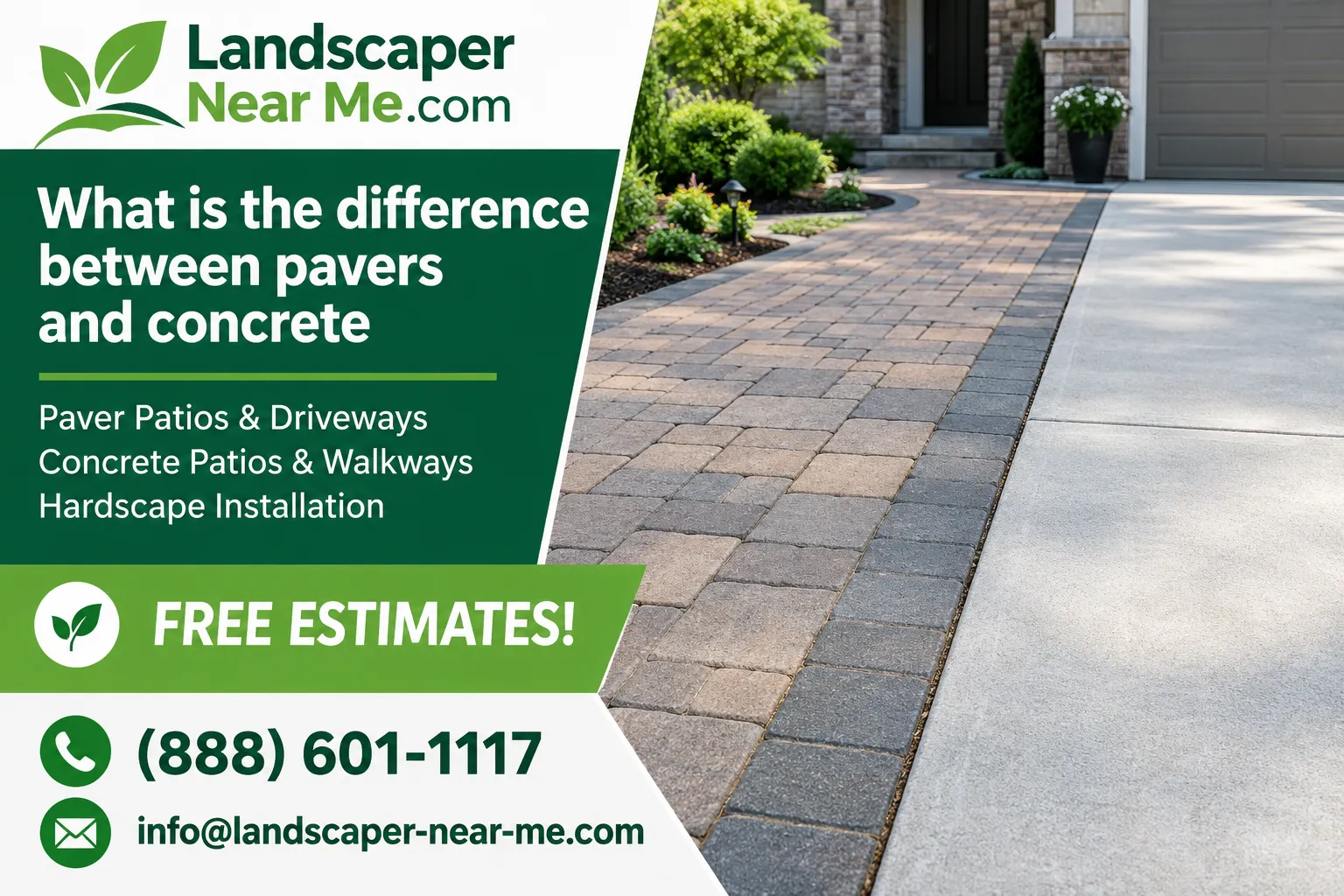
Planning a Paver or Concrete Project? Start With a Free Estimate
Choosing between pavers and concrete gets much easier once someone has stood in the space with you. We will measure the area, talk through how you plan to use it, look at grading and drainage, and prepare a free estimate for the hardscape approach that actually fits your property.
Comparing Installation Cost Against Long-Term Ownership Cost
Cost is usually the first question and rarely the most useful one on its own, because the two materials distribute their costs across different points in a project’s life. We avoid quoting fixed square-foot figures because material selection, base depth, site access, demolition of existing surfaces, drainage work, pattern complexity, cut volume, and local market conditions all move the number significantly.
Where the Upfront Difference Comes From
As a general pattern, poured concrete carries a lower initial installation cost for a comparable area. The material is placed in bulk and finished as a single operation, which keeps labor concentrated. Pavers carry a higher upfront cost in most cases because each unit is handled individually, cuts are made on site, edge restraint is added, and joint work and final compaction follow. That labor is the reason the pavers versus concrete cost comparison usually favors concrete on the first invoice.
Decorative work narrows the gap. A stamped and colored concrete patio with a detailed finish is a very different line item from a standard broom-finished slab, and it can approach or overlap the cost of a straightforward paver installation.
What Ownership Costs Look Like Later
Long-term ownership is where the comparison shifts. Paver maintenance tends to be small, incremental, and localized: replenishing joint material, addressing weed growth, cleaning, and occasionally lifting and resetting a section. Concrete maintenance tends to be infrequent but larger in scale. A slab can perform for a long time with very little attention, and then require a meaningful repair, resurfacing, or partial replacement when cracking or settling becomes a problem.
Neither pattern is automatically cheaper over the life of the surface. What matters is which pattern fits how you prefer to manage a property. Owners who would rather handle small, predictable upkeep often lean toward pavers. Owners who prefer a surface that asks for nothing until it genuinely needs work often lean toward concrete.
How Pavers and Concrete Respond to Movement, Settling, and Cracking
Every hardscape surface sits on ground that moves. Soil expands and contracts with moisture, irrigation and rainfall change the moisture profile, tree roots grow, and fill areas consolidate over time. The difference between concrete and pavers is not whether movement happens but how each surface expresses it.
What Movement Does to a Slab
Because a concrete slab is rigid and continuous, it resists movement until it cannot, and then it cracks. Control joints are placed specifically to direct that cracking into a straight, planned line where it reads as part of the design. Cracking that appears outside those joints usually indicates something about the conditions below: inadequate base preparation, poor compaction, moisture moving under the slab, root pressure, or a subgrade that was never stable to begin with. Differential settling can also lift or drop one section relative to another, creating an edge that is both visible and a trip consideration.
What Movement Does to a Paver Field
A paver surface absorbs small movement across many joints, which is why minor ground activity often produces no visible damage at all. Larger movement shows up as settling: a low spot, a dip near a downspout, or a section that no longer sits flush with its neighbors. The units themselves usually remain intact because they were manufactured or quarried as individual pieces rather than cast as one surface.
The Factor That Outweighs Material Choice
Base preparation influences durability more than the choice between pavers and concrete. Insufficient excavation depth, poor compaction, inadequate grading, or unmanaged water will shorten the useful service life of either surface. A properly installed concrete slab over a well-compacted base outperforms a paver field installed carelessly, and the reverse is equally true. When a customer tells us a previous surface failed early, the conversation almost always ends up underground.
When Something Goes Wrong, Which Surface Is Easier to Repair?
Repairability is one of the clearest practical differences between the two materials, and for many property owners it ends up being the deciding factor.
Repairing Pavers
Individual pavers can be lifted out and reset or replaced. If a section has settled, the affected units are removed, the bedding and base beneath them are corrected and recompacted, and the same units are reinstalled. If a unit is cracked or stained, it can be swapped for a replacement. Because the repair works with the original units, a corrected area usually blends back into the surrounding field. This is also why we encourage customers to keep a small quantity of leftover pavers after installation; manufacturers change product lines and color batches over time, and having original stock on hand makes a future repair much easier to match.
Access also matters more than people expect. If an irrigation line, drain, or conduit runs beneath a paver surface, the units above it can be removed and reinstalled. The same work beneath a concrete slab requires cutting.
Repairing Concrete
Repairing a cracked or settled slab is more involved. Small cracks can be cleaned and filled, but filled cracks generally remain visible because the repair material rarely matches aged concrete in color and texture. Slab jacking can lift a settled section back to grade. Resurfacing can restore appearance across a larger area. When the damage is extensive or the underlying cause has not been corrected, removing and replacing the affected section is often the honest answer, and a newly poured section will not match the color of the surrounding original concrete.
None of this makes concrete a poor material. It makes concrete a material whose repairs are less discreet. A property owner who expects a surface to look unchanged after a repair should weigh that carefully.
Base Preparation Decides How Your Hardscape Ages
Settling, cracking, and standing water almost always trace back to what happened below the surface. Our crews handle excavation depth, base material, compaction, grading, and edge restraint so the paver or concrete surface you choose performs the way it should for years.
What Routine Maintenance Looks Like for Each Surface
Maintenance expectations are worth setting honestly before a project starts, because the pavers versus concrete maintenance comparison is about the type of attention required rather than the total amount.
Maintaining a Paver Surface
Routine care for pavers is mostly about the joints. Sweeping and occasional rinsing handles surface debris. Joint material can gradually migrate under heavy rain, pressure washing, or repeated traffic, and topping it up keeps the units interlocked and discourages growth in the openings. Weeds and moss in joints are typically the result of windblown seed and organic debris collecting on the surface rather than growth coming up from the base, so keeping the surface clear does most of the work. Polymeric joint sand can reduce that maintenance, though it has its own installation requirements and is not appropriate for every project.
Sealing pavers is optional and project-dependent. A sealer can deepen color and make some stains easier to manage, and it also becomes a recurring task once started. We treat it as a preference rather than a requirement.
Maintaining a Concrete Surface
Concrete asks for very little day to day. Sweeping and rinsing keep it clean, and a continuous surface with no joints to maintain is genuinely low effort. Attention is concentrated on cracks as they appear, on surface conditions such as scaling or spalling, and on stains, since an unsealed slab is porous and oil or organic staining can set in. Decorative concrete generally has a higher maintenance profile than plain concrete, because stamped and colored surfaces usually rely on a sealer to preserve their appearance, and that sealer needs periodic renewal.
Irrigation and Landscape Interaction
Surfaces next to planting beds and lawns need a little coordination. Sprinkler overspray onto hardscape wastes water and can leave mineral deposits on both pavers and concrete, and misdirected heads are one of the more common causes of staining we see. Adjusting spray patterns or converting bed irrigation to drip near hardscape edges solves most of it, and our Irrigation Services team regularly makes those adjustments when a new patio or walkway changes the shape of a planted area. Where irrigation mainlines or laterals will sit beneath a planned hardscape surface, sleeving them during installation is far easier than reaching them afterward.
Drainage, Soil, and Site Conditions That Should Shape the Decision
Drainage is the factor most likely to override appearance and budget preferences, and it is the reason we push for a site evaluation before a material is chosen.
Standard Installations Manage Water at the Surface
A conventional paver field and a conventional concrete slab are both effectively impervious. Water runs across them and has to be sent somewhere deliberate. Pavers allow a small amount of infiltration through their joints, but that is incidental and should not be mistaken for a drainage strategy. Both surfaces depend on correct slope, and on directing runoff toward drains, swales, or planted areas rather than toward a foundation, a walkway, or a neighboring property.
Permeable Systems Are a Different Design Entirely
Permeable interlocking concrete pavement and pervious concrete are engineered systems, not the standard versions of each material. They use open-graded aggregate reservoirs beneath the surface so stormwater can infiltrate and be stored rather than run off. The EPA’s permeable pavement design and maintenance guidance describes how those subsurface layers are sized and why they matter as much as the visible surface. These systems also carry maintenance obligations of their own, chiefly keeping sediment from clogging the surface. If stormwater management is a project goal, that intent needs to be established at the design stage rather than assumed because a surface has joints in it.
Site Conditions Worth Evaluating Before Choosing
- Soil behavior. Expansive clay soils move more with moisture change than sandy soils and affect both surfaces, though a rigid slab shows that movement more dramatically.
- Slope and runoff path. Where water currently goes, and where it should go, often determines the layout before the material is chosen.
- Existing surfaces. Demolition and haul-off of a failed slab is a real cost and a real schedule item.
- Trees and roots. Mature roots near a planned surface influence both material selection and layout.
- Vehicle loading. Driveways, parking areas, and access lanes need a base section designed for the loads they will carry.
- Utilities and irrigation. Anything running beneath the planned area should be located, sleeved, or rerouted before installation.
Hardscape rarely sits in isolation. The surface meets planting beds, lawn edges, drainage outlets, and lighting, and a patio that ignores those relationships tends to look installed rather than designed. We plan hardscape alongside our Landscape Services work so grading, plant placement, and drainage are resolved together rather than sequentially.
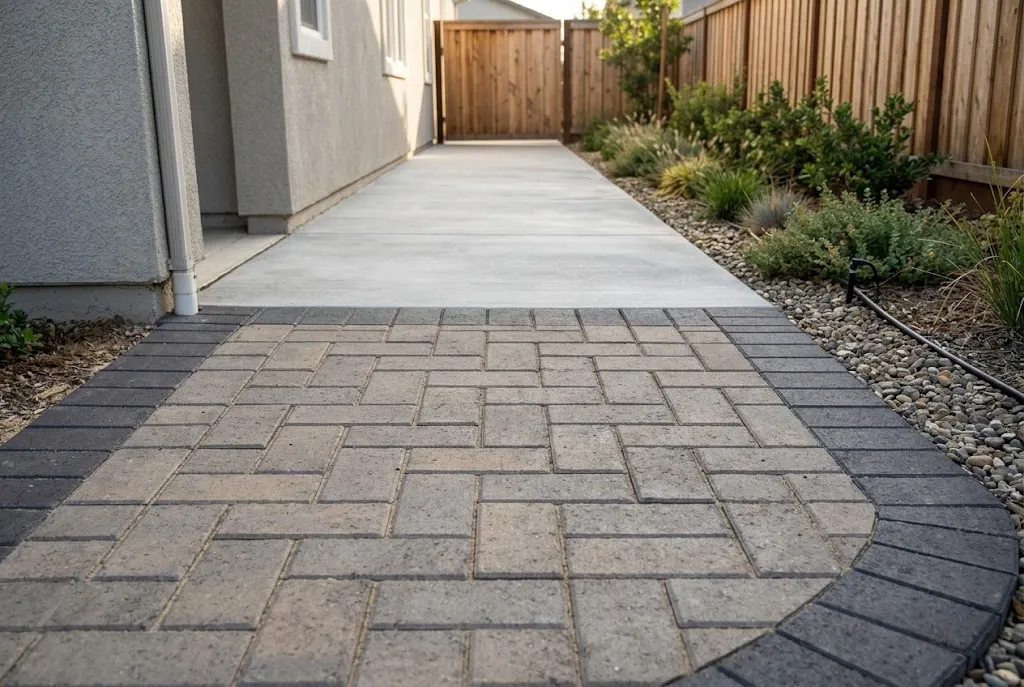
Still Weighing Pavers Against Concrete? Let Us Look at Your Site
Soil behavior, slope, drainage, existing surfaces, and vehicle loads all shape the right answer. Call (888) 601-1117 or request a call back, and we will review your property and explain which material makes practical sense for the space you are improving.
Choosing Between Pavers and Concrete for Your Patio, Walkway, or Driveway
Intended use narrows the field faster than any general comparison, so it is worth looking at the three most common applications separately before drawing a conclusion.
Patios and Outdoor Living Areas
Patios are where design flexibility carries the most weight, because the surface is seen up close and lived on. A paver patio supports pattern work, borders, curves, integrated seat walls, and simple future expansion, and patio pavers can be swapped individually when one is damaged without disturbing the rest of the field. A concrete patio delivers a clean, continuous surface at a lower initial cost and, when stamped or finished decoratively, a considerable amount of visual character. Furniture stability is worth a thought: both surfaces work well, though a properly compacted paver field with a smooth unit profile is generally more comfortable for chairs than a heavily textured stamped finish. There is no single best material for a patio, only the one that matches how the space will be used.
Walkways and Pathways
A paver walkway is the easier choice when the route curves, changes width, or has to tie into existing hardscape, since small units follow a radius without formwork and borders can define the path edge cleanly. A concrete walkway handles straight runs and side-yard utility paths perfectly well at lower cost. Width, slope, and the transition at each end usually matter more to how a path feels underfoot than the material does.
Driveways and Courtyards
Driveways raise the stakes because vehicle loads are repeated and concentrated. Whether you use pavers or concrete, the surface performs when it is engineered for the load, and there is no universal best material for a driveway. A paver driveway built with interlocking pavers rated for vehicular use distributes load between units and can be lifted and reset if a section settles, which is useful where utility access beneath the driveway is a possibility. A concrete driveway provides a continuous surface with a lower upfront cost and a straightforward finish, and it remains a dependable default for a standard residential property. Comparing a paver driveway vs a concrete driveway usually comes down to whether repair access and appearance matter more than the initial budget. In either case the base section, not the surface, determines how the driveway ages, and the excavation and compaction required for a driveway are considerably more demanding than for a patio.
When Concrete Is Usually the Better Fit
Concrete tends to be the stronger choice when the initial installation budget is the controlling factor, when a large uninterrupted surface is wanted, when the preferred look is clean and architectural, when the property owner wants minimal ongoing upkeep and accepts that an eventual repair may be visible, or when a decorative finish such as stamped concrete already delivers the appearance the project is after.
When Pavers Are Usually the Better Fit
Pavers tend to be the stronger choice when design flexibility is a priority, when curves, borders, or mixed formats are part of the plan, when the ability to repair or access the surface without visible patching matters, when future expansion is likely, when utilities run beneath the planned area, or when the property owner prefers small routine upkeep to occasional larger repairs.
The Honest Conclusion
Neither material wins this comparison outright. Pavers and concrete solve the same problem in two different ways, and the better answer depends on how the space will be used, what the budget has to cover, what appearance the property calls for, how the ground behaves, where water goes, and how you would rather handle maintenance and repairs over the years you own the surface. A property can reasonably use both — a stamped concrete driveway with a paver walkway and courtyard is a combination we install regularly.
If you are weighing the difference between pavers and concrete for a specific project, the most useful next step is having someone look at the actual site. Grading, soil, drainage, existing surfaces, root conditions, and vehicle loading are difficult to assess from photographs, and they change recommendations more than material preference does. Our Hardscape Services team will walk the area with you, explain what each option would involve on your property, and provide a free estimate for the approach that fits. Call (888) 601-1117, email info@landscaper-near-me.com, or request a call back and we will arrange a time to take a look.
FAQ's - Frequently Asked Questions
Sometimes, but it depends entirely on the condition of the slab. An overlay generally requires a slab that is structurally sound, properly drained, and free of significant cracking or settling, and it raises the finished surface height, which affects thresholds, steps, and the transition to adjacent surfaces. If the slab is already cracking or moving, installing pavers over it usually transfers the same problem to the new surface. We evaluate the existing concrete before recommending an overlay rather than a removal.
What most people see growing in paver joints started on the surface, not underneath it. Windblown seed and organic debris settle into the joints and germinate there. Keeping the surface swept, keeping joint material topped up, and addressing growth early handles most of it. A properly installed base with the right joint material makes the problem much smaller than it is often assumed to be.
A paver field installed over a well-compacted base with proper edge restraint should stay flush. When settling does appear, it is usually localized, often near a downspout, a trench line, or an area that was filled rather than compacted. The practical advantage is that a settled section can be lifted, the base beneath it corrected, and the same units reset so the repair blends in.
No. Stamped concrete is a poured slab that is textured and colored while still plastic to resemble stone, brick, or tile. It reads as a continuous surface and behaves like concrete in every structural respect, including how it cracks and how it is repaired. It is a good option when you want visual variation without the joints of a segmented surface, but it does not offer the individual-unit repairability that pavers do.
Neither material requires sealing to function. Sealing is a preference that affects appearance and stain resistance, and it becomes a recurring task once you begin. Decorative and stamped concrete is the common exception, since color and texture treatments typically rely on a sealer to keep looking the way they did on day one. We explain the trade-off before a project rather than after.
It varies with area, site access, demolition, drainage work, and pattern complexity, so we give a schedule with the estimate rather than a general figure. One difference is worth planning around: a paver surface is normally usable as soon as the final compaction and joint work are finished, while a concrete surface needs a curing period during which foot and vehicle traffic have to stay off.
Often, yes, provided the underlying cause has been addressed. Resurfacing can restore appearance across a slab that is structurally sound, and slab jacking can raise a settled section back to grade. If the cracking is the result of a base or drainage problem that has not been corrected, resurfacing tends to be temporary. We look at why the slab failed before recommending how to treat it.
Surface texture matters more than material. A smooth, sealed surface of either type is slicker when wet than a textured one, and shaded areas that stay damp can develop algae regardless of what they are made from. Where slip resistance is a concern, such as around a pool or on a sloped walkway, we select a texture and finish appropriate to that use rather than relying on the material alone.