What Is Crown Thinning in Tree Trimming?
Crown thinning is the selective removal of a limited number of smaller live branches from inside and around the outer edge of a tree’s canopy so that foliage becomes less dense, while the tree keeps its existing height, spread, and natural outline. It is one of the more commonly requested pruning approaches we discuss during tree trimming services, and it is also one of the most frequently misunderstood. Property owners who ask us what is crown thinning in tree trimming are usually looking at a canopy that has grown dense enough to darken a yard, shade a patio, or crowd a roofline. Below we explain what the work actually involves, what it can reasonably accomplish, where its limits are, and how we decide whether a tree is a good candidate before any branch is removed.
What Is Crown Thinning in Tree Trimming, and What Does It Remove?
A tree’s crown is everything above the trunk: the scaffold limbs, the smaller branches growing from them, and the leaves those branches carry. Crown thinning works inside that structure. Rather than shortening limbs or lowering the tree, the work concentrates on removing a modest number of smaller live branches so light and air move through the canopy more freely and the remaining foliage is distributed more evenly.
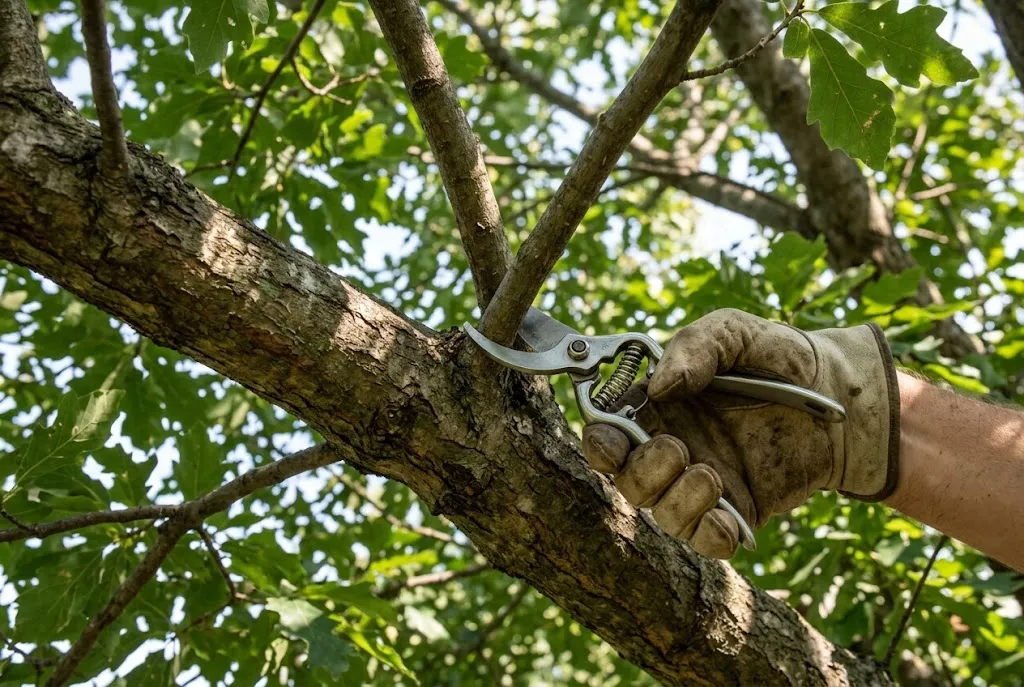
Most of the branches selected during tree crown thinning are small in diameter and located toward the outer portion of the crown, where growth is densest and where duplicate, crossing, or crowded branches tend to accumulate. Large structural limbs are generally left alone. That distinction matters, because the size of the cuts made during canopy thinning has a direct relationship to how quickly a tree seals its wounds and how much of its stored energy it has to redirect.
Selective Branch Removal, Not General Trimming
Selective branch removal is the operating principle. Each cut is chosen for a reason: a branch that rubs against a neighbor, a cluster of parallel shoots competing for the same space, or a section where growth has become so tight that interior leaves receive almost no light. The tree should still look like itself afterward. When someone stands back and cannot immediately tell that pruning has occurred, but the canopy reads as noticeably lighter, the work has generally been done well.
What Crown Thinning Can and Cannot Do for a Tree
Understanding crown thinning benefits and risks is easier once the objective is stated plainly. Thinning is usually requested for three reasons: more light reaching the ground or a structure, more air movement through the canopy, and a less congested appearance. Those are reasonable goals, and a carefully thinned canopy can support all three.
What thinning does not do is act as a general health treatment. A vigorous mature tree with a naturally dense canopy is not unhealthy simply because it is full. Leaves are how a tree produces the resources it uses for growth, wound response, and root development, so every leaf removed is a small subtraction from that supply. Routine thinning performed on a schedule, without a specific objective, does not automatically improve a mature tree’s condition and can work against it if repeated too aggressively.
We are also careful about what we will not claim. Thinning is not a disease treatment, it is not a guarantee against storm damage, and it does not make a structurally compromised limb sound. Some of those outcomes may improve as a side effect of good pruning, but a tree that has a defect still has that defect after its canopy has been lightened.
Crown Thinning for More Sunlight
Crown thinning for more sunlight is probably the single most common request we hear from homeowners. It is achievable within limits. Thinning increases dappled light beneath the canopy rather than opening a hole in it, and the increase is temporary because the tree responds by producing new growth. Turf struggling under deep shade may improve modestly, but if the underlying problem is that a shade-intolerant grass has been planted beneath a broad canopy, pruning is treating a symptom. In those situations we often suggest looking at ground-level planting choices alongside the pruning question.
Crown Thinning vs. Crown Reduction, Deadwooding, and Other Pruning Approaches
Pruning terminology gets used loosely, and two people can walk away from the same conversation with different expectations. These distinctions are worth keeping straight before approving work.
- Crown thinning vs crown reduction. Thinning changes foliage density and leaves the tree’s dimensions alone. Reduction changes the dimensions themselves, shortening limbs to lower the height or pull in the spread. If the concern is a tree that has grown too large for its space, reduction is the relevant conversation; our article on what crown reduction means in tree trimming explains how those cuts are made and when they are appropriate.
- Crown thinning vs deadwooding. Deadwooding removes branches that are already dead, and because it takes no live foliage, it does not reduce the tree’s resources the way thinning does. The two are sometimes performed during the same visit, but they answer different concerns. Our guide to deadwooding in tree trimming covers that work in detail.
- Crown lifting. Lifting removes or shortens the lowest branches to create clearance over a walkway, driveway, lawn area, or roofline. It affects the bottom of the crown; thinning affects density throughout it.
- Crown thinning vs topping. Topping cuts limbs back to stubs without regard to branch structure. It is not a thinning technique and it is not an accepted pruning practice. It removes large amounts of foliage at once, creates wounds the tree struggles to seal, and typically triggers a flush of weakly attached shoots. If someone proposes topping as a way to “thin out” a tree, that is a reason to pause and ask for a different plan.
Deciding among these approaches is less about vocabulary than about naming the problem accurately. A request for thinning often turns out, once we are standing under the tree, to be a request for clearance, for deadwood removal, or for a conversation about a limb the owner has been quietly worried about for two seasons.
Free Estimate for Crown Thinning on Your Trees
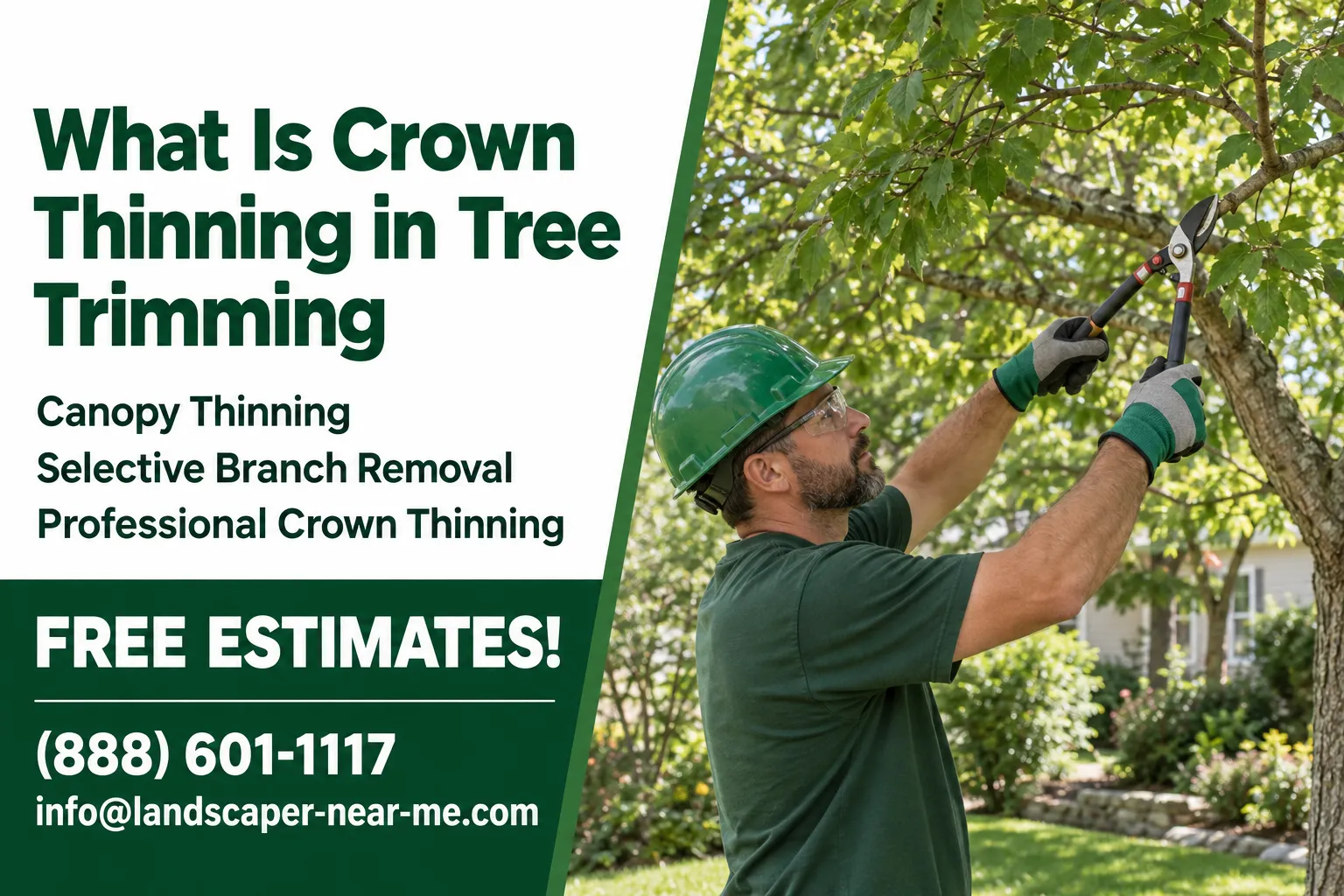
Not sure whether the tree in your yard is a candidate for thinning? We will look at the canopy, explain what we would remove and what we would leave, and give you a free estimate for the pruning. Call (888) 601-1117 or request a callback and we will set a time to walk the property with you.
Does My Tree Need Crown Thinning? How We Evaluate the Request
“Does my tree need crown thinning” is the right question to ask, and the honest answer is that many trees do not. A full canopy is often exactly what a healthy tree of that species is supposed to look like at that age. Before recommending thinning, we work through several considerations on site.
- The objective. What is the actual concern? More light on a patio, a lawn area that stays wet, branches brushing a second-story window, and a canopy that simply looks heavy are four different problems with four different answers.
- Species and growth habit. Some species carry dense foliage naturally and respond poorly to having it removed. Others tolerate light thinning well. Species also differ in how readily they produce sprouts after pruning.
- Maturity and vigor. Young trees, trees in active decline, recently transplanted trees, and trees under drought stress all warrant caution. A tree with limited reserves has less margin for foliage loss.
- Existing foliage distribution. We look at where leaves actually are. A canopy already carrying most of its foliage at the branch tips does not need further thinning; it needs the opposite conversation.
- Previous pruning. Past topping, repeated heavy thinning, or old stub cuts change what is appropriate now. Sprout-heavy regrowth from earlier work is handled differently than original branch structure.
- Surrounding conditions. Root-zone paving, recent grading or trenching, irrigation changes, and construction near the tree all affect how much pruning a tree can comfortably absorb.
Where the concern is congestion or shade but the tree is not a good thinning candidate, we say so and describe what else could address it. Talking a customer out of unnecessary pruning is part of the job, and it is one reason property owners searching for local tree services should expect an assessment rather than an immediate quote for whatever was requested by name.
How Branches Are Selected During Professional Crown Thinning
Professional crown thinning is a sequence of individual decisions rather than a single technique applied uniformly. The work begins with a walk around the tree, viewing the canopy from several angles and at a distance, because density that looks severe from directly underneath often reads differently from across the yard.
From there, branch selection follows a few consistent priorities. Branches that cross, rub, or grow directly back into the center of the crown are usually the first candidates. Clusters of parallel shoots competing in the same space can be reduced to the strongest one. Small branches duplicating the function of a neighbor a few inches away are removable without leaving a visible gap.
Just as important is what stays. Interior foliage is retained deliberately, because those leaves shade the bark of limbs that were never meant to be exposed and they contribute to the branch taper that helps limbs support their own weight. The tree’s natural form is preserved, so the outline a homeowner recognizes from their kitchen window remains recognizable. Cuts are kept small, positioned correctly relative to the branch collar, and limited in number, because every cut is a wound the tree has to respond to.
The work itself is performed by trained crews using appropriate access methods, and the specifics of climbing, rigging, and cutting are not something a property owner needs to manage. What the property owner should understand is the plan: which branches, how many, and why.
Over-Thinning and Lion’s Tailing: What Poor Crown Thinning Looks Like
The most common way crown thinning goes wrong is that too much comes out, and it comes out of the wrong place. When interior branches are stripped and growth is left concentrated at the ends of long, bare limbs, the result is lion’s tailing. The name describes the appearance: a bare limb with a tuft of foliage at the tip.
The consequences are structural as well as cosmetic. Weight shifts outward to the ends of limbs, which changes how those limbs load in wind. Branch taper develops poorly when interior growth is repeatedly removed. Bark that spent decades shaded by interior leaves becomes exposed to direct sun. And the tree frequently responds with a flush of vigorous sprouts, which is not a sign of recovery so much as a stress response, leaving the owner with a denser tangle than they started with a few seasons later.
An over-thinned canopy is easy to spot once you know the look: you can see straight through the tree, individual limbs read as lines rather than as leafy structures, and the foliage that remains sits in isolated clumps. Cooperative extension guidance on pruning mature trees, including Colorado State University Extension’s discussion of pruning mature shade trees, addresses both the limited amount of live canopy that should be removed at one time and the structural problems that follow lion’s tailing. That guidance is consistent with how we approach the work.
Set the Pruning Objective Before the First Cut
Thinning without a defined objective is how trees end up stripped on the inside and top-heavy at the ends. Tell us what is actually bothering you about the tree and we will identify which branches address it, how much foliage stays, and whether another pruning approach would serve you better.
How Much Can a Tree Crown Be Thinned, and How Often?
How much can a tree crown be thinned is a question without a single number attached to it, and treating any published percentage as a universal target is a mistake. The appropriate amount depends on the pruning objective, the species, the tree’s age and condition, how much foliage it is currently carrying, and what pruning it has already received. Published guidance for mature trees generally points toward removing only a small share of the live canopy in a single operation, with less taken from older or stressed trees. A young, vigorous tree in good growing conditions has more tolerance than a mature specimen that has been through several dry years.
In practice, the objective usually sets the amount before the tree does. If the goal is to reduce rubbing between two limbs over a driveway, a handful of cuts may accomplish it. If a customer’s expectation is a dramatic change in the amount of light reaching a lawn, the amount of foliage removal required to produce that effect is often more than the tree should give up, and that is a conversation worth having before work is scheduled rather than after.
How Often Should a Tree Be Thinned?
How often should a tree be thinned is best answered by the tree rather than by the calendar. Trees grow back. Foliage removed this year is replaced over following seasons, which is why thinning is not a permanent condition. Reassessment every few years is generally more sensible than automatic annual pruning, and many trees go considerably longer between thinning operations without any harm.
Timing within the year also matters. Dormant-season pruning suits many deciduous species and makes branch structure easier to read without leaves in the way. Some species and some regional pest or disease concerns argue for avoiding particular windows, and freshly made pruning wounds can be more attractive to certain insects at certain times of year. Our article on the best time of year to trim trees covers those seasonal considerations in more depth.
Crown Thinning Before and After: What to Expect and When a Different Assessment Is Needed
Realistic expectations prevent most disappointment. Comparing crown thinning before and after, the tree should look like the same tree, with the same height, the same spread, and the same familiar silhouette, but with a canopy that reads as lighter and more open. Light beneath it should be dappled and more evenly distributed. Interior foliage should still be present. If the tree looks like a different tree, too much was removed.
In the weeks and months that follow, the tree will respond. New growth appears, the canopy gradually fills, and the additional light gained at ground level diminishes over time. A few observations are worth mentioning to us if you notice them: dieback at the tips of branches that were pruned, an unusual concentration of sprouts along limbs or at cut sites, leaves that are noticeably smaller or off-color the following season, or bark on newly exposed limbs that begins to crack or discolor.
When Thinning Is Not the Right Question
Some concerns need a broader assessment than a pruning request can carry. Significant dieback across the upper canopy, a large limb with a visible crack or a compromised attachment, fungal growth at the base, a noticeable lean that has changed, or damage from a storm or nearby excavation are all conditions where the relevant question is the tree’s overall condition and stability, not how dense its foliage is. Thinning will not resolve any of them.
That kind of assessment sometimes concludes that the tree can be retained with different work, and sometimes it leads to a discussion about tree removal. Neither outcome should be assumed in advance. What matters is that a tree showing signs of structural or health problems is evaluated on those terms rather than being quietly pruned and left in place.
Talk With Our Tree Trimming Crew About Your Canopy
Still deciding? A short conversation usually settles it. Reach Landscaper-Near-Me.com at (888) 601-1117 or info@landscaper-near-me.com to discuss your tree, or request a callback and we will reach you at a time that works for your household or property schedule.
Questions Worth Asking Before You Approve Crown Thinning
By the time a proposal is in front of you, the useful questions are specific ones. Before approving crown thinning on your property, we encourage you to ask any tree care professional the following.
- Why is thinning being recommended for this tree? The answer should describe a condition in the canopy and an objective, not a general statement that the tree needs attention.
- Which branches would be removed? Size, location within the crown, and the reason each category is being selected.
- How much foliage will remain? Including how much of the interior canopy is being retained.
- How will the tree look afterward? And how long the change in light is expected to last before new growth fills in.
- Would a different pruning approach address the concern better? Reduction, lifting, or deadwooding may fit the actual problem more closely than thinning does.
- What happens next? When the tree should be looked at again, and what to watch for in the meantime.
Residential, HOA, and Commercial Property Considerations
On residential properties, the balance is usually between wanting more light and wanting to keep the shade and appearance that made the tree worth having. Evaluating light around a patio, pool deck, or seating area across the whole day, rather than at the single hour when the shade is most noticeable, tends to lead to better decisions.
On apartment communities, HOA common areas, and commercial grounds, the pruning decision is only part of the project. Access for equipment, parking impacts, staging and cleanup, resident and tenant notification, and scheduling around business hours all shape how the work is carried out. We coordinate tree work alongside the rest of the site’s maintenance for managed properties, and our commercial landscape services cover that broader scope where a property needs it.
If you are weighing crown thinning for a tree on your property, the most useful next step is an assessment. We will look at the tree, tell you whether thinning is appropriate, explain what we would remove and what we would leave, and give you a free estimate for the work. Call Landscaper-Near-Me.com at (888) 601-1117, email info@landscaper-near-me.com, or request a callback and we will arrange a time to walk the property with you.
FAQ's - Frequently Asked Questions
Not quite. “Tree trimming” is a general term that covers several different pruning approaches. Crown thinning is one specific approach: selectively removing a limited number of smaller live branches to reduce foliage density while leaving the tree’s height, spread, and outline unchanged. When we quote tree trimming, we identify which pruning approach the tree actually needs rather than using the terms interchangeably.
It can help modestly, but it is rarely a complete solution on its own. Thinning increases dappled light beneath the canopy rather than opening it up, and the tree replaces the removed foliage over following seasons. If turf is failing under deep shade, we usually look at the grass species and the ground-level conditions alongside the pruning question instead of removing more foliage than the tree should give up.
No. Species differ in how much foliage they can comfortably lose, how they respond with new growth, and how well they tolerate newly exposed interior bark. Some carry dense canopies naturally and are better left alone. We identify the species and consider its growth habit before recommending thinning.
We would not promise that. Air can move more freely through a thinned canopy, which some property owners find reassuring, but thinning does not repair a weak branch attachment, a crack, or decay, and over-thinning can actually shift weight toward the ends of limbs. If you are concerned about a specific limb, that limb should be assessed directly.
Young trees are usually better served by pruning aimed at developing sound branch structure than by thinning for density. A young tree is still building the framework it will carry for decades, and removing foliage reduces the resources available for that growth. We approach young trees differently from established ones.
It varies with the tree’s size, access, and the number of cuts involved. Many single residential trees are completed within a day, including cleanup, while larger specimens or trees with difficult access take longer. We give you a time estimate with the written quote so you can plan around access and parking.
Trees do respond to pruning with new growth, and heavy thinning can trigger a vigorous flush of sprouts, which is why removing too much at once is counterproductive. Thinning done conservatively produces a more gradual return to previous density. That regrowth is the main reason thinning is not permanent and why reassessment every few years makes more sense than annual pruning.
It depends on where the tree is and who has authority over it. Some cities have ordinances covering street trees or protected species, and HOAs and commercial leases may have their own requirements for work on common areas or shared landscape. We recommend checking with your city and, where applicable, your association or property manager before scheduling, and we are glad to provide a written scope describing the proposed work.