
When Is the Best Time of Year to Trim Trees?
Timing is one of the most consequential decisions in tree care, and it is the question we field more than almost any other. When is the best time of year to trim trees? For most deciduous landscape trees in our service area, late winter through very early spring — while the tree is still dormant and before buds break — is the window that generally produces the healthiest, cleanest results.
That answer covers a great deal of ground, but it does not cover every tree. There is no single pruning window that suits every species, every property, and every objective. A flowering tree that set its buds last summer needs different handling than a young shade tree being trained for structure. An evergreen that holds its canopy year round behaves differently than a sycamore standing bare in January. And a cracked limb hanging over a driveway does not wait for a season at all.
This guide explains how we approach tree trimming season on the residential, commercial, multifamily, and HOA properties we maintain: why dormant season tree pruning earns its reputation, where the real exceptions are, how the pruning objective changes the calendar, and which situations call for immediate attention regardless of the month. By the end you should be able to look at the trees on your own property with a reasonable sense of when each one should be scheduled.

Request a Free Tree Trimming Estimate for Your Property
Every property is different, and so is every tree. We will walk your landscape, evaluate species, condition, and structure, and tell you what should be trimmed now and what belongs in the dormant window. Estimates are free and there is no obligation.
When Is the Best Time of Year to Trim Trees?
For the majority of deciduous landscape trees, the best time of year to trim trees is the late dormant season. In Southeast Los Angeles County and Orange County that usually falls between January and early March, after the coldest stretch has passed and before new growth pushes out. Pruning in that window leaves the shortest possible gap between the cut and the spring growth surge that seals it.
We want to be direct about the limits of that recommendation, though, because the phrase “best time” hides an important question: best for what? Timing that favors rapid wound closure is not always the timing that favors flower display. Timing that suits a young tree being trained is not the timing that suits a mature tree being thinned for wind movement. And no season at all outranks safety when a limb is already failing.
So the practical answer has three parts. Most deciduous trees do best with late winter pruning. Flowering trees are scheduled around their bloom rather than the calendar. Dead, damaged, diseased, and hazardous wood comes out whenever it is found. Everything else in this article is a refinement of those three ideas.
Why There Is No Universal Pruning Window
Put simply, the best time to trim trees on one side of a property may be the wrong time for the tree standing thirty feet away. Trees are not interchangeable. Species differ in how they store and move energy, when they set flower buds, how quickly they compartmentalize wounds, and which pests and pathogens are active around them. On a single property we routinely see a liquidambar, a jacaranda, a citrus, a queen palm, and a Chinese elm within fifty feet of one another, and no two of them belong on the same schedule.
Site conditions matter as well. A tree growing in a lawn with regular irrigation behaves differently than the same species in a dry parkway strip. A tree that has been topped in the past carries weak, densely attached regrowth that needs a different corrective approach than a tree with sound structure. Age, vigor, recent stress, root conditions, and prior pruning history all feed into when to trim trees on a given property.
What Dormant Season Tree Pruning Actually Does for a Tree
Winter tree pruning is not a tradition without a reason behind it. Several real advantages line up in the dormant window, and understanding them helps explain why we schedule so much of our tree trimming work between January and March.
- Branch structure is visible. With the leaves down, we can read the whole architecture of the crown — crossing limbs, rubbing branches, included bark at weak unions, competing leaders, and deadwood hidden all summer. Decisions made with a clear view of the framework are better decisions.
- The tree responds quickly. Cuts made late in dormancy sit exposed for a short time before the tree begins closing them with the first flush of spring growth. Wounds made in early winter wait considerably longer.
- Pest and disease pressure is generally lower. Many insects that are attracted to fresh wounds and many fungal spores that colonize them are less active in cool weather. Timing cuts to reduce that overlap is a reasonable precaution, particularly on species known to be sensitive.
- Energy reserves are in the roots and trunk. A dormant deciduous tree is not carrying a full canopy of leaves it just spent resources building, so removing wood costs it less than the same cut would in midsummer.
- Site conditions cooperate. Lawns and planting beds are less actively growing, and access equipment does less cosmetic damage moving across a property.
None of this makes dormant pruning risk free or universally appropriate. Heavy cuts still stress a tree, and a poorly placed cut in February is no better than a poorly placed cut in July. Timing improves the odds; technique determines the outcome.
Late Winter Versus Early Winter
When we say dormant season tree pruning, we generally mean the back half of dormancy rather than the front. Pruning immediately after leaf drop leaves wounds open through the wettest, coolest months. Waiting until the tail end of winter shortens that exposure and puts the cut closer to the tree’s own repair response. On most deciduous landscape trees in our region, that is a meaningful difference.
Tree Type Changes the Answer
The single biggest factor in when to prune trees is what kind of tree you are standing under. Grouping them broadly gives most property owners enough to work with.
Pruning Deciduous Shade Trees
Deciduous shade and street trees — sycamore, liquidambar, elm, ash, oak, maple, and similar species — are the clearest candidates for late winter work. This is when structural pruning is most effective, when thinning cuts can be placed with full view of the canopy, and when the tree is best positioned to respond. Most of the spring tree pruning we are asked about would genuinely have been better performed a few weeks earlier.
Pruning Evergreen Trees
Evergreens never go fully dormant in the way deciduous trees do, and in our mild climate they may push growth across much of the year. Light shaping and deadwood removal on broadleaf evergreens is generally tolerated across a wide window, though late winter to early spring, just ahead of the main flush, is still a sensible default for anything beyond minor work. Conifers are less forgiving: many will not regenerate growth from bare interior wood, so pruning evergreen trees of that type is about restraint and careful cut placement rather than season alone.
Pruning Flowering Trees
Flowering trees are where the calendar rule breaks down most visibly, and where we see the most avoidable disappointment. The governing question is when the tree sets the buds it will open.
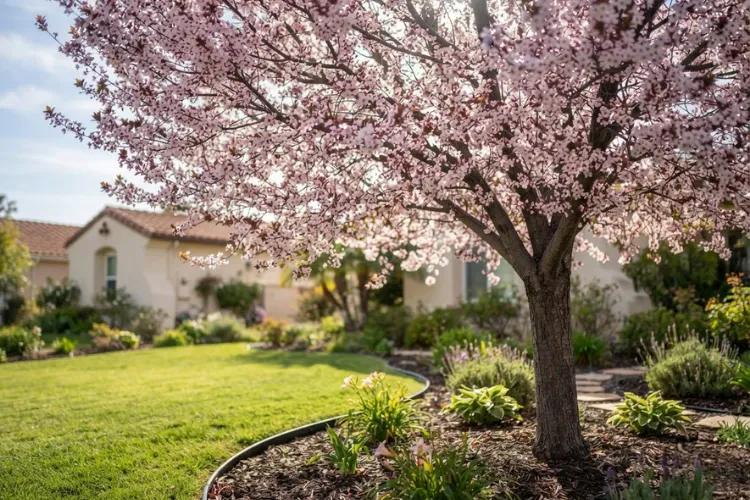
- Spring bloomers such as ornamental plum, redbud, and many magnolias generally form their flower buds during the previous growing season. Pruning them in winter removes the display before it happens. The reliable approach for when to prune flowering trees of this group is to wait until just after the blooms fade, then prune promptly.
- Summer and fall bloomers such as crape myrtle and jacaranda typically flower on growth produced in the current season, so dormant pruning does not cost you the show. These fit the late winter window comfortably.
University of California Master Gardener guidance on pruning landscape plants follows the same logic, and it is a useful reference for homeowners who want to check a specific species before scheduling.
Young Trees Versus Mature Trees
Young trees benefit from light, frequent, corrective pruning that establishes a sound framework early. Mature trees generally need less removal and more judgment; large cuts on an established tree create large wounds and rarely improve anything. Newly planted trees are usually left alone apart from broken or clearly defective branches while the root system establishes. Pruning at planting time is no longer the standard recommendation it once was.
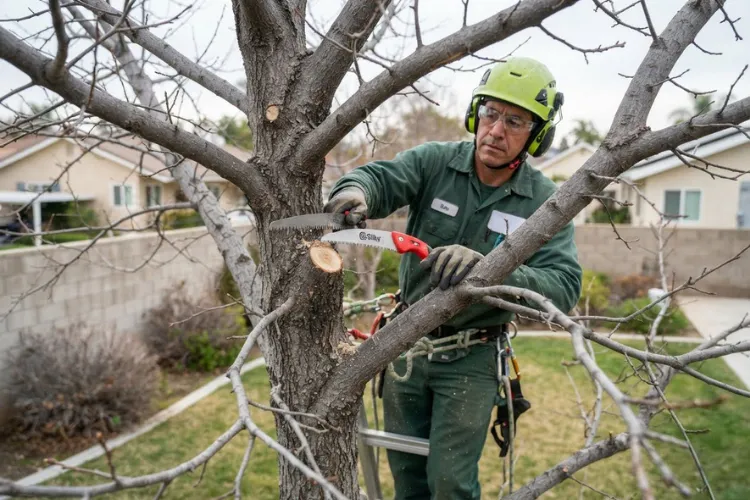
Structural Pruning Protects a Tree for Decades
Well-timed structural and maintenance pruning is what keeps a landscape tree from becoming an expensive problem twenty years from now. Let us build a pruning plan around the trees you already have, on a schedule your property can sustain.
Your Pruning Objective Should Set the Calendar
Two crews can stand under the same tree in the same month and do entirely different work. Tree trimming timing follows the goal, and the goal should be defined before anyone picks up a saw. These are the objectives that come up most often on the properties we maintain.
Structural Pruning
Structural pruning shapes how a tree will grow for decades: establishing a dominant leader, correcting codominant stems, removing branches with weak attachments, and spacing scaffold limbs. It is most effective on young and early-mature trees, and it is far and away the best return on a tree care dollar. Dormancy is the natural window because the framework is visible and the tree is ready to respond.
Deadwooding
Deadwooding in tree trimming means removing dead, dying, and broken branches from the canopy. Because dead wood is no longer connected to the tree’s living systems, its removal is not constrained by season. We deadwood year round, and on properties with foot traffic, parking, or play areas beneath the canopy we treat it as a safety item rather than an aesthetic one.
Crown Thinning
Crown thinning in tree trimming selectively removes interior branches to reduce density while keeping the natural shape and overall size. Done properly, it improves light penetration and lets wind move through the canopy instead of pushing against it. Done improperly, it strips the interior and leaves weight out at the branch tips. Winter visibility makes thinning cuts easier to place well, which is why we prefer to schedule it then.
Crown Reduction
Crown reduction in tree trimming lowers the height or spread of a tree using cuts back to appropriately sized lateral branches. It is a demanding operation with real limits, and it is not the same thing as topping. Topping mature trees is not a recommended practice; it creates large wounds, forces dense weakly attached regrowth, and permanently damages the tree’s form. When reduction is genuinely needed for clearance or risk, dormancy usually gives the best result.
Clearance and Routine Maintenance Pruning
Raising a canopy over a walkway, clearing a roofline, restoring sight lines at a driveway, or opening a light fixture is routine maintenance pruning. Light clearance work can generally be handled across a wider portion of the year than structural work, which is useful for commercial and HOA properties where appearance and access have to be maintained continuously.
Tree Work That Should Not Wait for a Season
Seasonal guidance describes elective pruning. Some conditions are not elective, and holding them until the next dormant window is the wrong call. We recommend addressing the following whenever they are identified:
- Dead, dying, or clearly diseased limbs, particularly over walkways, driveways, patios, parking, or play areas.
- Branches cracked, split, hanging, or partially detached after wind or storm loading.
- Limbs contacting a roof, gutter, chimney, sign, light, camera, or building face.
- Branches blocking sight lines at a driveway, intersection, crosswalk, or entry gate.
- Growth obstructing an emergency exit, fire lane, or required access route.
- Visible decay, cavities, mushroom conks at the base or on major limbs, or seams and cracks in the trunk.
- Trees showing sudden lean, soil heaving at the root plate, or exposed and severed roots after nearby excavation.
Safety pruning is judged on condition, not on the calendar. A tree with a compromised limb over an occupied space presents a real risk today, and delaying removal of that limb for seasonal reasons trades a small horticultural benefit for a much larger liability. When we see conditions like these during an estimate, we say so plainly.
What Each Season Can and Cannot Do
Rather than treating spring, summer, fall, and winter as good or bad, it helps to understand what each part of the year is actually suited for. The best time to prune trees is whichever window matches the objective, and seasonal tree trimming is largely about lining those two things up.
Winter and Late Dormancy
This is the primary tree pruning season for most deciduous landscape trees: structural pruning, crown thinning, meaningful reduction, and correction of crossing or crowded limbs. Visibility is best, response is strongest, and disease pressure is generally lowest. If a tree on your property needs significant work, this is usually the window we recommend.
Spring
Spring tree pruning is mostly a corrective and finishing window. Once buds break and leaves expand, the tree has already committed stored energy to that growth, and heavy removal at that point is wasteful. Spring is the right time for pruning spring-flowering trees immediately after bloom, and for cleaning up damage that appeared over winter. We generally avoid large structural cuts once growth is fully underway.
Summer
Summer tree pruning has legitimate uses: slowing overly vigorous growth, removing water sprouts, correcting minor clearance issues, and taking out deadwood that only becomes obvious when the canopy is full. It is also when defects reveal themselves under leaf and fruit weight. What summer is not suited for is heavy removal, especially during extended heat, when a canopy is also providing shade and cooling to the trunk and root zone below it.
Fall
Fall is the season we most often advise against for major pruning. Wound closure slows as the tree shifts toward dormancy, and late-season cuts can encourage tender growth at an inopportune time. In our region, fall also overlaps the onset of Santa Ana wind conditions, which makes it a sensible time for inspection and hazard removal even though it is a poor time for elective structural work. Deadwooding and safety pruning in fall: appropriate. Large reduction cuts in fall: better scheduled a few months later.
Not Sure Whether Your Trees Should Be Trimmed This Season?
Tell us what you are seeing and we will take a look. Our team will assess your trees, explain the right timing for the work they need, and answer your questions directly. Call (888) 601-1117 or request a callback at your convenience.
How Southern California Growing Conditions Shift the Schedule
Most published pruning advice is written for climates with a hard, well-defined winter. Ours is not that. Southeast Los Angeles County and Orange County sit in a mild Mediterranean climate where dormancy is shallower, growing seasons run long, and a substantial share of the urban canopy is evergreen or subtropical rather than classically deciduous. That changes how seasonal tree care plays out on real properties.
A few local realities shape our scheduling in Whittier, Cerritos, Downey, Long Beach, Commerce, City of Industry, Anaheim, Fullerton, Orange, Garden Grove, Santa Ana, Costa Mesa, Newport Beach, and Irvine:
- Dormancy is brief and inconsistent. Deciduous trees here may hold leaves later and break bud earlier than the textbook window suggests, which compresses the ideal pruning period and makes on-site observation more useful than a fixed date.
- Much of the canopy is evergreen. Ficus, magnolia, olive, pine, eucalyptus, and citrus are common on our properties and follow their own timing logic rather than a dormant calendar.
- Wind events are a scheduling factor. Santa Ana conditions typically arrive from fall into winter. Trees carrying heavy end weight, dense unthinned canopies, or existing deadwood are the ones most likely to shed limbs during those events, which is an argument for inspection ahead of the season.
- Irrigation drives growth. Trees in regularly watered turf and planting beds often grow faster and denser than the same species elsewhere, and they usually need a shorter interval between trimmings.
- Palms are their own category. Palms are not pruned like broadleaf trees. They are generally maintained by removing dead or fully declining fronds, and over-pruning into the green canopy weakens them.
Local rules can also apply. Some cities and many HOAs have their own requirements covering street trees, protected species, permits, or approved work windows. We recommend confirming those requirements with the relevant city or association before scheduling significant work on a tree in a parkway or common area.
Signs Your Trees Need a Professional Assessment Before the Next Window
Seasonal planning assumes the trees are in reasonable condition. Sometimes they are not, and the right first step is an assessment rather than a date on the calendar. Professional tree trimming is worth arranging when you notice:
- Bare, brittle branches that do not leaf out with the rest of the canopy.
- Thinning foliage, undersized leaves, or dieback beginning at the branch tips.
- Heavy end weight on long horizontal limbs, especially over structures or vehicles.
- Dense, unthinned canopies that catch wind rather than letting it pass.
- Vigorous upright shoots crowding an old topping cut.
- Bark splits, seams, cavities, oozing, or fungal growth at the base or major unions.
- Branches growing into a roofline, wall, fence, sign, or light standard.
- Roots lifting hardscape, or a tree that has visibly shifted or leaned.
We also encourage property owners to be realistic about which work belongs to a homeowner and which does not. Learning how to trim tree branches safely within easy reach from the ground is reasonable for most homeowners. Large limbs, elevated work, chainsaw use, ladder work, and anything near a structure or a utility line is another, and it accounts for a significant share of serious homeowner injuries every year. That is the point at which our Tree Trimming Services, and the broader Tree Care Services we provide alongside them, are worth bringing in. Branches near energized power lines are not a do-it-yourself matter under any circumstances; that clearance work is handled by the utility, and the utility should be contacted directly.
What an Assessment Should Tell You
A useful assessment answers four questions: what condition is the tree in, what work does it actually need, what is the right season for that work, and what can wait. A visit that produces only a price to “trim the trees” has skipped the part that protects your investment. We would rather tell a property owner that two of their five trees should be left alone this year than perform unnecessary pruning.
Building a Tree Trimming Schedule for Your Property
Once you understand that the best time of year to trim trees depends on species, objective, and condition, the practical next step is turning that into a schedule you can actually follow. On most properties we manage, that looks less like a single annual event and more like a rhythm.
A workable pattern for many properties:
- Late winter: the main pruning window. Structural work, thinning, reduction, and correction on deciduous trees.
- After bloom: pruning for spring-flowering trees, scheduled by the tree rather than the calendar.
- Growing season: deadwood removal, clearance, water sprout removal, and light corrective work as needed.
- Before wind season: inspection focused on end weight, deadwood, and existing defects.
- Any time: hazard response, storm damage, and safety pruning.
Intervals vary. Young trees in an establishment phase often benefit from light attention every year or two. Established trees in good condition may go several years between meaningful prunings. Fast-growing species on irrigated sites, or trees with clearance obligations over walkways and parking, generally come up more frequently. For commercial properties, HOAs, and apartment communities, folding tree work into a documented annual maintenance plan tends to be less expensive over time than responding to problems as they surface, and it gives boards and managers something concrete to budget against.
If you have been searching for a tree service near me and what you actually want is a clear answer about timing rather than a quick quote, that is exactly the conversation we prefer to have. If you are trying to decide whether a specific tree should be trimmed this season or next, the fastest path to a good answer is having someone look at it. Our team works on residential, commercial, multifamily, HOA, and office properties throughout Southeast Los Angeles County and Orange County, and we are glad to walk your property, evaluate the trees you have, and give you a straightforward recommendation on what should happen now and what is better scheduled for the dormant window. Call us at (888) 601-1117, email info@landscaper-near-me.com, or request a callback and we will arrange a visit and a free estimate at a time that works for you.
FAQ's - Frequently Asked Questions
It depends on species, age, growth rate, and what the tree has to clear. Established trees in good condition often go three to five years between meaningful prunings, while fast-growing species on irrigated sites, or trees over walkways and parking, commonly need attention every one to two years. Young trees in their training years usually benefit from lighter, more frequent work. We would rather set an interval after looking at your specific trees than apply a blanket number.
A single mistimed pruning rarely kills an otherwise healthy tree. What poor timing more often causes is lost flowers, wasted energy, slower wound closure, or growth pushed at an unhelpful point in the year. The larger risks come from how much is removed and how the cuts are made. Heavy removal, topping, and cuts placed into the branch collar cause far more lasting damage than being a few weeks off the ideal window.
Yes, within limits. Summer is a reasonable time for deadwood removal, clearance work, water sprout removal, and light correction. We avoid heavy reduction or major structural cuts during extended heat, because the canopy is actively shading the trunk and root zone and the tree is already under demand. If a summer condition is a safety concern, we address it regardless of the season.
Less than most people expect. A commonly cited guideline is to remove no more than about a quarter to a third of the living canopy in a single pruning, and for mature trees the appropriate amount is usually well below that. Removing too much at once forces stress responses, weak regrowth, and sunburn exposure on previously shaded bark. Restraint is generally the better call on an established tree.
No. Palms do not have the same growth structure as broadleaf trees and are not pruned the same way. Maintenance generally means removing dead or fully declining fronds, along with fruit stalks and loose material, rather than shaping a canopy. Cutting into healthy green fronds weakens a palm and does not benefit it. Palm work is usually scheduled by condition and by seed or fruit drop rather than by dormancy.
Inspecting before wind season is a good practice, and removing deadwood, hanging limbs, and obvious defects ahead of time is sensible risk reduction. What we would not recommend is heavy reduction pruning as a wind strategy, since aggressive cutting can leave a tree weaker rather than stronger. Selective thinning to let wind pass through the canopy, done well and at the right time, is the more effective approach.
No, and no property owner should attempt that work either. Vegetation clearance around energized utility lines is handled by the utility company, which has the training, equipment, and authority for that environment. If you have branches approaching or contacting service lines, contact your utility provider directly. We are glad to handle the rest of the tree once the line clearance situation is resolved.
Yes. We work with homeowner associations, apartment and condominium communities, retail centers, office buildings, and industrial properties throughout our service area. For those properties we typically build a documented plan covering the main dormant-season work, growing-season clearance and deadwooding, and pre-wind-season inspection, so boards and managers have something predictable to budget and schedule against.